The server reaches across the table.
Your fork is still moving.
Your stomach drops like a stone in cold water.
It is just a plate. You know this. But your hands tighten, and something old and sharp rises through your chest – faster than logic, louder than manners. You flash a smile and say nothing. You always say nothing. That is the part that keeps you up at night.
There is a version of you that is composed, well-traveled, cultured enough to eat in restaurants where the servers wear black aprons and hover with precision. And then there is the other version. The one who grew up watching the pot too closely. The one who learned, somewhere in the years before memory fully formed, that what is in front of you can disappear before you are finished with it. The gap between those two versions of you – that is the Identity Gap. It is the distance between the adult who orders confidently and the child who still believes there won’t be enough.
1. The Vanishing Plate Loop
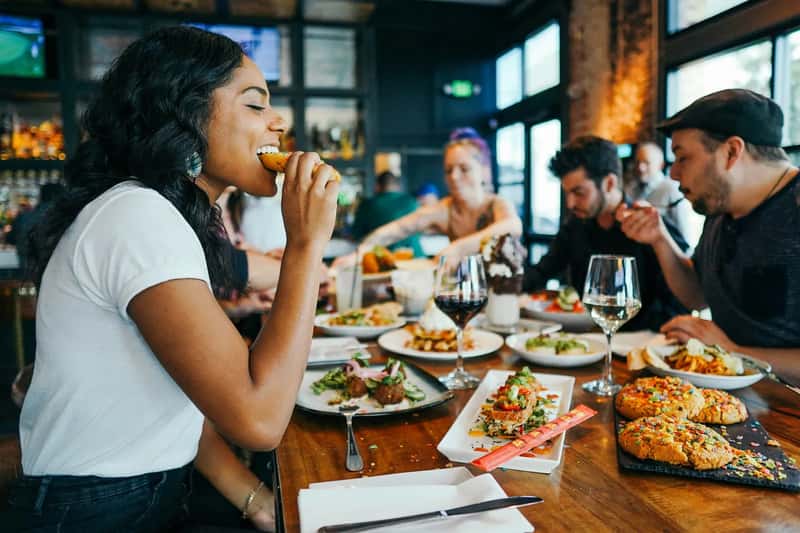
It starts with something small. A server clears your plate mid-bite. A waiter assumes you’re done because you set your fork down for two seconds.
And something ancient fires.
Scarcity mindset is what your brain adopts when it believes that resources are scarce. It does not matter that you are in a gastropub in Lisbon or a dim-lit trattoria in Bologna. What matters is that your brain stem – the part that does not speak in paragraphs – just received a signal it recognizes from childhood.
The signal is: this is being taken before you are ready.
When you persistently lack access to food, you give your brain stem the notion that food is scarce. Your brain stem reacts rather than thinks. It reacts to the data it is given.
The panic is not about the plate. It never was. It is the original wound in its most polished, modern costume – sitting across from you in a charming restaurant, wearing a black apron.
2. The Survival Inventory
You scan the bread basket before anyone else at the table has unfolded their napkin.
You calculate silently. Three rolls. Four people. You take one early.
This is not greed. This is arithmetic that was taught to you at a kitchen table where the numbers never quite added up. Children who grow up with food insecurity are more likely to emotionally overeat and disregard their body’s cues that they’ve eaten enough – because even when they no longer experience food scarcity, they worry they could again. It’s a survival instinct that can linger into adulthood.
You are not overreacting. You are running an old program on new hardware.
The inventory never really stops. You just learn to run it quietly – under the table, behind the smile, between sips of wine that cost more than you once spent on a week of groceries.
3. The Speed Eater’s Secret
You eat fast. You have always eaten fast. Your travel companions comment on it with a kind laugh.
You laugh back.
But speed-eating is one of the most intimate confessions the body can make. It is the body saying: I learned, early on, that slowness is a luxury I could not afford. Meals that were unpredictable in timing, in quantity, in availability – they produced eaters who move with urgency. Individuals who faced prolonged periods of hunger or uncertainty about their next meal often develop anxieties and fears surrounding food. This trauma can manifest as heightened stress, anxiety, depression, and even disordered eating patterns.
The speed is a fossil record.
Pressed into the body like an impression in stone, it tells the story of every meal that wasn’t guaranteed.
4. The Hoard in the Hotel Room
You take the extra breakfast roll from the buffet. You slide it into a napkin and put it in your bag.
You are not hungry. You just did it without thinking.
Scarcity trauma can create a deep-seated fear of lack, leading to behaviors such as hoarding, overworking, eating expired foods, chronic anxiety about money, or difficulty trusting that resources will be available in the future.
The hotel room accumulates small things. An extra water bottle. Two packets of instant coffee you will never drink. Three sugar sachets. All of it unconscious. All of it protective.
One common manifestation of scarcity trauma is a hyper-focus on saving, accumulating possessions, or even hoarding. For those affected, the fear of scarcity becomes a driving force, compelling them to hold onto material goods as a buffer against future uncertainty. The accumulation of possessions can provide a semblance of security, creating an illusion of safety and control in an unpredictable world.
You check out. You leave the sugar sachets behind. It takes effort.
5. The Guilt That Comes With Plenty
I remember the first time I sat at a table with a tasting menu. Eleven courses. Each one smaller than the last. The kind of meal that takes three hours and costs what my mother once paid in rent.
I smiled at every course. I took photographs. I said all the right things.
But underneath it, something was wrong. Every beautiful plate that arrived felt like a test I hadn’t studied for. And when each one was taken away – still half-full, as the format demanded – I felt a stab of something I couldn’t name until years later.
It was loss. Completely disproportionate. Entirely real.
An expectation of scarcity has been deeply ingrained, and expressions of the need for physical or emotional good things are tied to the expectation of disappointment. Adults with this style typically have great difficulty recognizing, asking for fulfillment of, and even tolerating fulfillment of, their own needs and desires.
Plenty, when it arrives, can feel more threatening than lack. Because lack, at least, is familiar terrain.
6. The Hyper-Vigilant Diner
You are seated at the table. You are also watching the room.
You notice which server has the most tables. You track how long other diners have been waiting. You calculate – unconsciously, efficiently – whether your needs are at risk of being overlooked.
At its core, scarcity trauma arises from a chronic state of deprivation and insecurity. When individuals are consistently exposed to situations where their basic needs are unmet, the stress response system is activated continuously. This prolonged state of hyperarousal can lead to significant psychological repercussions, such as anxiety, depression, and chronic stress.
The hypervigilance that once read a family home for warning signs – the tension before dinner, the empty refrigerator, the unpredictable moods of those who controlled your access to food – does not retire when you buy your own groceries.
It relocates. It finds new rooms to scan. New tables to surveil.
You are not paranoid. You are adaptive. The adaptation is just running in the wrong decade.
7. The Control Freak Order
You don’t like surprises on the plate. You ask very specific questions. You modify the dish before it arrives.
Traveling companions find this exhausting. You find their ease baffling.
Scarcity mindset can lie at the root of many behaviors, most of which are along the fight-flight-freeze continuum. Children may exhibit intense anxiety around food, becoming very dysregulated when the food looks different, or when it is served at a slightly different time.
That child – the one who got dysregulated by the wrong texture, the unexpected ingredient, the meal that didn’t look like what was promised – is still making your dinner reservations.
Control over the plate is control over what can be taken or changed without your consent. It is sovereignty over one small square of an unpredictable world. When the dish arrives wrong, what you feel is not inconvenience. It is the old unsteadiness, surfacing briefly, wearing the mask of pickiness.
8. The Emotional Overhead of Sharing
Someone reaches across and takes a piece of your food without asking.
It is playful. It is affectionate. You know this.
And still, something cold moves through you.
Feeling stressed and anxious if other people used your resources is not a character flaw. It is a deeply encoded response. Prolonged perceived food scarcity led the brain to develop all manners of other anxieties and behaviors related to general resource scarcity. The branch spreads wide. What began as fear of an empty bowl becomes discomfort when a friend casually borrows your charger, wears your jacket, or eats off your plate in a tapas bar in Madrid.
You want to be generous. You practice generosity. But the body keeps its own ledger, and it does not always agree with your intentions.
The ledger is not about selfishness. It is about a child who once learned that what is yours can disappear without ceremony.
9. The Overachiever at the Table
You order more than you need. You feel reassured by abundance on the table – even when you cannot finish it. Leftovers comfort you in a way that is hard to explain to those who grew up with refrigerators that were always full.
This is the inverse of the hoard. It is the need to create, visually and materially, the abundance that was once missing.
Another way scarcity trauma reveals itself is through patterns of overworking or overachieving. Individuals who have experienced deprivation may develop an intense drive to succeed and secure their place in the world. This relentless pursuit of achievement often stems from a deep-seated fear of returning to a state of lack.
The table piled with dishes is, in miniature, the same psychology as the career piled with achievements and the bank account that never feels full enough. You are rebuilding the world into a place where there is always more. Where the plate is never taken before you are done. Where running out is something that happens to someone else.
10. The Weight of the Taken Plate
Here is the heaviest truth.
The server takes the plate. And for a fraction of a second – before the cognition catches up, before the adult voice in your head says this is fine, this is normal, this is how restaurants work – you are not in that restaurant.
You are somewhere smaller. A kitchen that smelled a certain way. A table where the mood determined the meal. A childhood where the adults held all the power over the most fundamental thing: whether you were fed, and when, and how much, and with what kind of emotional weather surrounding the act of eating.
Food insecurity is a multifaceted adverse psychological experience, even for children. Children experienced themes of anxiety over not having enough food, anger and frustration, embarrassment, a strain on their family’s dynamics, and sadness – above and beyond their general awareness of household food insecurity.
The experience of scarcity leaves lasting imprints on an individual’s cognitive and emotional processing, influencing their relationship with consumption and material goods. The plate being cleared too early is not the wound. It is the key that opens the wound. And every time it opens, it is asking to be seen – not managed, not smiled through, not photographed and filtered into something palatable.
Seen.
There is a particular loneliness in traveling the world and still carrying the village you came from in your nervous system. You sit in beautiful restaurants in cities whose names once sounded impossible to you, and you order from menus in languages you taught yourself, and you are impressive by every external measure. But the panic at the taken plate does not check your passport. It does not notice that you have arrived.
As adults, we think we’ve moved on from childhood, but many experiences in childhood and adolescence color our worlds decades later – for better or for worse. The scarcity loops are not failures of character or evidence of ingratitude. They are the fossils of a child who learned, in the most formative years of their life, that the world operates on the assumption of not enough. That child kept you safe. That child got you here. The work now is simply to let them rest – to tell them, meal by meal, moment by moment, that the plate is yours for as long as you need it.
The server will wait.