The bars appear one by one.
Your stomach drops.
You were free. For exactly forty-seven minutes, you were no one’s problem.
And just like that – a buzz, a chime, a cascade of notifications landing like small grenades in the pine-scented quiet – you are someone’s problem again.
This is the chasm between who you perform yourself to be in the connected world and who you quietly, almost guiltily, become when the network disappears. Out there on the ridge, with dead air in your pocket, you weren’t anxious. You were whole. The dread isn’t about the mountains. It’s about the re-entry.
The signal does not make you less real. But it makes you less yours. The version of you with five bars is assembled from other people’s expectations, other people’s timelines, other people’s urgencies. The version of you with no signal was assembled, quietly and without interruption, by you.
1. The Signal as Summons
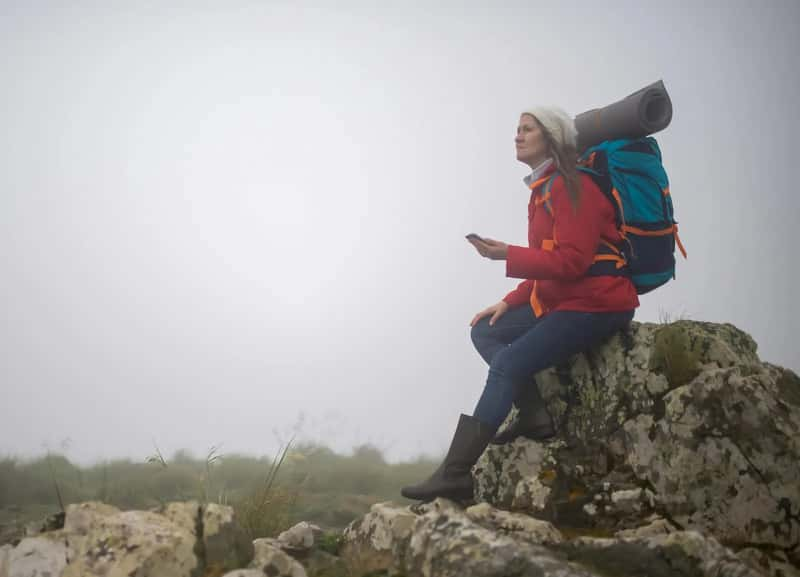
There is a reason that first bar of signal feels less like relief and more like a court summons.
Anxiety is provoked by several factors, such as the loss of a mobile phone, loss of reception, and a dead mobile phone battery. But the inverse is equally true and far less discussed: the return of reception carries its own dread. The world rushing back in.
It’s not the messages themselves.
It’s the obligation they carry.
The moment your phone finds signal, you are legally, socially, emotionally present again. You can no longer claim the innocent alibi of the wilderness. You are reachable. And reachability, for many modern travelers, is not safety – it is exposure.
The mountain gave you a character. Signal takes it back. That transition – that specific, stomach-hollowing moment – is the heartbeat of what psychologists are beginning to recognize as a distinct flavor of accessibility anxiety: not the fear of losing your phone, but the fear of being found by it.
2. The Temporary Identity
Up in the high altitude, you were someone slightly different.
Quieter. More deliberate. Unbothered by the inbox.
Periodically withdrawing from society and into nature allows you to drop your public persona and connect with your authentic self. That’s not a metaphor. It’s a documented psychological shift. The social roles we perform daily – employee, partner, content creator, quick-responder – require constant cognitive maintenance. Remove the signal, and the performance pauses.
What blooms in that pause is often startling.
You notice the weight of your own breath. You make decisions without consulting anyone. You exist without narrating the existence to others. Such withdrawal gives us the necessary freedom and privacy to drop our public persona and social obligations.
The dread of signal’s return, then, is really a grief. You are mourning a version of yourself that is about to be overwritten.
3. The Nomophobia Inversion
Most research on phone anxiety focuses on the fear of losing signal, not gaining it.
The term NOMOPHOBIA or NO MObile PHone PhoBIA is used to describe a psychological condition when people have a fear of being detached from mobile phone connectivity. It’s studied extensively. There are questionnaires for it.
But accessibility anxiety operates in the opposite direction.
Where nomophobia is the terror of disconnection, this is the terror of reconnection. Expectations of being digitally connected all the time, combined with the fact that smartphone apps are designed to be highly addictive in order to increase user engagement, is a powerful formula for driving an emotional and psychological dependence on the smartphone.
That dependence has a shadow side.
When you’ve tasted genuine freedom from it – even briefly, even accidentally – the re-engagement with that system feels less like returning home and more like returning to a job you’ve been dreading.
The phone didn’t miss you. But it acts like it did. And that performance of urgency is the cruelest part of the whole transaction.
4. The Exit Strategy Interrupted
Here is the uncomfortable truth about mountain trips, long-haul flights, and remote road journeys.
Many of us don’t plan them primarily for the scenery.
We plan them for the excuse.
As digital-free travelers, a sense of adventure and a thrilling “nobody knows where we are!” sense of liberation created by being off-the-grid is one of the most commonly reported emotional rewards of disconnected travel. But when signal interrupts the journey early – when the ridge has better coverage than your apartment – the exit strategy collapses mid-execution.
The mountain was supposed to be a parenthesis in your life.
Signal turns the parenthesis back into a sentence.
That loss of the planned escape is a specific psychological injury. You had mentally budgeted for absence. You had told yourself: for this stretch of trail, I am unreachable and therefore unaccountable. The early return of connectivity doesn’t just disrupt your plans. It ruptures the psychological container you’d built around the whole experience.
5. The Moment It Got Personal
I remember the exact moment I understood this in my own body.
A trail in the high country. Three days in. The silence had settled into something almost architectural – solid, load-bearing. I’d stopped mentally composing emails. I’d stopped rehearsing conversations. I was, genuinely, just walking.
Then my phone vibrated.
Not a buzz of joy. A buzz of dread. The same dread, I realized later, that I feel on Sunday evenings before a Monday. The week arriving before I am ready for it.
Mental exhaustion was a common aspect pointed out by participants. It was mainly because of excessive digital engagement and feeling stress, anxiety, and cognitive fatigue as a result of constant notification checking and social media comparisons.
That fatigue doesn’t disappear when you go into the mountains. It waits. And the buzz of returning signal is the sound of it waking back up. The wilderness hadn’t healed me. It had just given me a room where the noise couldn’t reach. Signal was the sound of someone opening the door.
6. The Performance Resumption
Connection doesn’t just bring messages. It brings roles.
Our online presence often serves as a reflection of our identity. We seek validation through the approval of others, whether in the form of likes, comments, or shares. This pursuit of social recognition can make us more dependent on staying digitally connected.
On the mountain, there is no audience.
Nobody is watching you scramble over a loose scree field. Nobody is rating the quality of your rest. You are radically, uncomplicatedly private. And privacy, for the chronically connected, has become a form of luxury so rare it borders on the erotic.
The return of signal is the return of the audience.
You are now being observed again – or, more accurately, you are now capable of being observed, which activates the same psychological machinery. The performance resumes whether or not you post a single thing. The mere potential of visibility is enough to shift your internal posture. You stand differently. You think differently. You are, once again, a character rather than a person.
7. The Cortisol Cascade
The dread isn’t purely emotional. It is thoroughly, measurably physical.
The signs and symptoms observed in nomophobia cases include anxiety, respiratory alterations, trembling, perspiration, agitation, disorientation and tachycardia. These same physiological signatures appear in the inverse scenario: the moment of unwanted reconnection.
Your nervous system doesn’t distinguish between threat types.
A notification arriving unexpectedly in the wilderness triggers the same threat-detection loop as a rustle in the dark. Research by psychologist John Cacioppo found that chronic loneliness triggers the same stress responses in the body as physical pain. The brain perceives prolonged social disconnection as a threat, leading to higher cortisol levels, increased inflammation, and even a weakened immune system.
But here’s the inversion: prolonged social connection, under duress, can generate its own cortisol cascade. The body that had finally stopped bracing – that had finally let its shoulders drop on day two of the trail – must now brace again. The buzz of signal is a physiological command: prepare yourself. And the body obeys, even when the mind would rather not.
8. The Reachability Contract
Modern life runs on an unwritten reachability contract.
You did not sign it consciously. But you agreed to it the moment you bought your first smartphone and gave the number to someone who needed something from you.
Pressure for continually being connected to social (virtual) networks may increase anxiety as it leaves no time for relieving daily stress during solitude, which is an essential component of our well-being.
The mountains represent a legal loophole in that contract. No signal means no obligation. It is the only universally accepted excuse for absence in our culture. A dead zone is the closest thing we have to a doctor’s note for the soul.
When signal returns unexpectedly, you are contractually reinstated without consent.
The dread is the sensation of a door you’d locked being unlocked from the other side. You are available again, whether you are ready to be or not. The contract doesn’t ask. It simply resumes, and the mountain has no jurisdiction over it anymore.
9. The Self-Reflection Severance
The most psychologically costly thing signal does is not interrupt your peace. It interrupts your thinking.
Picking up the phone takes away the opportunity for self-reflection, and researcher Virginia Thomas found that in young people this can interfere with self-reflection and interfere with the process of identity formation because self-reflection can be pretty crucial for that period of life when people are young and still discovering themselves.
In the wilderness, something rare is happening.
These studies emphasize the significance of the wilderness, far from daily demands, and devoid of technological stimuli allowing the silence, time and space for self-reflection and contemplation on the sacredness and meaning of life.
You were, in the deepest sense, thinking. Not problem-solving. Not planning. Actually thinking. Following an internal thread somewhere private and uninterrupted. The arrival of signal cuts that thread cleanly. What you were working through – the unexamined grief, the suspended decision, the half-formed realization – returns to the shelf, unfinished. Signal doesn’t just interrupt your vacation. It interrupts your becoming.
10. The Identity That Needs No Bars
Here is the heaviest truth inside all of this dread.
The anxiety you feel when your phone finds signal is not a symptom of something wrong with you. It is, in its way, a deeply accurate reading of what has been happening to you in the mountains. These practices challenge the individual who alone in the wilderness battles fear and loneliness only to discover inner strengths and true identity. The solo experience may serve as an antidote to the loneliness, stress, and depression on the rise in the current era, which have been linked to our overly stimulated urban environments and lifestyles.
You were becoming more yourself. The signal threatens that process.
Solitude is psychological detachment from society for the purpose of cultivating the inner world of the self. It is the act of emotionally isolating oneself for self-discovery, self-realization, meaning, wholeness, and heightened awareness of one’s deepest feelings and impulses.
The dread is a kind of loyalty. A protective impulse toward the self you were just beginning to remember.
There is a practice some mountaineers develop over years of high-altitude travel. When signal returns, they wait. They sit with the bars for a moment before opening anything. They let the network know they are technically present without immediately surrendering to it. A pause. A breath. A small, deliberate act of refusal.
It does not solve the problem of reentry. Nothing fully solves the problem of reentry. But it creates a sliver of space between the wilderness self and the connected self – enough space, perhaps, to carry a small piece of the mountain back with you. Not in a photograph. Not in a caption. In the quality of your attention as the notifications begin to land.
The bars will always find you eventually. The trail runs out. The ridge ends. The valley below, with its towers and its signals, is always waiting. But the version of you that existed in the dead zone – that quieter, slower, more honest version – does not have to vanish the moment the network remembers your name. Hold it a little longer. The world can wait a few more seconds. It has been waiting your entire life, and it will survive a few more seconds of you being simply, stubbornly, unreachable.