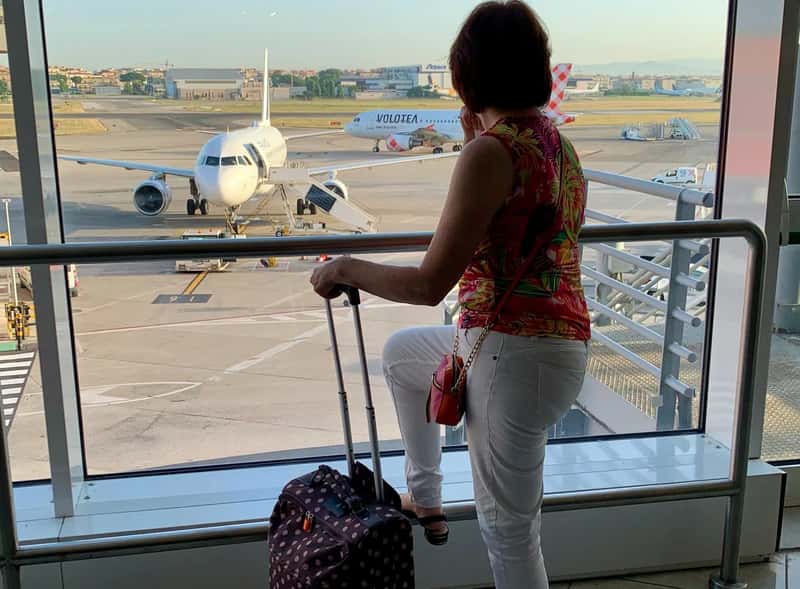
The departures board changes.
Your jaw tightens.
A number blinks. A gate shifts. A small word – Delayed – lands in your chest like a stone.
And you are suddenly, irrationally, furious.
Not inconvenienced. Not mildly put out. Furious. The kind of fury that belongs to something much older and much darker than a missed connection or a rescheduled meeting. The kind of fury that belongs to a person who just had something taken from them. Something essential. Something they didn’t even know they were carrying.
The Wired Brain
Let’s start with the biology, because the fury isn’t your fault.
When the brain can’t predict or influence what’s coming, it defaults to threat-detection mode – the nervous system stays primed, scanning constantly for danger. This is not metaphor. This is architecture. Your amygdala doesn’t distinguish between a cancelled Airbus and a stalking predator with any meaningful sophistication.
The brain cannot distinguish between real danger and perceived danger, thus it can initiate the fight-or-flight response for perceived danger just as it would do for the real one.
A delay is perceived danger. The announcement is the trigger. And your nervous system, loyal and ancient and deeply misguided in this context, begins doing exactly what it was built to do: when the brain perceives a threat, the sympathetic nervous system is activated to initiate what is often referred to as a “fight or flight” response. Your heart rate climbs. Your palms go slick. You scan the terminal for exits that don’t exist and solutions that haven’t materialized. You are, in every physiological sense, preparing for combat with a departure board.
The Agency Architecture
Here is a truth that most self-help books will dress up prettier: uncontrollable stressors produce significantly larger and more prolonged cortisol responses than stressors that feel manageable, even when the objective difficulty is equivalent. The brain isn’t responding to the event; it’s responding to the absence of control over the event.
Read that again. Slowly.
The delay isn’t the problem. The absence of control is the problem. Two hours sitting in an airport cafe by choice feels nothing like two hours sitting in a terminal by mandate. The time is identical. The furniture is the same. The coffee is equally mediocre. But one scenario leaves you feeling human, and the other leaves you feeling caged.
Research using fMRI imaging showed that participants exposed to stressful stimuli that were either controllable or not demonstrated that the ability to control a stressor results in reduced activity in key areas of the brain that coordinate responses to a perceived threat. Agency, it turns out, is not a preference. It is a neurological sedative.
The Autonomy Contract
There is a theory in psychology – foundational, quietly devastating – called Self-Determination Theory. Self-determination theory posits that people are driven by three innate and universal psychological needs, and that personal well-being is a direct function of the satisfaction of these basic psychological needs. Autonomy is the need to experience oneself as the origin of one’s own behaviour. When people act autonomously, their actions reflect their genuine interests, values, and integrated self-concept rather than external pressure or obligation.
The airport violates this contract completely.
When these psychological needs are unsupported or thwarted, wellness and growth will be negatively affected. A delay doesn’t just inconvenience your schedule. It thwarts a basic human need. It tells your nervous system, in the most direct and inescapable language available, that you are not the origin of your own behavior right now. Someone else – weather, mechanics, an algorithm you will never see – is running your life. And your brain treats that information like a wound.
The Social Threat
It gets more complicated. Because the fury isn’t only about control. It’s also about status.
Threats aren’t limited to physical threats. Social acceptance and status are beneficial to our survival and health, and the brain recognizes that by viewing a wide variety of psychological and social states as threatening. And nothing strips status faster than being made to wait, publicly, with no recourse. You, the person with the premium boarding pass and the loyalty points and the carefully arranged itinerary, are standing in the same limbo as everyone else. The gate agent isn’t looking at your tier.
The brain perceives threats to status and social standing – social injury – similarly to the way it perceives physical injury and pain. So the indignation you feel isn’t vanity. It’s pain. Your brain has mapped being-made-to-wait directly onto the same neural circuitry as being physically hurt.
Which explains the impulse to argue. To demand explanations. To corner the gate agent with questions they cannot answer about systems they do not control. When perceived control drops below a certain threshold, some people don’t withdraw – they escalate. Anger, impulsivity, and even aggression can function as attempts to reassert agency in a situation that feels threatening.
The Fortress We Built
I remember a terminal in Frankfurt.
Gate C19. A Tuesday in November that smelled of recycled air and overpriced pretzels. My connection had shifted by forty-three minutes. Forty-three minutes. I had three hours of buffer built into my day, exactly for this reason. I had prepared for this. And still – still – I felt the cortisol spike like a small detonation somewhere behind my sternum. I felt cheated. I stood at the board and stared at the word Delayed like it had been written specifically for me.
It hadn’t. But the brain doesn’t traffic in statistical probability. Your nervous system is running software written thousands of years ago – software that treats an uncertain outcome as a potential threat. And mine was running it at full volume over forty-three minutes of rescheduled nothing. The delay hadn’t created the pressure. I had built the pressure long before I arrived at the airport. The delay just found the crack.
The Liminal Trap
Airports are not ordinary spaces. They never were.
Airports are also an “in-between” space between one’s point of origin and destination. The liminal nature of airports allows for unique interactions and experiences that break the boundaries between home and away, and between work and leisure. But liminality has a cost. When your flight is delayed, the place loses its original purpose and liminality. It both feels and doesn’t feel like a destination. Something seems off about the place.
You are no longer in motion. You are not yet arrived. You are held, suspended, in a space designed for transience that has now become permanent. The lines of culture and identity blur. At the airport, everyone morphs into the same anticipatory entity, suspended in the act of waiting. Your carefully maintained sense of self – professional, directed, autonomous – has nowhere to anchor. The delay doesn’t just delay the flight. It delays you. And you cannot tolerate that, because you have built an identity on momentum.
The Catastrophizing Engine
Here is what the brain does with ambiguity: it fills the void with the worst available narrative.
A delay introduces uncertainty, which is a powerful psychological stressor. This uncertainty extends beyond the immediate travel time, impacting crucial downstream activities such as business meetings, family events, or connecting flights. The mind does not wait for facts. It extrapolates. It catastrophizes. It fast-forwards to the meeting you’ll miss, the connection that won’t hold, the entire structure of the week unraveling from a single blinking screen. When the brain begins to process information more quickly, we tend to react automatically to attack or avoid before the rational part of the brain has a chance to evaluate the options available to us.
The rational brain – the part that knows forty-three minutes is recoverable, that connections have buffer, that the world will not end – is simply too slow. The amygdala has already filed the report. The verdict was rendered before you had time to think. And the verdict reads: threat.
The Illusion You Packed
You didn’t just pack clothes for this trip. You packed a version of yourself.
The travel mindset is a psychological state characterized by heightened emotional sensitivity, loosened behavioral constraints, elevated openness to novelty, and a distinctive relationship with time, money, and identity. You travel, in part, to feel like a different person. More capable. More interesting. More free. Travel is the one context where your daily identity – your job title, your obligations, your careful social performances – loosens its grip.
But one of the most profound psychological effects of airports is how they temporarily strip away our usual identity markers. In the international transit zone, national boundaries become fluid, and our usual social roles temporarily suspend. This dissolution of identity can be both liberating and unsettling. Some travelers embrace this temporary freedom from social constraints, while others might feel adrift without their usual anchors of self-definition. A delay catches you in this undefended state. The version of yourself you packed is still in the overhead locker. The version that’s standing at the gate is the raw one. The one without armor.
The Control Ritual
Watch what people do when a flight is delayed. Really watch.
Some check the board again. Then again. The number hasn’t changed. They check it anyway. Humans crave control, especially in stressful settings. Gate anxiety often manifests as rituals designed to regain that illusion of control. These behaviours don’t actually influence boarding. They are not strategies. They are compulsions. Small, repetitive acts of agency performed against a situation that offers none.
Others queue. Before the gate has opened. Before the boarding group has been called. They stand in a line that isn’t a line yet, because standing in proximity to the door makes the departure feel less conditional. When passengers are empowered to engage in these actions, their sense of control is partially restored, which mitigates feelings of helplessness and frustration. Any action – any action at all – is pharmacological. The nervous system will accept even the performance of control as a partial substitute for the real thing. We are, in the most fundamental sense, willing to be fooled.
The Disproportionate Response
Here is the part nobody says out loud: the fury is almost never about the flight.
Although it is understandable that we would want to act to reduce and/or to protect ourselves from threats, when we let our threat systems dominate we are likely to act in ways that are disproportionate to the situation. The delay is the trigger. But the ammunition was loaded long before check-in. Every morning you got up and held a schedule together by sheer willpower. Every meeting where you performed competence under pressure. Every moment you absorbed someone else’s chaos and kept your face neutral and professional. All of it, compacted. All of it waiting for a release valve.
A passenger’s attitude is essentially an evaluative judgment – a summary assessment combining cognitive beliefs such as “The airline is incompetent” and affective responses such as “I feel angry and frustrated.” But the cognitive belief is borrowed. The affective response is entirely yours. It belongs to every day you felt out of control but performed otherwise. The departure board didn’t create the pressure cooker. It just read the pressure gauge and reported honestly.
The Honest Terminal
The most unsettling thing about delayed flights is not the waiting. It is the clarity.
The way we react when our flight gets delayed isn’t random. It’s a window into our deepest personality traits, our coping mechanisms, and yes, even our generation’s collective mindset. Strip the schedule. Remove the momentum. Leave a person in a plastic chair under fluorescent light with nowhere to go and nothing to do but wait – and you have stripped away every layer of performed selfhood. What remains is the raw material of character.
Our ancestors lived in harsh environments where they were vulnerable to attack from wild animals, invading tribes, and other physical threats that we typically do not have to face in our lives today. However, our brains and bodies are still wired the way our ancestors’ were. This means that we can be vulnerable to panic – an anxious stress response that is more intense than necessary.
The airport doesn’t lie to you. It can’t. There is no script for this particular silence. In the modern world, sensitivity to perceived threat can be maladaptive, meaning that a person can perceive threat when none is present, resulting in unnecessary and perhaps undesired emotional distress. But perhaps the distress is not entirely without value. Perhaps the fury at Gate 14B is the truest signal available: that the version of yourself you’ve been operating is running too hot. That the architecture of control you’ve built is load-bearing in ways you haven’t examined. That somewhere underneath the itinerary and the boarding pass and the loyalty tier, there is a person who is genuinely frightened of stillness.
The gate will open. It always does. The plane will carry you to wherever you said you needed to be. And you will arrive, slightly jangled, slightly softer at the edges, carrying the memory of who you were in the forty-three minutes when the world held its breath and didn’t ask your permission.
That person – the one without the armor, the one checking the board for the sixth time, the one who felt personally insulted by a machine – that person deserved more compassion than you gave them.
They still do.