You are standing in front of something ancient and magnificent.
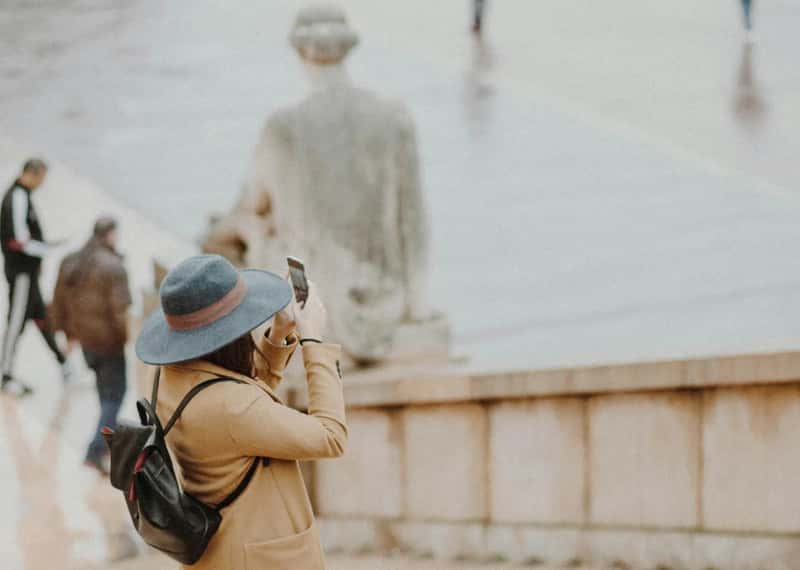
Your phone is already in your hand.
The shot is technically good. The light is right. The caption is forming in the back of your skull before your eyes have even finished looking.
And somewhere in the space between the cobblestones under your feet and the monument in front of you – the moment slips away, unmourned, like smoke. This is the Identity Gap. The distance between the traveler you are – present, breathing, alive inside a foreign city – and the traveler you are performing: the one curating, editing, and pre-approving joy for an audience that hasn’t asked for it yet. The gap is not geographic. It is not about where you are. It is about who needs to know you’re there – and why that need has grown louder than the city itself.
1. The Performance of Arrival
You land. You feel it – that electric, disorienting rush of somewhere new.
And then, almost immediately, the second brain switches on.
Not the one that smells the unfamiliar air or notices the quality of the afternoon light. The other one. The one that is already composing the grid. Already deciding which photo is the story opener. Already thinking about what this trip will look like, not what it will feel like.
Social media holidays are no longer about personal joy; they are about performance.
This is not vanity. It is something quieter and more complicated than vanity.
It is a fear – ancient and bone-deep – that an experience unheld by other people’s attention simply did not happen.
That your joy, floating unwitnessed in a foreign city, is structurally incomplete.
The performance of arrival is the ritual by which you make the experience real. Not for you. For everyone watching.
2. The Cognitive Split
Here is what happens in the brain when you are simultaneously experiencing a place and pre-processing its digital afterlife.
You are not present. You are not absent. You are split.
One half of your attention is on the piazza, the canal, the mountain. The other half is already back home, imagining the scroll. Imagining the pause. The double-tap.
These challenges are frequently attributed to cognitive overload and attentional fragmentation, as students compulsively monitor social media platforms for fear of being left behind – and the traveler’s version of this is no different.
The split is exhausting in a way that is hard to name because it masquerades as productivity. You think you are doing two things at once. You are actually doing neither.
The city gets a version of you with a hole in its center. And you get a photo of a city you were never quite inside.
3. The Validation Loop
Likes are not love. Everyone knows this.
And yet.
FoMO is associated with problematic social networking use due to its easy access and the constant need for personal validation and rewarding appraisals. The cognitive aspect is manifested by negative ruminations like frequently checking and refreshing for alerts and notifications.
The validation loop is a physiological event, not a moral failing. Your nervous system has learned to associate the upload with relief. The post with proof. The comments section with confirmation that the experience counted.
The loop tightens on the road because the gap between experience and audience grows temporarily wider. You are far away. The people you want to reach are not here. So you compress the distance with content.
You narrate the trip in real-time so you are never really alone in it.
Except you are. And underneath the narration, you know it.
4. The Instagrammable Landmark Trap
There is a specific category of modern travel grief that happens at famous places.
You have seen the shot a thousand times. The angle. The filter. The pose. And when you finally stand in front of the real thing – the thing you crossed an ocean to see – you feel a strange, flat disappointment.
Not because the place is not beautiful. It is.
But because you are not discovering it. You are re-enacting it.
Instagram is pivotal in promoting tourism, as the growing desire of travelers to capture moments at ‘Instagrammable’ destinations has driven an increase in visitor numbers. Among various travel posts, landmark photos are frequently used for bragging on Instagram.
You have been to this place before, in your feed. The actual arrival is almost administrative.
And so you take the photo – not to capture it, but to close the loop. To mark the location in your life the way a pin drops on a map. Done. Uploaded. Proven.
The landmark stands there, enormous and indifferent, while you caption it.
5. The Anecdote From the Amalfi Coast
There was an afternoon in a small town on a cliff above the Tyrrhenian Sea where I understood something.
I had taken forty-seven photos of the same stretch of water in thirty minutes. Different angles. Different zooms. Hunting for the one that would translate the feeling I was not quite having.
And I stopped. Put the phone face-down on the stone wall. Just looked.
The feeling arrived about ninety seconds later. Unhurried, unperformable, mine.
It lasted maybe four minutes. I did not photograph it. I did not post it. And it is the only thing from that trip I can still feel in my chest when I close my eyes.
Steer clear of uploading the photos to social media or even thinking about it, at least initially. Imagining others viewing your photographs may limit your enjoyment and feelings of presence as you take them.
The camera was not the problem. The audience in my head was the problem. The moment I stopped performing the coast and started receiving it – the experience became real.
6. The Need to Belong, Repackaged as Content
Underneath the filter, underneath the caption, underneath the careful curation of every travel story – there is something old and human and not remotely digital.
The need to belong.
People are social animals and we’re hardwired to fear exclusion. For early humans, being included in group activities like hunting was necessary for survival. This is why rejection can be such a painful experience; the brain is wired to seek a sense of belonging and acceptance by others.
Travel content is not really about travel. It is about inclusion. It is the modern postcard – the signal that says: I exist, I am here, I am someone, please confirm.
The fear is not that you are missing out. The fear is that you are missing out on mattering.
And so every shot becomes a small, desperate bid for membership in whatever version of the world your followers represent.
The tragedy is that you are standing in the most magnificent proof of your own aliveness, and you are spending it asking for a vote.
7. The Attention Economy Eats Experience Whole
The city does not care about your feed.
The light on the water at 6 AM in Lisbon does not adjust itself for your camera’s dynamic range. The market in Marrakech does not pause for your Story. The cathedral has been standing for eight hundred years and will continue to stand without your approval rating.
And yet we have been trained – algorithmically, socially, economically – to translate experience into content before the experience is even finished.
Over time, the pursuit of likes and shares can diminish genuine engagement with destinations, leaving travellers with memories filtered through the lens of approval-seeking rather than authentic enjoyment.
This is not an accident. It is a design feature. The attention economy does not profit from your presence. It profits from your documentation of presence.
Every second you spend post-processing in your head is a second you have donated – freely, willingly – to a system that will never give the moment back.
8. The False Memory Archive
Here is the quiet devastation of a trip spent performing rather than living it.
The photos are excellent. The grid is cohesive. The engagement was strong.
But when you close your eyes and try to go back – the sensory memory is thin. Ghostly. You remember composing the shot, not inhabiting the scene.
You remember the caption, not the smell. The filter, not the temperature of the air.
The psychological consequences are clear. Constantly comparing oneself to curated content can lead to heightened anxiety, diminished satisfaction, and a sense of perpetual “lagging behind” in life. Travel, which should be rejuvenating, risks becoming a source of stress and social comparison.
The archive of your travels is full. And somehow, strangely, empty.
Because the person who was supposed to be storing those memories was busy being a content creator instead of a human being standing in a remarkable place on a single, irreplaceable afternoon.
9. The Quiet Terror of the Unwitnessed Moment
Say it plainly. Because it deserves to be said plainly.
The fear driving all of this is not FOMO in the conventional sense. It is not the fear that others are having more fun. It is something subtler and more personal.
It is the fear that joy – unshared, undocumented, unratified by an audience – does not fully count.
Four themes that related to the experience of FoMO on social media were identified: feeling socially connected, staying informed on relevant topics, meeting social norms and expectations, and seeking recognition and validation.
Seeking recognition and validation. That last one. That is the engine.
The unwitnessed moment terrifies because it throws you back on yourself entirely. It asks you to be the sole authority on whether the experience was good. Whether you felt something real. Whether you were, in fact, moved.
And if you have spent years outsourcing that authority to an audience – the silence of the unshared moment can feel like falling.
10. The Heaviest Weight: You Were Already There
You did not need to document it to deserve it.
This is the hardest thing. This is the one that lands like a stone in still water.
You bought the ticket. You packed the bag. You took the flight in the thin, recycled air of an economy cabin and arrived, disoriented and exhausted, into a city that owed you nothing and gave you everything anyway – the smell of it, the sound of it, the specific quality of its morning light.
You were already there. You were already enough of a witness.
FOMO preys on low self-esteem, loneliness, and fear of social exclusion, and it can lead to feelings of anxiety and depression. And underneath every compulsively photographed vista, underneath every pre-captioned sunset, is a person who does not quite trust that their own witnessing counts.
That is the subtle fear. Not the fear of missing out. The fear that you, alone, without an audience, are not enough of an authority to confirm your own joy.
Mindful photography is a structure to make us pause and notice. To be mindful is to be present – not caught up in worry about the future or rehashing the past. But presence requires the courage to let the moment be yours before it belongs to anyone else.
There is a version of you that already exists inside every city you have ever visited – the one who walked slowly, looked up, said nothing to anyone on the internet, and simply received the place as it was.
That version of you did not go viral. That version of you came home changed in ways that do not photograph well – a quieter certainty, a shift in the bones, the private knowledge of having been somewhere so completely that the place got inside you.
The validation you have been chasing was never really about the trip. It was about the older, more tender question of whether you are worth witnessing at all – whether your experience of being alive has weight even when no one is counting the likes.
Put the phone down for four minutes. Let the city be unreported. Let the light fall on your face without an aperture between you and it. The joy that survives being unshared is the only kind that was ever really yours to keep.