The key card clicks.
The door swings open.
And there it is. A single bed. Tight walls. One small window with a sealed latch.
Your chest tightens before your bag hits the floor.
That reaction – the one you dismiss as a “preference,” as being “picky about hotels,” as simply “needing a nicer room” – is not about the mattress size. It never was. It is the body keeping a very old, very precise score. There is a gap between the traveler who books a room and the child who once had no room to call their own. Between the adult who insists on a suite and the kid who slept in noise, in closeness, in the breathless compression of a home that never quite had enough air. That gap is where the real story lives.
1. The Compressed Self
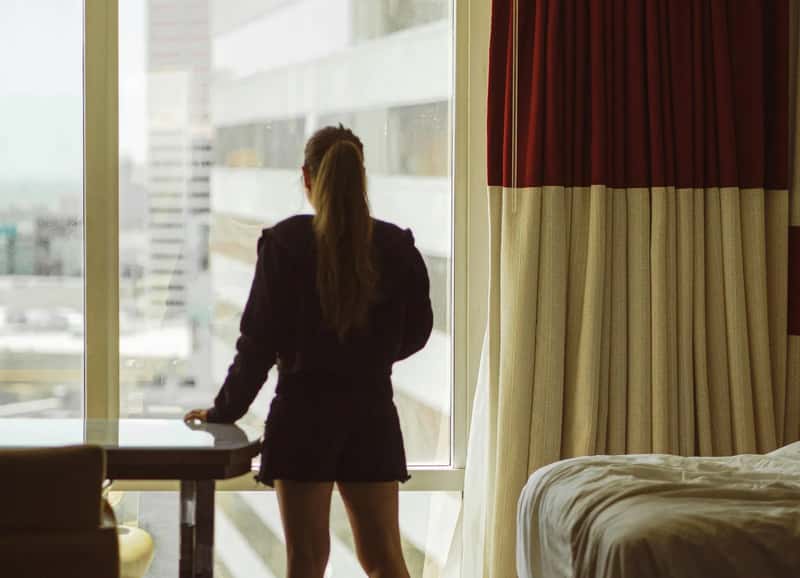
There is a particular kind of adult who arrives in a small hotel room and cannot sit still.
They open drawers they will never use. They check the thermostat twice. They pace the seven steps from the door to the window and back again.
This is not restlessness. This is measurement. The body is doing what it was trained to do in childhood – assess the perimeter, calculate the exits, determine whether there is enough room to be a full-sized human being.
The composed adult everyone admires for being so easy to be around is often harboring a secret: they’re the same intense, sensitive child they always were, just expertly compressed into a more palatable version that’s slowly suffocating inside.
The single hotel bed is a mirror. It reflects back the smallness that was once imposed on you.
Not just physical smallness. Emotional smallness. The kind that comes from growing up in a space where your presence was too large, too loud, too much – and you learned to fold yourself in half to survive it.
The room feels impossible because the childhood did too. And the body has an extraordinary memory for impossible.
2. The Autonomy Wound
When you grow up without a space you can call entirely your own, something precise breaks inside you.
It is not dramatic. It is quiet. A slow erosion of the belief that you are entitled to a corner of the world.
Having a room teaches you boundaries – both with your stuff and with your time. It’s a small step toward independence that’s so important. But what happens when that step never comes?
What happens is the adult version of you arrives in a hotel room and cannot claim it.
They rearrange nothing. They put their bag by the door, not in the wardrobe. They sleep on one side of the bed even when alone, because taking up the full width feels presumptuous.
When you don’t have a room of your own, it’s hard to feel like you have any personal space to just be yourself. Your things are always in shared spaces, where anyone might move them or comment on them.
The single bed triggers the autonomy wound. Not because it is small. Because it offers no margin. And children who grew up with no margin never learned how to stop living at the edges.
3. The Surveillance Loop
Here is something that happens in cramped childhood homes that no one talks about enough.
You are always being watched. Or felt. Or heard.
There is no acoustic privacy in an overcrowded house. Conversations leak through walls. Arguments move through ceilings. You develop – as a survival mechanism – a permanent low-grade hypervigilance. A listening posture. A readiness.
Children who do not have space of their own, where they can withdraw, experience stress – and conflicts become more frequent when there is no physical refuge to retreat to.
In a small hotel room, that hypervigilance reactivates.
The walls feel thin. The stranger next door feels close. The aircon rattles, or doesn’t work, and you attempt to relax on an oversized bed with stiff pillows, listening to the TV from next door or to strangers whispering in the corridor.
The surveillance loop never fully switches off. It just waits for the right environment to confirm what it always believed: there is no safe, private place. There never was.
4. The Exit Strategy
Watch someone with a cramped childhood walk into a hotel room.
Before anything else, they find the door. They note the chain lock. They check that the window opens – at least a crack. Their eyes sweep for exits the way a soldier clears a room.
This is not paranoia. This is a nervous system that learned early that confined spaces without clear exits are dangerous. Not theoretically. Experientially.
People with claustrophobia typically experience an intense fear of suffocation or restriction and a desire to escape – automatically checking for exits, standing near them, or feeling alarmed when all doors are closed.
The need for exits is a need for options. It is a need to know that you are not stuck. That if the walls close in – and they always did, once – you can leave this time.
The single hotel bed, positioned against one wall, blocks one exit by definition. The body notices. The body always notices what the mind is still trying to rationalize away.
5. The Inventory of Absence
I want to be honest with you about something.
I have stood in enough hotel rooms at 11 PM, bag still zipped, heart running too fast for the hour, to know that this is not abstract theory. There is a particular grief that arrives in small rooms. A grief that doesn’t belong to the room at all. It belongs to something older – to the childhood bedroom I shared with two other people, where the only place I ever felt truly alone was inside my own head.
Privacy might seem like a luxury for kids, but it’s actually a basic need. Without a room, there’s no place to go when you just need time alone – to think or relax without people around.
A small hotel room does not just feel physically cramped. It conducts an inventory. It asks: what are you carrying? What did you never get to put down?
Having no place to be alone can make you feel trapped – like you’re never fully relaxed or yourself.
The single bed is the inventory completed. One person. One mattress. Nowhere to spread out. And suddenly, all of the absence you learned to call normal is sitting right there on the duvet with you.
6. The Boundary Architecture
Children who grow up cramped become adults who are architects of invisible walls.
They need defined edges in their adult environments because they never had them as children. They are drawn to rooms with clear zones – a sitting area, a sleeping area, a desk. They are unsettled by rooms where everything bleeds into everything else.
A single hotel room with a single bed offers no architecture. It is one undifferentiated space. Sleep here. Exist here. Think here. All in the same seven square meters.
Personal space is the distance each person needs between their body and other people – and their environment – to feel comfortable and at ease. But what happens when the environment itself provides no differentiation?
The nervous system scrambles. It tries to build the architecture internally – mentally sectioning the room, arranging objects as anchors, constructing psychological walls where physical ones don’t exist.
When parents respect a child’s room, it shows the child that their space, feelings, and boundaries matter. Without this, it’s hard to develop a clear sense of self or even learn how to respect other people’s boundaries, because you’ve never been able to practice with your own.
The single hotel room collapses all that practice. And the adult inside it is suddenly a child again, building walls from furniture and habit.
7. The Control Deficit
One of the most corrosive things about growing up in a cramped, overcrowded home is what it does to your sense of agency.
You cannot control the noise. You cannot control who enters your space, or when, or why. You cannot control the temperature, the rhythm, the volume of your own domestic life. You are subject to the crowd.
Research has found that housing crowding leads to adult psychological withdrawal, loneliness, and negative parent-child relations. These are not just sociological statistics. They are the emotional weather of a cramped childhood – absorbed into the body at the cellular level.
Adults operating in crowded home environments are often subject to physiological and psychological stressors and deteriorated personal relationships relative to those in uncrowded environments.
The small hotel room triggers the control deficit because it offers almost nothing the guest can modify. The bed is bolted. The art is screwed to the wall. The thermostat is locked behind a plastic cover. Everything is fixed. And for the person who grew up in fixed, uncontrollable compression, that is not a minor inconvenience. It is a full nervous system reactivation.
8. The Breath Test
There is a breath that happens in a room with enough space.
You feel it – that slow, involuntary exhale when you walk into a room that has air in it. High ceilings. A window that opens onto something vast. A bed with room on both sides. The body releases something ancient when it senses enough.
But in a single room with a single bed, the breath test fails.
Being enclosed – or even thinking about being enclosed – in a confined space can trigger fears of not being able to breathe properly and running out of oxygen.
For the person who grew up cramped, this is not metaphorical. The childhood home was also a breath test that failed, daily. Too many bodies in too little air. Too many needs competing for too few cubic feet of emotional oxygen.
Overcrowding adversely affects mental health, leading to heightened stress, anxiety, and depression. The lack of privacy and increased physical contact contribute to social and behavioral issues, particularly in childhood.
The single hotel bed withholds the exhale. And the body, trained to expect suffocation, does not wait to find out if this time is different. It panics first. It asks questions later. If ever.
9. The Return to the Scene
Here is the darkest and most precise truth about the traveler who cannot sleep in a small hotel room.
Every time they check in, they are not arriving somewhere new.
They are returning. Returning to the original scene of compression. To the childhood space that taught them their dimensions were too large for the container they’d been given. The single bed is not just a bed. It is a stage set. It recreates – with horrible fidelity – the original geometry of not-enough.
Some adults with claustrophobia report one or more events where they were trapped or confined to a tight space as a child – and researchers believe these formative experiences are a significant factor in the development of confined-space anxiety in adulthood.
Poor housing conditions have significant effects on different aspects of a child’s life. These negative effects during childhood can persist throughout life, ultimately affecting their future socioeconomic status and, likely, their adult wellbeing.
And so the traveler stands in the doorway of Room 214. And they are also standing in the doorway of every room that was too small, too full, too loud. The ones where no one ever said: this space is yours. The ones where belonging was conditional on compression.
The return to the scene is not conscious. It is not chosen. It is the body’s loyalty to its own history – a loyalty so fierce, so precise, that it can be triggered by the width of a mattress and the distance between a wall and a window.
What we call “travel anxiety” or “hotel preferences” or “being difficult” is often none of those things.
It is an autobiography written in the body’s oldest language. It is the residue of rooms that did not have enough space for a child to become fully themselves – rooms that taught, through years of daily repetition, that space is not a right but a luxury, and that you, specifically, do not quite deserve the luxury version.
The remarkable thing is not that adults who grew up cramped struggle in small hotel rooms. The remarkable thing is that they travel at all. That they keep moving. That they keep checking in, key card in hand, hope outrunning history one corridor at a time. Every trip is a negotiation between the child who never had enough room and the adult who is quietly, relentlessly, trying to find it.
Maybe the single bed is not the enemy. Maybe it is the invitation – to finally notice what you have been carrying, to set it down on the luggage rack by the door, and to take up, for one night, exactly as much space as you have always deserved.