You land after a long flight, your phone is at a sliver of battery, and someone friendly offers to sort out your ride. At that moment a screen, a badge or a confident voice can feel like proof. Most travelers don’t stop to question it.
Warnings about fake rides and fake booking screens at airports have been piling up through 2026. The Terminal 4 label attached to this story deserves a careful look, because the documented facts are more specific than the headline suggests.
What the Reports Actually Confirm
Reporting from 2024 to 2026 does not point to a single, named fake taxi booking app operating at one Terminal 4 and nothing else. What it does show is a cluster of related tricks: impostor drivers, doctored payment screens and card machines that charge far more than agreed. Terminal 4 turns up repeatedly in the best documented cases, particularly at Cancun International Airport in Mexico.
That distinction matters, because several airports have a Terminal 4, including Heathrow, which sits on the southern side of the airfield, apart from the other terminals. Terminal 4 there has its own approach road and its own loop on the Piccadilly line.[1] Searches for fake app warnings at that terminal turned up nothing verifiable, so this article sticks to what is documented.
Why Cancun’s Terminal 4 Keeps Coming Up
Cancun’s Terminal 4 handles a steady flow of North American visitors. Air Canada, WestJet and Porter flights arrive there.[2] A tourist stepping out of customs is often tired, unfamiliar with the layout and unsure which exit leads to a legitimate ride.
Local reporting has tied the problem to the arrivals area itself. Unlicensed solicitors operate primarily outside Terminal 2 and Terminal 4, wearing polo shirts and button downs designed to mimic airport staff.[3] The setting does a lot of the persuading before anyone says a word.
How the Impostor Transporters Work

The pitch is rarely a plain offer of a taxi. Posing as airport authority figures or terminal coordinators, these drivers allegedly intimidate tourists into canceling rides they arranged in advance.[3] The goal is to pull a traveler away from a booking that was already paid for or confirmed.
Riviera Maya News described similar behavior. Transporters in shirts labeled as official transport were reported to be telling arriving passengers that app based ride services were banned.[4] Workers at the terminal also criticized the airport operator, ASUR, pointing to what they described as apparent tolerance of the practice.[4]
The Claim That Uber and DiDi Are Illegal
This is the statement travelers hear most often, and it deserves a clear answer. Tourists are not violating any laws by using transportation apps, and curbside solicitors cannot detain or penalize them.[3] The dispute is between local taxi groups and digital platforms, not between the traveler and the law.
There is a practical wrinkle, though. As of July 2026, Uber and DiDi still had no pickup area at Cancun airport.[2] So the honest summary is that using an app is not a crime, but the airport does not offer a simple curbside pickup for those services, which gives impostors room to blur the line.
A Short Ride and a Very Large Charge

One widely shared account from August 2026 shows how a payment can go wrong. A traveler took a car between terminals, and a ride of about five minutes from Terminal 3 to Terminal 4 cost him $6,018 USD.[5] He said the driver claimed his card was declined twice.
The traveler then tapped on a different reader for what he understood to be a small amount. Once on WiFi, he checked his banking app and found two charges from a company called Luxora Mobility.[5] The account comes from a traveler’s own post, so it is an allegation, though it matches an earlier case in which a Canadian visitor paid an 800 peso fare in cash and later found 8,000 pesos charged to the card twice.[2]
An Older Trick at the Exit Doors
Terminal 4 has been a trouble spot for years, not just in 2026. An older warning from a local transfer company argued that the building’s design leads people to leave through the Friends and Family exit, which opens into the departures area, instead of the Ground Transportation exit.[6] That warning is dated, so current signage and layouts may differ.
Its description of the method is still useful. Unauthorized drivers could not enter the ground transportation area, so they waited for people to take the wrong exit.[6] The same company showed a fake ticket that a driver had handed to a client, presenting it as proof for reimbursement.
When the Fake Is on the Phone Screen
Fake apps are real, even if no single one has been tied to Terminal 4. In March 2024, Delhi residents reported drivers using apps that imitated the payment screens of popular cab services. One passenger booked a ride from the city’s international airport for 340 rupees.[7] The next day his own app showed the bill was only 127 rupees.[7]
Delhi police confirmed the pattern. An officer from the Cyber Crime Cell said fake apps had been made to look like the payment gateways in popular cab aggregator apps.[7] The advice from a senior officer was simple: riders should rely on the fare shown on their own mobile app.[7]
The Cancel Your Booking Pattern
The same script is showing up on other continents. In October 2026, South African outlets reported that people posing as e-hailing drivers were approaching passengers at Cape Town airport exits. Some reportedly told travelers that official pickup areas were too far away, encouraging them to cancel their app bookings.[8]
The money trick was the same as in Cancun. According to a contractor interviewed, the scammers type a far larger number into the card machine than the fare of about 250 rand.[9] These are allegations from one source, though the tactic of steering people away from their booking appears again and again.
Warning Signs Worth Remembering
A few signals hold up across all these cases. Legitimate taxis rarely solicit passengers inside the building.[10] A driver who approaches you instead of waiting at a rank or desk deserves suspicion.
Pressure to change plans is another one. A driver who pushes you to cancel an app booking or a ride arranged in advance is a red flag.[10] Payment is the third: be wary when a card reader suddenly shows a declined message, especially when a second device appears.
Practical Steps That Hold Up
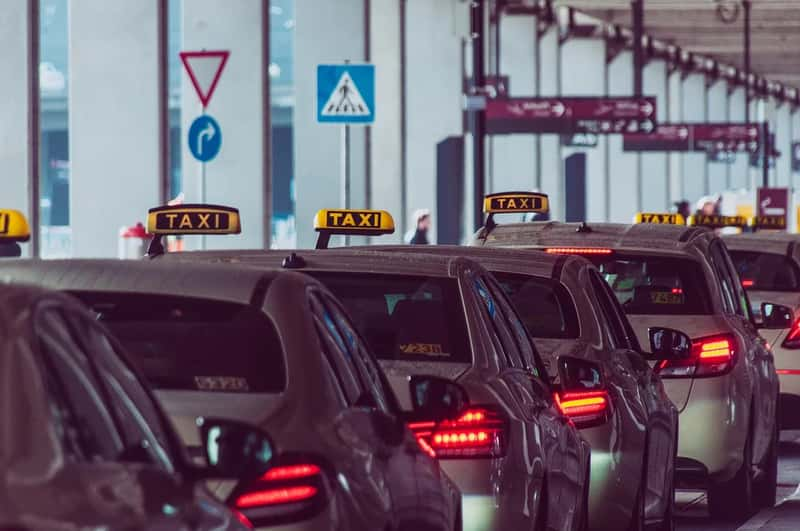
Local transfer advice for Cancun is to decide on your ride before you fly and agree the total price in writing.[2] It also stresses confirming the quote covers the whole vehicle, not each person. More broadly, Fodor’s suggests heading to a designated office that offers secure taxis at a fixed and prepaid price.[11]
Keep your own app open and trust its fare over a screen held by someone else. Check your bank notifications right after paying, as the traveler in the August case did. For wider context, the U.S. Department of State most recently updated its Mexico advisory on May 29, 2026, keeping it at Level 2, which means exercise increased caution.[12]