The broom is in the closet. You found it on day one.
You didn’t plan to use it.
And yet here you are. Checkout is in forty minutes. You are on your knees, wiping a countertop that a professional cleaner will sanitize within the hour.
Nobody asked you to do this. The cleaning fee was already charged. The host is offline. The apartment doesn’t care.
So why can’t you stop?
There is a version of you that pays for services without apology. That version orders room service and leaves the tray outside. That version checks out of a hotel without refolding the towels. But an Airbnb is not a hotel. It is someone else’s life, curated and rented. And somewhere between booking and checkout, you absorbed a guilt that was never yours to carry. You started performing goodness for an audience that wasn’t watching. You started apologizing, with a sponge, for the crime of being temporarily human in a space that belongs to someone else. The identity you carry at home – competent, self-contained, unapologetic – doesn’t quite fit inside borrowed walls. And the gap between who you are and who you feel you must be in someone else’s space? That gap is the whole story.
1. The Borrowed Life Problem
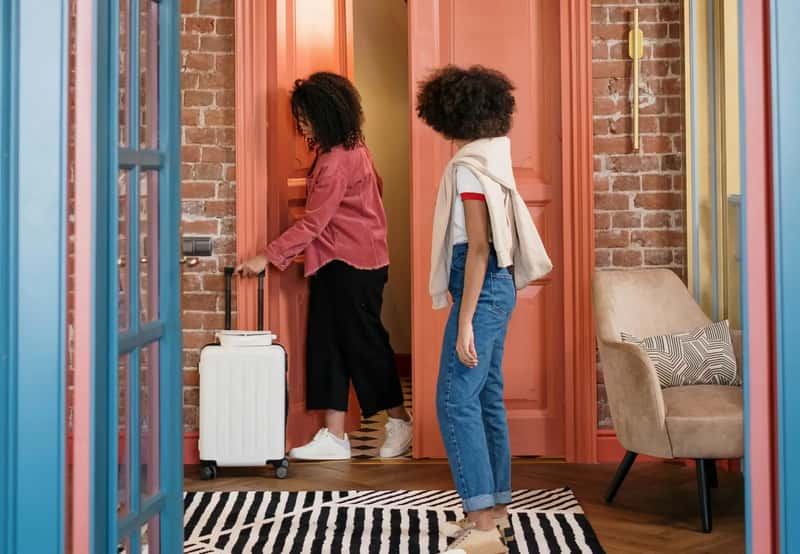
The moment you unlock an Airbnb, you step into someone else’s constructed identity.
Their books are on the shelf. Their art is on the wall. Their throw blanket is draped at a specific angle that communicates taste, intention, personality.
None of it is yours. All of it surrounds you.
A carefully decorated Airbnb – with its curated art and its host’s cookbook on the shelf – is a particular kind of problem. It looks like a place. It performs personality. It has the aesthetic grammar of belonging. But it is not yours, and some quiet, instinctive layer of your brain knows it immediately.
That knowing is not paranoia. It is your nervous system performing a fast, wordless audit of the space.
It asks: Do I belong here? The décor says someone does. That someone is not you.
The cleaning impulse begins here – in the friction between a space that performs intimacy and a body that knows it is a guest. You clean not because you made a mess. You clean because existing felt, somehow, like a trespass.
2. The Debt You Never Agreed To
You paid for this. The transaction was clean. There was a price, a booking confirmation, a check-in code.
And yet the feeling that persists is not that of a customer. It is older than that. More tangled.
Airbnb users often feel a sense of guilt toward their host for letting them stay, because the only association many people have with this type of stay is out of generosity, which is rooted in being indebted to another.
That word. Indebted.
It is irrational in the context of a commercial transaction. It is completely rational in the context of human psychology.
When you see a face attached to a space – a profile photo, a welcome note in the host’s handwriting, a small laminated card explaining which drawer the bottle opener lives in – the transaction stops feeling like commerce. It starts feeling like hospitality. And hospitality, for most of human history, was not something you paid for. It was something you owed.
So you scrub the sink. You owe them something. The receipt didn’t clear the debt your nervous system registered the moment it saw that welcome note.
3. The Primary Territory Displacement
At home, you are the ruler of a small kingdom. You know where the light switch is without looking. You know which floorboard creaks. You have, through years of daily ritual, claimed every corner as yours.
A primary territory is a physical space central to our daily life that we “own” and control. It’s most often our home, or a room in our home. Because we are the rulers of these mini kingdoms, we have a degree of freedom and control typically lacking in other physical spaces – one of the few places where we’re the “boss” and can do as we please.
An Airbnb strips that. The territory belongs to someone else.
According to Shawn Burn, professor of psychology at California Polytechnic State University, staying in someone else’s space means temporarily losing your primary territory – a physical space central to your daily life that you “own” and control, which supports many psychological needs, including a need for control and predictability.
Cleaning before you leave is your attempt to restore the balance. You arrived as an intruder into someone else’s primary territory. You are leaving as a good one. You are paying, in elbow grease, for the psychological permission to have been there at all.
4. The Performance of the Good Guest
There is a character you become inside an Airbnb. Quieter. More careful. More aware of the sound your shoes make on the hardwood.
You turn down the music you’d blast at home. You close the refrigerator gently. You check, twice, that you haven’t left a ring on the coffee table.
To protect their sense of propriety, guests usually feel compelled to change what they normally do in someone else’s space. This self-monitoring and vigilance requires thought and effort, and some anxiety.
This is the performance of the Good Guest. It is exhausting. It runs on a background anxiety – the low hum of “am I behaving correctly?” – that never fully powers down, not even during sleep.
The Good Guest doesn’t spill. Doesn’t leave towels on the floor. Doesn’t exist too loudly.
The cleaning before checkout is the final act of this performance. The curtain call. You are erasing the evidence of yourself – not because you did anything wrong, but because you internalized the idea that merely existing in the space was an imposition worth apologizing for.
5. The Mirror That Doesn’t Know You
I once spent four days in a borrowed apartment in a city I loved. Everything about the space was objectively beautiful. High ceilings. Morning light. A bookshelf someone had curated over a decade.
On the last morning, I reorganized the kitchen counter I’d rearranged on day one. Then I remade the bed. Then I wiped the bathroom tiles. Then I stood in the doorway and scanned the room one final time, looking for traces of myself to erase.
There were none. There had never been any. I had lived in that apartment like a ghost – present but trying, the entire time, not to be.
In a foreign Airbnb, the territorial pulse fires loudly because the environment offers no reciprocal signal. Nothing in that room knows you. Nothing reflects you back.
At home, a space knows you through accumulated time. The indent in the couch. The mug that’s always in the same cabinet. The light you never turn on. In a borrowed room, none of that accumulation exists. You are invisible, and invisibility – even when you chose it – has a weight to it. The pre-checkout cleaning is a final, futile attempt to leave a mark. And then you erase the mark. And then you lock the door. And the room forgets you before you reach the elevator.
6. The Rating Apparatus and the Anxiety It Manufactures
There is a score attached to your stay. You knew this before you arrived. It hovered, unspoken, over every moment you spent in the space.
The review system changes the texture of your presence. Behavioral science plays a huge role in reviews. With an Airbnb host, guests see the face of the owner and perhaps even a picture of their family. They grant access to their property; it’s very personal. This intimacy ultimately leads guests to be more forgiving of the provider.
More forgiving, yes. And more anxious about being judged in return.
The guest knows they, too, are being evaluated. There is a profile. A score. A short paragraph that future hosts will read before they decide whether to let you into their life for a weekend.
This bilateral surveillance creates a pressure that no hotel has ever manufactured. A hotel doesn’t write about you afterward. An Airbnb host does.
So you clean. Not just for the host. For the algorithm. For the score. For the stranger three cities from now who will decide, based on four sentences written by a person you never met, whether you deserve a good bed.
7. The Contamination Fear
There is an older, quieter fear beneath the guilt. Older than ratings. Older than hospitality economics.
It is the fear of contamination – of having “fouled” a space that wasn’t yours to foul.
Territorial contaminations are when someone “fouls” someone else’s territory. A host may feel a guest has contaminated their space if they make a mess or leave belongings strewn about. Meanwhile, house guests themselves may feel invaded if someone enters their temporary space uninvited.
You do not think of yourself as someone who contaminates spaces.
And yet. There is grease near the stove. There is a hair in the shower drain. There is the ghost of your shampoo still fogging the bathroom mirror.
These are the ordinary residues of being alive. You would not notice them at home. Here, they feel like evidence of wrongdoing.
You clean them away because the body knows something the mind hasn’t fully articulated: you were a foreign presence in someone else’s carefully maintained ecology, and you want to leave it the way you found it. Untouched. As if you were never really there.
8. The Ritual as Coping Mechanism
There is a science to the cleaning reflex. It is not merely guilt. It is also anxiety looking for an outlet – and finding one that looks, conveniently, like virtue.
There is scientific evidence of the correlation between stress and ritualization – redundant, repetitive behaviors like washing dishes or scrubbing counters. Research suggests that rituals like cleaning and organizing might be an effective coping mechanism for anxiety, with higher-anxiety individuals making more rigid and repetitive movements as a coping strategy.
The pre-checkout clean is a ritual. Like all rituals, it provides the illusion of control.
You cannot control whether the host likes you. You cannot control your review score. You cannot control the fact that you’ve spent four days in a space that never fully accepted you.
But you can control the angle of the dish towel. You can control the alignment of the throw pillows. You can make the space look as though you handled it with care. And in the handling, you convince yourself – briefly, usefully – that you were someone who deserved to be there in the first place.
9. The Identity You Carry Through Borrowed Doors
Here is the deeper question the cleaning reflex is asking.
Not: “Did I leave the apartment clean enough?” But: “Was I a good enough person to have occupied this space?”
The definition of identity is a mix of introjections from others and how we make sense of our experiences. Exploring who we are can be difficult in normal circumstances, but when we travel, we also deal with whatever stereotypes and prejudices precede us.
Travel puts the self under pressure. The familiar scaffolding of home – your routines, your objects, your people – is not here. What remains is a version of yourself that has to justify its presence in every new space it enters.
Travelling alone removes external influences and expectations. Every decision, big or small, comes from your own preferences. This clarity helps surface who you are when you are not performing a role or responding to others’ expectations.
The cleaning is a role. It is the role of Responsible Traveler. Good Guest. Person Who Leaves Things Better Than They Found Them. You put it on like a costume before checkout. And underneath the costume is a person who just wanted, for a few days, to exist somewhere without needing to perform their own worthiness.
10. The Erasure and What It Costs You
By the time you hand back the key or type in the checkout code, you have done something more than clean an apartment.
You have erased yourself from it. Systematically. With intention.
You are not keeping other people out. You are keeping the feeling of erasure at bay. The markers say: a person with a specific history stayed here. Even if the space will forget by checkout tomorrow.
This is the cost no one puts in the cleaning fee. The psychological labor of un-becoming. Of shrinking yourself down small enough that a space never had to truly accommodate you. Of performing your own disappearance so gracefully that the host finds nothing out of place, feels nothing disrupted, notices nothing at all.
You paid to be here. You paid again – in vigilance, in anxiety, in the hours of restrained living – to prove you deserved to be here. And then you cleaned away the proof that you were.
Displacement severs people from the places that once helped them understand who they were, and identity begins to fragment – not because of fragility, but because meaning itself has been disrupted. Even in the voluntary, comfortable displacement of a weekend Airbnb, something of that fragmentation is present. You left home to be somewhere else. And somewhere else didn’t quite have room for all of you.
The apartment is spotless now. The pillows are square. The dish towel hangs the way the host’s Instagram photo showed it hanging. You’ve left the key in the lockbox and you’re standing on the sidewalk with your bag and the particular hollowness that follows a stay somewhere that was almost, but never quite, yours.
The guilt that drove the broom was never really about cleanliness. It was about permission. About the internalized belief that occupying a space – any space – requires a justification that money alone cannot provide. The cleaning was your apology for the audacity of having needs, of sleeping and eating and living inside someone else’s walls without being invited in the old way, the human way, the way that would have required you to belong somewhere first.
Maybe the next time you find yourself on your knees in a borrowed kitchen twenty minutes before checkout, you’ll pause. Set down the sponge. Stand up. Look around at the space that held you – imperfectly, commercially, temporarily – and recognize that you didn’t owe it anything beyond what you already paid. You were allowed to be there. You were allowed to leave a mark. You were allowed, for a few days, to simply exist without earning it.