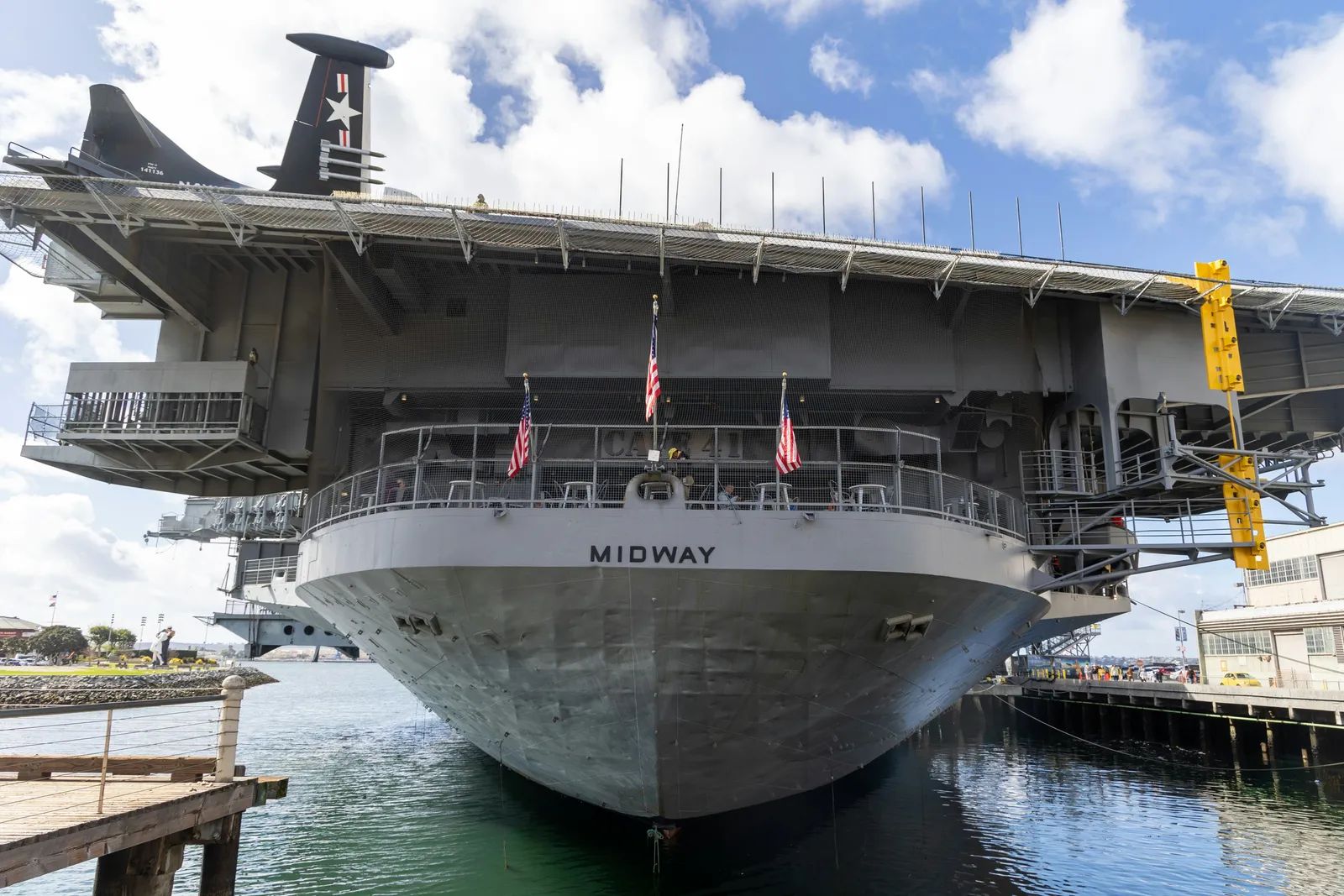
Along the downtown waterfront in San Diego, a steel flight deck stretches roughly 1,000 feet beside Navy Pier, and it is easy to forget that the vessel once held the title of biggest ship on Earth. A recent feature from Marks Meanderings [1] revisited that history. The ship’s path from wartime carrier to public museum shows how a Cold War vessel found a second life as a place for families, history buffs and aviation fans. ([1])
A carrier launched as the war ended
The USS Midway was commissioned eight days after World War II ended, which placed it at the start of the postwar Navy. Its service record describes it as the lead ship of its class and the largest aircraft carrier in the world until 1955. The ship took its name from the Battle of Midway, the 1942 Pacific engagement that turned the tide against Japan.
Although it never saw combat in World War II, the carrier became a training vessel and a flagship for naval operations in the years that followed. Its size also created engineering challenges. It was the first American carrier too wide to pass through the Panama Canal, a detail that signaled a shift toward larger and more capable warships.
Why it held the title for a decade
Few sources agree on every detail, but the core claim is consistent. Several travel and museum guides say the ship was the largest in the world until 1955, when newer vessels overtook it. Its dimensions help explain why it stood out at sea.
- Length: about 1,001 feet, or roughly 305 meters
- Width: about 258 feet at its broadest point
- Aircraft capacity: up to 80 planes in operation
- Crew: several thousand sailors and aviators, with figures varying by source
Some guides describe the Midway as the largest warship of its era, while others focus on its status as the largest carrier. Both descriptions point to the same reality: for a time, few vessels afloat could rival it.
From active duty to a museum deck
The ship remained in service for 47 years, a span that reached from the postwar period into the early 1990s. It was decommissioned in 1992 after taking part in operations including the Gulf War. During Operation Desert Storm in 1991, it served as a flagship for naval forces in the Persian Gulf and supported the effort to liberate Kuwait.
After its retirement, the carrier moved to San Diego and opened to the public as the USS Midway Museum on June 7, 2004. The museum has since become one of the most visited naval attractions in the United States, and it continues to add exhibits. In June 2025, it opened a display inside the ship’s restored Carrier Intelligence Center, a space that was once off limits because of its classified work. The addition gives visitors a look at naval intelligence that few previous exhibits could offer.
What visitors should plan for
The museum is open daily from 10:00 a.m. to 5:00 p.m., according to its own website, with last admission at 4:00 p.m. It closes on Thanksgiving and Christmas Day. The address is 910 N. Harbor Drive, on Navy Pier. The museum recommends setting aside at least four or five hours to see the ship properly, a suggestion that many first-time guests find accurate once they begin exploring the decks.
The self-guided audio tour is narrated by former Midway sailors and officers, which gives the walk through engine rooms, hangar bays and the bridge a personal voice. More than 30 restored aircraft sit on and around the flight deck, and volunteer docents, many of whom served aboard the ship, lead talks about launching and landing planes. Ticket prices differ across third-party sites, so checking the official museum website before a visit remains the most reliable approach.
Quick facts: the ship was commissioned in 1945, held the title of world’s largest ship until 1955, opened as a museum in 2004, and is open daily with last admission at 4:00 p.m.
The Midway’s record as the largest ship in the world may now belong to history, but the deck still carries the weight of that era. For visitors willing to spend an afternoon aboard, the ship offers a rare chance to stand where sailors once lived, worked and launched aircraft into the sky.