You scrubbed the stovetop twice.
You refolded the towels.
You vacuumed a floor you barely walked on.
Your own bathroom at home? It’s been three weeks. And somehow, that doesn’t bother you at all.
There is a gap that opens the moment you step into a space that isn’t yours. A quiet, disorienting distance between the person you have carefully constructed over years – through your objects, your routines, your bedroom lighting – and the stranger staring back at you in a mirror that belongs to no one you know. This is the Identity Gap. The chasm between who you are at home and who you perform when everything is borrowed – the furniture, the coffee mugs, the thin morning light through someone else’s curtains.
The compulsive cleaning isn’t about cleanliness. It never was. It’s about existing in a space where you feel you have no right to leave a mark, while simultaneously trying to leave no trace of yourself at all. It is guilt dressed up as domestic courtesy.
1. The Borrowed Life
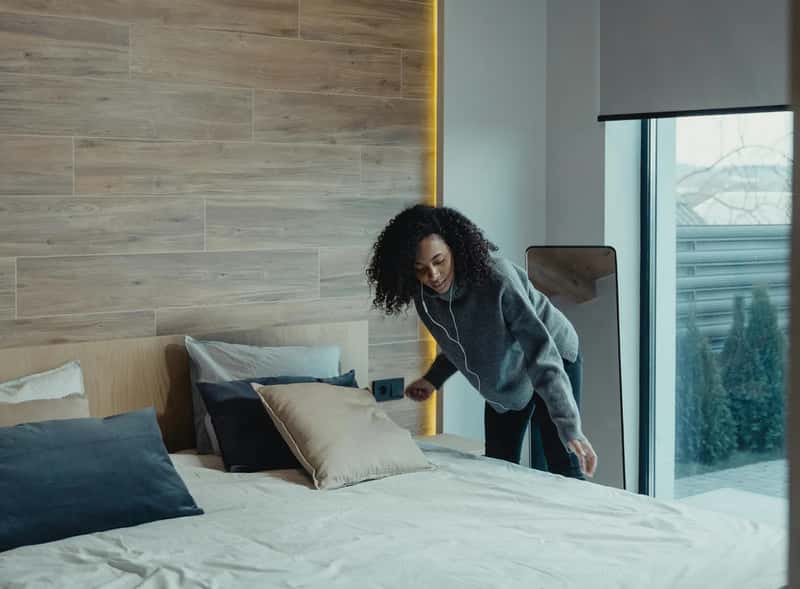
You paid for this place. The transaction was clean. The confirmation email arrived. The key code worked on the first try.
And yet.
You still feel like a trespasser in every room.
A carefully decorated Airbnb – with its curated art and its host’s cookbook on the shelf – looks like a place. It performs personality. It has the aesthetic grammar of belonging. But it is not yours, and some quiet, instinctive layer of your brain knows it immediately.
This is the borrowed life problem. You are not a hotel guest – those rooms are deliberately anonymous. You are living inside someone else’s identity. Their candles. Their throw pillows. Their framed print of a city they loved once. You are wearing another person’s coat, and it fits just well enough to make you anxious.
The guilt begins here. Not in the checkout instructions. Not in the star-rating pressure. It begins the second you put your bag down and realize the room already has a self – and it isn’t yours.
You start cleaning not to clean. You start cleaning to apologize for your own presence.
2. The Debt You Didn’t Sign For
The transaction was supposed to be simple. Money in exchange for space. A clean, commercial arrangement.
But Airbnb is not a hotel. And your nervous system knows it.
When you see the face of the owner – maybe even a picture of their family – they grant you access to their property. It’s very personal. This intimacy ultimately leads you to be more forgiving of the provider. It also leads you to feel a sense of guilt to your host for letting you stay at their place, because the only association you have with this type of stay is out of generosity, which is rooted in being indebted to another.
The debt is invisible. It’s not on the receipt. But it shows up in your hands at 7 AM, wiping down a countertop nobody asked you to touch. You are not cleaning a kitchen. You are paying a tax on existing. You are trying to offset the guilt of simply being present in a space that belongs, spiritually and emotionally, to someone else entirely.
3. The Trace Anxiety
You lie awake the last night thinking about it.
The coffee ring on the bedside table. The water splash by the sink. The fingerprints on the glass door you touched without thinking.
This is Trace Anxiety – the low-frequency dread of leaving evidence of yourself behind. Psychologists have long recognized that our surroundings act as an extension of identity. The objects, colors, and routines that make up “home” help stabilize our sense of self. Strip those away, check into a room with a coded lock box and a laminated instruction sheet, and something ancient and nervous wakes up inside you.
In your own home, your traces are proof of life. The coffee ring is a memory. The fingerprints are yours. They say: I was here. I live here. This is mine.
In someone else’s space, the same trace becomes an intrusion. An offense. The physical evidence of a self that had no business being there in the first place. So you scrub it. Not for hygiene. For absolution.
4. The Star-Rating Surveillance
You are being watched. Not by cameras. By the promise of judgment.
The five-star review looms over every spilled drop, every moved chair, every dish left in the drying rack instead of put away. You know this is irrational. You know the host isn’t sitting in a control room watching a live feed of your breakfast habits.
But you behave as if they are.
Human psychology means that Airbnb users often leave reviews that don’t necessarily accurately reflect their experience. The same is true in reverse. You don’t live accurately in the space. You perform your stay. You become the ideal guest – conscientious, invisible, apologetic – because you are already anticipating the moment you will be evaluated. The cleaning is preemptive. It’s a performance for an audience that may never check.
The surveillance isn’t external. It’s internal. And it never takes a day off.
5. The Impersonation Problem
Let me tell you something true.
I once stayed in an Airbnb in a city I had wanted to visit for years. High ceilings. A rust-colored velvet armchair. Edison bulbs casting amber light across exposed brick. By any measure, the room was more beautiful than my apartment at home. And within thirty minutes of arriving, I had reorganized the kitchen so my things occupied one specific corner. I had moved the armchair three inches closer to the window. I had placed my book on the nightstand even though I knew I wouldn’t read it.
I wasn’t nesting. I was impersonating someone who belonged there.
Tapping into the fantasy of “living like a local,” Airbnb consumption plays out analogically: one can be “like” someone else only on condition of remaining different. The Airbnb experience sets in motion a mimetic interaction, in which guests tend to take the host’s perspective while also maintaining a certain distance, assuming in-between identities.
The cleaning that follows is the act of erasing the impersonation. Of restoring someone else’s life to the state you found it, as if you were never foolish enough to try living it in the first place.
6. The Primary Territory Collapse
Before we talk about cleaning, we need to talk about what home actually means to the brain.
Not an address. Not a lease. Not a mortgage.
A primary territory.
Psychologist Irwin Altman argued that many people see their home as a “primary territory” – distinct from secondary territories like workplaces and bars, and tertiary spaces like park benches. Primary territories are understood as extensions of the self, places where the self is protected against others.
An Airbnb is someone else’s primary territory. You are a guest inside the most psychologically significant space a human being can occupy. You are inside the extension of another person’s self. That is not a casual transaction. That is an intimate intrusion – consented to, paid for, well-intentioned, and still deeply uncomfortable at the neurological level.
The compulsive cleaning is your attempt to restore their primary territory to its original condition. To undo your impact. To pretend, as convincingly as possible, that your self never entered their self at all.
7. The Invisible Rulebook
Every Airbnb has a house manual. Usually four pages of laminated anxiety, covering everything from which bin is for recycling to the precise angle at which you should leave the shower door.
You read it twice. Maybe three times. On the plane. Before sleep. The morning of checkout.
But there is another rulebook. An invisible one. The one written entirely in guilt.
When we travel, we sacrifice a lot of the control we have over our lives. We generally end up inhabiting spaces that are not our own, and where we are restricted in many ways. We are usually unable to organize the space how we want physically and are generally unable to control all the things that happen in the space.
The invisible rulebook fills every gap the printed one leaves. Don’t be loud. Don’t cook anything with a strong smell. Don’t rearrange too aggressively. Don’t exist too loudly. Don’t let your presence feel permanent. Don’t be the kind of guest who gets talked about. The invisible rulebook is authored entirely by your own anxiety, and it is exhaustive.
8. The Exit Strategy Guilt
You check out at ten. You start cleaning at seven.
Three hours of quiet, meticulous erasure. Dishes, surfaces, bedsheets pulled tight. The bathroom scrubbed to a standard it probably wasn’t at when you arrived.
This is Exit Strategy Guilt – the specific anguish of the departure ritual. Regret is defined as a negative emotion predicated on an upward, self-focused, and counterfactual inference. This phenomenon has emerged as a crucial feature of customer negative experiences. But the regret here is not about the booking. It’s about the occupation. You are already performing retrospective guilt for the days you spent simply living in the space, eating at the table, sleeping in the bed, breathing the air.
The exit cleaning is not practical. No cleaning fee covers three hours of pre-emptive shame. It is psychological. It is the body’s way of completing a ritual it never had language for: the act of formally, physically apologizing for having existed somewhere you didn’t entirely belong. The door clicks behind you. You exhale. The guilt doesn’t follow you out.
Most of the time.
9. The Identity Continuity Break
At home, you are consistent. The same mug. The same corner of the couch. The same light you leave on when you’re working late. Your surroundings hold the narrative of you – every object a quiet sentence in the story of who you are.
Strip that away and something loosens.
Place attachment captures the emotional, cognitive, and behavioral bonds people develop with specific environments. These bonds are shaped by social relationships, physical features, personal memories, and the symbolic meanings we assign to spaces. Understanding the two core dimensions of this attachment helps explain why certain places become so central to who we are. When those attachments are severed – even temporarily, even voluntarily – the self feels slightly unmoored.
The Airbnb guest who over-cleans is, in part, a person trying to reassert narrative control over a space that refuses to tell their story. The cleaning is an attempt to write yourself into the room – and then, before you leave, to edit yourself back out. It is a frantic, tender act of identity management in a space that was never designed to hold your particular identity at all.
10. The Weight of Being Witnessed
This is the heaviest one.
Beneath all the surface-level guilt – the star ratings, the house rules, the borrowed intimacy of someone else’s primary territory – there is something quieter and far more fundamental.
You are afraid of being seen as someone who doesn’t take care of things.
Seeking experiences outside the traditional tourism market is associated with identity construction. Tourism, in general, has been linked to class-related social aspirations, and defined as a “way of positioning oneself in the world.” The Airbnb, then, is not just a room. It is a mirror. And how you leave it is, in your quietly anxious mind, a referendum on who you are.
The person who leaves a space better than they found it is a person of character. A considerate person. A person who earns their place in the world rather than simply taking up space in it. The deep, wordless terror driving all that scrubbing is the fear that without proof of your consideration – left in the form of a spotless kitchen and a neatly stripped bed – the world will see what you sometimes secretly suspect: that you take up too much space. That you always have. That you always will.
The mop is not about the floor. It never was. It is about the oldest guilt there is: the guilt of simply existing, loudly and messily and humanly, in a world that keeps asking you to be smaller.
There is a version of you that travels freely. Unbothered. Light. And then there is the version standing at the door at 11 PM in a stranger’s home, running diagnostics on every window latch like a night-shift security guard no one hired. Both are real. Both are you. The gap between them is not a flaw. It is a map of every moment you were told – explicitly or otherwise – that your presence required justification.
The cleaning will not close that gap. Neither will a perfect five-star review, or a host’s message that says “wonderful guests, left the place immaculate.” The immaculateness is not the point. The point is the anxiety that made you immaculate. The point is the hours you spent trying to erase a version of yourself that had every right to exist in that room, to cook eggs in that kitchen, to leave a wrinkle on that sofa cushion, to live – briefly, impermanently, but genuinely – inside a borrowed life.
You are allowed to occupy space without apology. You are allowed to exist in temporary places without treating your own presence as damage to be undone. The next time you find yourself on your knees scrubbing a baseboard at 6 AM while the taxi is already waiting, stop. Just for a moment. Ask yourself what you’re actually cleaning. Because the room, in all likelihood, was already fine. It is something older and quieter than tile grout that you are trying, desperately and tenderly, to make clean.