Most travelers assume airport staff keep a secret menu of perks for anyone over 60. The official rules tell a different story: the one well-documented age-based perk starts at 75, not 60.
Nearly everything else on this list is available to any traveler who needs it, which is exactly why so few people know to ask. Keep reading, because the countdown ends with a courtesy that surprises even frequent flyers.
#24 – The Wheelchair Ride Nobody Needs a Diagnosis For
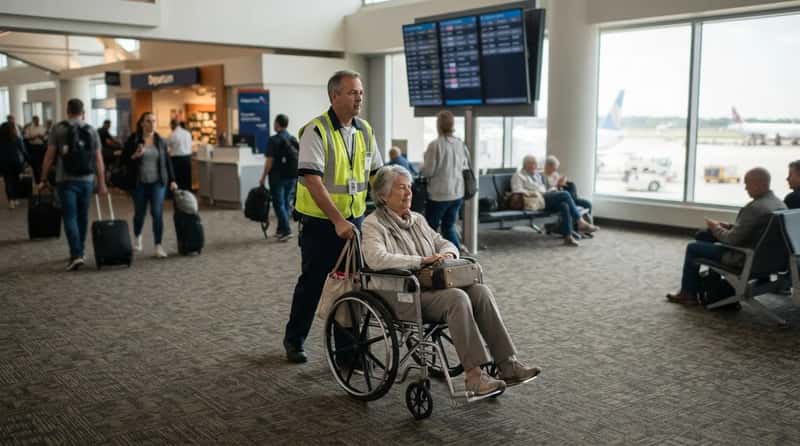
The most-used courtesy on this list has nothing to do with your birthday.
The U.S. Department of Transportation says to request an airport wheelchair when you make your reservation if you are unable to walk long distances. Nothing in that guidance sets an age limit.
Here’s the part most people don’t realize: airport wheelchair service is provided by your airline, and TSA does not provide it. So the person to ask is the airline, not the security officer.
Staff tend to offer it to older travelers because older travelers often have trouble with distance. The rule is need, not age.
But the next courtesy shows up at the gate, and it catches plenty of people off guard…
#23 – Early Boarding, If You Ask for It
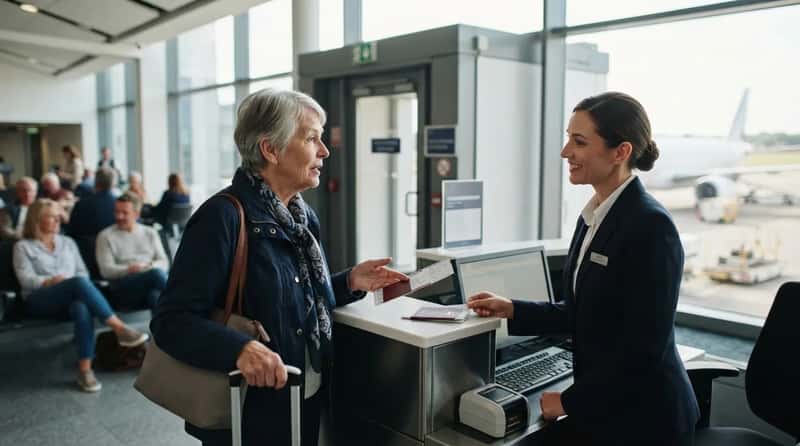
Pre-boarding is secretly one of the most underused courtesies at any gate.
American Airlines tells passengers to request early boarding with the gate agent if they need extra time or assistance boarding. Delta says you may board during pre-boarding or when your zone number is called.
Notice the wording. It’s a request-based option tied to need, not a benefit that switches on at a certain age.
Many gate agents will honor a polite request from an older traveler. Nobody will announce it for you.
And there’s a companion rule that many families completely overlook…
#22 – A Travel Companion Can Board With You
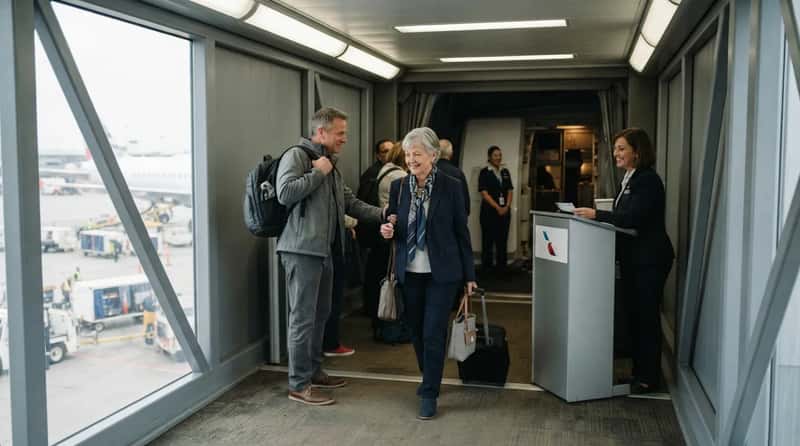
You may not have to face the jet bridge alone.
If you need special assistance from gate staff, ask before boarding begins, and most airlines allow one travel companion to preboard with you. That means a spouse, friend, or adult child can help you settle in.
One source on wheelchair services says the companion can also pre-board with the passenger requiring assistance. The catch is that policies differ by airline, so “most” is not “all.”
Ask the gate agent directly and don’t assume. A ten-second question can save a lot of hassle in the boarding line.
Worth Knowing
- Most airlines allow one companion to preboard with you.
- Ask before boarding begins, not once the line has formed.
- A spouse, friend, or adult child can fill the role.
- Policies differ by airline, so confirm yours in advance.
Next up is a ride that many travelers never knew existed…
#21 – The Courtesy Cart Between Gates
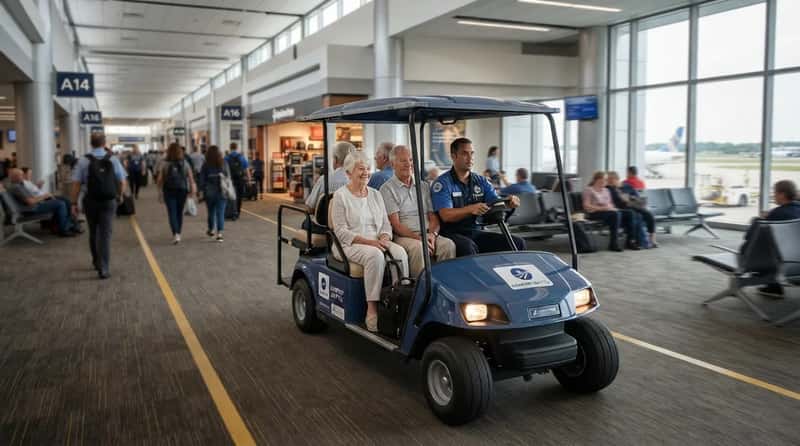
Some airports run golf-cart-style vehicles for people who can’t manage the walk.
Airport staff drive these vehicles to pick up passengers who need extra assistance or have tight layovers. Policies vary widely, so check the airport’s website or call your airline ahead of time.
Here’s the twist: if free transportation isn’t available, some airports work with contractors to provide cart services for a fee. So “free” depends entirely on where you land.
Don’t count on a cart appearing on its own. Ask ahead.
The people who arrange all of this often wait right at the curb…
#20 – Curbside Help From Car to Gate
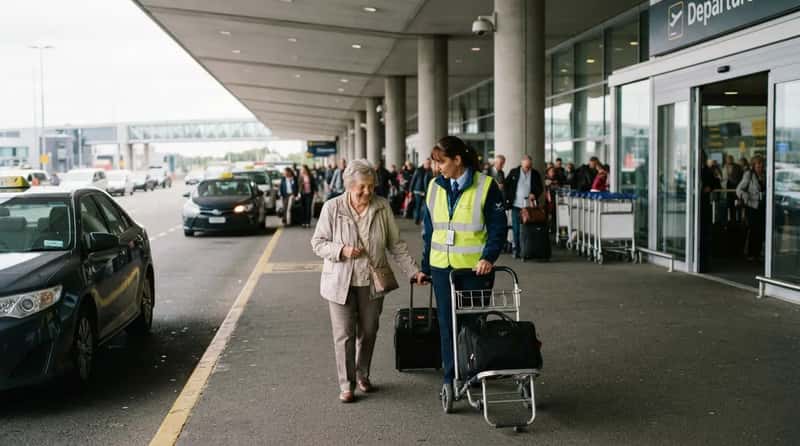
At some airports, the service starts before you reach the terminal door.
Many airports have curbside programs that dispatch personnel to help passengers from their cars, through ticketing, security, and to their gate. Some may transport seniors in carts or wheelchairs.
The truth is that these programs differ so much from airport to airport that no single rule applies. The advice is to check the options in advance.
A phone call to the airport’s customer service line beats guessing at the curb. It also tells you whether the help is free.
Some airports go a step further, and the next courtesy involves real people, not vehicles…
#19 – Volunteers Who Walk You to Your Destination
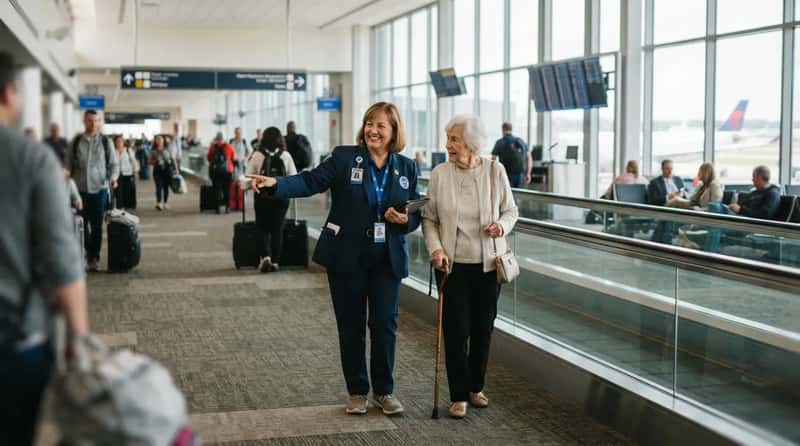
Certain airports quietly run volunteer guide programs that most travelers never notice.
Some airports connect passengers needing assistance with volunteers who guide travelers to ticket counters, gates, baggage claim, and ground transportation. Navigator programs may include multilingual volunteers for international travelers.
Whether your airport has one is entirely a local matter. Ask before you fly if your airport offers such a program.
Don’t expect it at every terminal. Small airports may not have anything like it.
That patchwork also explains why a quiet room might be waiting for you, if you know where to look…
#18 – The Rest Areas Most Travelers Walk Right Past
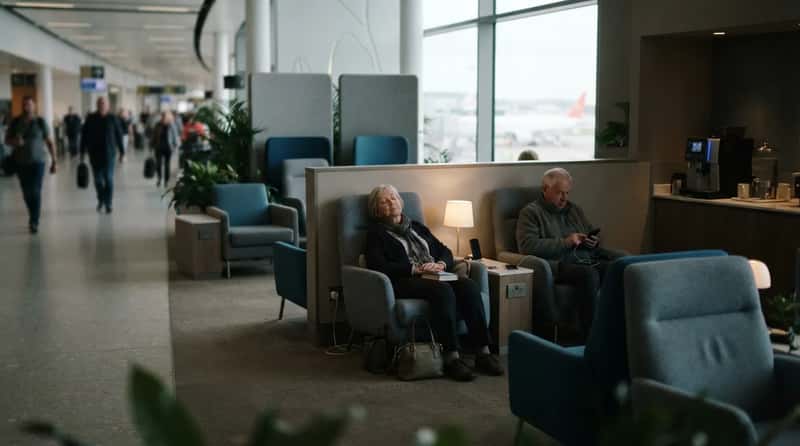
Some big airports reportedly set aside quieter spaces for passengers who need a break.
Some larger airports have private lounges for passengers needing additional assistance or a place to rest, often with comfortable seating and snacks or drinks. Many also have outlets for charging mobility devices.
Here’s the honest caveat: the source describing these lounges is a general guide, not an airport directory. It advises checking with your airport and gates in advance to see if such facilities are available during longer layovers.
If you have a long layover, ask at the information desk. Worst case, you get pointed to a quieter gate.
Now for a courtesy you can spot on someone’s neck, and one people often misunderstand…
#17 – The Sunflower Lanyard (It’s Not a Fast Pass)
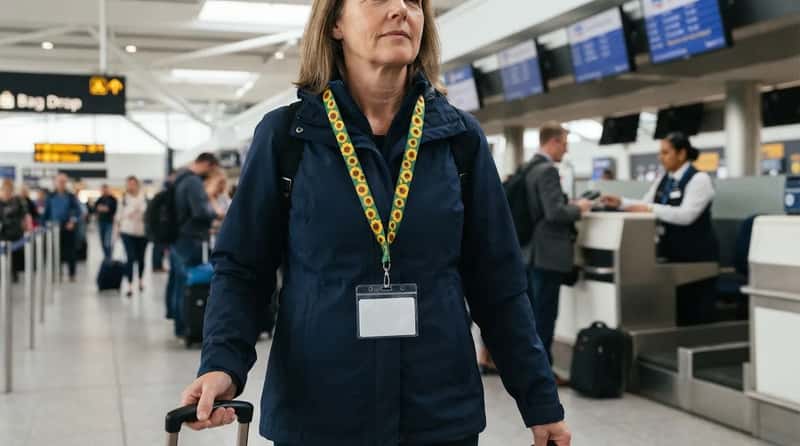
Many travelers assume the sunflower lanyard skips lines. It doesn’t.
The program helps travelers subtly tell airport staff that they have an invisible or less visible disability and may need extra help. San José airport states plainly that lanyards are not fast passes and bring no expedited service at check-in or security.
It’s also open to anyone. No proof of disability is needed to receive one.
One working group counts more than 327 airports in 70 countries taking part. That makes it far more common than most people think.
The next tool has the opposite problem: it works, but only if you plan ahead…
#16 – The TSA Helpline Almost Nobody Calls

There’s a phone number for security questions, and it isn’t just for younger travelers.
TSA Cares is a helpline for travelers with disabilities, medical conditions and other special circumstances who need extra help during screening. TSA asks people to call at (855) 787-2227 72 hours before traveling.
Most people don’t realize you can also submit an online form instead of calling. TSA lists both options on its site.
It’s aimed at need, not age. But an older traveler with a medical device or mobility question fits right in.
If you skip the call, there’s a small card that can do some of the talking for you…
#15 – The Notification Card That Speaks for You
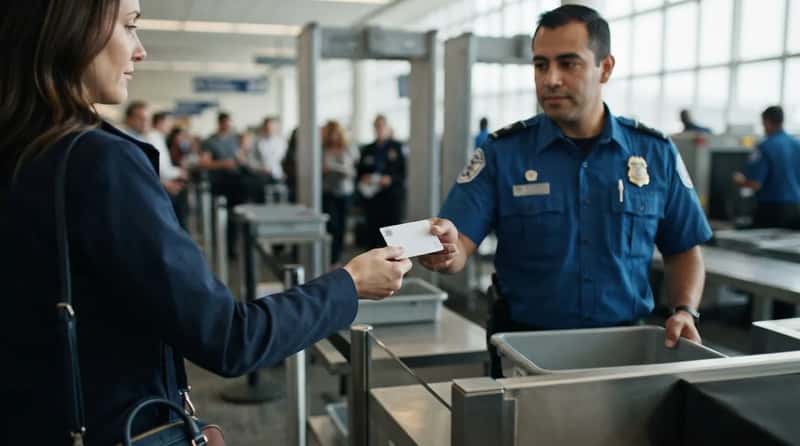
A single card can spare you an awkward explanation at the checkpoint.
Travelers with disabilities and medical conditions may consider a TSA Notification Card, which lists health conditions, disabilities, or medical devices that may affect screening. You hand it to the TSA officer when you reach the checkpoint.
Turns out you don’t need the card to get help. Travelers without it can still request assistance once they arrive at the airport.
The card simply keeps the conversation private. That matters if you’d rather not announce a hip replacement to the whole line.
And if a card isn’t enough, TSA has people whose whole job is to step in…
#14 – A Passenger Support Specialist on the Spot
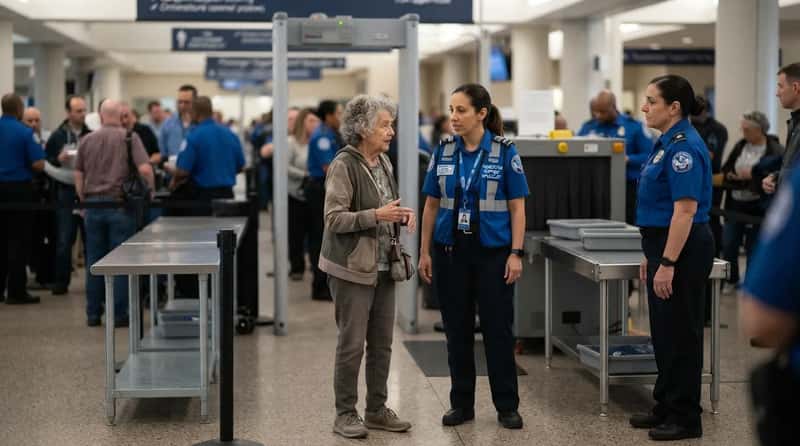
Most travelers don’t realize TSA has specially designated staff for tricky screenings.
Travelers with special needs or concerns may ask a TSA officer or supervisor for a passenger support specialist who can provide on-the-spot assistance. You don’t have to arrange it weeks ahead.
That said, TSA itself asks for at least 72 hours’ notice when you can give it. Requests go through the TSA Cares form or helpline.
Think of it as a backup, not a replacement for planning. Both routes exist for a reason.
What you carry can matter as much as how you walk, as the next item shows…
#13 – Screening While Seated or in Private
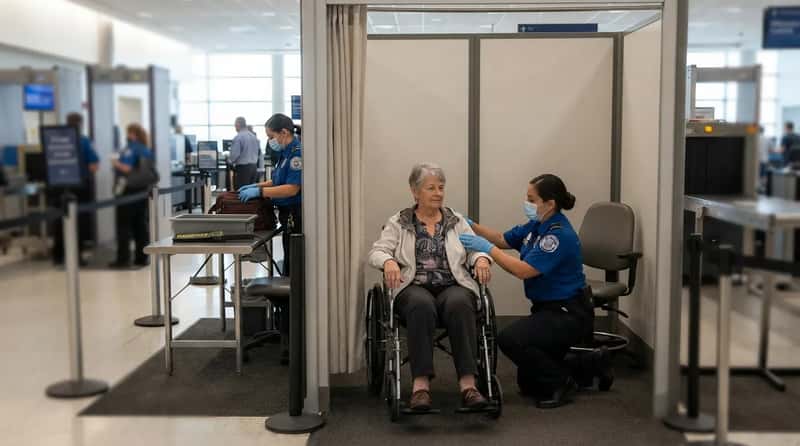
You may not have to stand or walk through the scanner in front of everyone.
A TSA spokesperson told The Washington Post that wheelchair users can ask to remain seated at the checkpoint or use a private screening room. Another guide says those in need can request private screenings instead of walking through metal detectors.
Again, the trigger is a need, and not turning 60. Age alone doesn’t unlock it.
Still, an older traveler who struggles with standing has every right to ask. Say so plainly and early.
Quick Compare
- Wheelchair user: can ask to stay seated or use a private screening room.
- Trouble standing: can ask for manual inspection instead of the scanner.
- Age 75 or older: may receive expedited screening, but is still screened.
Some of the most practical help involves things you carry, including medication…
#12 – Medications and Devices, Handled Without a Fuss
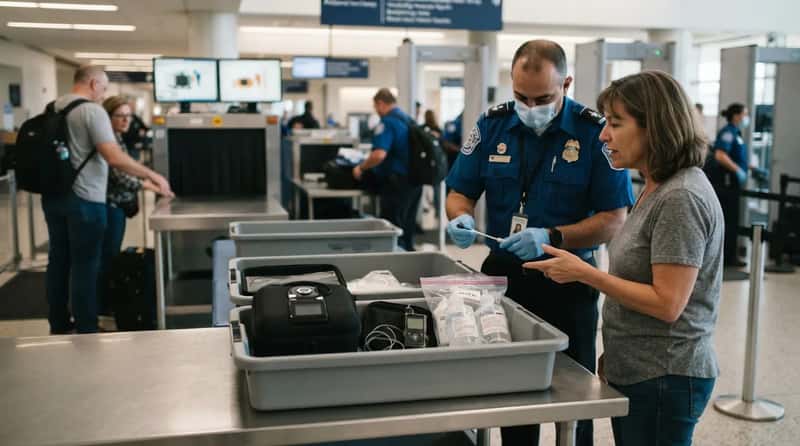
Medical items can cause panic in the security line, and TSA has a plan for them.
TSA says it’s okay to bring a CPAP machine, and passengers can travel with an insulin pump or an ostomy pouch. Passenger support can also help travelers carrying medically necessary liquids, gels, or aerosols over 3.4 ounces.
Every traveler still gets screened, and no accommodation changes that. TSA requires all travelers to undergo screening at the checkpoint.
The difference is in how it’s done. Telling the officer up front usually prevents confusion.
The government’s own advice on speaking up may surprise the more polite travelers…
#11 – The Rule Says You Must Speak Up
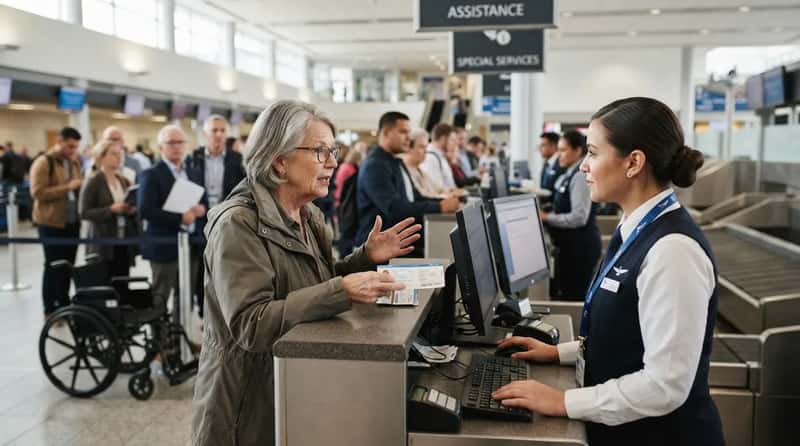
Waiting to be noticed is the habit that quietly costs travelers the most help.
The Department of Transportation says it is important to self-identify as a passenger with a disability needing assistance when you arrive at the airport. Staff can’t always see what you need.
The agency also advises arriving as early as possible to allow time for bag check, security screening, and boarding. Rushing is what makes every other courtesy on this list harder to use.
Many travelers hate to “make a fuss.” The official advice runs the other way.
Once you’ve asked, here’s what happens if your trip includes a connection…
#10 – An Escort to Your Connecting Gate
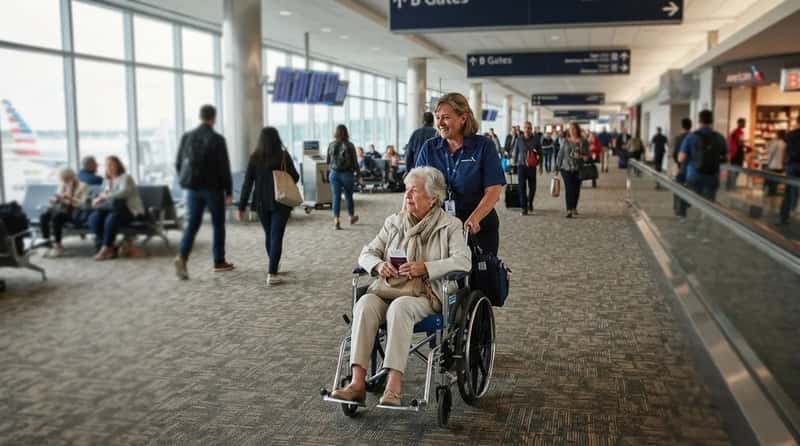
Missing a connection is a real fear, and airlines do plan for it.
American Airlines provides wheelchair assistance for customers making interline connections, with authorized personnel escorting the customer to the other carrier’s gate. Assistance doesn’t end when your first flight lands.
But watch the fine print. If another airline is involved in the itinerary, American’s guidance says to contact that airline directly for wheelchair service.
Confirm every leg of your trip. One missed phone call can leave you waiting at a gate with no help.
And if you can’t manage the aircraft door, there’s special equipment waiting…
#9 – The Narrow Aisle Chair
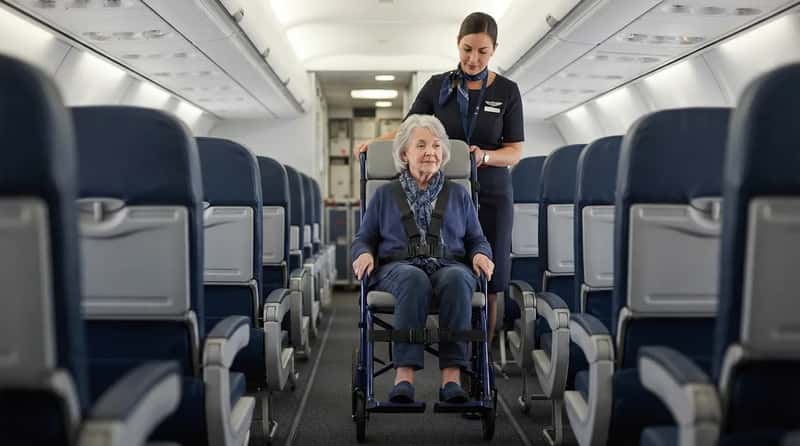
Boarding help goes all the way to your seat if you need it.
Delta says aisle chairs are available if you need help boarding from the jet bridge and getting to your seat, with an agent transferring you at the aircraft door. They have chest and leg straps to keep you secure during the transfer.
Delta asks passengers to speak their needs to the transfer agent, because verbal direction helps the agent assist them best. Don’t be shy about it.
This is a mobility service, not a senior perk. But it’s one that older travelers often benefit from.
Not every courtesy involves moving, though. The next one is about hearing and seeing…
#8 – Safety Briefings You Can Actually Follow
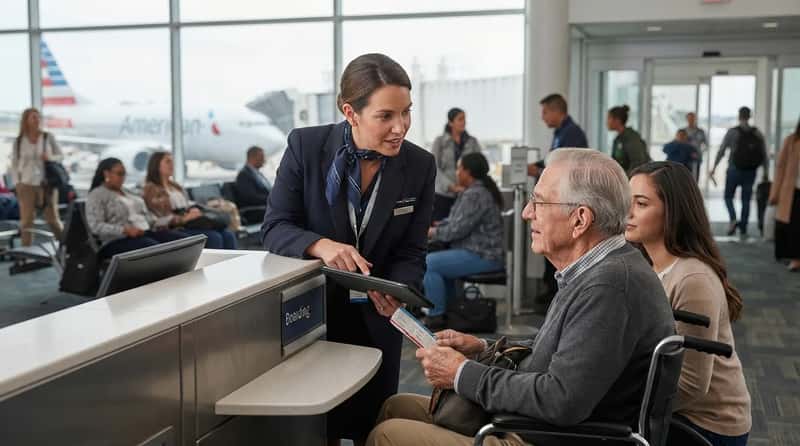
Some of the most important help at the airport has nothing to do with walking.
American Airlines asks passengers to tell a team member about vision or hearing limitations so they can receive a safety briefing and important updates. That covers flight changes and gate announcements too.
Most people don’t realize you can ask staff for this before you board. Many just nod along and hope they caught the gate change.
If you’re hard of hearing, say so at check-in. It costs nothing.
The help doesn’t stop when the plane lands, either…
#7 – Help From Your Seat to the Curb
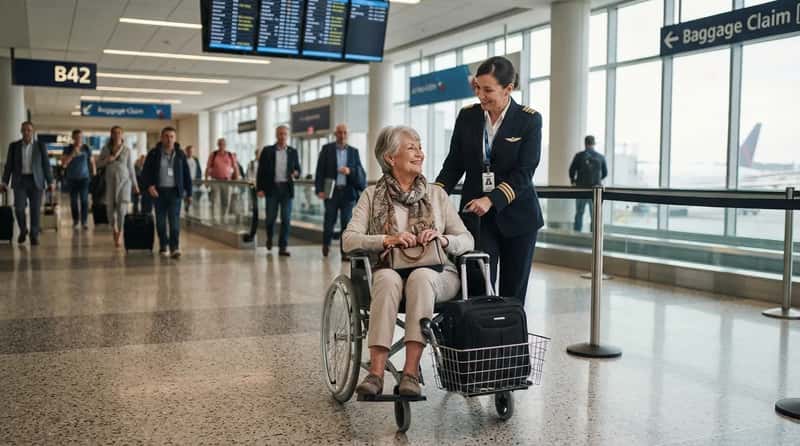
Arrival assistance is the courtesy people forget to request.
One large airport’s service description lists help for passengers from their arriving flight’s seat through the airport to baggage claim, the terminal entrance, or vehicle pick-up. Escorts don’t only work on departure day.
The same notice encourages passengers needing wheelchair assistance to tell their airline when arranging the flight. So the arrival help usually has to be booked on the outbound side too.
Tell the airline for both directions. Otherwise you may land and find nobody waiting.
Fast Facts
- Arrival help can run from your seat to baggage claim, the terminal entrance, or vehicle pick-up.
- Tell your airline when you arrange the flight.
- Confirm it for every flight on your itinerary, including the trip home.
Behind the scenes, there’s one detail about airport layouts that can make or break your walk…
#6 – The Elevator Instead of the Stairs
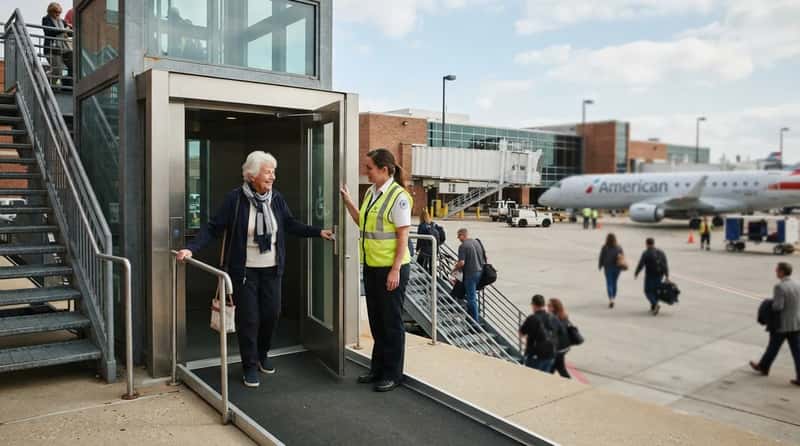
Some flights still board from the tarmac, and stairs can be a serious barrier.
American’s guidance notes that many airports have elevators for reaching the tarmac area, and passengers should tell airport personnel if they need to use one. If you don’t say so, nobody will assume it.
This is one where the accommodation exists but never gets advertised. You have to ask for it by name.
Mention stairs when you book. Then mention them again at the gate.
Then there’s a rule that applies to travelers with powered equipment, and it’s easy to miss…
#5 – The One-Hour Head Start for Battery-Powered Chairs
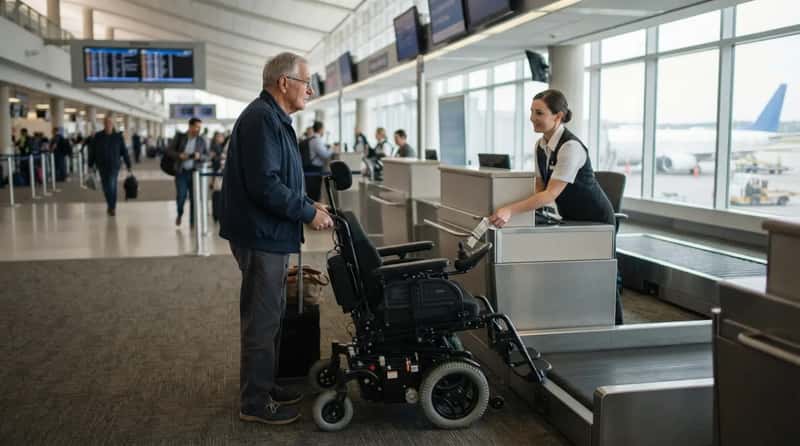
A powered wheelchair changes your arrival plan completely.
The Department of Transportation says travelers with a battery-powered wheelchair must arrive at the airport one hour before the normal check-in time. That extra hour is for the airline to handle the device safely.
Skipping it is a costly mistake. Your chair is treated as checked baggage and stored in the cargo hold.
Personal wheelchairs are stored in the aircraft’s hold, according to one overview of disability assistance. Arriving early gives staff time to do it right.
So what if nobody at the checkpoint seems to know these rules? There’s an answer…
#4 – The Supervisor You’re Allowed to Call
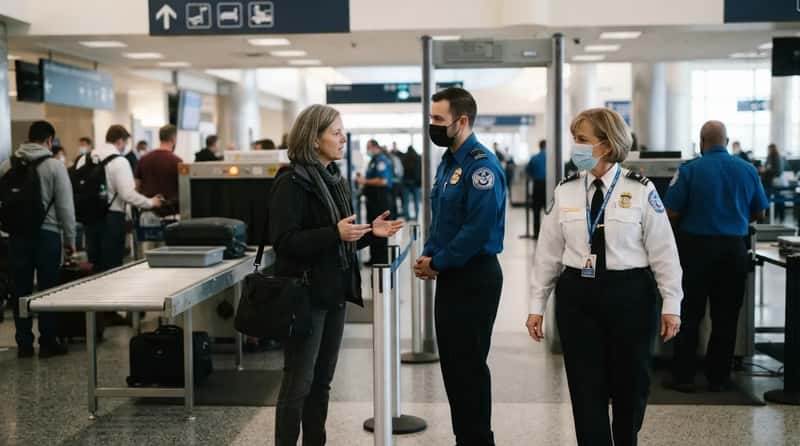
Not every checkpoint experience goes smoothly, and TSA admits it.
TSA says that if your screening experience did not meet your expectations, you may request to speak with a supervisor at the checkpoint. That option is open to everyone.
Here’s the uncomfortable truth: plenty of travelers never use it because they assume the officer’s word is final. It isn’t.
Stay calm and ask politely. A supervisor can often sort out a misunderstanding on the spot.
Now we’re getting into the courtesies that really do depend on your age…
#3 – Hands-On Screening in Place of Standing
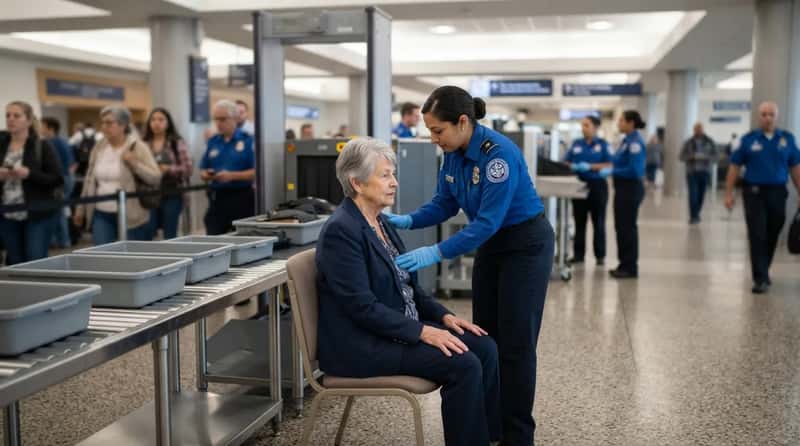
If you can’t stand for the scanner, there’s a workaround in TSA’s process.
A travel industry blog on seniors and security notes that travelers 75 or older receive expedited screening, and that anyone unable to stand for screening will be cleared by manual inspection. The second point depends on ability, not age.
Many people blur the two. Being 75 doesn’t automatically mean you’ll skip the scanner, and being younger doesn’t rule out a seated option.
Know the difference before you reach the front of the line. It helps you ask for the right thing.
Which brings us to the perk everyone thinks they know about…
#2 – Keeping Your Shoes On
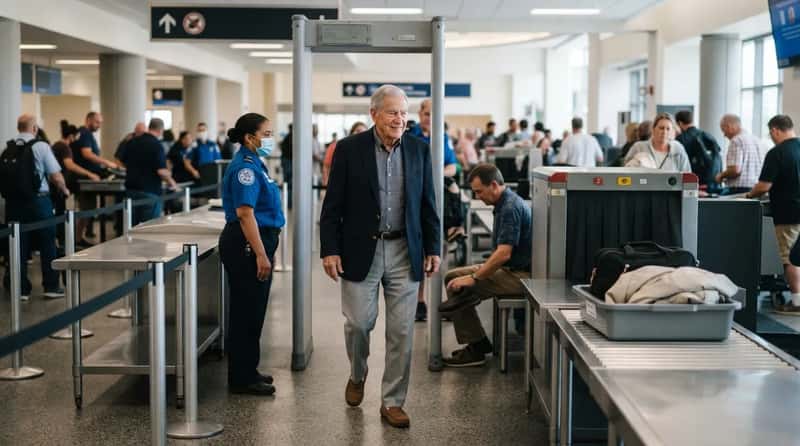
Shoes are the courtesy that gets the most attention, and the picture just got messier.
TSA’s page for passengers 75 and older says you may leave your shoes on, but removing light jackets is required for advanced imaging screening. If an alarm goes off, you may still be asked to remove shoes for further screening.
Here’s the twist: one site reports that TSA ended the mandatory shoe-removal rule for all passengers in July 2025. Other pages still describe the 75-and-older rule, so check TSA’s current guidance before assuming either.
One forum poster argued that TSA PreCheck is still the better bet. They said it sends you through the PreCheck line instead of just hoping you keep your shoes on in the regular one.
At a Glance
- TSA’s 75-and-older page says shoes may stay on.
- Light jackets still come off for advanced imaging screening.
- An alarm can still lead to a request to remove shoes.
- Rules are shifting, so check TSA’s current guidance before you fly.
But the biggest age-based courtesy isn’t about shoes at all, and it’s the one that matters most if the scanner beeps…
#1 – A Second Scan Before Any Pat-Down
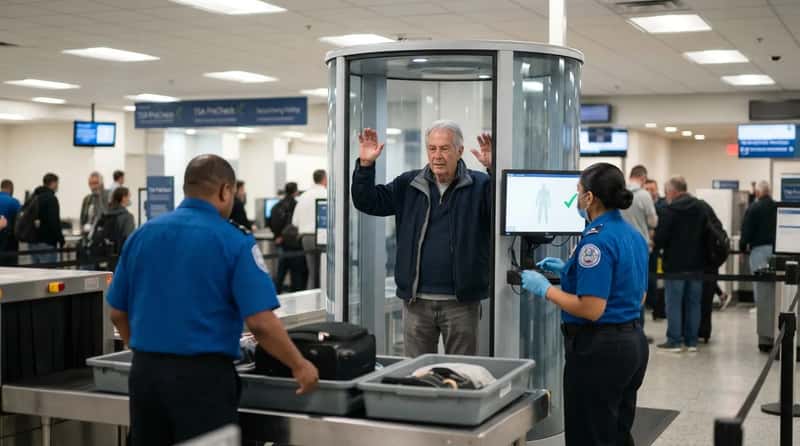
This is the clearest age-linked courtesy in the whole system, and it starts at 75, not 60.
TSA’s rules for passengers 75 and older include an additional pass through advanced imaging technology to clear any anomalies before other steps. The changes are meant to reduce, though not eliminate, pat-downs.
Then there’s how they know your age. When the procedure was first tested, officers were to make a visual assessment of whether a passenger was over 75. No ID check was described.
TSA’s page says passengers 75 and older can receive expedited screening through risk-based security measures. That’s the whole official age-based list we found, and it’s far shorter than the rumors suggest.
The biggest finding is that most of these courtesies aren’t reserved for people over 60. They depend on you asking, and the federal advice is to self-identify when you arrive.
The clearest age-based perks we found are TSA’s modified screening steps for passengers 75 and older. Everything else, from wheelchairs to pre-boarding to lanyards, follows need and airport policy.
Which of these did staff offer you without being asked, and which did you have to request yourself?