The gate changes without warning.
Your boarding pass is already damp from your palm.
The sign above you clicks over to a different city.
And still – you raise your phone. You photograph the sign.
Not the destination. Not the sunset bleeding through the terminal glass. The sign. The font. The precise, deliberate, unapologetic geometry of Helvetica telling you exactly where to go.
There is a gap between the person who has a home address and the person who knows seventeen airport lounges by the smell of their carpet. Between the one who has a “usual” at the neighborhood bar and the one whose most consistent relationship is with a particular shade of wayfinding yellow. That gap is where millions of modern travelers actually live – not in transit, but as transit.
1. The Non-Place Problem
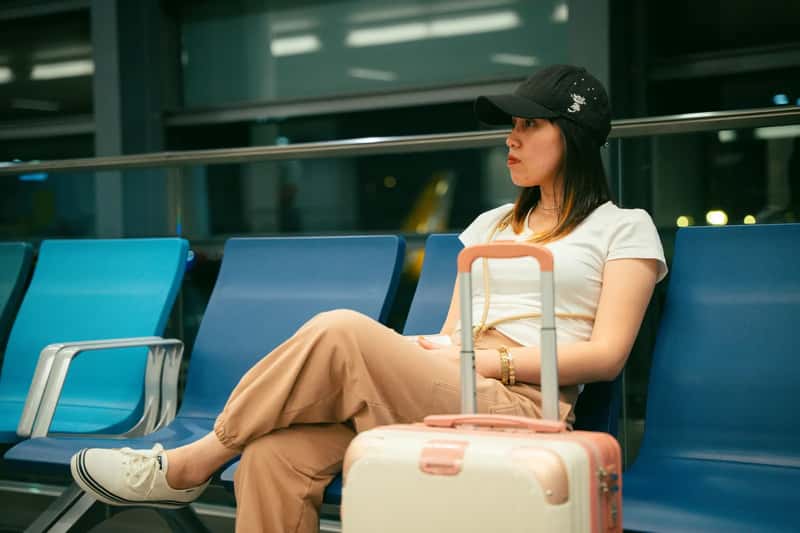
Theorist Marc Augé called airports “non-places” – spaces so stripped of cultural identity that they exist purely as functional corridors between real life.
The prevalence and importance of signage in airport space was examined by Augé in his seminal 1995 text Non-Places, where he writes that “the link between individuals and their surroundings in the space of non-place is established through the mediation of words, or even text.”
Read that again.
Words. Text. Signs.
In a world stripped of landmarks and familiar territory, the only thing tethering you to reality is typography. The person obsessively photographing airport signage isn’t being eccentric. They are doing exactly what Augé predicted – using words on walls to construct a relationship with a space that, by design, has no soul.
Lacking the distinct physical landmarks and heterogeneous characteristics of urban environments, signs become an essential component of wayfinding and spatial legibility at the airport. And for the traveler who photographs them, they become something more. They become proof. Proof that they were here. Proof that here was real.
2. The Control Mechanism
Psychology has long understood that humans seek order when chaos is imminent.
People navigating uncertainty often develop dysfunctional beliefs that can include a heightened sense of responsibility, intolerance of uncertainty, and perfectionism. Sound familiar? The frequent flyer who can’t walk past a beautifully kerned departure board without capturing it is not obsessive in a clinical sense. They are compulsively human.
The camera becomes a tool of psychological sovereignty.
When your schedule is dictated by airline algorithms and your address changes every seventy-two hours, the act of documentation is the act of ownership. Coherence – the extent to which one perceives life as meaningful – and control – the extent to which one feels capable of initiating and pursuing goals – are central pillars of a stable self-view.
The sign doesn’t move.
Even when everything else does.
3. The Typography of Calm
There is a reason airport typography is not accidental.
The illuminated signage, unified and continuous design, and striking and concise typography are engineered to stand out from complex surroundings, increasing legibility. These aren’t aesthetic choices made by someone who cares about beauty. They are psychological choices made by someone who understands panic.
And the traveler – the one with the camera – feels that.
Illegible signs can induce stress, confusion, and feelings of incompetence. Their inverse is equally true. Legible, ordered, confident signage induces calm. It induces the sensation that the world has been organized on your behalf. For the person whose life resists easy organization, that sensation is close to sacred.
The font isn’t just a font.
It’s a promise that someone, somewhere, thought things through.
4. The Liminal Identity
Liminality is the psychological state of existing in a threshold.
From the Greek limnos, meaning “threshold,” liminality describes an in-between time when what was, is no longer, and what will be, is not yet. It is the airport’s native emotional climate. And for people who spend enough time there, it stops being a temporary state and starts being a permanent address.
When we enter the liminal zone, our identity is held in suspension. The neophyte in that space has no family, property, or even identity.
That is terrifying for most people.
For others, it is the only state in which they feel honest.
The liminal experience of hypermobility becomes the key existential state around which some individuals form their identities – choosing freedom and autonomy over possessions, and valuing change over stability. The sign on the wall, then, becomes the only stable thing in a life built on chosen instability.
5. The Archive as Autobiography
I’ll be honest.
I once spent forty minutes in Singapore’s Changi Airport not eating, not sleeping, not buying overpriced duty-free whiskey. I was photographing the wayfinding system. Gate arrows. Level indicators. The precise weight of the sans-serif chosen to bear the word “DEPARTURES.”
I told myself it was research.
It wasn’t. It was autobiography. It was my way of saying: I was here. This was real. I existed in this moment, in this terminal, under this sign.
That impulse is not unusual. Research has found that people with highly mobile lives harbor a more fluid conception of home that isn’t tied to a physical place, and are able to feel at home anywhere in the world through the cultivation of certain mobile practices. Documenting signage is one such practice. It is the construction of a portable, visual autobiography that requires no fixed address.
The archive becomes the home. The photographs become the walls.
6. The Wayfinding Self
Here’s the dark irony: the person most obsessed with airport signs is often the most lost.
Not geographically. Existentially.
Geographer Yi-Fu Tuan proposed that place represents security while space represents freedom – and we are drawn to both. The frequent traveler lives permanently in the tension between those two poles. They have chosen space – radical, untethered freedom. But the hunger for security never disappears. It just changes shape.
It becomes a hunger for legible signs.
While the nomadic lifestyle can feel chaotic, having a consistent structure is essential. Structure does not mean rigidity; rather, it is a repeating framework that gives each day purpose and efficiency. For some people, the repeating framework is a morning routine. For others, it is the ritual of photographing the bold geometry of a departure board at 5 AM. Different architecture. Same psychological need.
7. The Identity Gap
There are two versions of the airport-signage documenter.
The version they present to the world – curious, aesthetic, perhaps a little eccentric – and the version that exists at 3 AM in a half-lit terminal in a city whose language they do not speak.
Without a doubt, living in liminal space, making a home in that intersection of multiple identities, is more complex than living in a singular reality. It is also the experience of increasing numbers of people the world over.
That gap – between presented self and felt self – is where the compulsion lives.
The loss of a stable reference point for identity can make a person feel, in their own words, emotionally homeless. The sign on the wall is a counter-argument to that feeling. It is an insistence that even in a non-place, there is legible logic. Even here, something is organized. Even here, you are pointed somewhere.
The camera shutter is a small act of defiance against emotional homelessness.
8. The Anxiety Architecture
Airports are, by design, anxiety engines.
Crowds. Queues. Incomprehensible PA announcements. The low-grade existential dread of being a biological organism hurtling through the stratosphere in a pressurized aluminum tube. Airports are complex spaces that exist primarily for the purpose of moving significant numbers of people, and in these spaces, wayfinding is an important process given that people need to be moved in a time-effective and safe manner.
Time-effective. Safe.
Two things the transitory mind desperately craves.
Showing the time it takes to reach a gate on signage can reduce people’s anxiety and help them organize their time reasonably. Even this micro-detail – a number, a font, a calculated reassurance – lands differently on the person for whom the airport is home. It is not just practical information. It is evidence that time, in this space, is knowable. Measurable. Controlled.
The person photographing that sign is archiving the evidence of a controllable world.
9. The Nomadic Hunger for Pattern
The human brain is a pattern-recognition machine.
Deprive it of pattern and it will manufacture one. Give it consistent, repeating visual grammar – the same typeface in Dallas and Dubai, the same color hierarchy in Frankfurt and Nairobi – and it will use that grammar as scaffolding for a sense of stability.
Routine, for nomadic individuals, is used to foster a sense of familiarity and create a mobile sense of home no matter where in the world they happen to be. Airport signage is the most globally consistent visual routine that exists. Frequent travelers actually prefer to navigate the airport using signage alone – not maps, not staff, not apps. Just the signs. Just the clean, repeating visual logic that feels, after enough flights, like the most reliable relationship in their lives.
The globe-hopper who photographs signs is mapping their own consistency. Proving to themselves that in a world of constant change, some things – these fonts, these arrows, these illuminated certainties – stay the same.
10. The Soft Architecture of Belonging
This is the heaviest truth.
For a significant portion of modern travelers – the digital nomads, the expats, the perpetual contract workers, the people for whom “home” is a concept they’ve quietly stopped believing in – belonging has no fixed address. What nomadic communities show us is that home isn’t necessarily tied to territory, but can be imagined, cultivated, and experienced in mobile and multiple ways.
But imagining and cultivating are work. Hard, daily, exhausting work.
Some transnational professionals “could not live without mobility,” because they craved experience, not things. And yet the craving for something to belong to never fully leaves. It just transforms. It becomes the craving for a visual system that is the same everywhere. A typeface that doesn’t change its mind. A directional arrow that means what it says.
The obsessive documentation of airport signage is not a quirk. It is not an Instagram aesthetic. It is the soft architecture of belonging – constructed one photograph at a time, in terminals that were never meant to be anyone’s home, by people who have quietly decided that “meant to be” is a luxury they don’t need.
They are building a home from the only material consistently available to them: the clean, honest, universal grammar of public typography.
There is something almost tender about it, when you hold it up to the light. The person crouching to get the angle right on a departure board isn’t chasing aesthetics. They are chasing continuity. They are reaching into a world that refuses to hold still and pulling out the one thing that does – the geometry of organized intent, the silent promise of a well-designed sign that says: this way, clearly, without apology.
We build homes from what we have. Some people have backyards and mortgage documents and a drawer full of takeout menus from the same three restaurants. Others have an archive of 4,000 photographs of airport signage across six continents, and a bone-deep knowledge of which terminals use Frutiger and which ones compromised with Arial. Neither home is more real than the other. Both are built on the same foundation: the need to know that somewhere, something is in order.
So the next time you see someone in a terminal raising a phone to a sign – not to check their gate, but to keep it – don’t pity them the restlessness. Recognize it. They have simply found their architecture in a different material than you found yours, and they are, in their own deliberate and unhurried way, completely, quietly at home.