The gate number changes. You don’t notice.
The bourbon in your hand is the same temperature as your ambition. Lukewarm. Useful.
Outside, thirty-seven thousand feet of sky waits to swallow you whole.
You open your notebook. The words come. They always come here.
Not at your desk. Not in your apartment with the good lighting and the ergonomic chair you spent four hundred dollars on. Here. In this carpeted, pressurized anteroom between two versions of your life.
There is a name for what you feel in those places. Psychologists call it liminality – that ambiguous period when we leave an old identity behind but haven’t yet stepped into a new one. The airport lounge is its physical cathedral. Marble countertops. Soft lighting. The quiet hum of a hundred people going somewhere else. And you, scribbling like you’ve never scribbled before, convinced that this – this – is where you do your best work.
1. The Temporary Identity
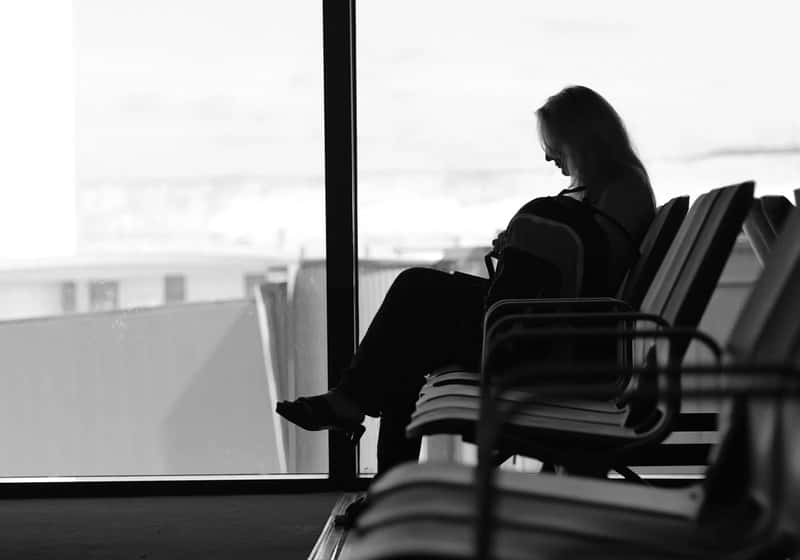
The lounge strips your labels like a customs officer at the gate.
No one here knows if you’re a good father. A mediocre employee. A person who still hasn’t called their mother back.
Escaping the constraints of your usual self-concept when you’re between roles or life phases allows you to experiment with aspects of your identity that might have remained dormant in more stable times. The airport lounge is the most socially engineered version of that escape hatch. Everyone there is temporarily nobody. And in that collective anonymity, you become someone worth listening to – even if only in your own head.
The psychology here isn’t complicated. It’s almost embarrassingly simple.
When the usual markers of who you are get suspended – your job title, your address, your relational obligations – your nervous system relaxes its grip on performing the self.
You stop being a character and start being a person.
The notebook opens. The ideas rush in. And you mistake the relief of shedding your identity for the arrival of genius.
It isn’t genius. It’s decompression. Beautiful, necessary decompression. But the two feel identical at gate C-14.
2. The Neuroscience of Nowhere
Your brain is not the same brain in the lounge.
Genuinely, physiologically, it is doing something different.
Liminal spaces change how the brain processes information. The anterior cingulate cortex – your brain’s conflict detector – becomes hyperactive in ambiguous situations. Meanwhile, your amygdala starts firing warning signals about potential threats lurking in the unknown. But here is the counterintuitive gift: that heightened state of alert, when combined with physical safety and soft lighting and a glass of something cold, transmutes into creative fuel.
The brain, unable to predict what comes next, starts making connections it normally wouldn’t.
When your usual assumptions are suspended, your brain makes novel connections you’d normally miss.
The lounge is not a muse. It is a neurological disruption dressed in leather seating.
The disruption is real. The creativity it unlocks is real. But the dependency it builds is also real – and that part never makes it into the in-flight magazine.
3. The Anxiety-Curiosity Switch
There are two ways to sit in the uncertainty of transit.
The first is panic. The second is poetry.
If you are not trained in how to hold anxiety, how to live with ambiguity, how to entrust and wait, you will run – anything to flee this terrible cloud of unknowing. Most people run toward their phones. Toward the news. Toward the complimentary cheese platter. But some people – the ones who keep showing up at lounges with notebooks and a specific kind of hunger – have learned, consciously or not, to flip what researchers call the anxiety-curiosity switch.
They feel the vertigo of being between destinations.
And instead of bracing, they lean.
The ambiguity becomes interesting. The open ticket becomes a metaphor. The stranger at the adjacent charging station becomes a character in something they haven’t written yet.
This is not discipline. This is a coping mechanism that happens to produce beautiful things. And like most coping mechanisms, it works so well that it starts to feel like the only thing that works.
4. The Non-Place Doctrine
Anthropologist Marc Augé had a term for spaces like airport lounges. He called them “non-places.”
These are physical spaces designed for passing through, not staying in. Lobbies, parking garages, hotel corridors, airport terminals, and stairwells all qualify. They sit on the boundary between one destination and another.
The non-place has no memory of you.
It keeps no record. It holds no grudge. It does not know that you failed last quarter or said the wrong thing at dinner. It simply hums its fluorescent hum and lets you be whoever showed up with a boarding pass.
Liminal spaces carry a lack of clear purpose or identity. As we have a habit of dealing with a familiar situation that serves a clear purpose, the liminal space stands out as a place with no clear purpose and specific set of rules.
In a world saturated with expectation, a room with no rules feels like oxygen.
You breathe it in. You write. You think. You feel, for a very specific ninety minutes, like the person you always meant to become.
Then they call your row and the spell cracks like a boarding pass pulled too quickly from a coat pocket.
5. The Confession at Gate B-7
I’ll tell you something that took me years to admit.
I once booked a flight I did not need to take.
Not because of the destination. Because of the lounge. Because I had a deadline I was terrified of and a desk that had started to feel like an accusation. I needed three hours of being nobody. Of sitting in the quiet hum of a space where no one knew my name or my outstanding invoices or the draft that had been open on my laptop for six weeks.
I got on the plane. I wrote eight pages. I landed, took a cab home, and the next morning stared at the cursor again.
When your sense of self is clear and consistent, the brain automates a lot of decisions and behaviors. But during identity transitions, that autopilot goes offline. You’re suddenly living in manual mode – consciously thinking through things that used to feel intuitive.
I hadn’t bought a plane ticket. I had bought a temporary autopilot. And it worked beautifully, right up until it didn’t.
6. The Exit Strategy
Here is what no one tells you about people who only create in lounges, in hotel rooms, in rental cars moving through unfamiliar cities.
They are not running toward the work.
They are running away from being known.
Liminal spaces are transitional zones, often physical or emotional, that can feel unsettling because they interrupt our usual sense of self, time, or place. These periods of ambiguity often bring up anxiety or identity confusion, but they can also open the door to creativity, insight, and healing.
The lounge is an exit strategy disguised as a creative ritual.
It says: you can only access the best of yourself when no one is watching. When accountability is checked at the door with the oversized luggage. When your real life is at a comfortable altitude below you.
That belief – quiet, persistent, rarely examined – is not a creative philosophy. It is a form of identity avoidance with excellent Wi-Fi.
And it will follow you home. Every time.
7. The Neutral Zone Addiction
Dr. William Bridges, who spent decades mapping the psychology of transition, had a specific name for the lounge-state of the soul.
Dr. William Bridges, who pioneered the concept of transitions in his work on change and identity, describes this in-between phase as the “neutral zone” – a space in which the brain is often flooded with uncertainty and ambiguity.
Most people find the neutral zone unbearable. They sprint through it toward the next fixed identity.
But some people – and these are the airport lounge devotees – find the neutral zone addictive.
Seductive in its suspension. Rich with unrealized potential. Safe in its impermanence.
Because here is the dark mathematics of the neutral zone: you cannot fail at something you haven’t committed to yet. The lounge writer is always almost-great. The idea is always forming. The draft is always beginning. Nothing has been submitted, reviewed, rejected, or judged.
The neutral zone feels like freedom. But it is also a very comfortable cage.
Living in the liminal space can be challenging. But one can learn to tolerate the anxiety and develop the faith that things will take shape. The addiction is not to airports. It is to the sensation of things perpetually about to take shape.
8. The Self-Concept Collapse
There is a clinical term for what happens to your sense of self during transit.
Psychologists call it self-concept clarity – and in-between spaces quietly erode it.
Research shows that people experiencing life transitions often report lower levels of self-concept clarity – a psychological term for how clearly and confidently you understand who you are.
In the lounge, that clarity dissolves intentionally. You choose to not be fully yourself. You choose the suspension. The anonymity. The lack of fixed role.
And while that dissolution is initially liberating, repeated visits start to hollow something out.
You begin to need the transit in order to feel whole. The lounge becomes the only place you trust yourself. Your desk becomes foreign terrain. Your living room becomes a stage where you perform the person who can’t write.
It is simultaneously a time of destruction and creation, disorientation and reorientation, unmaking and becoming. The identity questioning that feels so unsettling is also what allows genuine transformation.
The problem is not the questioning. The problem is when you stop ever wanting to answer.
9. The Performance of Movement
Here is a sociological observation that stings a little.
The airport lounge has been carefully, deliberately engineered to make you feel like a version of yourself you prefer.
Airport lounges seek to reduce the stress, both physical and psychological, of travel through design and amenities. By making decisions that enhance wellbeing, lounges facilitate more focused work alongside a relaxing experience.
You are being managed. Beautifully. Expertly.
This is reinforced through multisensory design – a layered experience evoked with signature scents, thoughtful lighting levels, music, and texture.
The creativity you feel in that space is partly yours. And partly theirs.
The lighting is calibrated. The sound is controlled. The temperature is set to a precise degree of productive comfort. You are not in a liminal space so much as a curated simulation of one – a theme park of the in-between, designed by architects who understand exactly how permission and anonymity make people spend more, feel better, and return reliably.
Your best ideas did not arrive because you were between lives.
They arrived because someone spent three million dollars making sure you felt that way.
10. The Arrival You Keep Postponing
The heaviest truth about the lounge-dependent creative is not that they are lazy.
It is that they are terrified of landing.
Transition is “the inner process through which people come to terms with a change, as they let go of the way things used to be and reorient themselves to the way things are now.” Change is the event on the outside, and transition is the process on the inside. The person who can only create in transit has confused the process for the destination. They have decided, somewhere below the level of conscious thought, that arrival is the enemy. That being known – being placed, being seen, being accountable to a fixed address – means the end of becoming.
And becoming is the only identity they fully trust.
Feeling in between their former identity and a future one, people must cope with emotional turmoil and make psychosocial adjustments before being able to progress to a new meaningful and synthesized identity. But what happens when the adjustment never comes? When the emotional turmoil is mistaken for a personality trait? When the in-between becomes not a passage but a permanent address?
You become a person who lives in airports without ever leaving the ground.
The notebook fills. The ideas multiply. The flight lands. And you go home and wait, with the quiet patience of someone who has done this many times, for the next departure.
There is nothing wrong with the lounge. There is nothing wrong with doing your best thinking while suspended between two cities, drinking something cold, accountable to no one. Some of the most honest thinking in the world happens in transit. The threshold has always been a sacred space – a laboratory for transformation, creativity, and growth.
But the question that deserves to be carried past the gate, through customs, and all the way home to the desk and the chair and the ordinary afternoon light – is this: what are you actually afraid will happen when you land? What becomes of your best self when the flight ends and the city reassembles around you and the people who know your name begin to reappear?
The lounge will always be there. Gate A, gate C, gate wherever. The marble and the soft light and the hum of collective departures. But so will you – with or without a boarding pass, in whatever ordinary room holds your ordinary life – capable, still, of being between things. Because the most generative liminal space you will ever inhabit is not an airport. It is the quiet moment, sitting still, choosing to become.