The bunk bed creaks at 2 AM.
Someone laughs in the kitchen down the hall.
A backpack zipper tears through the dark.
And you exhale.
Finally. You exhale.
There is a particular kind of traveler who doesn’t just prefer hostels. They need them. Not for the budget savings. Not for the free walking tours or the rooftop bars. They need the noise. They need the shuffle of strangers, the low hum of other people existing nearby, the soft evidence that the world is still populated and moving and loud. They need it the way some people need a nightlight. They just don’t know that’s what it is yet.
This is the Identity Gap. The distance between the story you tell – I’m spontaneous, I’m free, I travel light – and the truth underneath: you are managing something. Something old. Something that started long before you ever booked your first hostel bed. The nomadic identity is real. The wanderlust is real. But it is also, for many people, a very elegant coping mechanism wearing a very convincing disguise.
1. The Noise Was Never About the Noise
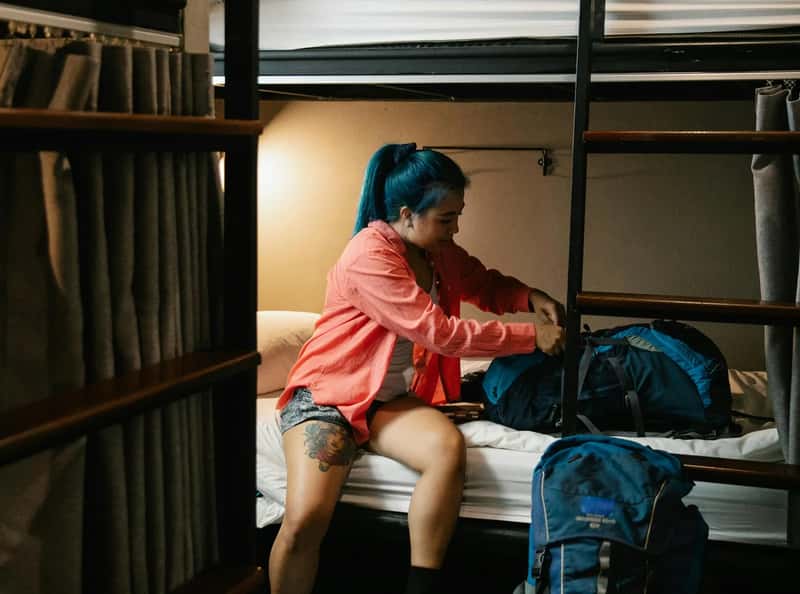
Here is the thing nobody tells you about growing up in a silent house: silence isn’t always peaceful.
Sometimes silence is a held breath. A waiting. A reading of the room for what might come next.
The dark clouds of past threats can cast a long shadow over a person’s present, perpetuating the belief that sheltering traumatic experiences in silence is the only way to ensure safety. For a child who grew up in a home where silence preceded tension, where quiet meant something was about to shift or snap, the nervous system begins to associate stillness with danger. It rewires itself. It learns that noise – other people, activity, movement – means the threat has not yet arrived.
This is not a character flaw. This is survival architecture.
The adult who books the loudest dorm room in Lisbon isn’t being reckless. They are, in the language of their nervous system, being incredibly careful. The hostel isn’t fun. It’s a fortress. And the sound is the wall.
2. The Amygdala Doesn’t Know It’s Bangkok
The brain doesn’t care that you have a passport now.
It doesn’t know you are twenty-nine and free and nobody can touch you here.
It only knows what it learned.
Your amygdala – the brain’s fear and stress center – is highly reactive to auditory stimuli, and chronic exposure to threatening silence can lead to its overactivation. When that overactivated amygdala is suddenly dropped into a quiet room, a quiet apartment, a quiet Sunday, it does what it was trained to do. It scans. It braces. It waits for what the quiet is about to deliver.
But put that same brain in a hostel common room in Southeast Asia, surrounded by the clattering noise of twenty strangers making instant noodles and arguing about bus schedules, and something remarkable happens.
It settles.
Not because it found peace. Because it found the particular texture of noise it learned to associate with not yet. Not now. Still okay.
3. The Childhood Silence That Had Weight
Not all childhoods are loud with violence. Some are loud with absence.
There are homes where nobody shouts and yet everyone is terrified. Homes where the quiet at the dinner table is a kind of pressure. Where you learned to read the silence the way a sailor reads weather – looking for the shift before the storm.
The effects of chronic trauma tend to be cumulative, because each event serves as a reminder of the prior trauma and reinforces its negative impact. A child exposed to a series of difficult environments may become increasingly convinced that the world is not a safe place. When that child grows up, they carry the weight of that conviction in their body. In their sleeping habits. In their inability to tolerate an empty apartment on a Tuesday evening without the television running, without music going, without something happening.
The hostel is just the premium version of that something.
It is that television turned all the way up. Played on every continent. Followed from city to city so the signal never drops.
4. The Identity That Only Exists in Motion
There is a version of you that is remarkably confident.
They order food in languages they don’t speak. They navigate foreign metros at midnight. They make friends in dorm rooms within forty minutes of arriving.
That person is real. Don’t diminish them.
But notice where they live. Notice that they tend to exist most vividly when everything is temporary. When there are no stakes. When nobody knows your last name or your history or what your childhood bedroom looked like.
The very act of travel can make emotional needs more obvious when people are away from their support networks. If you want to recognize the kind of loneliness you encounter, ask: is your loneliness caused by the travel itself, or does travel amplify something you’re already experiencing?
That is the question that changes everything. That is the question that, if you sit with it long enough in a quiet room – which you will avoid – will point you directly back to the silence you’ve been running from since you were seven years old.
5. What I Understood at 3 Am in a Hostel in Porto
I remember lying in the bottom bunk, listening to a German stranger snore above me, and feeling – genuinely, inexplicably – calm.
I had not slept well in my own apartment for months. I had described it as insomnia, as city stress, as too much coffee. I had not yet found the right word for it. The right word was quiet.
The quiet of my own apartment felt like a held question. Like waiting for something I couldn’t name. In that hostel in Porto, surrounded by the breathing of six strangers, I slept eight hours straight. I woke up confused by how rested I was. And then, somewhere in the fluorescent-lit hostel bathroom at 6 AM, I started to understand what I was actually doing every time I booked a dorm bed.
I was recreating safety through sound. I was outsourcing the work of feeling secure to the ambient noise of other human beings. I was, in the most literal psychological sense, using strangers as a nervous system regulation tool.
It worked. It just wasn’t sustainable. And it wasn’t mine.
6. The Attachment Map We Carry Through Customs
Attachment theory has a lot to say about this.
It says that what we learned about safety in our earliest relationships becomes the template we apply to every room we ever enter.
Disorganization results because of frightening, confusing, or traumatic behavior by attachment figures that promotes avoidance on the part of the child, which is in direct conflict with the evolutionary attachment system that encourages a person to approach their attachment figure when frightened and distressed. When the person who was supposed to be safe was also the source of danger – or when safety was simply absent – the internal map gets scrambled. You stop knowing what safe feels like from the inside. You start looking for external evidence of it. You start needing the room to tell you that you’re okay.
A busy hostel tells you that constantly. Without ever being asked.
The laughter from the kitchen. The sound of someone’s phone playing music. The hum of the common room. All of it saying, in the only language your nervous system fully trusts: occupied, populated, safe.
7. The Exit Strategy That Isn’t an Exit
Here is the dark irony at the center of this.
The traveler who books another ticket every time they start to feel the silence closing in believes they are escaping. They are not escaping. They are extending the lease on an avoidance strategy that has been running since childhood. Every departure is a deferral. Every new city is another room full of noise purchased on credit against the reckoning that is waiting, patiently, at home.
Insecure attachment styles developed due to early trauma can lead to poor emotional regulation, interpersonal challenges, and feelings of hopelessness. Avoidant individuals tend to suppress or avoid expressing their emotions, which can lead to accumulated emotional distress.
Accumulated distress doesn’t disappear in Bali. It comes with you. It checks into the same hostel. It sleeps in the bunk above you, which is why sometimes, even in the loudest dorm room in the loudest city in the world, there is a hollow feeling you cannot explain. A sense that the noise isn’t quite landing. That you are watching the party through glass.
That glass is the unprocessed silence from twenty years ago. And it is extremely well-traveled.
8. The Loneliness That Lives Inside the Crowd
There is a particular loneliness that only people who need noise understand.
It is not the loneliness of being alone. It is the loneliness of being surrounded by people and still feeling entirely unseeable. Of performing connection in a hostel kitchen while something deep and interior remains completely untouched by all of it.
Loneliness in a hostel doesn’t always come from being alone. It comes from feeling like you don’t belong – even when you’re surrounded by people.
This is the loneliness that childhood silence creates. It teaches you that even in a room full of people, you might be essentially invisible. That your inner world is not a place anyone can reach. And so you fill the outer world with as much noise and motion and temporary connection as possible, hoping that at some point, the volume of it will be enough to convince you that you exist. That you matter. That you are here.
It is never quite enough. Because the thing you are trying to convince is not listening to the noise. It is listening to something much older and much quieter than that.
9. The Nervous System Doesn’t Lie
Your body has been telling you the truth this whole time.
The way your chest tightens when you come home to an empty apartment. The way you immediately turn on a podcast, a TV show, a playlist – anything – before you’ve even taken off your coat. The way weekends with no plans feel vaguely threatening rather than restful. The way silence, real silence, feels less like peace and more like a question you don’t want to answer.
Perceptions of social isolation increase vigilance for threat and heighten feelings of vulnerability while also raising the desire to reconnect. This implicit hypervigilance for social threat alters psychological processes that influence physiological functioning and diminish sleep quality.
Your nervous system learned its threat response in a specific place, at a specific time, around specific silences. It has been applying that response ever since – in every apartment, every relationship, every quiet Tuesday – because that is what nervous systems do. They protect you using the best data they have. Even when the data is decades old. Even when the threat is gone. Even when the silence is now just a Tuesday.
10. The Thing on the Other Side of the Noise
This is the heaviest point. The one that requires you to sit still long enough to feel it.
On the other side of the noise – on the other side of the endless tickets and dorm beds and the beautifully curated identity of the person who is always somewhere interesting – there is something waiting for you that is not a threat.
It only feels like one. Because the last time you were truly quiet, truly still, truly without external scaffolding, you were a child. And for that child, silence carried genuine weight. Genuine danger. Or genuine grief. Or genuine loneliness that nobody named or witnessed.
For individuals who have experienced trauma, silence can be a double-edged sword. While it can be triggering, when carefully controlled and introduced, it can also be a vital component of healing. The noise you have been using to survive is not the enemy. It got you here. It kept you functional. It gave you stories and stamps and a version of yourself you genuinely love.
But it is also the thing standing between you and the silence that, if you could learn to sit inside it long enough, might finally stop feeling like danger. Might finally just feel like rest. The hostel was never the destination. It was the waiting room. And you have been sitting in it, beautifully and bravely, for a very long time.
The work – the quiet, unglamorous, non-Instagrammable work – is learning that an empty room is not the same as an empty self. That stillness is not the same as abandonment. That the silence your childhood taught you to fear was not a prophecy about who you are or what you deserve. It was just a room. One room. In one house. In one chapter of a story that has many more pages left.
You don’t have to keep running toward the noise to prove you’re alive. You were always alive. Even in the quiet. Especially in the quiet.
Put down the backpack. Stay somewhere long enough to hear what the silence is actually saying now.