The onions are burning.
Nobody cares.
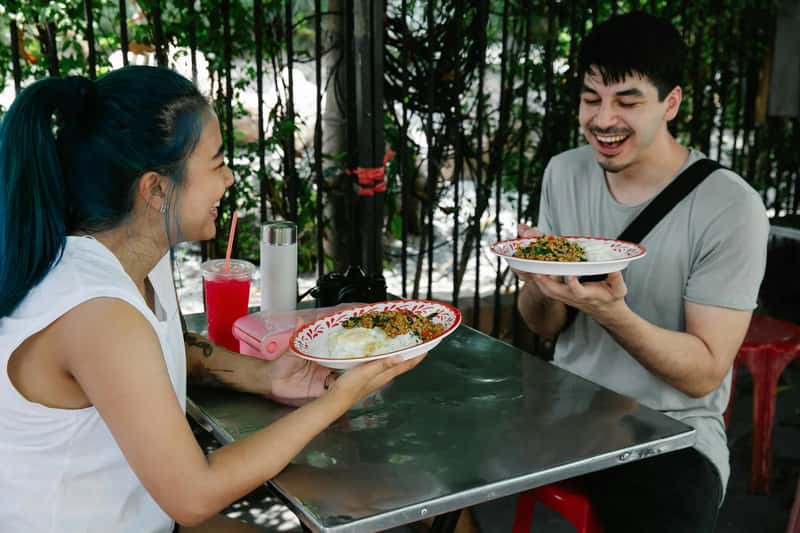
Someone from Oslo is laughing. Someone from Nairobi is asking if there’s enough rice. A backpack sits open on a plastic chair like a confession.
This is the hostel kitchen. Eight burners. Mismatched mugs. The smell of a dozen countries compressed into one room. And somehow – against all logic – it feels more like home than home ever did.
Here is the identity gap nobody talks about: the curated self you carry through airports, through fine dining rooms, through Instagram grids of carefully lit entrées – versus the self that actually exhales when someone passes you a wooden spoon and says, taste this. The performing self. And the real one. The distance between them is not inches. It is years.
1. The Table Nobody Set for You
There is a table in your childhood you can still feel.
Maybe it was always empty. Maybe it was full of the wrong kind of noise – tension dressed as dinner, silence dressed as family.
Attachment theory, typically applied to interpersonal relationships, can be extended to understand how shared meal routines in early life contribute to secure attachments and a sense of safety and predictability, shaping later social interactions.
Which means the inverse is also true.
When those early meal routines are absent, chaotic, or cold, the psyche takes note. It files the absence. It waits. And years later – in a hostel kitchen in Porto or Chiang Mai – it recognizes something it was owed.
The fancy restaurant never offered this. It offered performance. A dress code. A menu in a language you had to pretend to understand.
The hostel kitchen offers something older. Looking back through time, the shared meal wasn’t just a pleasant custom – it was often a matter of survival. Early human societies frequently hunted and gathered together, and the resulting food was distributed and consumed collectively. This wasn’t just about efficiency; it solidified group bonds, established trust, and reinforced social hierarchies and responsibilities.
You are not being nostalgic. You are being ancestrally accurate.
2. The Neurology of the Shared Burner
Your brain does something specific when you cook beside a stranger.
It doesn’t do the same thing when you sit across from one in white-tablecloth silence.
Research published in Adaptive Human Behavior and Physiology shows that social meals stimulate the brain’s endorphin system – the same pathways closely linked to oxytocin and dopamine, the neurochemicals responsible for bonding, trust, and pleasure.
The hostel kitchen accelerates this. You are not just eating together. You are making something together. That is a different neurological event entirely.
Sharing food can stimulate the release of oxytocin, reinforcing social bonds and fostering a sense of community and belonging. The body is not confused. It knows exactly what it is doing.
The fancy restaurant activates transaction. The server brings. You receive. The brain notes pleasure, yes – but not belonging.
The hostel kitchen activates participation. And participation is what the deprived self was always starving for.
3. Erikson’s Unfinished Room
There is a developmental sequence the psyche expects.
Erikson mapped it. It does not forgive you for skipping steps.
During the identity versus role confusion stage – from adolescence to early adulthood – people try to find a stable identity. They do this through friction. Through proximity to other people figuring themselves out at the same time.
Some of us didn’t get that friction. We got early responsibility instead. We got households that needed us adult before our social circuitry was ready.
You didn’t get the dormitory years. You didn’t get the late-night kitchen conversations with strangers who became friends before breakfast. You didn’t get the beautiful, unstructured chaos of belonging to a group of people you owed nothing to.
The hostel kitchen is not a step backward. It is a door the self left open. It has been waiting, patiently, in the exact shape you left it.
4. The Democracy of the Cheap Knife
The fancy restaurant is a hierarchy.
There is the sommelier. The maître d’. The person at the adjacent table who ordered better than you and you can feel it.
The hostel kitchen is a democracy.
Eating together also helps bridge cultural and social divides. Studies show that sharing food fosters equality and trust across class, race, and gender lines – a kind of social lubricant that softens boundaries and allows empathy to take root.
Nobody in a hostel kitchen cares what your job title is. Nobody is performing wealth or refinement. The currency is simple: do you have garlic? Can I borrow your pan?
For someone who grew up in a household where worth was conditional, where love arrived with performance requirements attached – this democracy is not trivial. It is revolutionary.
The resulting friendships that are formed around these tables are intense – experiencing a new country together for a short period of time encourages a kind of radical openness, a closeness that comes not from extended years of shared history but from the knowledge that these people will only be in your life for a short time, so you have little to lose by being fully and completely yourself.
5. The First Time I Let a Stranger Season My Food
I need to stop here for a moment.
I remember a kitchen in Lisbon. Tile floors. A window that wouldn’t quite close. A woman from Guadalajara who watched me boil pasta in unsalted water and looked genuinely concerned for my soul.
She took the pot. She added salt. She added more salt. She handed it back like a correction offered with kindness.
I stood there and realized I had never in my adult life allowed someone to simply fix something for me without bracing for the criticism underneath.
That is what the hostel kitchen does. It lowers your armor because the environment never asked you to put it up.
As NYU professor Fabio Parasecoli explains, “Food and sharing food are very important elements in building identities, both as individuals and as members of communities.” “When this sense of belonging is not there, it brings emotional consequences. That act of physically eating together is a crucial part of how we define ourselves.”
I have eaten in restaurants with starred chefs and forgotten every dish. I have never forgotten that pot of pasta in Lisbon.
6. The Science of Eating Alone – And What It Costs
Modern life has industrialized solitude at mealtimes.
We accepted this so gradually we stopped noticing the damage.
One in four Americans now eats every meal alone, a 53 percent increase since 2003. That is not a lifestyle choice. That is a public health condition dressed in casual clothes.
According to the 2025 World Happiness Report, meal sharing ranks among the strongest predictors of well-being, comparable to factors like income and employment.
And yet the luxury dining industry sells you the illusion of connection – two people across a candlelit table, each on their phones between courses, performing intimacy for the room.
Even meals at restaurants are relatively isolated – inviting a stranger to sit down at the table with you would generally be considered a faux pas. The architecture of exclusion is built right into the floor plan.
The hostel kitchen has no such architecture. Its entire design is accidental belonging.
7. Positive Regression – And Why It Is Not What You Think
Psychology has a name for what happens when you go back to simpler social environments under stress.
It sounds clinical. It isn’t an insult.
Positive regression is defined as a temporary retreat to earlier forms of behaviour while under stress that leads to disharmony, self-evaluation, reflection, reintegration, and enhanced self-awareness.
Read that list slowly. Reintegration. Enhanced self-awareness. This is not collapse. This is construction.
It sometimes occurs by re-experiencing regressive situations from earlier childhood stages of development in the more secure adult years. The 37-year-old in the bottom bunk is not regressing in the clinical sense. They are doing something braver.
The person who chooses the hostel kitchen over the tasting menu is not failing at adulthood. They are completing something adulthood interrupted. They are finishing a sentence the self started in a childhood that moved too fast.
8. The Weight of the Curated Meal
There is a particular exhaustion that comes from eating expensively.
It is not about the money. It is about the performance tax.
The fancy restaurant demands you know what you’re doing. Know what to order. Know how to hold the conversation. Know how to be the version of yourself that deserves to be there.
Existential authenticity arises from immersive engagement in local culture, enabling backpackers to perceive a truer sense of self while traveling – emphasizing the importance of subjective experiences and emotionally charged interactions among backpackers in hostels.
The hostel kitchen demands nothing except your presence. Your actual presence – not your resume, not your reputation, not your performance of a well-traveled, well-fed self.
The psychological significance of sharing food is further underscored by its role in emotional expression and attachment. When we share food with others, we are, in effect, sharing a part of ourselves, our culture, and our emotions.
The tasting menu asks you to appreciate it. The hostel kitchen asks you to belong to it. These are not the same invitation.
9. The Community That Was Supposed to Become Standard
Somewhere in the architecture of a normal childhood, community was supposed to be built in.
Neighborhood tables. Family dinners. The particular warmth of someone saving you a seat.
For many people – children of divorce, of poverty, of emotionally unavailable homes, of constant relocation – that infrastructure never materialized.
The act of sharing a meal promotes a sense of belonging and reduces feelings of loneliness. In an era where mental health issues are on the rise, fostering environments where people can come together over food is increasingly important.
The hostel traveler who gravitates toward the communal kitchen is not choosing budget over luxury. They are choosing repair over performance.
Communal eating offers a way to counteract the fragmentation of modern life, providing a deliberate space for connection in an increasingly individualized world. It becomes a proactive choice to build community, rather than relying solely on pre-existing structures.
The self knows what it missed. And it is methodically, quietly, plate by plate, making up the deficit.
10. The Kitchen That Does Not Ask for Your History
This is the heaviest truth of all, and it lives in the steam rising off a shared pot at 9 PM in a city whose name you will always mispronounce.
The fancy restaurant wants your credit card and your composure. The hostel kitchen wants nothing from you except your willingness to share the space.
It is the hunger to be known by strangers who chose you without history, without obligation, without résumé.
For those who grew up performing worth – performing competence, performing okayness in homes that needed them to be fine – this is not a small thing. It is everything.
At a time when the world seems so stressful and so uncertain, the hostel kitchen serves as a model of a different kind of sustenance. We’re not hungry for the most luxurious menus or over-the-top cocktails. What we’re craving is simultaneously free and invaluable. Communal dining with strangers could be a balm to so much of what ails us: isolation, loneliness, hunger – both literal and figurative.
To eat side by side is to recognise one another’s humanity; it’s an act that resists the forces of isolation, consumption, and division that so often shape modern life.
The person standing at the hostel stove has, perhaps without knowing it, found the most psychologically honest answer to the question their childhood kept asking: Is there room for me here? And the answer – for once, finally – comes back yes.
There is a version of healing that doesn’t look like healing. It looks like someone standing in a hostel kitchen in a city they’ve never been to, chopping vegetables for people they met three hours ago, laughing at something that doesn’t translate, feeling – against all reasonable expectation – completely at ease.
Not fixed. Not finished. But present, without armor, in a room full of strangers who became, for one meal, exactly the community that was always supposed to be there.
The onions are still burning. Nobody has moved to fix it. And somehow, that too feels like enough.