Everyone else has their phone out.
The light is perfect. The monument is right there.
And you are somewhere just outside the frame.
Not by accident. By design.
There is a specific kind of person who moves through the world’s most beautiful places without leaving a single trace of themselves behind. They take photos of the architecture. The food. The cobblestones. The light hitting a canal at that precise, unrepeatable angle. They capture everything. Everything except themselves. And they have a reason for it – always a very reasonable, very logical, very airtight reason. “I don’t like how I look in photos.” “I’m the photographer in the group.” “Selfies are narcissistic.” The reasons shift. The avoidance stays constant.
1. The Architecture of Avoidance
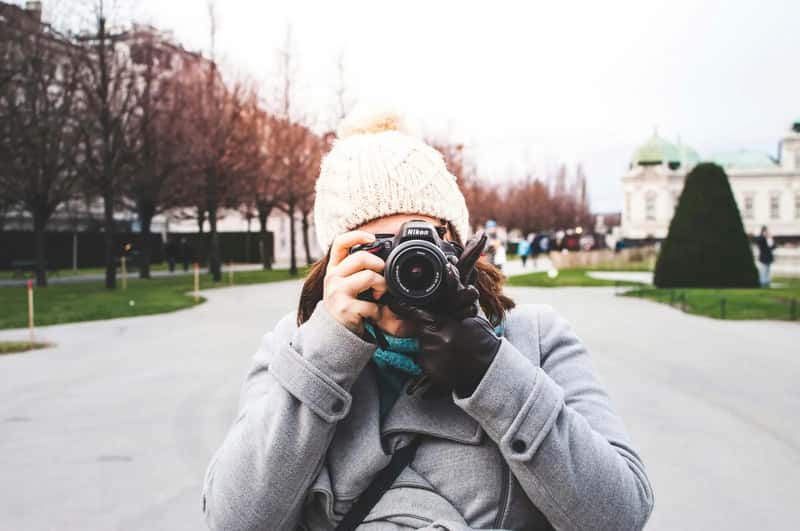
Children who are teased about their appearance in photos don’t just develop a preference for being off-camera. They develop a full architecture of avoidance.
That architecture is invisible to everyone else.
It looks like humility. It looks like being the designated photographer. It looks like a preference, a quirk, a personality trait.
But underneath it, there is a blueprint. Laid down early. Reinforced often. Many photo-averse individuals carry negative associations from previous photography experiences – school pictures where they felt humiliated, family photos that became sources of teasing, or professional images that misrepresented their intentions or character.
The camera didn’t start as a neutral object for these people.
The family portrait became an instrument of judgment. And somewhere in the nervous system, that lesson calcified. The camera equals danger. The camera equals exposure. The camera equals the moment where someone finds you lacking.
So you step back. You frame the shot. You make yourself invisible.
And you call it a preference.
2. The Permanence Problem
The photo isn’t the real fear.
The permanence is.
Photo aversion stems from fundamental psychological vulnerabilities that cameras uniquely trigger. Unlike casual social interactions where people maintain some control over how others perceive them, photography creates permanent records that can be scrutinized, shared, and judged indefinitely. This permanence activates deep-seated fears about judgment, control, and self-worth that many people struggle to manage consciously.
Think about what that actually means.
In conversation, you can clarify. You can shift. You can add context, laugh off a misstep, soften a misread. A photograph strips all of that away. The idea that a single frame can become the definitive edition of you. Filed, archived, forwarded. Stripped of context. Stripped of the laughter that came before and the wine that came after.
That is not a minor inconvenience for people carrying visibility trauma.
That is an existential threat dressed in JPEG clothing.
And the more beautiful the location, the more permanent the record feels. Standing in front of something iconic. Immovable. Historic. You are being asked to match its permanence with your own. And something deep inside says: I am not ready to be permanent yet.
3. The Famous Place Effect
Here’s what nobody tells you about iconic destinations.
They don’t soften the anxiety. They amplify it.
Famous places are, in a very specific way, the world’s most demanding stages. They come pre-loaded with a script. You’re supposed to look wonder-struck in front of the Louvre. You’re supposed to look radiant at Santorini. You’re supposed to look serene at Angkor Wat. The place itself has a visual identity so powerful, so globally reinforced, that it dictates what your face is supposed to do while standing in front of it. For someone who already finds authenticity in front of a camera unbearable, the added performance requirement of a famous backdrop is paralyzing.
This is the cruelty of it.
The places that are most worth documenting are the exact places that feel most impossible to appear in.
Because the beauty of the place becomes a kind of contrast. A spotlight. The Sistine Chapel ceiling above you. The Amalfi Coast behind you. And you – ordinary, flawed, carrying whatever you carry – standing in the middle of it all, being asked to belong there.
And that belonging feels like a lie your body refuses to tell.
4. The Control Surrender
Control is everything to someone who was once made to feel powerless by how they looked.
Being photographed requires surrendering control over one’s image and how others will perceive, interpret, and judge that representation. This control loss triggers primitive psychological defense mechanisms that evolved to protect individuals from social rejection and group exclusion – fears that once carried survival implications.
The body doesn’t know you’re in front of the Colosseum.
The body only knows: someone is looking. Someone is capturing. Someone is about to make a permanent record of me without my full consent.
Social expectations around photography create additional pressure layers. People feel obligated to look happy, attractive, and engaged regardless of their actual emotional state or comfort level. This disconnect between authentic feeling and expected performance creates internal tension that manifests as visible discomfort.
And so the person steps back. Offers to take the photo instead. Becomes the archivist of everyone else’s joy.
It looks generous.
It is self-protection wearing a generous face.
5. The Invisibility Sanctuary
I have stood at the edge of the Grand Canal in Venice – vaporetto wake lapping at the steps below me, the gold-hazed campanile pulling every tourist’s phone toward the sky – and felt nothing but relief that no one was pointing a camera at me. Not one photograph of myself from that entire trip. Not one. I told myself it was aesthetic. That I was collecting impressions, not images. That a photograph would somehow flatten the experience.
But the truth was simpler and darker than that.
I didn’t believe I deserved to be in the frame.
For the person carrying visibility trauma, travel does something different. It gives them permission to disappear more completely. No one here knows your name. No one here has a history with your face. You can move through Rome or Tokyo or Buenos Aires as a pure observer. Unseen. Unknown. Gloriously unrecorded. The trip becomes a sanctuary of invisibility.
Which feels like freedom. Until it doesn’t.
6. The Shame Blueprint
Shame is not an emotion you feel once and move past.
Shame is a lens. And once fitted, it reshapes everything you look through it at.
Shame is one of trauma’s central emotions, especially in interpersonal trauma. Shame often drives secrecy, withdrawal, self-criticism, and delayed help-seeking.
It also drives something more specific. Something that shows up precisely at the wrong moments. In the best light. In the most beautiful place. When someone says, “Let me take your photo.”
Early experiences of criticism, neglect, or social exclusion can shape how individuals perceive themselves in social situations. Children who are frequently judged or compared to others may grow into adults who fear being scrutinized.
That fear doesn’t announce itself as shame. It announces itself as preference. As taste. As the quiet certainty that you simply aren’t photogenic. That you always blink. That you never know what to do with your hands.
These are not quirks. They are shame in disguise. And they follow you from city to city, landmark to landmark, doing what shame always does.
Making you smaller than the frame.
7. The Self-Concept Wound
At the clinical core of all of this is something that psychologists call self-concept fragility.
When there’s a camera in front of us, with a person looking at us while they take our portrait, if we don’t have that self-value and inner confidence, we start to feel uncomfortable. We feel like we’re not worthy of all that attention and would prefer that nobody look at us instead. This is the clinical core of it. Self-concept fragility. The belief – often pre-verbal, often deposited in childhood by someone who should have known better – that your face, your body, your mere physical presence in the world is not something worth documenting. Not something worth keeping.
Let that settle for a moment.
Not worth keeping.
That is what’s happening when someone ducks behind the camera at every landmark. They are enacting a belief that was handed to them. A belief so old and so embedded that it doesn’t feel like a belief anymore. It feels like fact. It feels like physics. Like gravity. Like something simply true about the nature of reality.
Experiencing trauma, bullying, or rejection can reinforce the belief that being noticed leads to criticism or harm, making people more cautious about exposure.
Caution that calcifies. Over years. Over continents.
8. The Survival Signal
The nervous system is not sophisticated.
It does not know the difference between a camera lens and a threat.
Trauma tells people that safety lies not only in avoiding reminders, but in avoiding visibility. It teaches that the best way to protect yourself is to make yourself small enough that no one can find you. It teaches this lesson so thoroughly, so early, and so deeply that standing in front of a wonder of the world with a camera pointed at you can feel indistinguishable from danger.
This is not dramatic. This is neuroscience.
Photo aversion isn’t just psychological – it creates measurable physiological responses that directly interfere with natural expression and authentic appearance. Understanding these biological reactions helps recognize when subjects are experiencing genuine stress rather than simple reluctance or vanity.
The racing heart. The sudden blankness on the face. The impulse to laugh nervously or wave the camera away. These are not personality traits. These are survival signals misfiring in a safe situation.
The body is trying to protect you from a threat that ended years ago.
But the body has no calendar.
9. The Guilt Layer
There is something that compounds the avoidance. Something quieter and crueler than the fear itself.
Guilt.
One reason this phobia affects people so deeply is that on top of the anxiety it causes can often come a sense of guilt. A feeling that one is hurting family or friends by not participating in their happy memories.
You stood at the edge of the Grand Canyon and didn’t get in the photo.
Your family has a picture of the canyon. They have a picture of each other. They do not have a picture of you standing there, eyes wide, quietly undone by the scale of the thing.
And somewhere under the relief of having escaped the camera, there is a grief. A small, persistent grief about your own erasure. About the evidence that will not exist.
“It’s really our awareness of other people’s judgment that makes being perceived so uncomfortable,” explains psychotherapist Eloise Skinner. And that awareness doesn’t go quiet at the rim of beautiful things. It gets louder. Because the beautiful thing says: this moment matters. And the wound says: but you don’t.
Both things running at once. Neither one winning.
10. The Weight of Being Unrecorded
Here is the heaviest part of all of this.
You were there.
You were standing in the exact place that millions of people spend years saving money to reach. You felt the mist from the waterfall. You smelled the brine off the harbor. You sat in the slant of afternoon light that painters have spent centuries trying to capture. You were there, with your whole complicated, wounded, luminous self.
And there will be no record that you were.
The photograph was never really about the photograph. It was about whether you believed you deserved to be in the frame of your own life.
The fear of being seen stems from heightened self-consciousness and fear of judgment. It can appear as avoidance, hesitation, or physical discomfort in social situations. Childhood experiences, past trauma, personality traits, and societal pressure often contribute. When unaddressed, it can impact relationships, careers, self-esteem, and overall well-being.
And yet the healing is not a camera shoved into a reluctant hand. It is not a friend saying “just get in the photo.” Healing this fear doesn’t happen through logic alone. It happens by creating new experiences of safety while being seen – teaching the body that visibility can coexist with calm.
That is the work. Slow, patient, unglamorous work. The kind that doesn’t photograph well.
There is a version of you that exists only in the memories of the people who were standing beside you. Who remember the way you tilted your head back to look up at the dome. The way you went quiet at the water’s edge. The way you were, completely and entirely, there.
That version is real. It is not diminished by being unrecorded. But it is also not the whole story. Because the avoidance is a story too. And it is one worth reading slowly, in private, without judgment. Not to fix anything. Not to get in front of more cameras. But to understand what you have been protecting, for how long, and at what cost.
Somewhere between the monument and the moment, there is a version of you that is worth keeping – not for the algorithm, not for the archive, but because you were here, and being here was enough.