The trail doesn’t care who you are at the office.
It doesn’t know your job title. Your relationship status. The version of yourself you’ve been carefully curating for five years.
On a difficult hike, the only identity that survives is the one your body insists on.
There is a wide, poorly lit corridor between the self we perform and the self that exists when the performance falls away. Most of us live in that corridor. We’ve decorated it beautifully. We’ve filled it with routines, screens, personas, and quiet, relentless worry. We’ve learned to call it home.
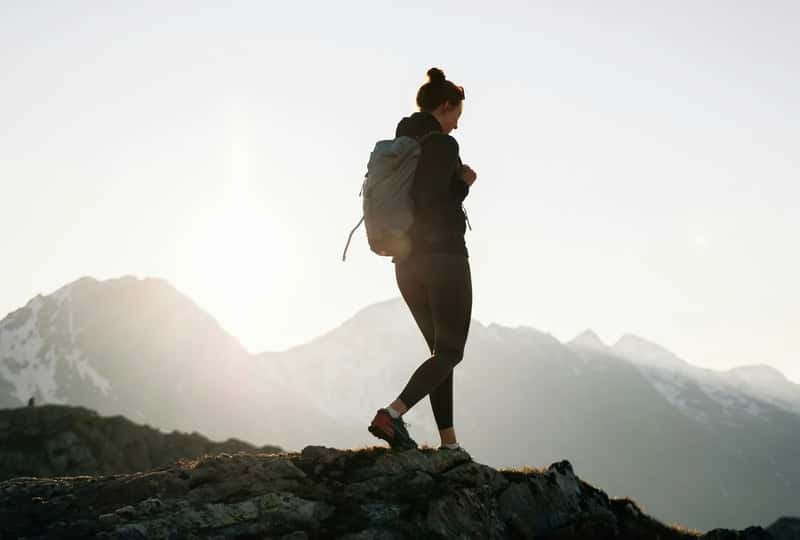
But step onto a steep, unforgiving trail – the kind that demands every calorie you have and borrows a few more – and the corridor disappears. The persona dissolves. What remains is something more honest: muscle, breath, heartbeat, fear, and the primitive knowledge that the next footfall matters more than your inbox ever will.
1. The Borrowed Body
Most of us are renters inside ourselves.
We inhabit our bodies the way we inhabit a furnished apartment – using the furniture, yes, but never quite feeling like it belongs to us. Anxiety accelerates this estrangement. When anxiety strikes, it’s not just a mental experience – it’s a full-body phenomenon. The body activates the sympathetic nervous system, triggering a cascade of physiological responses including increased heart rate, shallow breathing, and muscle tension. These physical manifestations feel foreign. Threatening. Like someone else’s emergency happening in your chest.
A difficult hike reverses this theft.
When the trail demands everything – when the grade hits forty percent and your lungs start bargaining – you can’t afford to be a tourist in your own body anymore. The lease expires. You move in. Embodiment practices are a great way to treat anxiety by helping clients get their minds out of the way. The mountain does this without a therapist’s couch. It does it with gravity and stone.
The difficult hike is, at its core, a forced eviction notice from your own head.
2. The Anxiety Negotiation
Anxiety speaks a very specific dialect.
It speaks in futures. In hypotheticals. In the space between what happened and what might. It is a language of abstraction – and abstraction, by definition, has no body. Anxiety frequently begins as a physiological event, not a psychological one. Your nervous system detects a cue of danger – real or perceived – and launches a cascade of physical responses before your conscious mind even registers what’s happening.
Physical challenge speaks back in the only currency that counts: the present tense.
The loose scree under your boot. The burn in your quadriceps. The cold wind arriving without warning at the ridge. These are not abstractions. They cannot be deferred, argued with, or reframed. When we’re experiencing anxiety, our body is telling us something important about our sense of safety. By working directly with the body, we can access pathways to regulation that thinking alone cannot reach.
The trail doesn’t negotiate. It legislates.
And in that absolute, sensory demand, the anxious mind finally – reluctantly, gratefully – goes quiet.
3. The Sympathetic Shutdown
Here is what the science says with unusual clarity.
Your body has two modes: fight-or-flight and rest-and-digest. Anxiety parks you in the first one permanently. It never turns the engine off. The body stays ready – tense, vigilant, metabolically expensive. The physiological response to anxiety or trauma can look like “labored breath, tightened muscles and activation of the sympathetic autonomic nervous system.”
A difficult hike does something counter-intuitive. By giving that arousal system an actual, legitimate physical task, it burns through the stockpiled threat energy. Animals in the wild routinely shake off stress after a threatening encounter – literally trembling to discharge the survival energy – and then return to normal. Humans, it appears, often don’t complete this discharge cycle. Instead, we suppress the body’s natural stress response, and that trapped activation contributes to chronic anxiety, tension, and trauma symptoms.
The hike completes the cycle the modern world keeps interrupting.
Your nervous system finally gets to do what it’s been trying to do for years. It’s not therapy. It’s permission.
4. The Cortisol Contract
Cortisol is the villain everyone loves to blame. But it’s more complicated than that.
Cortisol is not inherently dangerous. It’s a pressure system – useful when the pressure is real, destructive when it runs without interruption. Cortisol is the stress hormone that triggers our fight-or-flight response, and if we don’t reduce our levels, we end up living in a constantly heightened state. When you hike, your cortisol levels lower, and you enjoy better, more regenerative sleep.
Nature accelerates this process in ways that feel almost unfair.
Hiking through mountain environments can boost energy and confidence and help people escape their own minds. Hiking through forests lowers cortisol by activating the parasympathetic nervous system. This isn’t poetry. This is biochemistry with an altitude preference. Cortisol – the body’s primary stress hormone – decreases, quieting brain regions associated with worry and rumination. Feelings of emotional fatigue, mental fog, and irritability tend to subside.
The mountain doesn’t just tire you out.
It chemically renegotiates your entire relationship with dread.
5. The Identity Vanishing Point
I want to tell you something true.
I once stood on a switchback in near-darkness, three hours into a trail I had underestimated, legs shaking, headlamp fading, and felt – for the first time in months – completely and entirely fine. Not fine in the way I’d been telling people I was fine. Actually fine. Present. Solid. Unambiguous about who I was and what I needed, which was simply to put one foot forward and then the other.
Nothing from my ordinary life had followed me up there. Not the identity I was protecting. Not the anxiety that had been living in my chest like a quiet housefire.
Psychology has a name for this. Loss of self-consciousness results in freedom from self-monitoring, which enhances intuitive engagement to help us achieve our goals with aplomb. On the trail, the self that watches and judges and performs simply runs out of bandwidth. During a flow state, your sense of self-consciousness dissolves. You stop worrying about how you look or what others think. It’s just you and the activity, merging into one seamless experience. This loss of ego and self-criticism can feel incredibly liberating.
That night on the switchback, I wasn’t lost. I had simply, briefly, found the version of myself that didn’t require an audience.
6. The Flow Channel
There is a precise psychological territory between too easy and too hard.
Psychologist Mihaly Csikszentmihalyi spent his career mapping it. He called it the flow channel – and a difficult hike, by its very nature, forces you into it. The flow state arises when your perceived skills match the perceived challenges of the task. Too easy and you get bored; too difficult and you become anxious. The “flow channel” is that sweet spot of engagement.
A flat sidewalk doesn’t do this. A Netflix queue doesn’t do this. But a technical trail with genuine consequences? That’s the laboratory.
When individuals enter a state of flow during leisure physical activities, they temporarily forget the passage of time and become fully immersed in the experience of the present moment, thereby reducing anxiety and negative thinking. The trail essentially engineers the conditions that the anxious mind can never manufacture alone: a demand complex enough to require total attention, but survivable enough to feel like mastery.
The difficult hike is not an escape from your life. It is a forced upgrade of your attention system.
7. The Awe Interrupt
Anxiety is, among other things, a failure of perspective.
It collapses the world down to the size of your own skull. Everything becomes about you – your fears, your threats, your narrative. The mountain offers a brutal and beautiful correction. Functional MRI studies have demonstrated that brain regions associated with pleasure, emotional processing, and self-transcendence are activated during awe experiences in nature. The neurological impact includes reduced activity in default mode network regions, creating a temporary “quieting” of the ego. This shift in brain activity has been linked to increased cognitive flexibility and creative thinking.
Awe is not a mood. It is a neurological event.
Studies from UC Berkeley found that experiences of awe reduce inflammatory cytokines, quiet the default mode network – the brain’s anxiety loop – and shift our attention from self-focused worry to something larger. You look up from the switchback and there is a valley below you the size of a secret, and for one full breath, your anxiety cannot compete with the scale of what you’re seeing.
The mountain doesn’t care about your problems. Mercifully, ruthlessly, beautifully – it simply doesn’t care.
8. The Proprioceptive Truth
There is intelligence in your joints that your brain never consults.
Proprioception – your body’s ability to know where it is in space without looking – is ancient. Far older than language. Far older than anxiety as a cognitive construct. On a difficult trail, this system reactivates with authority. Every footfall on uneven terrain is a conversation between your body and the earth that bypasses thought entirely.
Affective and physiological neuroscience seeks to explain how the physical body is linked to neurological processing, and conscious movement practitioners have known this implicitly for years. Conscious movement impacts psychological functioning because engaging the body engages the right brain and offers an in-the-moment experience which activates memory, emotion, and sensory processes simultaneously.
The trail awakens a wisdom that rumination suppresses. These practices work by changing the conversation between your body and your brain. Instead of trying to think your way out of anxiety, they offer your nervous system direct evidence of safety – through touch, movement, sensory engagement, and physical release.
The body, it turns out, was always the more reliable narrator.
9. The Comfort Zone as Cage
We have been told that comfort is safety. We have believed it almost completely.
But psychologically, extended comfort without challenge produces the same cognitive landscape as anxiety: a narrowing of identity, a shrinking of what we believe ourselves capable of. The comfortable life and the anxious life begin to look remarkably similar from the inside – a loop of the familiar, a careful avoidance of anything that might reveal us. Hikers want to have the sense of accomplishment, want to know their own limits or even push the limit, go beyond their comfort zone, and all of these help them to enhance self-esteem.
A difficult hike is, in essence, a voluntary destabilization of the self.
An assumption underpinning adventure recreation research has been that “challenging situations often inherent in adventure experiences may help participants develop adaptive systems that will aid them during future uncertain and demanding events.” The comfort zone is not a resting place. It is, over time, a contraction. And the trail – merciless, honest, indifferent – is the expansion that anxiety pretends it doesn’t need.
10. The One Thing Anxiety Cannot Survive
Anxiety cannot survive total physical presence.
This is not a metaphor. It is a mechanical fact about the limits of attentional bandwidth. Fear, frustration, and panic don’t just happen in the mind – they affect our breathing, our decision-making, and our pace. Learning to regulate emotions during stressful moments is essential. But when the stressful moment is a boulder scramble at elevation with a forty-pound pack and fading light, there is no cognitive spare capacity left for the elaborate fiction of anticipated catastrophe.
The anxious mind is a future machine. The hiking body is a present-tense machine. They cannot occupy the same consciousness simultaneously.
Contact with nature has been shown to be linked to psychological wellbeing, and recreation in wild landscapes – including backpacking, hiking and camping – has been shown to reduce stress and anxiety. But it is not merely the nature. It is the difficulty. It is the demand. Conquering challenging trails and achieving hiking goals instills a sense of accomplishment. Overcoming physical and mental barriers on a hike can translate to enhanced confidence in other areas of life. The trail doesn’t shrink anxiety by being gentle. It shrinks it by being unignorable.
This is the deepest, most irreducible truth the trail teaches: the body, when finally forced to commit, is the only therapy that anxiety cannot talk its way out of.
There is something worth sitting with in all of this. Something that doesn’t resolve neatly, and shouldn’t. The fact that we must leave our lives to feel present in them – that the sensation of being fully embodied requires a mountain, a burn in the calves, a cold that bites through the jacket – says something quietly devastating about the lives we have constructed. We have built environments optimized for comfort and accidentally optimized for dissociation. We scroll. We cushion. We automate. And then we wonder why we feel like ghosts moving through our own afternoons.
The hike doesn’t fix this. When you come down, the ordinary world is still waiting at the trailhead, engine running, notifications loaded. The gap between your performed self and your actual self hasn’t been permanently closed. But for the hours you were on the ridge, it didn’t exist. And that memory – of being so present that the future was structurally impossible – that stays in the body longer than any resolution you’ve ever made indoors. The nervous system remembers being asked something real of it, and meeting the ask.
Maybe the trail isn’t a destination at all. Maybe it’s just the oldest evidence we have that we were always capable of being here – exactly here, exactly this – before we learned to be afraid of everything that hasn’t happened yet.