You booked the suite.
You didn’t tell anyone the price.
You sat at the marble restaurant table, alone, ordering the wine list item second from the top – not the most expensive, not the cheapest – and felt something you couldn’t name.
Not guilt. Not pride. Something older than both.
There is a version of you – eight, maybe nine years old – who watched a parent sigh when you pointed at something in a store window. Who learned, with the quiet efficiency of all children, that wanting things out loud was a form of selfishness. That desire, unchecked, made you a burden. That need was something to be ashamed of, managed, kept small and apologized for.
That child didn’t disappear. She just learned to wait.
And now, forty-odd years later, she is checking into a hotel room she has all to herself, running her hand across the white linen, and exhaling for the first time in what feels like a decade.
1. The Suitcase as Time Machine
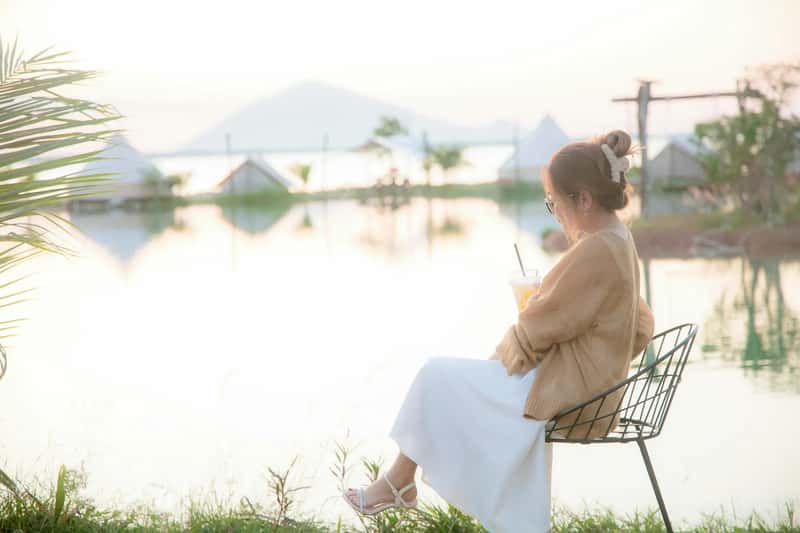
There is something almost surgical about packing a bag alone.
You choose everything. You omit everything else. Nobody’s preferences compete with yours. Nobody sighs at your skincare routine or questions whether you really need a fourth pair of shoes.
Your inner child is the part of you that holds the emotions, experiences, and beliefs you formed during childhood – carrying both your innocence and your sense of wonder, but also the pain of unmet needs.
The suitcase, it turns out, is a container for that child.
Every upgrade you book, every room you choose facing the water instead of the carpark, is a quiet dispatch to a younger version of yourself. A note slipped under a door that reads: You are allowed.
Psychologists call this reparenting. You may have been calling it a vacation.
Both things are true. They are not in conflict. The suitcase doesn’t care about the distinction. It just knows it’s finally full of exactly what you want.
2. The Guilt That Arrives With Room Service
You’ve noticed it.
The moment the trolley arrives. The white cloth. The small vase with a single flower you didn’t ask for. The little chocolate beside the water glass.
And then – before you can even lift the cloche – a feeling arrives like a cold draft under a door.
Who do you think you are?
When we experience emotional deprivation in childhood, this feeling of not being important or lovable enough can persist into adulthood as a “deprivation mindset” – we may never feel as if we have enough of the things we need.
The guilt isn’t about money. It never really was.
It’s the internalized voice of a household where desire was rationed. Where asking for the nicer thing was evidence of ingratitude. Where “we can’t afford that” slowly calcified into “you shouldn’t want that” – and then, most insidiously, into “you don’t deserve that.”
The room service trolley just knocked on the door of all of it.
Eat the food. It was always meant for you.
3. The Temporary Identity
One of the more disorienting gifts of solo luxury travel is this: nobody here knows who you are supposed to be.
No family role. No professional title. No relational obligation to perform yourself correctly.
By removing the need to negotiate, perform, or compromise, you reclaim your most valuable cognitive assets – and the world stops demanding things from you, allowing you to finally hear your own internal rhythm again.
The hotel room is a laboratory for identity.
You sleep diagonally. You eat breakfast at 11. You spend forty-five minutes in the bath reading a book you’ve carried for three years and never opened. You order the most interesting thing on the menu, not the safest.
This is not indulgence. This is data collection.
You are finding out, quietly, carefully, who you are when nobody is watching and nobody needs you to be smaller.
4. The Scarcity That Never Left
Here is what childhood scarcity does to the nervous system: it doesn’t end when the scarcity does.
The body, as well as the mind, remembers the scarcity.
You can have a full bank account and still feel the phantom weight of empty cupboards. You can afford the flight upgrade and still hear a parental voice asking whether you really need it.
The upbringing and family environment play a significant role in shaping one’s mindset – if individuals grew up in families where scarcity was prevalent, where resources were limited, or where financial struggles were common, they are more likely to adopt a scarcity mindset as adults.
This is the wound the luxury hotel room is quietly addressing.
Not with therapy. Not with language. With thread count and silence and a view you chose for no reason other than it was beautiful.
For some, scarcity manifests in “treat yourself” behaviors, where immediate gratification provides temporary relief from deprivation. But for the reparenting traveler, it is something far more structural. It is proof of concept. It is the nervous system learning, slowly, that safety and pleasure can coexist.
5. The Pivot Point (A Personal Dispatch)
I remember the first time I booked a hotel room that made me nervous.
Not because of the destination. Because of the price. I sat with the confirmation email for a long time. I didn’t forward it to anyone. I didn’t post it anywhere. I just sat with it, the way you sit with a secret, checking the corners of it for danger.
What I was actually doing – though I wouldn’t have said it this way then – was checking whether wanting something beautiful made me a bad person.
Core beliefs are the foundational ideas we form about ourselves, others, and the world – growing up in an environment where approval was only given for achievements could lead you to believe that you must constantly prove your worth to be loved.
I had been proving my worth for decades. Frugality as virtue. Practicality as morality. The smaller you made your needs, the less trouble you were. The less trouble you were, the safer you were.
The hotel room was the first crack in that architecture.
I checked in. I unpacked slowly. I opened the curtains.
Nobody took it away from me.
6. The Exit Strategy
Solo luxury travel is also, if we’re being honest, an exit strategy.
Not from life. From the accumulated weight of being known.
A 2015 report by the International Journal of Tourism Research found that internal feelings of freedom, escape, and bravery were the strongest motivators for solo travelers, particularly female travelers.
When you are someone’s parent, partner, colleague, child – you are performing a version of yourself so consistently that you forget it’s a performance. The role becomes the person. The function eats the self.
The airport lounge at 6 AM is one of the few places on earth where you are simply a body in transit.
No history. No obligations. No one who needs anything from you until the flight boards.
That anonymity isn’t emptiness. It’s oxygen. And the child inside you – the one who was told that having needs was inconvenient – breathes it in like she’s been underground for years.
7. The Luxury of Being Witnessed by Yourself
There is a specific thing that happens when you take yourself somewhere beautiful alone.
You become, simultaneously, both the person experiencing the beauty and the person who chose to give it.
When you plan trips that promise joy and fulfillment, you are engaging in an act of self-love and affirmation – directly countering the abandonment wounds of not being seen or heard, since it places your desires at the forefront.
This is the architecture of reparenting in its most elegant form.
You are the parent. You are also the child. You are sitting across from yourself at the restaurant, ordering what you actually want, and asking no one’s permission.
To reparent your inner child means to become the parent your inner self needs and wants.
The solo traveler eating dinner alone at a good table, wine in hand, watching the street below – she is not lonely. She is, possibly for the first time, fully accompanied.
8. The Permission Slip Nobody Gave You
The reason the solo luxury trip feels transgressive is that it was supposed to be.
Wanting nice things was the original sin of your particular childhood mythology. It meant you didn’t understand sacrifice. It meant you were ungrateful. It meant you didn’t see how hard everything was.
Growing up in an environment lacking emotional support can result in individuals feeling unworthy of love and connection – childhood emotional neglect is a form of scarcity trauma that can lead to low self-esteem, difficulty in forming healthy relationships, and a tendency to seek validation in unhealthy ways.
So you stopped wanting out loud. You became very good at wanting quietly, privately, apologetically – or not at all.
And now here you are. In the suite. With the view.
An example of reparenting is when an adult who may have lacked emotional support as a child begins to give themselves the validation and comfort they need – practicing positive self-talk, nurturing themselves through self-care activities, or setting boundaries that protect their emotional wellbeing.
The trip is the permission slip. You wrote it yourself. It counts.
9. The Nervous System Knows
You may have noticed that the first day of a solo trip feels strange in your body.
Restless. Itchy. Difficult to settle.
This is not boredom. This is your nervous system processing the unprecedented information that you are safe, unchosen for, and allowed to simply be.
Most people grow up carrying wounds that keep them stuck in old cycles – reparenting shows you how to finally break free by recognizing how childhood experiences shaped your beliefs and behaviors, and understanding how your nervous system’s survival responses still impact your adult life.
The body took on the anxiety of the household it was raised in. It learned to be vigilant. It learned that relaxation preceded punishment, that comfort was borrowed and not owned.
Give it forty-eight hours.
By the second evening, something shifts. The shoulders drop. The jaw unclenches. The book stays open past the point where you would normally force yourself to do something productive.
That is not laziness. That is the sound of a wound closing.
10. The Weight of Coming Home
Nobody talks about this part.
The re-entry. The moment the taxi pulls up to your house and the trip, which has been a kind of sanctuary, is over.
The internal climate shifts before you even open the front door.
If you experienced neglect, trauma, or other emotional pain, your inner child might feel small, vulnerable, and in need of protection – you may have buried this pain deep to hide it and protect yourself, but hiding pain doesn’t heal it. It often surfaces in adult life as distress in personal relationships or difficulty meeting your own needs.
What you are grieving on the doorstep isn’t the hotel room.
You are grieving the version of yourself who existed there. The one who ordered what she wanted. Who slept until she was finished sleeping. Who had no history, no role, no accumulated expectation to perform.
The trip changed the coordinates of what you know to be possible for yourself. And the returning self – the one with the grocery list and the unanswered emails and the needs of everyone else stacked in the hallway – has to decide what to do with that knowledge.
This is the heaviest moment in the entire reparenting arc. Not the first night in a beautiful room. Not the guilt over room service. But the Tuesday morning after. The ordinary life that must now be lived by someone who has tasted what it feels like to be prioritized.
The process of individuation involves integrating all aspects of your psyche – including those wounded, childish parts – and the idea is that by integrating the parts of yourself that were shut off and hidden, you begin to put the puzzle pieces together to form a more whole picture of who you are.
The trip is not the destination. The trip is the evidence that you are allowed to want a life that feels like that trip. Not the marble and the white linen – though those are fine – but the quiet, the self-direction, the absence of apology.
The child who was told she was “too much” did not go away. She became a person who books flights. Who reads menus carefully. Who chooses the room with the view, even when it costs a little more.
She is still learning that she was never too much.
She was just in the wrong rooms.