England’s southern coast compresses geology, seaside culture, and contemporary travel habits into a narrow ribbon of cliffs and coves. In Dorset, two locations stand out for their instantly recognizable sea rocks and for the very modern challenge of popularity: Swanage and West Lulworth. Both sit along the Jurassic Coast, a UNESCO-listed stretch where rock layers read like an open book of deep time. Both are beautiful, photogenic. Careful though: especially West Lulworth can get—especially in summer—extremely busy.
Geographically, we’re on England’s southwest edge, roughly halfway between Southampton and Exeter. Swanage sits on the Isle of Purbeck, facing east toward the English Channel, while West Lulworth lies about 17 miles west, tucked into a small valley that opens directly onto the sea. By car, the drive between the two takes around 40 to 50 minutes on local roads, depending on traffic, which can slow dramatically in summer. You can definitely see both in one day-trip, even though, despite the short distance, they feel distinct: Swanage reads as a working seaside town with rail links and a pier, while West Lulworth functions as a compact gateway to some of the coast’s most famous rock formations.
Swanage and the Drama of Old Harry Rocks
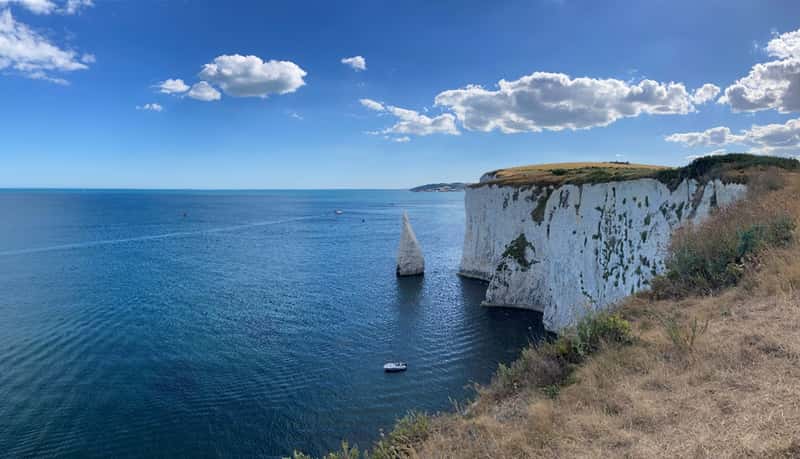
Swanage feels like a traditional English seaside town that happens to sit beside some of the most theatrical chalk formations in the country. The star attraction lies just north of town: Old Harry Rocks, towering white stacks rising from the sea at the end of the Ballard Down headland. They mark the eastern edge of the Jurassic Coast and visually echo the chalk cliffs of the Isle of Wight across the water.
The walk to Old Harry Rocks from Swanage Pier covers roughly 2.5 miles round trip. Adults and kids can walk the distance no problem. The path is flat and follows open grassland cliffs with uninterrupted sea views, and on clear days the light sharpens every edge of the chalk. The design appeal here is geological: clean lines, negative space, and a restrained palette of white stone, green turf, and blue water. It’s also fully exposed, so wind can be strong even on sunny days.
There is more to the trip than the amazing rocks: Swanage itself is a nice stop to recharge. The pier hosts swimmers year-round, while the town offers cafés, fish-and-chips counters, and small hotels that still feel rooted in local life. Practical note: parking in Swanage fills quickly. Public lots near the seafront often reach capacity by late morning in summer, and street parking is limited. Arriving before 9 a.m. or after 5 p.m. dramatically changes the experience, for the better.
West Lulworth and the Geometry of Durdle Door
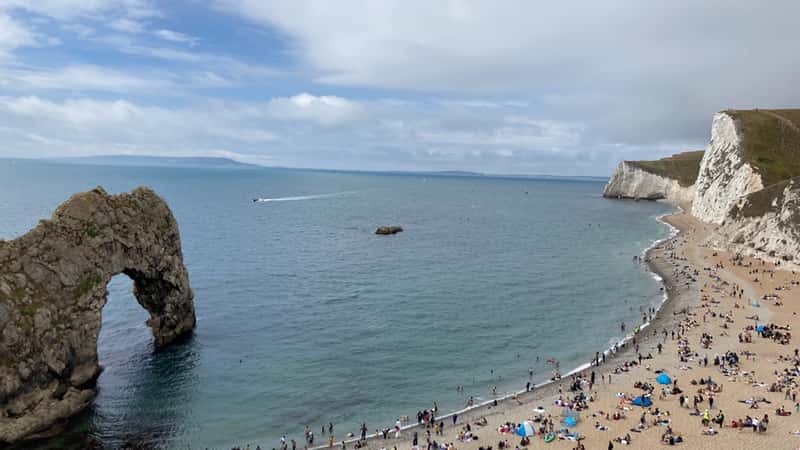
If Swanage unfolds gradually, Durdle Door announces itself instantly. The limestone arch near West Lulworth is one of the most photographed natural landmarks in the UK, and its fame shows. The path from the main parking area to the viewpoint is short—about 0.6 miles—but steep, descending sharply toward the beach. Still perfectly feasible with kids.
The appeal lies in pure form. The arch frames the sea like a piece of monumental land art, its curve softened by erosion and time. From above, the contrast between the pale stone and dark water feels almost graphic. From beach level, scale takes over. Waves funnel through the opening, and swimmers float beneath a structure that looks engineered but isn’t.
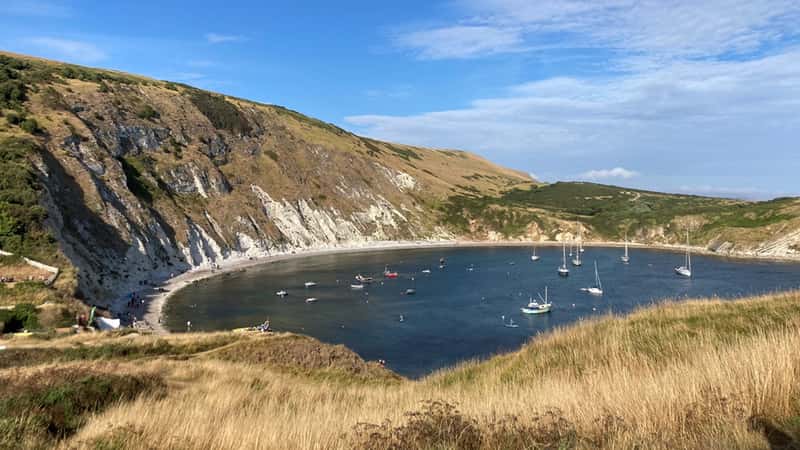
Just east of Durdle Door sits Lulworth Cove, a near-perfect circular bay shaped by erosion through different rock layers. The cove functions as a natural amphitheater, ringed by cliffs and always busy on warm days. West Lulworth village, a short walk inland, supports the traffic with pubs, bakeries, and small shops.
This area gets extremely crowded. On summer weekends, parking lots often close by mid-morning, and footpaths can feel like slow-moving lines. Temperatures in the 70s °F amplify beach traffic, and there is limited shade. Comfortable shoes, water, and patience make a difference.
Practical Tips for Visiting Both
Timing matters more here than almost anywhere else along the coast. Early mornings and evenings offer the best light and the smallest crowds. Sunset at Durdle Door is visually stunning but logistically tricky if parking is restricted, so check local updates before committing.
Distances are deceiving. These sites are close on a map but slow to navigate during peak season. Driving from Public buses run, but schedules thin out in the evening.
A Shared Lesson in Popular Beauty
Swanage and West Lulworth show how iconic landscapes operate in the real world. They reward planning, flexibility, and a willingness to step slightly off the obvious schedule. Their sea rocks have lasted millions of years; the challenge for visitors lies in navigating the modern patterns layered on top of that deep history. Seen with awareness, both places still deliver something rare: a direct encounter between human scale and geological time. And this is what I love about roaming these lands.