
What is it actually like to ride Saigon’s first-ever metro line? After years of construction delays and public anticipation, Metro Line 1 (Bến Thành – Suối Tiên) is finally operating, and I wanted to see for myself whether it lives up to the expectation.
I took the train from Opera House Station in District 1 to Thu Duc, tested the ticket machines, explored the station layout, and paid attention to the details most travellers care about – ticket prices, payment methods, cleanliness, speed, and convenience. Here’s exactly how my first ride on Saigon Metro Line 1 went.
A Metro That Took More Than 12 Years to Arrive
For a long time, the metro felt more like a rumour than reality in Ho Chi Minh City.
Construction stretched on for years, with roads being dug up and deadlines shifting. Most people simply carried on using motorbikes and buses, but thankfully, Metro Line 1 – officially the Ben Thanh – Suoi Tien Metro Line – is now operational, connecting central District 1 with Thu Duc and beyond.
This is the city’s first metro system, which alone makes it significant. But significance aside, I wanted to know something more practical: is it actually useful?
Starting at Opera House Station

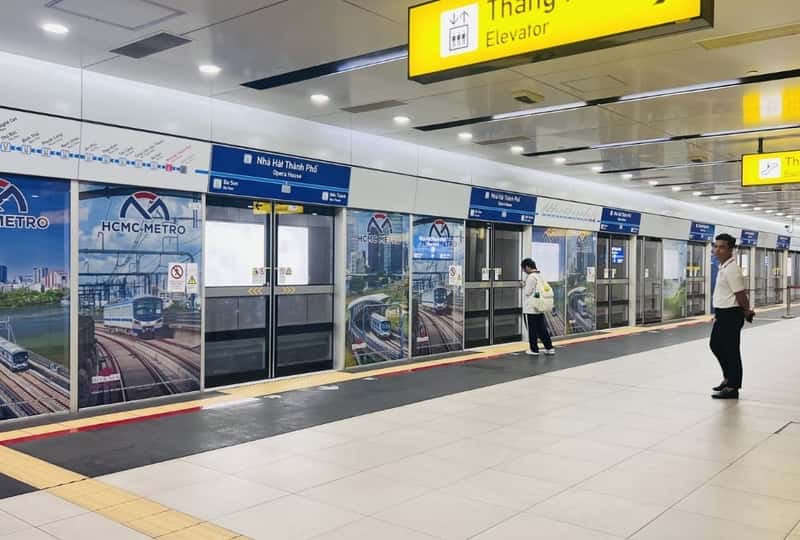
I began my journey at Saigon Opera House Station, right in the heart of District 1.
The entrance feels modern and minimal. Escalators take you underground, and the layout is surprisingly intuitive. Clear signage, digital boards showing arrival times, and wide corridors give it a much more structured feel than most public transport in the city.
It was noticeably clean, and there wasn’t any noise, chaos, or confusion. Staff stood nearby, calmly directing people where needed. If you have questions, ask them – they speak basic English and are genuinely helpful.
Ticket Prices and How It Works

Before boarding, I wanted to understand the ticket system properly.
Ticket prices on Metro Line 1 depend on distance:
- Single ticket (cash): 7,000 – 20,000 VND
- Single ticket (cashless): 6,000 – 19,000 VND
- 1-day pass: 40,000 VND
- 3-day pass: 90,000 VND
- Monthly pass (regular): 300,000 VND
- Monthly pass (students): 150,000 VND
For my ride from Opera House to Thu Duc, I simply bought a single ticket.
You have multiple ways to pay:
- Bank card
- Bank transfer
- MOMO
- Cash
- Ticket booth
The machines are straightforward to use and accept digital payments, which reflects how comfortable Vietnam has become with mobile banking.
If you choose to buy from the ticket booth, there’s one detail to know: you’ll need to pay a 15,000 VND deposit for the physical ticket card. When you arrive at your destination and return the card, the deposit is refunded. It’s a simple system, but useful to know in advance.
A Small Detail: Buying a Drink Inside the Station

One thing I didn’t expect was the vending machines. Inside the station, there are drink machines that accept bank transfers, MOMO, or cash. It sounds like a minor detail, but it speaks to the infrastructure – clean, modern, and designed with convenience in mind.
I bought a drink before boarding, with the process taking less than a minute. It felt different from typical street-side transactions. Controlled, organised, and surprisingly efficient.
Boarding the Train
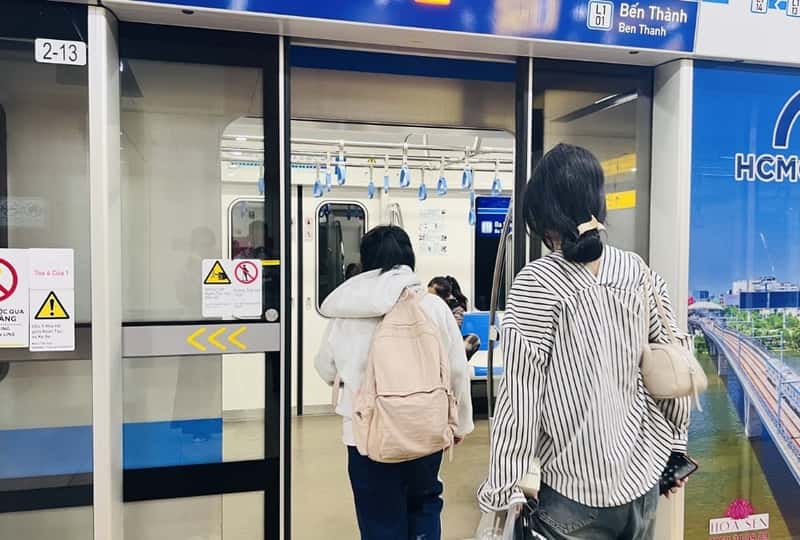
When the train arrived, the doors opened wide, and people entered calmly.
Inside, the carriage was:
- Clean
- Air-conditioned
- Quiet
- Brightly lit
The seating layout is practical, with space for standing passengers as well. Announcements are clear, and digital route maps above the doors show upcoming stations.
Compared to sitting in traffic on a motorbike, the difference is immediate. The train accelerates smoothly with no jolting or abrupt braking, and within minutes, the city noise fades. It’s fast, not dramatically high-speed, but consistent. And consistency is what Saigon traffic almost never offers.
Arriving at Thu Duc Station

When I arrived in Thu Duc, the station layout was just as clean and straightforward.
Here’s an important tip:
Use the walking bridge to cross the road.
It’s tempting to go downstairs and try to cross at street level, but traffic outside can still be busy. The pedestrian bridge is safer and far more convenient.
From the station exit, booking a Grab or BE is easy. There are clear pick-up areas, and drivers seem already familiar with the metro stops. Within minutes, I could continue my journey without stress.
What Is Around the Metro Stations?
Another pleasant surprise: every metro station seems to have life around it. The Vietnamese never miss a chance to do business, so most metro stations are surrounded by coffee shops, street food and small local restaurants, making it easy to grab a quick bite if need be.
Thu Duc especially has plenty of casual places to sit, eat, or grab a drink. You won’t struggle to find somewhere nearby after exiting the station. The metro doesn’t feel isolated. It connects naturally to the neighbourhood.
How Fast Is It Really?
From Opera House to Thu Duc, the ride felt efficient and predictable.
Compared to peak-hour motorbike travel, which can vary unpredictably with congestion, the metro offers a stable travel time. There’s no weaving through traffic, exhaust fumes, or constant braking, which is a life-changing experience if you frequently need to travel long distances through Saigon’s traffic.
The Atmosphere Onboard
One thing I noticed was how quiet it is. People weren’t talking loudly, phones weren’t blasting music, and the carriage felt calm. It doesn’t feel overcrowded, perhaps because it’s still new, but that may change as more residents incorporate it into their daily routines.
For now, it feels efficient and slightly experimental. As if the city is still testing how it fits into everyday life.
Is Saigon Metro Line 1 Worth Using?
Yes – especially if your route matches the line.
The metro is affordable, clean, and reliable. The air-conditioning alone makes a difference in a city where heat and traffic can quickly wear you down. Payment is flexible, whether you prefer using a bank card, mobile transfer, MOMO, or cash. The stations are organised, and the staff are approachable and helpful if you’re unsure about anything. It feels structured in a way that much of Saigon’s transport historically hasn’t.
That said, it’s still just one line. It doesn’t reach every district, and for most journeys you’ll still need a Grab or motorbike to complete the final stretch. It’s not yet a full replacement for how the city traditionally moves.
But it works. And more importantly, it works consistently. For now, that alone makes it worth using.
Final Thoughts
After more than a decade of waiting, Saigon finally has its metro – and it functions well. My ride from Opera House to Thu Duc was smooth, affordable, and far more comfortable than sitting in traffic.
It won’t replace motorbikes overnight, and it doesn’t yet cover the entire city, but it marks a shift in how Ho Chi Minh City moves. Clean stations, flexible payment options, helpful staff, and easy connections make it genuinely practical. For residents and visitors alike, Metro Line 1 isn’t just symbolic progress – it’s usable progress.