Anyone who spends a lot of nights in hotel rooms eventually builds a private list of small fixes that make sleep easier. None of these tricks require a hotel upgrade or a fancy gadget budget. They’re the kind of low cost adjustments flight attendants, road warriors, and other frequent travelers swap on TikTok and in airport lounges, usually because they’ve tested them on hundreds of stays.
What’s interesting is how consistent the advice is across sources, whether it comes from a crew member with a decade of overnight stays or a travel blogger who’s booked hundreds of hotel nights. The following seven hacks show up again and again because they solve the same handful of problems: light leaking around curtains, unfamiliar noise, unpredictable room temperature, and the nagging worry that someone might walk in while you’re sleeping or away.
1. Clip the curtains shut with a hanger

Hotel blackout curtains often leave a gap right down the middle, and that sliver of light from a parking lot or streetlamp is enough to disrupt sleep for a lot of people. A flight attendant’s advice shared on TikTok was to clip the curtains closed to avoid being woken up earlier than intended.[1] The fix doesn’t require packing anything special either.
Simply grabbing a hanger or two from the closet and using the clips to bring the curtains together was a tip offered by multiple flight attendants.[2] If a hotel closet doesn’t have clip hangers, a regular hanger can still pinch fabric together in a pinch. Some frequent travelers go a step further and pack their own lightweight plastic clips, which can block out light and double as tools for organizing cables or sealing bags[1].
2. Pack a sleep mask as a backup plan

Even with curtains clipped shut, some rooms just aren’t dark enough, especially in cities with a lot of ambient light or hotels with older window coverings. That’s why a sleep mask remains one of the cheapest, most reliable tools in a frequent flyer’s bag. Hotel blackout curtains are great when they work, but they often leave a gap, and a sleep mask solves that instantly, since it’s compact, cheap, and works anywhere.[3]
The mask also earns its keep beyond the hotel room. It also helps significantly when crossing time zones and trying to reset the body clock.[3] A small packing tip worth repeating: pack a sleep mask in the carry-on rather than checked luggage, since it’s useful on the plane too.[3]
3. Turn the room’s own fan into a white noise machine

Unfamiliar noise, whether it’s hallway chatter, a rattling elevator, or a neighboring room’s television, is one of the most common reasons people struggle to sleep away from home. Long before white noise apps existed, travelers figured out that the hotel room itself often has a built in solution. The in-room HVAC unit, whether set on the fan function or air conditioning, can be a great tool to block out unwanted noise, as can the bathroom ventilation fan.[4]
For those who want more control, a phone app is the free upgrade. White noise provides the broadest coverage across frequencies and is often the most useful starting point in a hotel setting.[5] Some travelers prefer a gentler option, since pink noise sits between white and brown, and for a night or two in a hotel with moderate noise it often provides good coverage while feeling more comfortable for overnight use.[5]
4. Ask for a room away from elevators, ice machines, and the lobby

This one costs nothing and takes about thirty seconds at check-in, yet it’s easy to forget when you’re tired and just want your key. Aiming for a quieter spot away from elevators and ice machines is a common recommendation, and higher floors can reduce outside noise as well.[6] Rooms near the lobby, restaurant, or reception area tend to carry the most late night foot traffic and noise bleed.
Frequent business travelers have refined this into a habit rather than an afterthought. The advice is to avoid sleeping near noisy common spaces, ask for a room at the end of the hall far from the elevator, stairs, and ice or soda machines, since higher floor rooms are generally quieter too.[7] It’s a request front desk staff hear often enough that most will accommodate it if a room is available.
5. Dial in the temperature before you unpack

Hotel rooms are often set to a temperature the previous guest liked, which may not match what helps you sleep. Cooler rooms tend to support deeper sleep for most people, and this is one of the more consistent findings in sleep research over the years. A slightly cool room promotes deeper sleep, and if the room has air conditioning or a thermostat, aiming for around 18 to 20 degrees Celsius, or roughly 64 to 68 degrees Fahrenheit, is a reasonable target.[3]
Rather than fighting the thermostat all night, it helps to plan ahead. If you tend to run warm, requesting an extra blanket lets you adjust during the night rather than waking up overheated.[3] Most properties keep spare blankets and pillows on hand specifically for this kind of request, so there’s rarely a reason to just tough it out.
6. Use the Do Not Disturb sign as a security check, not just a courtesy
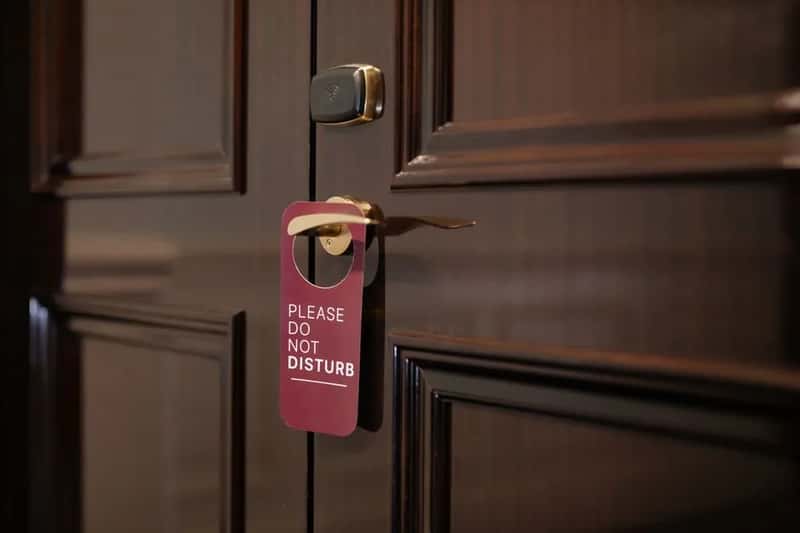
Beyond avoiding an unwanted housekeeping knock, some frequent travelers have turned the Do Not Disturb sign into a low tech security tool. One flight attendant positions the sign between the door and the door frame when leaving the room, so if it’s moved, there’s a strong likelihood someone has entered the room while she was gone.[2] It’s a simple tripwire that takes seconds to set up.
The sign still serves its original purpose too, which matters more than people expect on a trip with an early wake up call. Forgetting to hang it when planning to sleep past 8am almost guarantees being woken by a knock at the door and a voice calling out for housekeeping.[4] Combining both uses, comfort and a rough security check, makes the sign worth the two seconds it takes to hang.
7. Bring your own pillowcase and set more than one alarm

Comfort and reliability round out the list, and both of these habits come from people who’ve had enough bad nights to know better. One flight attendant who shares travel tips says she always packs at least one pillowcase from home.[1] Beyond the comfort factor, there’s a practical reason too, since sleeping on a pillowcase from home can also help avoid contact with bacteria and allergens that may be lurking in unfamiliar sheets.[1]
The other half of this habit is about not leaving your wake up time to chance. Setting backup alarms matters because stressing over whether an alarm will go off or a wake up call will come through is no way to fall and stay blissfully asleep.[4] A phone alarm plus the hotel’s wake up call service, set a few minutes apart, covers most failure points without any extra cost.