You are standing in an airport bookstore at 6:47 AM.
The overhead lights are the color of old fluorescent guilt.
You are holding a 400-page hardcover about geopolitics or behavioral economics or the neuroscience of sleep.
You will not read it.
You already know this. And you buy it anyway.
There is a gap between the person who boards the plane and the person who lands. Not a geographical gap. An identity gap – the hollow space between who you genuinely are in the quiet of a Tuesday morning and who you perform yourself to be when strangers, authority figures, or the ghost of a third-grade teacher might be watching. Due to the haziness of time and place, airports create a sense of disorientation. We define ourselves in terms of time and place. We know who we are in relation to our daily routines and our familiar environments. Strip those away and you are left with the rawest version of your ambition – reaching, as you have always reached, for the prop that says: I am a serious person.
1. The Prop, Not the Product
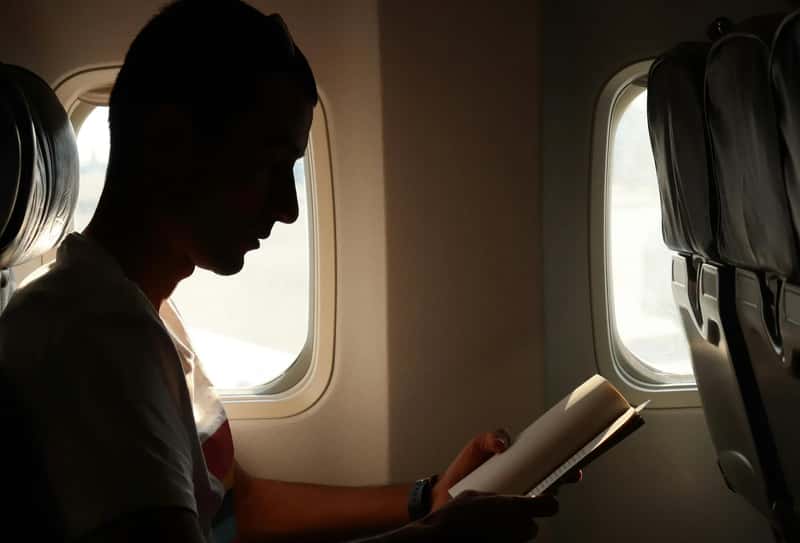
The book is never really about the book.
It is a signal. A carefully curated object designed to communicate something to the room.
The titles we choose to display are a form of self-expression and can influence how others perceive us. This phenomenon is often linked to identity signaling, where our possessions broadcast aspects of our personality to the world.
Think about which book you reach for. It is almost never a beach thriller. It is almost always something that makes you look engaged. Something with a serious spine. Something a professor might nod at.
You are not buying a story. You are buying a costume.
In today’s reading culture, books are often bought for the identity they project rather than the stories they tell. Our shelves have become mirrors of aspiration, taste, and online influence. And the airport bookstore? It is simply the most concentrated version of that mirror – a room full of people trying to become someone slightly better before the gate closes.
The book is the prop. You are the performance.
2. The Dopamine Con
Here is what your brain is actually doing at that bookstore shelf.
It is not planning. It is not preparing. It is collecting a reward it has not yet earned.
When you buy a new book, your brain releases dopamine – the feel-good chemical. But this isn’t a reward for finishing the book. It’s a hit you get from the anticipation of learning something new or diving into an exciting story.
The purchase is the act. The reading is beside the point.
Buying books triggers dopamine, the brain’s reward chemical that makes us feel excited. The act of purchasing satisfies our intellectual hunger. The anticipation of reading brings motivation, but fades after buying.
So the moment the book slides into your bag, the neurological transaction is complete. Your brain has already filed it under “growth.” The actual pages are administrative detail. You are operating on a chemical confidence trick you have been running on yourself since the third grade.
3. The Illusion of Progress
You do not just want to be smart. You want to look like you are becoming smarter. Actively. Visibly. In motion.
This is not vanity. It is survival instinct – a deeply trained response to early environments where productivity was not a personal value but a performance for someone else’s benefit.
Many people buy books they never read because of the illusion of intellectual progress – the belief that owning books makes us smarter, even if we never open them. Books symbolize intelligence and personal growth, making us feel accomplished.
The book in the bag means you are on your way to being the reading person. The intended person. The improved person.
Buying a book becomes a declaration of intent, a signal to yourself about the person you want to become. Business books, for example, often serve less as page-turners and more as symbols of ambition. They sit on shelves like promises, reminders that you’ll master a new strategy, adopt a better habit, or gain an edge.
But a promise you make at 6:47 AM in an airport bookstore is a promise made to no one. Except, maybe, the child who still lives somewhere behind your sternum – showing off for a teacher who isn’t there anymore.
4. The Liminal Zone and Its Permission
Airports are not real places. Not in the psychological sense.
They exist in the space between one version of your life and another – an anthropological “non-place” where normal accountability is suspended and the rules of your identity become briefly negotiable.
Airports are considered liminal zones where traditional notions of place and time become blurred, leading to feelings of disorientation and altered behavior.
When people travel, they experience a partial release from their everyday identities. The “you” who travels is subtly different from the “you” who commutes to work, attends school meetings, or manages household chores. Travel creates psychological permission to behave differently – to try new foods, buy things you wouldn’t normally buy, engage with strangers, and step outside habitual patterns.
And in that permission, the old childhood reflex activates. In the suspension of your regular self, you reach instinctively for the identity you always wanted to be assigned. The intellectual. The curious one. The reader.
The airport gives you a stage. The book is your opening line.
5. The Ghost in the Bookstore
I have to tell you something I have never said out loud about a particular airport in Atlanta.
I was running late. Boarding in twenty-two minutes. My carry-on was already too heavy and I had three unread books sitting on my nightstand at home – one still in its original shrink-wrap. And I walked into the Hudson News and spent eleven minutes choosing between a book about ancient Rome and one about decision-making under pressure.
I bought both. I read none.
What I remember most clearly is the sensation that accompanied the purchase – not excitement about the content, but a specific, irrational relief. The same relief I used to feel as a child sliding a library book onto my desk before the teacher arrived. The message wasn’t for me. It was for the room. It was: I am prepared. I am productive. I am not wasting time.
In childhood, parental authority gives structure and direction to a child’s life – declaring what to do, what not to do, what is right, what is wrong, what works, what doesn’t work. It gives the child a reference for making decisions that they can internalize and follow without having to figure out how to believe and behave entirely on their own. Somewhere in that internalization, many of us absorbed a single, corrosive lesson: being seen as productive is more important than being productive.
6. The Aspirational Identity Stack
The book does not represent who you are.
It represents who you are allowed to become – a future self you are keeping on retainer.
Consumer researchers describe possessions as “extensions of self,” objects that help us tell a story about who we are. A stack of unread books can represent potential identities, versions of ourselves we hope to grow into.
And there is something achingly human in that. When you bought those books you never got round to reading, you were the kind of person who was happy to spend a little bit of money for the short-term pleasure of being the kind of person who owned those books.
The airport bookstore is just a very efficient delivery system for aspirational selves. A place where, for twelve dollars, you can briefly inhabit the identity of someone who understands monetary policy. Or the history of the Roman Empire. Or the neuroscience of habits.
You do not read the book because the purchase already did the work. The identity has been acquired. The costume has been fitted. The performance has begun.
7. The Intention-Behavior Gap
Psychology has a name for what happens between “I will definitely read this on the plane” and “It is now three weeks later and the book is under a pile of mail.”
It is called the “intention-behavior gap” in psychology.
Optimism bias means you genuinely believe that future-you will have more time, focus, and discipline. Future-you is disciplined. Future-you has long, contemplative stretches of uninterrupted reading time. Future-you is the person the book was purchased for.
Present-you is on a plane, slightly dehydrated, watching a movie you have already seen, scrolling the same four apps in rotation because your nervous system cannot sustain thirty consecutive minutes of focused prose.
The gap between these two people is not a personal failing. It is a structural one – built into the way authority-oriented childhoods trained us to announce our intentions more loudly than we ever needed to fulfill them. You learned early that the performance of effort was rewarded as highly, sometimes more highly, than effort itself.
8. The Spine Facing Outward
Notice something the next time you pack a book for travel.
Notice which direction it faces in the overhead bin. Notice where you place it on the tray table. Notice how you feel when someone in the adjacent seat glances at the cover.
This is not imagination. Books aren’t just stored anymore – they’re styled. From dark academia vibes to minimalist stacks, our shelves become quiet statements of taste, mood, and identity. And the airplane seat is just a portable shelf.
Even without being read, books create an aura of knowledge, signaling both to the owner and to anyone visiting that the space is one of learning and depth. In that sense, hoarding books isn’t irrational.
The spine facing outward is a childhood behavior in a grown-up body. It is the raised hand in class. It is the neat handwriting on the homework you did not fully understand but submitted with excessive care. It is the old, ancient need to be legible to authority – to be read as a certain kind of person before anyone has the chance to look closer.
9. The Fear That Lives in Idle Hands
Somewhere very early in life, you were taught that not being productive was dangerous.
Not dangerous in the physical sense. Dangerous in the social sense. Dangerous in the sense that an idle child gets scrutinized. Gets questioned. Gets found wanting.
Adverse childhood experiences, including various forms of emotional pressure, can have long-lasting effects well into adulthood. Therapists often find that these experiences manifest in deep-seated fears and anxieties surrounding authority figures.
The book in the airport is an anxiety management tool disguised as a purchase. It fills the idle hands. It occupies the visible, assessable surface of your time. It tells the ambient authority figure – the one who no longer exists but whom you still carry – that you are using this time correctly.
Airports can make people feel lost or confused. In daily life, we define ourselves by our routines and familiar places. At an airport, those things disappear. And when those anchors disappear, the oldest coping mechanism resurfaces: perform competence. Signal productivity. Show them you are not wasting the moment.
The book is proof. Proof offered to a jury that disbanded decades ago.
10. The Heaviest Thing in Your Bag
The unread book you carry onto every flight is not made of paper and ink.
It is made of every classroom where you had to look busy. Every dinner table where intellectual engagement was the price of being taken seriously. Every report card, every raised eyebrow, every silent parental expectation that communicated – without ever saying it directly – that your mind was only acceptable when it was visibly, verifiably at work.
Authoritarian parenting is linked to adverse psychological consequences in children. Children raised by authoritarian parents may display reduced self-esteem because of the focus on compliance and conformity, which comes at the cost of autonomy and originality. And one of the quietest casualties of that cost is the death of reading for pleasure – replaced, slowly and without ceremony, by reading as performance. Or the performance of reading. Or the purchase of the performance. Until even the purchase is too much and the book just travels with you like a passenger who never speaks.
Psychologists remind us that books, whether read or not, are more than objects. They’re symbols of identity, ambition, and memory. For some, a shelf of untouched titles is a record of curiosity and hope. For others, it’s a reminder of futures never lived. The airport book is often both simultaneously – hope for the reader you want to be, haunted by the suspicion that you are still, decades later, just trying to impress someone sitting at the front of the room.
The heaviest thing in your carry-on has no pages left to turn.
There is something tender, when you look at it long enough, about a person standing in an airport bookstore at 6:47 in the morning, choosing between geopolitics and behavioral economics with the quiet urgency of someone defusing a bomb. That person is not pretentious. They are not delusional. They are trying, in the oldest language they know, to be enough. To be legible. To be the kind of person who does not waste the in-between spaces of their life.
The tragedy is not that you buy the book and never read it. The tragedy is that you never needed the book to be that person. The reading, the learning, the curiosity – all of it was always already yours. It simply got buried under the performance of it. Under the childhood arithmetic that said: visible effort equals safety equals love.
The next time you are in that bookstore, with the overhead lights humming their fluorescent hymn, you are allowed to put the book down. You are allowed to board the plane with nothing but your phone and your coffee and the quiet acknowledgment that you do not need to prove your mind to a gate agent, a seatmate, or the third-grade teacher who has been dead inside you for years. The gap between who you are and who you think you need to appear to be – that gap is not a failure of character. It is just the last carry-on you forgot to unpack.