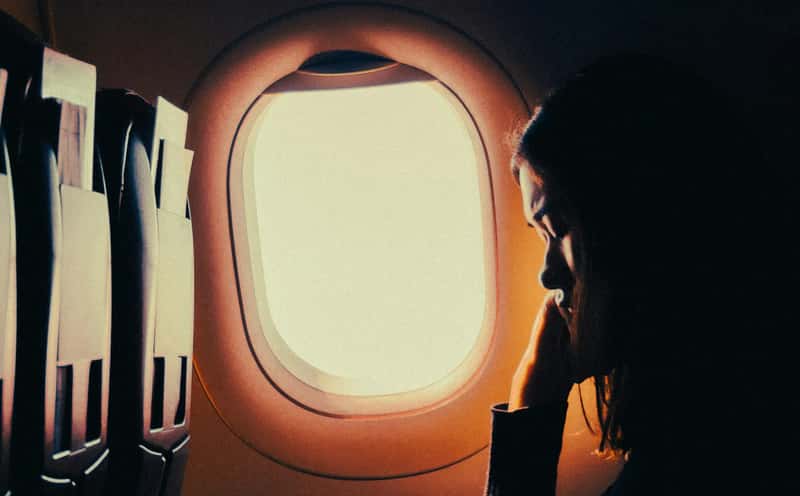
The cabin lights come on.
You feel it before you think it.
A low hum behind the sternum. Not fear. Not sadness, exactly. Something older.
The tray table locks. The seat snaps upright. And you – the you that spent seven days being nobody in particular – begin to dissolve back into the you that has a name, a role, a pile of unread emails, and a parking space with your name on it.
This is the Identity Gap. The thin, electric air between who you performed yourself to be back home and who you quietly became the moment the wheels left the ground. Travelling, whether for weeks or months, undoubtedly breaks you out of your usual routines and roles. And the terror – yes, terror – of the descent is the terror of those roles rushing back to reclaim you.
1. The Temporary Identity
Here is what nobody tells you about travel.
The destination is secondary.
What you are actually buying – with every overpriced flight and questionable hostel – is the right to be someone without a history.
Away from your usual environment, people may no longer expect anything specific from you. You can simply exist. No one at that café in Lisbon knows you are the person who still hasn’t called their mother back. No one at the guesthouse in Chiang Mai knows you said the wrong thing at that dinner party in 2019.
Abroad, the self is a clean slate. Every morning is a first impression. Every conversation is with a stranger who has no file on you.
Travel often plays a role in identity formation. Someone who has spent weeks hiking in Patagonia may begin to see themselves as an adventurous, nature-oriented person. But here is the darker, more honest version: sometimes that person isn’t a new discovery. Sometimes it’s a recovery. A version of you that predates the job title, the mortgage, the slow accumulation of other people’s expectations.
And the plane is about to take that version away.
2. The Anticipatory Grief
The grief starts before landing.
Sometimes it starts days before.
In the last fortnight of extended travel, a sad, sinking feeling begins to appear. It is pervasive. It doesn’t respond to logic. You are still in a beautiful place. You are technically still free. And yet the countdown has begun.
Psychologists have a name for this. This sadness is a form of anticipatory grief – the emotional weight of knowing the adventure is ending. But there is something more precise happening beneath that clinical label.
It is not just that you are losing a place.
You are losing the self that lived in that place.
Leaving what is familiar – language, social networks, the texture of daily life – carries a real loss of social structure and culture. This loss triggers a grief reaction. And that grief is legitimate, regardless of how long you were gone. Even a long weekend can crack you open.
The seatbelt sign dings. The self-mourning begins.
3. The Reverse Culture Shock Nobody Warns You About
You expect culture shock going out.
Nobody prepares you for the shock of coming back in.
Reverse culture shock occurs when a person becomes accustomed to a culture or way of life in another place, then experiences shock upon returning home and re-entering their former society. The architecture is familiar. The language is yours. And somehow it all feels slightly wrong.
The coffee is the same brand. The commute is the same length. But you are standing in the middle of it all like a ghost of your own life.
The traveler’s reference points – routines, conversations, and even tastes – shift during travel. Upon returning home, these shifts can make familiar environments feel strangely foreign or uninspiring. This dissonance may manifest as irritability toward mundane tasks or difficulty re-connecting with people who did not share the travel experience.
This is not malaise. This is not ingratitude.
This is the specific vertigo of being the only person in the room who changed – in a room that didn’t wait for you.
4. The Role You Were Cast in Before You Left
Your home is a stage set.
Your friends, family, and colleagues are the casting directors. They hired a specific version of you long ago. They expect continuity.
Migration and transition involve a profound alteration of the sense of identity, because the individual loses cultural, linguistic, and social reference points that formed part of their sense of self. Even a short trip creates a miniature version of this rupture.
The person who boards the return flight is not the same one who departed. But the audience at the arrival gate wants the original. They want the known quantity. The reliable model. The version of you that agrees to brunch at the same place you’ve been going to for six years.
Psychologists studying cultural adaptation describe travel – especially long-term or immersive travel – as a miniature version of expatriation. In such cases, returning home requires a reverse acculturation process. Research found that re-entry involves behavioral and emotional adjustments as individuals re-engage with a culture that may now feel less aligned with their evolved identity.
The problem is not the homecoming. The problem is the casting. You’ve outgrown the part. The costume no longer fits.
5. The Morning You Woke up Somewhere Else and Felt Like Yourself
I want to tell you about a specific morning.
I was in a rented room above a small bakery in a city where I knew no one. The mattress was narrow. The walls were yellow. There was a sound of bread being loaded into ovens somewhere below, and the smell of it moved through the gap under the door like an old friend.
I lay there for a long time before I moved. Not because I was tired. Because I was – and I could feel this clearly, the way you can only feel things when there is no performance required – simply at ease inside my own skin.
No one needed anything from me that morning. No one in that city had a version of me they were protecting. Travel can highlight the parts of life that feel heavy or stagnant. Sometimes, the sadness of coming home isn’t about leaving the specific destination – it can be about what you’re returning to.
That morning above the bakery, I wasn’t homesick. I was sick of home. There’s a difference, and most people spend years confusing the two.
6. The Permanent Impermanence
Here is the strange math of the traveler’s soul.
The less permanent the situation, the more present you become.
The hotel room you’ll never see again becomes a sanctuary. The stranger you share a train compartment with for four hours becomes, briefly, one of the most honest conversations you’ve ever had. The friendships or bonds formed during travel are intense yet transient, and their absence can feel like a form of loss.
Nothing is weighted down by history in transit. There is no emotional mortgage to pay. The temporary nature of everything is not a flaw – it is the entire point. It is why the coffee tastes better at a corner table in a foreign city than it does in your own kitchen.
Avid travelers love the feeling of being in an unfamiliar country, stepping out of their comfort zone and experiencing ultimate freedom. This new and exciting environment is constantly creating new connections within the brain, forcing you to come up with solutions for problems you face.
Permanence is the enemy of presence. And home – for all its warmth – is a permanent address with a permanent version of you attached to it.
7. The Neurological Withdrawal
This grief isn’t only philosophical. It is also chemical.
Your brain on travel is a different brain.
Exploring the world and immersing in local culture has the power to teach and transform. Upon returning home, that transformation process is halted. Home has seemingly frozen in time, completely unchanged from when you left.
Mental health professionals believe several factors trigger post-travel blues. Most experts think transitioning from a holiday to everyday life causes an adrenaline crash that accounts for the syndrome. But adrenaline is only part of the story.
Novelty is the brain’s favourite drug. New streets, new menus, new social dynamics – all of it keeps the prefrontal cortex lit up like a switchboard. New sounds, scents, textures, and views stimulate the brain in grounding ways. When that stops – when you are back on the same route, past the same buildings, into the same chair – the withdrawal is real.
The descent is, among other things, a comedown.
And the version of you waiting at home is the hangover.
8. The Social Contract of the Known Self
People who love you are also, quietly, invested in your stability.
This is not malicious. It is human. But it means that your transformation – however genuine, however hard-won at altitude – is inconvenient to them.
Family therapists who counsel expatriates agree that grief is an overlooked dimension of the culture shock cycle. And at the centre of that grief is this uncomfortable truth: the people waiting for you need the old you to return. Not out of cruelty. Out of love. Out of the deep human hunger for continuity in the people we depend on.
Families who deny or are otherwise unable to deal with feelings of grief and loss get emotionally stuck, and find it hard to embrace new experience – a circumstance that, with proper support, could be avoided.
So you step off the plane. You perform the homecoming. You answer the questions – “How was it? Was it amazing?” – and compress fourteen days of internal renovation into three words: “Yeah, really good.”
The self shrinks back to the size of the room it’s always lived in.
9. The Suitcase That Stays Unpacked
There is a reason you don’t unpack immediately.
It isn’t laziness. It isn’t fatigue.
It is a small, quiet act of resistance. The suitcase is still open. Which means, technically, you haven’t fully returned. A week or two flies by and you still can’t help daydreaming about your trip, your suitcase still unpacked in the corner of your bedroom, constantly tempted to book another flight.
The suitcase is a protest. It is a physical argument against re-absorption.
While we may mourn the person we once were in a particular place, we never stop evolving and growing. Our identity can comprise many places. It is our story that makes us unique and whole, and we carry that with us throughout our lifetime.
But knowing that intellectually does not stop the fist-tight feeling in the chest when the bag is finally, reluctantly, emptied. When the last foreign currency coin disappears into a drawer. When the particular smell of somewhere else fades from the lining.
The suitcase closes. The sentence ends. The old self is fully back in residence.
10. The Version of You That Didn’t Come Home
This is the heaviest truth of all.
Part of you didn’t get on the plane.
The version of you that was lighter, freer, less fluent in your own limitations – it stayed behind. It stayed in the time zone where no one knew your backstory. It stayed in the anonymity of arrival. The rupture of departure can last a lifetime. This process forces the traveler into a constant dialogue about identity with the new environment and often transforms them into a different person than they were.
And yet.
Those who have experienced a deeper cultural identity shift while travelling or living elsewhere may have more challenges assimilating back into their home culture. An important factor in this process is the degree of psychological flexibility – the ability to navigate between different cultural mindsets without feeling entirely detached from either.
The grief on the descent is not the grief of failure. It is the grief of awareness. You now know – with the specific, relentless clarity that only contrast can provide – that the version of you holding the boarding pass home is not the only version available. It is simply the one that has the most infrastructure.
The house is in its name. The job is in its name. The relationships were all built around its dimensions.
But the other version exists. It always will. It lives in the altitude between thirty thousand feet and the tarmac – the few minutes when you are neither here nor there, neither the person you were nor the person you became, suspended in the beautiful, terrifying nothing of the in-between.
The plane lands. The seatbelts click open like small surrenders.
And here is what no one says aloud in the shuffle toward the exit: the grief you feel is not irrational. It is not ingratitude. It is not a sign that your life at home is broken or insufficient. It is the perfectly proportionate emotional response to a real loss – the loss of a self that was briefly, brilliantly possible. Post-travel blues are not simply “in your head” in the dismissive sense – they are a real and well-documented psychological phenomenon rooted in adaptation, identity, and social connection. They are the proof that something real happened to you out there. That you were not just a tourist in a place. You were briefly a tourist in a different version of your own life.
The work – the quiet, lifelong, often thankless work – is not to stay in transit forever. It is not to spend your entire existence chasing the clean-slate feeling of a new city. It is to carry something of that lighter self back through customs. To refuse the full re-inheritance. To let the version of you that stood alone in a foreign square at dusk, with no plan and no performance, take up some permanent residency in the life you’ve come back to. Moving through that pain toward answers and changes produces a new sense of self that is both inwardly and outwardly kinder, more resilient, and more empathic. The traveler and the homebody are not enemies. They are negotiating, always, for shared space inside the same chest.
So the next time the wheels touch down and that strange, sourceless grief rises up through the floor of the cabin – let it. Don’t reach for your phone. Don’t scroll yourself back into your other life before you’ve had a chance to mourn this one. Just sit with the feeling for the length of one taxiway. Acknowledge what you are about to re-inherit, and ask yourself, quietly and without judgment, how much of it you actually want to keep.