The cab smells like someone else’s airport.
You are almost there.
Your suitcase still has sand in it from a place where no one knew your name.
And here, in the dark, sliding through familiar streets, you feel it – that slow, creeping dread. Not fear. Not sadness. Something more specific. The particular weight of a person who has been performing freedom, now walking back onto the stage where the script was written for them a long time ago.
There is a name for this place you inhabit in the gap between who you were and who you were pretending to be: the liminal period – the time when you are no longer who you had been and have not yet become who you would be. You occupy an intermediate state, suspended between identities, between social roles, between one chapter of life and the next. Travel is your church of suspension. Home is where the sermon ends.
1. The Temporary Identity
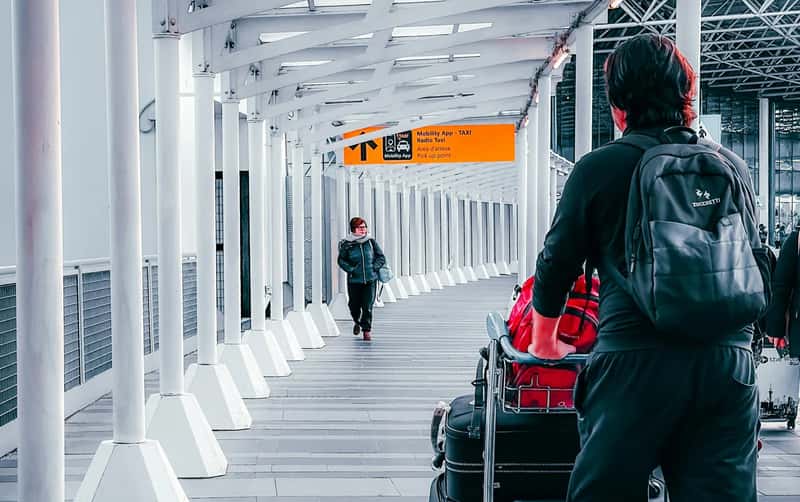
Here is the quiet secret that every frequent traveler carries: travel lets you be a draft.
Not a finished person. A draft. Unedited. Still becoming.
On the road, you are whoever you introduce yourself as being at a hostel bar in Lisbon or a guesthouse in Chiang Mai. Your failures do not precede you. Your debts are invisible. The version of yourself that snapped at your mother last Christmas doesn’t exist in this café.
Victor Turner, the anthropologist who mapped the inner landscape of transition, saw liminality as a condition with its own character – a space where social structure loosened, where normal rules were temporarily suspended, and where something new could emerge. He described it as a state of ambiguity and openness, a place where transformation becomes possible precisely because the usual structures are absent.
Travel is that structure-free zone made physical.
You don’t hate coming home because home is bad. You hate it because home is the only place that refuses to let you be a draft.
2. The Mirror You Keep Avoiding
Home is not a place. Home is a mirror.
And the mirror does not lie.
It shows the dishes you didn’t do before you left. The unanswered messages. The half-finished side project still open in a browser tab. The gym bag, unused, by the door. Much of the anxiety of returning comes from having lived too far away from what you actually feel is true for yourself, while still trying to maintain the image of a life that was supposed to look right from the outside.
While traveling, the mirror gets packed away.
Nobody in Prague is tracking your LinkedIn. Nobody in Mexico City knows about the promotion you didn’t get. Nobody in a night train through Portugal is expecting a better version of you than the one sitting there, watching the dark countryside blur past the glass.
Home removes that mercy. It sets the mirror back up in the hall where you walk past it every single day.
3. The Exit Strategy
Travel is a legal exit strategy.
Socially sanctioned. Admired, even. Nobody questions a person who needs to “get away.” Nobody calls it running. They call it adventurous. They call it worldly. They call it brave.
Liminal space is deeply uncomfortable for many – so much so that people often make choices or take action not because it feels aligned, but simply to escape the discomfort. Anything to get out of the vast unknown and move on, even if it’s not quite right.
The plane ticket is elegant in its simplicity. One booking. One departure. One entire self, neatly suspended at 35,000 feet.
The problem with exit strategies is that they require re-entry. The runway always comes back. The carousel starts turning. And all your luggage – the emotional kind, the kind you didn’t check in – was waiting at arrivals the whole time.
It never left. It just sat there, patient and heavy, knowing you’d come back.
4. The Reverse Gravity of Familiar Rooms
The hardest physics no one teaches you: familiar spaces pull you back into old shapes.
Your childhood bedroom makes you seventeen again. Your parents’ dinner table makes you small. The couch you grew up on makes your posture revert. You sit in it the same way you did when you were afraid of things you can no longer name.
When you return to the place where you spent most of your time growing up, you return to the same state of mind and basically the pecking order of the person that you were then – even if you have changed, others may not have or may not view you as you used to be.
This is the reverse gravity. Not metaphorical. Almost physical.
You felt expansive in Kyoto. You felt possible in Buenos Aires. But here, in the room where your report cards were read aloud, you feel the walls press in. The person you’ve been building – the open, curious, brave one – flickers a little. Goes quiet.
Home has a long memory. And it is not interested in your recent renovations.
5. The Identity Gap
I will tell you about a flight I remember.
I was somewhere over the Atlantic, going home after three weeks that had cracked me open a little. The kind of trip where you talk to strangers and somehow say more true things than you’ve said to people who’ve known you for years. The kind of trip where you walk alone through a market and feel – briefly, electrically – that you are exactly the right size for the world.
Then the descent began. And with it, a tightening. Not dread, exactly. More like a costume being refastened. Like the version of me that existed up there, untethered and honest, was being slowly archived.
The liminal space is the phase where the old identity has lost its authority, but the new one has not proven itself yet. You are not who you used to be, but you also don’t fully trust who you are becoming. That is why this phase can feel strangely unstable, even when nothing is wrong.
Nothing was wrong. I just didn’t fit back into myself the way I used to. That’s the identity gap. It doesn’t close just because the plane lands.
6. The Dopamine Cliff
Your brain on travel is your brain on novelty.
And novelty is a drug that does not warn you about withdrawal.
Neuroscience research shows that dopamine activity increases during novel experiences such as travel. The reward pathways in the brain respond strongly to new environments, contributing to heightened emotional engagement. When travel ends, dopamine stimulation decreases as routine returns. This reduction can create a subtle emotional low.
The cliff is not dramatic. It is quiet. It looks like standing in your kitchen, making the same coffee, listening to the same sounds, and feeling – under the ordinary surface of everything – a low, persistent hum of not-enough.
You don’t hate your kitchen. You miss the voltage. You miss the way a new street could make your pulse lift without explanation. Home is familiar. And back home, prediction becomes accurate again, which lowers dopamine spikes. The familiar is kind. But kindness doesn’t spike your chemistry.
7. The Witness Problem
When you travel, you get to choose your witnesses.
The woman at the small guesthouse who watched you cry over your pasta and didn’t ask why. The stranger on the overnight bus who loaned you a jacket and asked nothing in return. The bartender in a city whose name you struggle to spell, who listened to you with the patient attention of someone who had no stake in your story.
These witnesses are safe because they are temporary. A liminal space is a place of transition – an in-between space that exists on the boundary of what came before and what has not yet arrived. It can be a physical place. It can also be a psychological state, a transitional period in a life where the old structure has dissolved, and the new one has not yet formed.
Home has permanent witnesses. People who knew you before you had language for what you were. People who remember your failures in high definition. People who love you, yes – but love you as you were, not necessarily as you’re trying to become.
That permanent gaze is the heaviest thing you carry through arrivals.
8. The Performed Life
Social media gave us a new way to travel without leaving.
And it gave us a new kind of home – the performed one.
Social media has introduced new forms of liminality, where individuals navigate between online and offline identities. The curated version of your life – the one with golden hour photographs from a rooftop in Oaxaca – doesn’t have to explain the unopened mail when you get back. It doesn’t have to show the re-entry. The messy Tuesday. The ordinary Wednesday. The Thursday where nothing transforms.
Travel photography is a document of the performed self at its most aspirational.
Home is where the performance must eventually pause. Where the lens gets put down. Where the person behind the camera – tired, uncertain, less photogenic than their feed – has to sit with themselves in bad lighting. No filter. No caption. Just the Tuesday of themselves, unedited and unposted.
9. The Re-Entry Shock Nobody Names
Everyone warns you about culture shock going out. Nobody warns you about the shock coming back in.
Re-entry shock happens when someone returns to their home country after spending a significant amount of time in a different culture. You might expect to feel “back to normal,” but instead, you feel disoriented, disconnected, or even disappointed.
The disorientation is real. And it is specifically identity-shaped.
The Cultural Identity Model helps explain why some people struggle to reintegrate after living or traveling abroad. The model suggests that the more your cultural identity shifts while abroad, the more challenging re-entry can be. If your experiences fundamentally alter how you see the world, returning home may feel uncomfortable and disorienting.
You changed. The living room didn’t. And nobody built a bridge between who you went away as and who you came back being. You have to build it yourself, in real time, while people expect you to just pick up where you left off.
That bridge is the hardest construction project most of us will ever attempt.
10. The Thing You’re Actually Looking For
Here is the darkest and most honest part.
You are not looking for a new place. You are looking for a new self that survives the old place.
Every departure is a rehearsal for a version of you that has their life together. Every new city is a screen on which you project that version – confident, intentional, free of the particular embarrassments that accumulate in a place where people have known you since you were still figuring out how to take up space.
During time in the liminal space, a person’s previous identity will try to bring them back while their new identity pushes them forward. Torn between the push and pull, the person may either lose their newfound self or solidify their new identity.
This is what no one says at the departure gate. The trip is not the destination. The trip is the argument you are having with yourself about who gets to exist when you land back home. When the usual patterns are suspended, the brain becomes more plastic – more open to new connections, insights, and meanings. The loss of “normal” makes space for something more honest.
That honesty is what you carry home. That is the real luggage. And it is heavier than everything else on the carousel.
There is a version of coming home that doesn’t feel like a defeat. It requires something most of us spend years avoiding: the decision to stop needing a new latitude in order to be a new person. The decision that the self you built on the road – the open one, the honest one, the one willing to sit alone in a foreign restaurant and actually feel things – is allowed to exist in your own kitchen on a Tuesday.
That version of you doesn’t need a runway. Doesn’t need an unfamiliar skyline to feel permission. It needs something quieter and far more difficult: the willingness to be seen by the people who have the longest memory of who you used to be, while insisting, gently but completely, on who you have become.
Maybe the reason you keep leaving is not that you love elsewhere. Maybe it’s that you haven’t yet decided to fully arrive.