You book the flight before you know why.
Iceland. Patagonia. The Norwegian coast in January.
Not Lisbon. Not Tulum. Not anywhere warm and forgiving.
You tell people it’s the landscape. The light. The quiet.
You are not lying. But you are not telling the whole truth, either.
There is a version of you that has been hardened by something – a season of your life, a relationship, a long period of navigating the world without a safety net. You built something inside yourself during that time. Something load-bearing. Something that doesn’t show up on your face in photographs but lives in the way you make decisions and the way you scan rooms and the way you have learned, without being taught, to not need much in order to keep moving. That structure inside you is real. And somewhere in your nervous system, something has been looking for a landscape that matches it.
1. The Mirror You Never Asked For
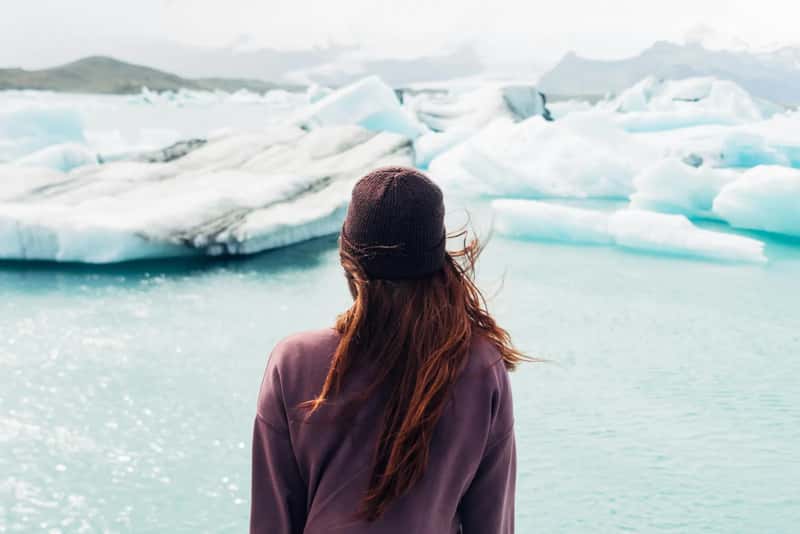
The destination is not separate from you. It is a projection of the self you’ve built.
This is not metaphor. This is the operating system of identity travel.
When you choose a destination, you are not choosing a place. You are choosing a reflection. You are choosing the version of the world that most closely resembles the version of yourself you have quietly become. The cold destination – the one with wind that finds the gap between your collar and your jaw – is not a random preference. It is a psychological homing signal.
You are not seeking discomfort. You are seeking congruence.
The cold is not punishing you. It is recognizing you.
And that recognition – the world being exactly as hard as you know it can be – is a form of rest that a sun-soaked beach cannot provide. Because a beach asks you to be soft. The frozen coast does not. It meets you exactly where you already are.
2. The Earned View
Winter destinations are beautiful in a way that requires something from you before they reveal themselves. You have to earn the view. You have to walk into the wind to get to it. You have to stand there, eyes watering, and decide that yes – this is worth it.
This is not a casual tourist’s logic.
That is not a casual tourist’s itinerary. That is the interior logic of someone who has learned that most good things are hard to reach.
You already knew this. You learned it the slow way. The cold destination is simply the first place in a long time that agrees with you.
The mountain does not offer its view to anyone who is unwilling to move toward it. You understand that arrangement implicitly. You’ve lived it in a different vocabulary – in the way you waited for certain things to reveal themselves only after you had suffered through the difficulty of patience. You are not a tourist here. You are a local of the internal geography this landscape resembles.
3. The Sharpening Effect
Cold does the opposite of heat. Cold weather can sharpen the senses, making outdoor experiences more vivid and grounding.
There is a reason this feels like relief.
You have spent months – possibly years – in environments that made you vague. Comfortable enough to be numb. Warm enough to be dissociated. The cold removes that option entirely. Cold demands your attention. It requires you to be in your body, in the moment, in the specific square foot of frozen earth beneath your boots. And that demand is, paradoxically, the most liberating thing you have felt in a long time.
Vagueness is its own kind of suffering.
The cold ends it. Immediately. Without negotiation.
You breathe in and every cell in your chest wakes up. You breathe out and you can see it happen. The cold makes the evidence of your existence visible. And for someone who has spent too long feeling invisible – in a relationship, in a career, in a room full of people – that visibility is everything.
4. The Permission to Be Hard
Navigating life in cold weather can be a bit of a challenge – icy roads, layers of clothing, and the occasional stubborn car that refuses to start on a frosty morning. But for those who love the cold, these inconveniences don’t dampen their spirits. Instead, they see each chilly day as an opportunity to conquer a new challenge.
This is a personality structure. Not a quirk.
The world gives very little permission to be hard. To not need coddling. To find difficulty agreeable rather than intolerable. In most social environments, resilience is praised in theory and penalized in practice. You are supposed to be tough, but not so tough that it makes other people uncomfortable. The cold landscape removes that contradiction entirely. Here, hardness is not a liability. It is the entry requirement.
You do not need permission from the cold to be exactly who you are.
It simply assumes you already are. And moves on.
5. The Thing I Noticed in Reykjavik
I want to stop here for a moment, because something specific happened to me in Iceland in February, and I’ve been trying to explain it to people ever since.
It was not the northern lights. It was the morning walk to the harbor. Wind that made it difficult to think in full sentences. Black water and gray sky doing the same thing. No warmth arriving from any direction. And what I felt – standing there alone, breath visible, ears numb – was not cold. It was recognition. The weather was doing what the last three years of my life had done to me. It was pushing hard, without apology, without softening. And I was still standing in it. Still looking at the water. That moment was not travel. It was confirmation. The world was hard, and I was still here, and those two facts were finally in the same sentence.
That is what cold destinations offer the quietly resilient. Not escape. Evidence.
6. The Solitude That Doesn’t Hurt
People who love cold weather often find a sense of peace and comfort in solitude. This doesn’t necessarily mean they’re introverted or antisocial, but rather they appreciate the tranquility that comes with a frosty landscape. Psychology suggests that the quiet, still atmosphere during colder seasons can have a calming effect, making it an ideal time for self-reflection and relaxation.
Here is the distinction that matters.
There is the loneliness you did not choose, and there is the solitude you walk into deliberately, wearing good boots, with a destination in mind. The cold climate produces the latter naturally. The chill in the air deters others from stepping outside, creating a sense of solitude and personal space for those who embrace the cold. For someone who has spent significant parts of their internal life navigating difficulty without company, this is not deprivation. It is the natural state.
The empty trail in February is not lonely.
It is familiar. It is yours. And in a world that fills every silence with noise, the cold has the rare decency to simply be quiet.
7. The Identity Alignment That Warm Climates Deny You
That is not a coincidence of geography. It is a lesson in identity alignment. When your environment is hard and you have decided to find it beautiful anyway – not in spite of the hardness, but through it – something shifts. The external difficulty stops being a threat and starts being a texture. Something that gives the life its definition, the way shadows give a photograph its depth.
This is the core of it.
Warm climates ask you to be someone else. They ask you to be open, easy, available. In warm climates, the body can lie. It can be soft. Relaxed. Uncommitted to the moment. Heat makes you slow and vague and pleasantly dissociated from the present. And if you have spent years building a self that is none of those things – a self that is precise and alert and honestly a little wary of how fast comfort can dissolve – then warmth is not rest. It is cognitive dissonance with good weather.
The cold asks nothing of you that you haven’t already built yourself to handle.
That alignment is not a small thing. It is the closest most of us get to feeling at home in a world that was never quite designed for us.
8. The Mindset That Rewrites the Storm
In Scandinavia, where the winters are among the coldest and darkest on earth, many people look forward to winter as a time of coziness, beauty, and rest. Psychologist Kari Leibowitz studies the power of mindsets to improve health and well-being in these extreme conditions.
The mechanism here is important.
Emerging research and established psychological principles suggest our affinity for certain weather patterns is intricately woven with our biological responses, psychological makeup, learned associations, and even our deep-seated personal history. What that means, practically, is that when you stand in a blizzard and feel something closer to calm than fear, you are not malfunctioning. You are operating from a mindset built through specific experience. The cold is not new information to you. You have processed its equivalent, internally, on many quiet evenings when no one was watching.
The storm outside does not surprise you.
You have been living a version of it for years.
And you are still here. Still upright. Still curious about what is on the other side of the ridge.
9. The Sensation-Seeking That Isn’t Reckless
A preference for harsh conditions can be driven by high “Openness to Experience” or “Sensation Seeking” traits – a fascination with nature’s power and dynamics, enjoyment of dramatic sensory input, and an adrenaline response.
But here is what the psychological literature underestimates.
For the quietly resilient, sensation-seeking is not recklessness. It is calibration. It is the need to feel the outside world at the same volume as the inside world. If your inner life has been running loud – grief, uncertainty, the specific pressure of holding everything together without acknowledgment – then a lukewarm environment feels like a lie. You need the external world to be at least as intense as the internal one.
The cold delivers that without drama.
Perhaps the most unique behavior of those who love cold weather is their ability to truly live in the moment. While others are busy wishing away the cold days in anticipation of warmer weather, they’re out there savoring each icy breath, each snowflake, each crackling fire. They don’t let the fleeting nature of seasons rob them of their present joy.
That presence is not accidental. It is the hardwired result of having learned that things pass. Everything does. Even the storm.
10. The Thing You Are Actually Looking For
Cold-weather lovers have a special way of seeing the world and living in it. Their ability to find joy and comfort in chilly conditions not only defines their preferences but also enhances their sense of resilience and mindfulness.
But the deepest truth is this.
You are not looking for hardship. You are looking for validation. The cold destination is the only honest environment. It does not pretend the world is easy. It does not suggest that comfort is the default or that beauty is always accessible or that you should be able to arrive without effort. It requires something from you – and in requiring it, it confirms that the something you have is real. That the resilience you built, quietly, alone, over a long period of time with very little outside acknowledgment, was not wasted. Was not nothing. Was, in fact, exactly the right thing to carry.
People high in Openness to Experience might appreciate the variety of weather, enjoying the unique beauty and sensory experience of a foggy morning or the first snowfall. They may be less likely to have a single strong preference and more likely to find value in different atmospheric conditions. But those who return, again and again, to the harsh and the cold and the demanding – they are not variety seekers. They are confirmation seekers. And what they are confirming, every time the wind meets them at the gate, is that they were built for exactly this.
That they were never fragile.
They just looked that way to people who had never been tested the same way.
There is a particular kind of person who will read this and feel something land in their chest that they do not immediately have a word for. It is not quite relief. It is not quite grief. It is the quiet sensation of being accurately described – possibly for the first time in a long time – in a language that doesn’t require them to explain themselves.
You did not choose the cold because you are punishing yourself. You chose it because something in the architecture of who you became recognizes it as honest. The world, in those destinations, is exactly what it is. The temperature does not negotiate. The landscape does not perform. The wind is simply the wind – indifferent and absolute and, in that absoluteness, deeply fair. Because it is the same for everyone standing in it. It does not care who you used to be. It only engages with who you are right now, in this coat, on this path, breathing visible breath into the gray morning air.
And maybe, after all the years of rooms that were too warm and relationships that asked you to be simpler than you are and environments that rewarded softness you never quite felt – maybe what you needed, all along, was just somewhere that already knew how to be exactly as hard as you.