You are standing on a foreign street.
The sign above you is in a language you cannot read.
You have been moving for three days.
And then you see it – grey, enormous, unapologetic – and you stop.
Not because you are tired. Because something in your chest just exhaled for the first time in years. What you felt in front of that building was not an aesthetic response. It was the specific, aching relief of being in the presence of something that would not change on you. Would not soften into something it wasn’t, or harden unexpectedly, or disappear while you were looking the other way. The building was simply, profoundly, immovably itself – and for someone who grew up in an environment where solidity was always conditional, that is not a small thing to encounter.
1. The Recognition Before the Reason
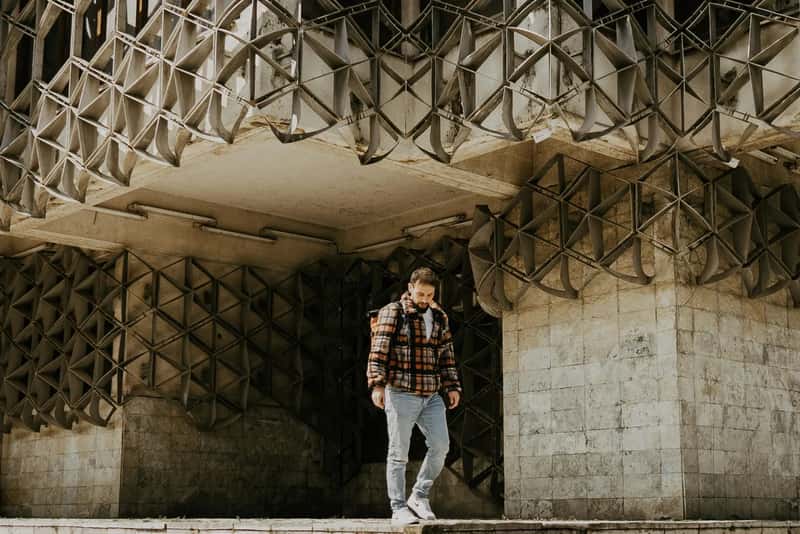
You stop walking. Not because you’re tired. Because the building in front of you looks exactly like something inside you.
This is not aesthetic appreciation. This is not a design preference you cultivated at art school. This is older than that. More animal. More honest.
Brutalist architecture often elicits strong reactions – discomfort, awe, indifference, or affection – because its formal language and social history activate sensory, cognitive, and cultural responses. But for a specific kind of traveler, the reaction is none of those things exactly. It is recognition. The specific, stomach-dropping recognition of meeting something that speaks your language.
The building doesn’t charm you. It doesn’t try to. And that, perversely, is the point. You have spent enough of your life surrounded by things and people that tried very hard to seem fine while quietly collapsing. A building that makes no promises is a building you can trust.
There is a tension between the physical and the psychological, whereby corporeal struggle intertwines with an abstract, aesthetic admiration of the Brutalist objects. That tension is where you live. You have always lived there. You just didn’t have a word for the address.
2. The Permanence Wound
Something happened early.
Not necessarily something dramatic. Not necessarily something with a name or a diagnosis. Sometimes it was simply the cumulative weight of an environment that could not be relied upon. A household that shifted its emotional temperature without warning. A sense that the ground beneath your early years was less solid than the ground beneath other children.
The impermanence wound runs deep. The mind tries to make sense of and know the unknown, to solidify the impermanent. It is one of the most exhausting cognitive habits a person can carry. The constant low-level scan for instability. The baseline vigilance that looks, from the outside, like awareness and intelligence, but from the inside feels like never being able to fully rest.
The person whose sense of home was always conditional looks at a brutalist building and feels something they haven’t felt in a long time: the comfort of a thing that will not disappear while you’re not looking.
The concrete doesn’t move. That matters more than you’ve let yourself admit.
3. The Honest Material
There is a word that runs through every serious conversation about brutalism. Raw.
Within the field of architecture, the term “Brutalism” refers to a post-World War II Modernist style, deriving from the French phrase béton brut, which means raw concrete. Raw concrete. Not decorated concrete. Not aspirational concrete. Concrete that is exactly what it appears to be, and nothing more, and nothing less.
Brutalism was meant to be an honest and direct expression of structure and materials that made architecture more transparent. It was meant to be ‘what it was’ rather than a symbol or representation of anything else.
This is the part that reaches into you and holds something still. You grew up around surfaces that presented differently than their interiors. Smiles that did not match. Stability that was purely cosmetic. You learned, early and efficiently, how to read the gap between surface and structure in people. Brutalist buildings have no such gap. What you see is what is holding the weight. That transparency is not cold. For you, it is the warmest thing in the city.
4. The Scale of Acknowledgment
It is very large.
That is not a small thing.
Core traits of Brutalism include functionalist design, daring geometry, overbearing scale, and the blatant exposure of structural materials, chiefly concrete and steel. The scale is not accidental. It is load-bearing in the most psychological sense. The building is enormous so that you don’t have to minimize what you feel standing in front of it.
Most of your life, you have been in environments that required you to make yourself smaller. To dial down the interior weather. To perform a more manageable version of your own experience for the comfort of the room. The brutalist building asks none of this. It stands at an overbearing scale, and it simply allows you to stand next to it at your full, undiminished size.
It is enormous and difficult and utterly, unapologetically present. You don’t have to explain yourself to a building that already looks like it understands. That is not a small architectural achievement. That is a profound psychological one.
5. The Interior Mirror
I want to tell you something personal. I remember the first brutalist building that stopped me cold – a government block on the outskirts of a city I had no reason to be in, at a time in my life when I had no real reason to be anywhere in particular. I stood in front of it for a long time. I told myself I was admiring the geometry.
I was not admiring the geometry.
I was recognizing, in that grey expanse of poured and unapologetic concrete, the internal architecture I had been carrying since childhood. The load-bearing walls I had built not out of preference but necessity. The total absence of ornament – because ornament had been a luxury my emotional economy could never quite afford.
People who carry invisible weight – grief they never named, trauma they never processed, responsibilities absorbed in childhood – often find that an overwhelmingly heavy structure is the first environment that finally matches their interior weather.
The building wasn’t beautiful. It was accurate. And accuracy, after a long period of misrepresentation, felt like the most profound relief I had ever stood inside.
6. The Survival Architecture
You became structural a long time ago.
When something or someone strips you down to function – when softness becomes a liability and every resource goes toward staying upright – you stop decorating. You become structural. You become load-bearing. You become, in the most literal psychological sense, brutalist.
This is not a failure. It is an engineering achievement. The problem is that the world does not tend to recognize survival architecture as beautiful. It tends to prefer the ornamental. The graceful. The effortless-seeming. You have spent years translating your load-bearing interior into a language that reads as socially acceptable, and it has cost you more than anyone around you knows.
The people who are drawn to these buildings are often the ones who know what it costs to be built for endurance rather than beauty. They know what it means to have your ornaments stripped away by circumstance.
The building in front of you was built the same way. It just never had to pretend otherwise. You admire it not in spite of that, but entirely because of it.
7. The Place Identity and the Borrowed Ground
There is a psychological concept worth sitting with. Environmental psychology uses the term “place identity” to describe how our sense of self is connected to the physical places we inhabit. If you grew up in places that felt unreliable – emotionally, architecturally, atmospherically – then your place identity was built on shifting ground.
The traveler who gravitates toward brutalist structures in foreign cities is often unconsciously seeking to borrow the solidity they never absorbed at home. The building becomes a surrogate anchor. A borrowed foundation beneath a self that has been in transit – not just geographically but psychologically – for most of its life.
During the early stages of adjustment, immigrants often feel that things fall apart as the concept of home becomes no longer synonymous with identity. As people begin to redefine those concepts, they often report feeling adrift, uncertain of the direction to head in. The traveler who never had a stable home to begin with already knows this feeling intimately. Every city is both foreign and familiar. Everywhere, in some essential way, is equally temporary. The concrete block on the corner is the most honest thing in the whole landscape. It does not pretend to be home. But it is, unmistakably, still standing.
8. The Identity in Transit
Travel is the great dissolvent of fixed selves.
When you travel, especially alone, the social mirrors are removed. Stripped of your usual context, your brain must generate a sense of self from within. This period of solitude and self-referential processing allows for a re-evaluation of your personal narrative.
For people whose personal narrative was written in difficult conditions, this re-evaluation is not always comfortable. The self that emerges in the absence of context is often the self that predates the coping strategies. The one that learned, very young, to scan environments for structural soundness. To read a room the way an engineer reads a blueprint. To understand intuitively which walls are load-bearing and which are decorative.
Freed from the expectations of others, we begin to ask: Who am I when no one is watching? Psychologically, solo travel engages deep processes of growth and identity reconstruction. For the traveler drawn to brutalism, this reconstruction has a preference. It wants to happen in front of something that will not change while the reconstruction is underway. Something enormous. Something grey. Something that has already survived its own demolition debate.
9. The Imperfect Holding Environment
There is a concept in developmental psychology called the holding environment – the idea that early caregiving should provide a stable, reliable surround within which the self can develop. When that environment is unstable, the developing self compensates. It over-regulates. It builds internal walls to substitute for the external ones that kept shifting.
The harshness of béton brut is instantly softened when collaboration and cohesion happen inside its walls. While brutalism favors functionality over aesthetics, it is above all about accepting urban imperfections. That acceptance is precisely what the early environment withheld. The message of the brutalist building – that something can be imperfect and enormous and still be standing – is not an architectural lesson. It is a corrective emotional experience delivered in concrete at a scale that cannot be ignored.
Brutalist architects use pure forms of a single element on their buildings so when people observe those brutalist buildings including various geometrical forms of a material, they feel comfortable because of the integrity and pureness of buildings. Integrity. Pureness. Those are not cold words. Those are the words of something that never had to lie about what it was made of.
10. The Thing That Will Still Be There
Here is the quietest truth of all of this.
You will leave the city. You will take a taxi back to an airport that looks like every other airport. You will sit in a plastic seat and check your boarding pass three times and feel the familiar low hum of the transit identity reassembling itself around you.
And the building will still be there.
When you stand in front of a building that went through the same process – a building that survived its own war and still stands – something in the chest recognizes it. Survival knows survival. It always does. The building does not need you to return. It does not need you to validate its solidity. It was standing before you arrived and it will be standing long after you’ve landed somewhere new and begun the quiet, relentless process of re-orienting yourself in yet another temporary space.
That permanence is not indifferent. It is the most generous thing in the world. It asks nothing from you. It needs no maintenance of relationship, no careful management of emotional temperature, no code-switching for comfort. It simply stands in the same coordinates it occupied when you stood in front of it and exhaled for the first time in years.
Travel is the most honest teacher of impermanence there is. But sometimes what the traveler is searching for, beneath all the motion and the new cities and the foreign alphabets on foreign signs, is not more impermanence. It is the one thing that will not move. The one structure that will not renegotiate its terms. The building that says, without saying anything at all: I was built to hold weight, and I am still here, and so, it seems, are you.
Sit with that for a moment. You have earned the stillness.