You are in a foreign city.
The street signs make no sound in your mouth.
The bread is different. The light is different. Even the silence feels rented.
You booked the ticket for this exact sensation – that vertigo of beautiful unknowing. But now that you are here, a quieter part of you is negotiating with the chaos. It is whispering the same word over and over: anchor.
This is the space between the traveler you perform – passport ready, itinerary loose, face open to the world – and the human animal beneath, who still needs something recognizable to hold onto. Using the laundromat is not weakness. This is the architecture of resilience. The traveler who seeks the laundromat is not hiding from the world. They are refueling inside it, using the most honest currency available: the ordinary.
1. The Nervous System Doesn’t Care About Your Bucket List
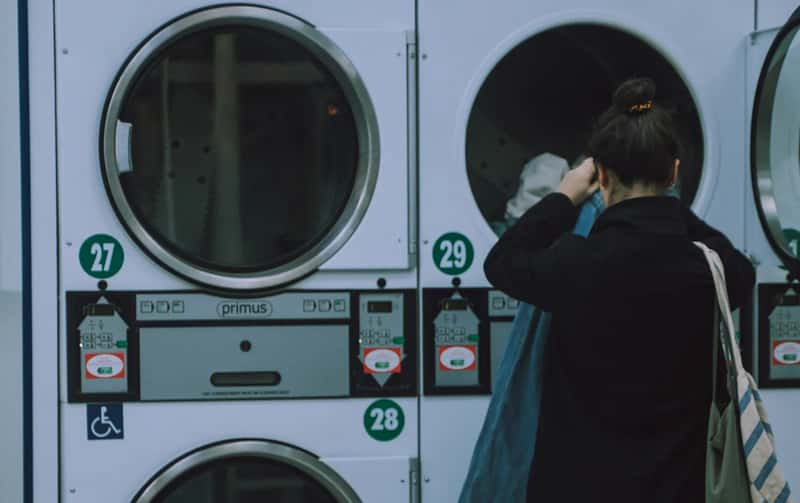
Here is something no travel influencer will tell you:
Your brain is constantly predicting outcomes. When it can accurately anticipate what will happen next, it conserves energy. When it can’t, it increases alertness. Travel introduces countless unknowns – new places, new rules, new cues – forcing the brain into continuous prediction mode.
That alertness is thrilling for about two days.
Then it becomes exhausting.
Travel disrupts your usual rhythms – meal times, sleep schedule, personal rituals. Accepting this disruption and planning for rest time helps minimize the stress of “everything must be perfect.”
The laundromat doesn’t ask you to accept anything. It asks you to press start and wait.
That is an instruction your nervous system recognizes. It has been recognizing it since childhood. And in a world that has spent three days confusing your every reflex, the machine’s familiar drum is less appliance and more lifeline.
2. The Competence Crisis No One Talks About
Travel is a slow, polite erosion of your self-image.
Abroad, you are frequently incompetent. You can’t read the menu. You took the wrong train. You paid with the wrong coin and a shopkeeper sighed at you with quiet, patient contempt. Every day of travel carries small humiliations, each one a tiny nick in your sense of self-efficacy.
Nobody warns you about this part.
The brochures show a confident silhouette against a golden horizon. They do not show the same person standing in a supermarket for eleven minutes, unable to locate the milk.
Then you do your laundry. And you are suddenly, undeniably, good at something.
You know exactly how much detergent. You know the temperature. You know the sequence. Competence floods back in – warm, quiet, restorative. The machine doesn’t care that you don’t speak the language. It just spins.
3. The Permission Slip to Slow Down
Modern travel has a pace problem.
Modern travel culture has a velocity problem. You are expected to consume experiences at the pace of a highlights reel – monument, meal, monument, museum, nightcap, sleep, repeat. The implicit pressure is relentless and exhausting. Slowing down feels like failure. Sitting still feels like waste.
The laundromat dissolves all of that in a single coin drop.
The laundromat gives you official permission to stop. Doing laundry while travelling forced you to slow down. And slower travel is almost always better. There is no guilt in a laundromat. You are not choosing to sit idle – you are performing a necessary domestic function. The world accepts this. Your inner critic, surprisingly, accepts this too.
You are not wasting the trip. You are breathing inside the trip.
That is a distinction most travelers spend years learning.
4. Routine as Identity Architecture
We do not talk enough about what routines actually are.
They are not habits. They are not chores. They are the scaffolding of a self.
Predictability as comfort is a travel philosophy rooted in nervous-system awareness. It recognizes that familiar patterns – repeated routines, known environments, and stable rhythms – aren’t boring. They’re calming. When the brain can anticipate what comes next, it relaxes. When it relaxes, travel becomes more enjoyable, present, and sustainable.
The laundromat is not a deviation from your identity. It is a reinforcement of it.
It says: I still exist. I still function. I am still someone who does the ordinary, necessary work of being a person.
That sounds small until you understand how large the alternative feels – the creeping, ambient vertigo of not knowing, for even a moment, who you are when everything familiar has been stripped away.
5. The Forty-Minute Window
I want to be honest with you about something.
I have sat in laundromats in three different countries. Each time, I told myself it was practical. Each time, the truth was simpler and more vulnerable: I needed a room where nothing was expected of me. No discovery. No cultural consumption. No proof that the trip was worth the cost.
Just a plastic chair and the sound of water doing something useful.
To feel grounded means to feel a sense of safety and familiarity as you prepare to fly or endeavor into the unknown. It means to take the time to remember who you are, what’s important to you, and what you want to experience in your day and life. This connection helps you stretch beyond your limits without losing your sense of self.
The forty minutes a wash cycle takes is not dead time.
It is the only truly unbookable, unoptimizable pocket of your entire trip. And in that enforced stillness, you remember the version of yourself that existed before you became a tourist – the one who has a routine, a rhythm, a kitchen, a life.
That person, it turns out, is still with you. They just needed a spin cycle to resurface.
6. The Unperformed Self
Travel does something strange to the self you carry.
It performs you back at you. Every choice – which café, which route, which souvenir – becomes a declaration of identity. You are curating yourself for an imaginary audience, even when no one is watching.
It has a name. Psychologists call it self-monitoring – the constant adjustment of behavior based on how others perceive you. The traveler moving through an unfamiliar city stops monitoring. There is nothing to monitor for. The audience is gone.
The laundromat accelerates this surrender.
There is no Instagram version of waiting for your clothes. There is no caption that redeems it. You are simply a person doing a task that everyone, everywhere, also does. The humility in that is not diminishing. It is deeply, quietly freeing.
You are not a traveler in a laundromat. You are just a human, briefly at rest.
7. The Cultural Intimacy of the Ordinary
We seek culture in the cathedral. We find it in the spin cycle.
Laundromats are genuine cultural artifacts – ordinary spaces shaped by ordinary people living ordinary lives. Sitting inside one is, paradoxically, a more intimate act of travel than any guided tour. The culture is not being performed for you. It is simply proceeding, and you are briefly, quietly inside it.
Think about what that means.
Every museum you visit has been arranged for your gaze. Every historic site has been preserved, interpreted, and narrated toward you. Visiting a laundromat is an interesting cultural experience – you interact with other travelers and locals during your wash-ups. These micro-interactions carry a weight that a scripted museum audio guide never will.
The woman who tells you which machine runs hot. The child who stares at your bag with frank, unselfconscious curiosity. These are not travel experiences. They are human ones. And they happen to be the same thing.
8. The Identity Continuity Problem
When you are away long enough, a quiet question starts forming.
Not where am I? But: who is the me that lives here now?
Place identity is concerned with the extraction of a sense of self based on the places in which one passes one’s life. Each of the psychological processes – attachment, familiarity, and place identity – is threatened by displacement, and the problems of nostalgia, disorientation, and alienation may ensue.
The laundromat is a small, portable answer to that question.
It says: regardless of which city this is, you are still someone who tends to their things. Who keeps themselves clean. Who performs the unglamorous maintenance of a life.
Whether it’s how you pack, your pre-departure habits, or your daily rhythm on the road, building familiar routines helps you stay grounded in unfamiliar environments. These small, steady rituals can ease mental load and create a sense of stability.
Identity continuity doesn’t come from the passport. It comes from the rituals that persist across borders.
9. The Place Where Travelers Become Locals for an Hour
There is a particular transformation that happens in a foreign laundromat.
It is brief. It is unannounced. But it is real.
You stop being a visitor and start being a resident. You occupy the same plastic chair as everyone else who lives in this neighborhood. You use the same machines. You wait with the same patient, slightly bored dignity. For the duration of the cycle, the city is not a destination. It is simply where you are doing your laundry.
Many laundromats double as cafés, wine bars, arcades, design studios or community hubs. Laundry day becomes fun – a way to slow down and soak in local culture.
That is not an accident of design. It is the function of the ordinary. When you stop consuming a place and start simply existing in it, the place begins to exist in you. The distinction between tourist and local blurs at the exact moment you stop trying to make it.
The laundromat removes the trying.
10. The Deepest Reason. The One Nobody Says Out Loud.
We travel to be changed.
But change is terrifying, even when we invite it. Cultural immersion creates a state of cognitive dissonance – a psychological discomfort that arises from holding conflicting beliefs or values. When we are confronted with a culture that has different norms and values than our own, we are forced to critically examine our own beliefs and assumptions. This process of critical self-reflection is a powerful catalyst for personal growth and identity change.
The laundromat, then, is not a retreat from that change.
It is the container that makes the change survivable.
You need the unfamiliar to crack you open. But you also need the familiar to keep you from fragmenting entirely. This doesn’t mean eliminating discovery. It means building a predictable foundation that allows curiosity to exist without tipping into overwhelm.
The drum spins. Something in you settles. And from that settling, you become capable of the next strange, beautiful, disorienting thing the city has planned for you.
There is a version of the travel story that nobody tells. Not the one that ends at a sunset cliff or a perfect bowl of soup discovered down a cobblestone alley. The one that ends in a plastic chair under fluorescent light, watching your clothes tumble in a language you don’t speak, feeling, for reasons you couldn’t quite explain to anyone waiting at home, entirely okay.
That story doesn’t photograph well. It won’t anchor a travel essay or validate the cost of the flight. But it contains something that the cathedral visits and the landmark selfies do not: the quiet, unguarded proof that you are still you, still intact, still capable of the small acts of maintenance that constitute a life.
The world outside the laundromat window will keep being foreign, beautiful, and slightly overwhelming. It will keep asking things of you that you don’t yet know how to give. But for now, the cycle has forty minutes left, and for once, you are not trying to do anything with the time except let it pass – which is, it turns out, the most radical act of travel there is.