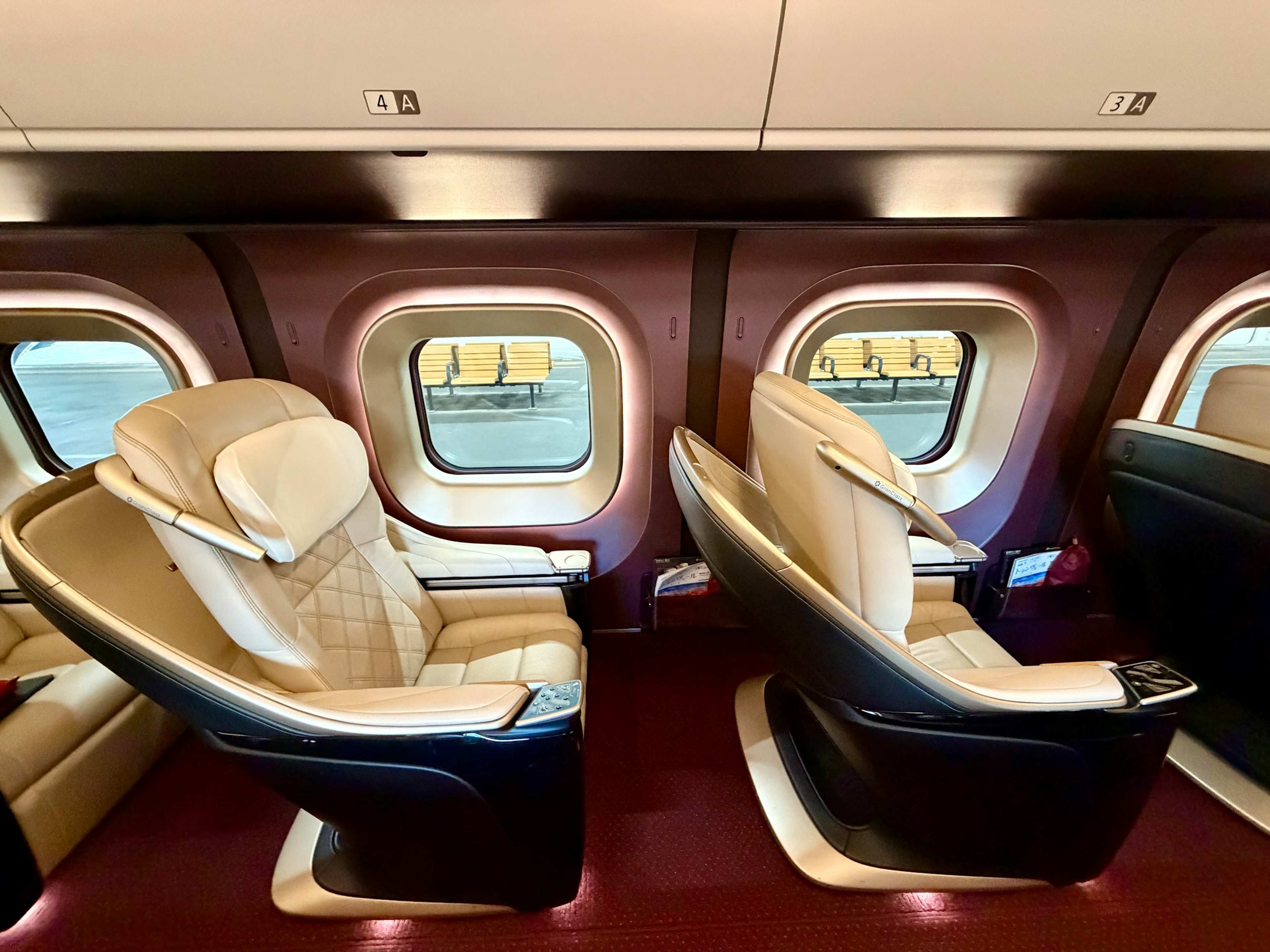
You’re standing under a vaulted ceiling.
The pigeons don’t care about your schedule.
A departure board clicks. One destination at a time.
You exhale. For the first time today, you exhale.
The airport never gave you that. The airport handed you a boarding pass and a binary choice: be here or be there. No corridor between. No ceremony. Just a pressurized tube that yanked one version of you off the ground and deposited something slightly altered – slightly frayed – somewhere else entirely.
In daily life, we define ourselves by our routines and familiar places. At an airport, those things disappear. The problem isn’t the disappearance itself. The problem is the speed of it. The problem is that nobody warned the inside of you before the outside of you got on the plane.
There is a name for what you are actually craving at a train station. It is not nostalgia. It is not the romance of steam and iron. It is the permission to transition slowly – to be neither the person you were at home nor the person expected at your destination. To exist, briefly, in the gap between those two performances.
1. The Velocity of Identity
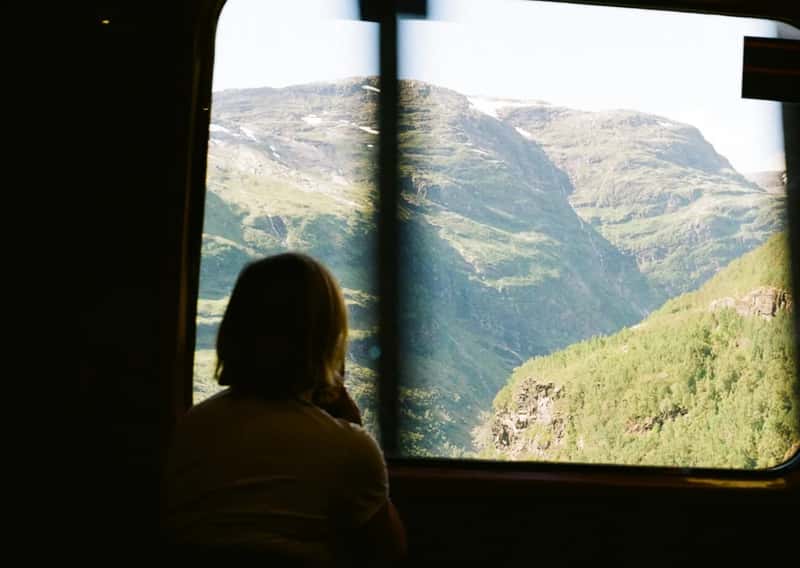
Modern air travel does something quietly violent to the self.
It compresses the transition.
One scholar, Alexandra Murphy, has argued that airplane travel is inherently liminoid – suspended in the sky, neither here nor there and crossing thresholds of time and space. Murphy posits that flights shift our existence into a limbo space in which movement becomes an accepted set of cultural performances aimed at convincing us that air travel is a reflection of reality rather than a separation from it.
A performance. That word lands hard.
Because that is exactly what you are doing the moment you buckle in. You are performing composure. Performing readiness. Performing the version of yourself that belongs at the destination – the professional, the tourist, the returning child – before you have had a single quiet moment to actually become them.
The train doesn’t ask for that performance. The train just moves. And while it moves, so do you – inward, gradually, through the layers of whoever you were this morning.
Identity needs velocity, too. Just not the kind that breaks the sound barrier.
2. The Permission Slip You Never Got
Airports were not designed for the inner life.
They were designed for throughput.
Due to the haziness of time and place, airports create a sense of disorientation. We define ourselves in terms of time and place. We know who we are in relation to our daily routines and our familiar environments. Strip those away at 500 miles per hour and the disorientation isn’t liberating. It’s destabilizing.
Train stations, by contrast, breathe at a human tempo.
You arrive early. You sit. You watch the city bleed into the suburbs through the glass. Each passing kilometer is a small renegotiation with yourself. The person who left the apartment is slowly becoming the person who will walk out the other end.
That renegotiation is not a luxury. Psychology calls it identity processing – the quiet, continuous act of reconciling who we have been with who we are being asked to be next.
The airport never gave you that time. It simply stamped your boarding pass and expected you to figure it out at 30,000 feet.
3. The Threshold Effect
There is an ancient word for what train travel offers.
Liminality.
Anthropologist Arnold van Gennep first described liminal spaces in 1909 as the middle phase of rites of passage – that ambiguous period when we leave an old identity behind but haven’t yet stepped into a new one.
Train travel is a controlled liminality.
You know where you started. You know where you’re going. But the time between – the scrolling fields, the tunnels that briefly swallow all light, the coffee cooling in the dining car – that time belongs to no role, no obligation, no performance.
The threshold is where transformation happens, precisely because the old structures have fallen away and the new ones have not yet taken their place.
A train station is a threshold you can stand in. An airport is a threshold you are pushed through.
The difference is consent.
And consent, in the psychology of identity, is everything.
4. The Noise You Can’t Name
The anxiety you feel at airports is not just about flying.
It’s about compression.
As the field of environmental psychology has demonstrated, human beings are very sensitive to our immediate surroundings and can easily become “overloaded” by stressors such as crowds and noise. Stress and anxiety can produce irritability, both on a temporary and ongoing basis. People who are generally anxious may be more prone to anger – and a temporary anxious mood can trigger angry outbursts.
But underneath all that sensory overload is something quieter and stranger.
It is the feeling of being asked to be two people at once.
The person at the check-in desk. The person at the destination. The person in the middle who has not yet been given any name at all.
Airports collapse that middle figure. The terminal is designed to make the middle disappear – to make the gap between who you were and who you must become seem like nothing more than a brief inconvenience between gates.
But the gap is not an inconvenience. The gap is where the real you lives.
5. The Anecdote I Keep Coming Back To
I took a night train once from one life to another.
I don’t say that dramatically. I mean it literally. I was leaving a job, a city, a version of myself I had worn so long it had started to feel like skin. I could have flown. It would have taken ninety minutes. Instead I booked a sleeper car, pressed my forehead against a cold window, and watched darkness scroll past for seven hours.
By the time dawn came, something had shifted.
Not resolved. Not fixed. But shifted.
The absence of structure, the loss of familiar roles and routines, creates a kind of openness. It is in these transitional times that many people report the deepest personal growth, the most significant shifts in how they see themselves and their lives.
The train didn’t fix me. It gave me time to be unfixed.
That is something an airport, with its fluorescent insistence on forward movement, will never understand how to offer.
6. The Architecture of Permission
Walk into a great train station and notice what happens to your body.
Your shoulders drop. Your pace slows.
There is a reason for this. Grand train stations – think the limestone arches of Union Station, the iron roof of St Pancras, the cathedral vault of Grand Central – were built with the unconscious in mind. Not intentionally. But architecturally, they function as permission structures: spaces that say, you are allowed to be here, in this between, for as long as you need.
Detachment from identity and roles is one of the common psychological effects of liminal space. When you encounter these “in-betweens,” the individual often gets detached from their usual identity and roles.
That detachment, inside a train station, feels like relief.
Inside an airport, the same detachment feels like panic.
The architecture is the difference. One space says: pause. The other says: move. Your nervous system knows the difference long before your conscious mind catches up.
7. The Social Contract of Slowness
There is an unspoken social agreement aboard a train that does not exist on a plane.
You are allowed to be nobody for a while.
One of the more stressful things about travelling with others is losing control over many aspects of how we spend our time en route. Lack of control makes us tense and as a result we’re both physically uncomfortable and less able to cognitively process incoming information.
But on a train, the loss of control feels chosen. You chose the window seat. You chose the rhythm. You chose to let the landscape do the work that your mind, for once, does not have to do.
The train offers what psychologists call restorative experience – a period of low-demand engagement that allows the directed attention systems to quietly recover. Contemplation and introspection are key psychological effects of these liminal spaces. These unfamiliarities give rise to deep thought, which leads to a better understanding of past, present, and future. Introspection acts as a tool in individual personal growth and development. Moreover, this introspection can make people understand their beliefs, values, purpose, and emotions.
The airport is the opposite of restorative. It is an attention ambush from the moment you step inside.
8. The Identity Gap
You are, at any given moment, several people.
The one your boss knows. The one your mother knows. The one you are when nobody is watching and the refrigerator is the only witness.
The same thing happens with identity. In normal life, we play certain roles, like being a worker, a student, or a parent. Being at an airport gives people a chance to step outside their usual identity, which can be refreshing.
But the airport’s version of identity freedom is a blunt instrument.
It doesn’t ask which version of you needs to emerge at the other end. It simply dissolves structure, floods you with strangers, and calls that liberation.
Train travel is more surgical. Psychologically, it is a kind of identity limbo. The person who you thought you were doesn’t fit anymore, but the new you hasn’t solidified yet. And that is exactly the state the long-distance train passenger inhabits – deliberately, willingly, with a cup of tea and a window.
The identity gap, on a train, is not a crisis. It’s a corridor.
9. The Nervous System Knows First
Your body understands transit before your brain does.
The gut tightens at departure screens. The jaw unclenches at the sound of wheels on iron. These are not irrational responses. They are ancient calibrations.
Liminal spaces change how the brain processes information. The anterior cingulate cortex, the brain’s conflict detector, becomes hyperactive in ambiguous situations. Meanwhile, the amygdala starts firing warning signals about potential threats lurking in the unknown. This neurological response evolved to keep our ancestors alive in genuinely dangerous situations.
A train moves at a speed the human nervous system can track. You can see the world passing. You can feel the deceleration as you approach a station. Your body receives constant information: you are here, now you are here, now here.
A plane offers none of that. You are hurled through a white void and asked to remain calm.
The nervous system doesn’t prefer the train for sentimental reasons. It prefers the train because the train tells the truth, in real time, about where you are.
10. The Slow Return to Yourself
The deepest reason you prefer the train station is also the hardest one to say out loud.
Because it requires admitting that the person you have to be at your destination is not always the person you want to be.
And that the journey – the slow, uncertain, coffee-scented, window-fogged journey – is the only time nobody is asking anything of you at all.
In psychology, a liminal space is called a threshold state: a pause, a transition, a space that can feel uncertain, uncomfortable and even disorienting. It tends to show up during big shifts – ending a relationship, changing careers, outgrowing an identity, healing from a former version of yourself. It’s the space between the old story and the new one – it rarely comes with a roadmap and often comes with a feeling of being lost.
Being lost, on a train, is tolerable. Even beautiful.
During their time in the liminal space, their previous identity will try to bring them back while their new identity pushes them forward. Torn between the push and pull, a person may either lose their newfound clarity or solidify a new identity entirely.
The train gives you long enough to feel both pulls. Long enough to sit inside the tension without resolving it prematurely. That is not a design flaw in rail travel. That is the entire secret of it.
We live in an era that is allergic to unresolved things. We fast-forward through the gaps. We optimize the transitions. We medicate the in-between.
But the in-between is where you actually live. It is where decisions form before they become decisions, where grief finishes its slow work, where the next version of you assembles itself quietly in the window seat, watching fields go by, not yet ready to arrive, not yet required to be anyone in particular.
The train station, with its pigeons and its iron and its patient clocks, is not a relic of slower times. It is a monument to a psychological truth the modern world keeps trying to route around: that the self is not a toggle switch. It does not flip from one state to another without cost.
It needs the corridor. It needs the rolling miles. It needs the particular mercy of a journey that cannot be fast-forwarded.
So the next time you feel more at peace on the platform than in your own home, don’t diagnose it as restlessness. Recognize it as intelligence – the intelligence of a self that knows it needs more time before it agrees to become the next thing you’re asking it to be.