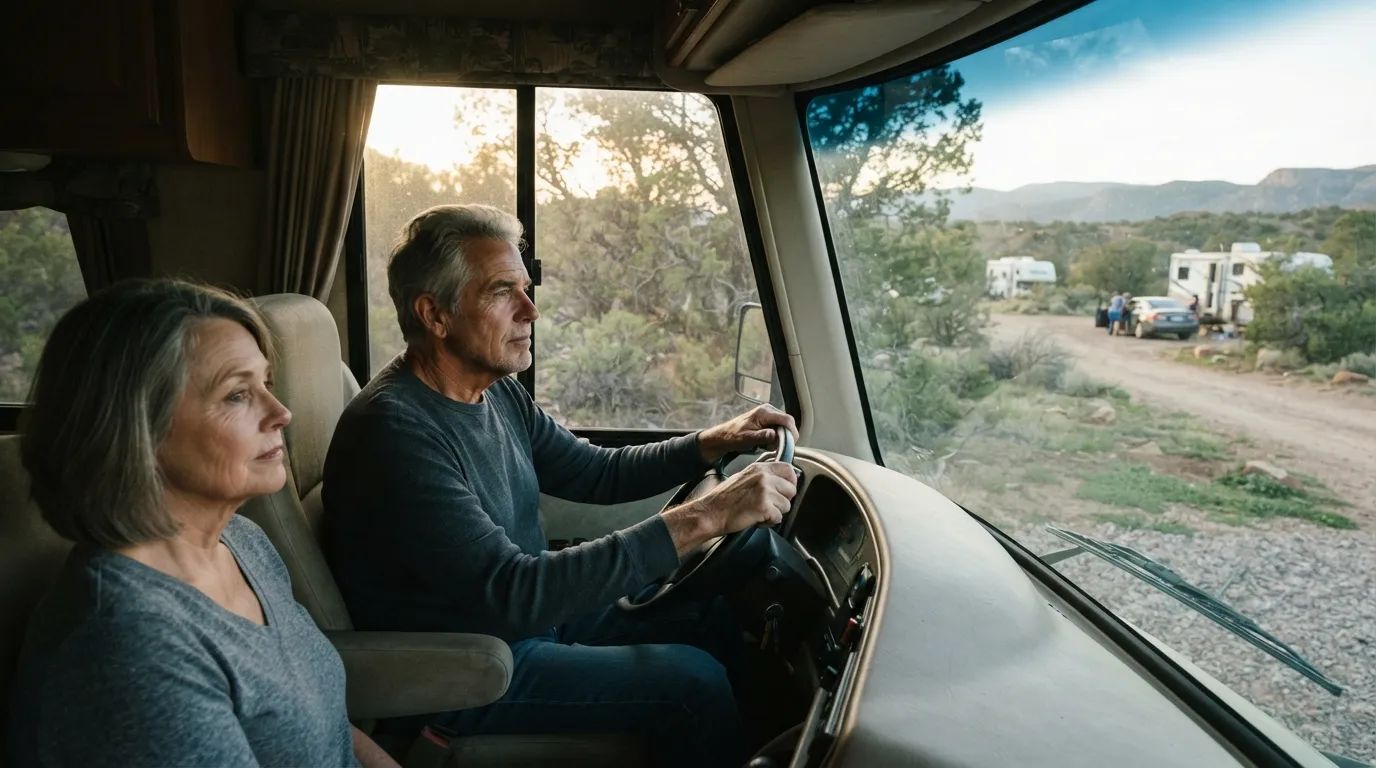
Most people assume the hard part of motorhome life is the driving. Longtime owners will tell you the real trouble starts after the engine shuts off, when a spot that looked perfect at 5 p.m. turns into a tilted, noisy, or flooded problem by midnight. These are the 13 checks they run before they ever unfold a chair.
The surprise is how unglamorous the list is. There are no gadgets and no secret campsites, just small habits that separate a smooth night from a 2 a.m. scramble. Some take ten seconds, and one of them decides whether you wake up where you parked.
#13 – The Level Check That Quietly Protects Your Fridge
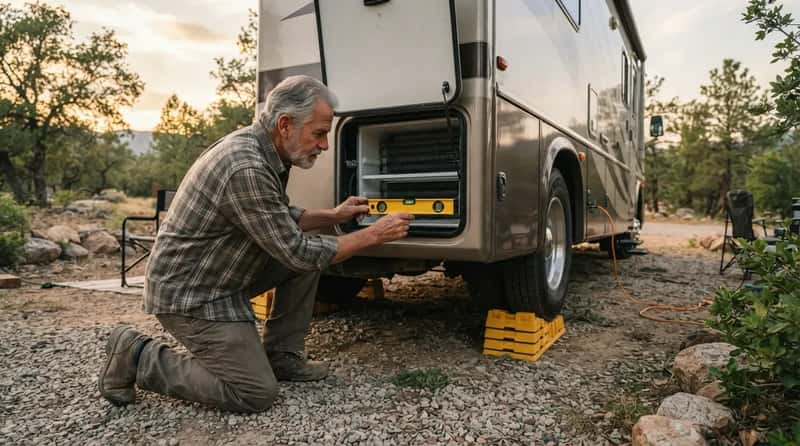
The first thing a veteran checks isn’t the view. It’s the bubble. Before unpacking anything, they find out whether the rig is sitting flat, because an unlevel night can affect more than your sleep. Many RV refrigerators use an absorption system with no compressor, and manufacturers commonly warn that running one well out of level hurts cooling.
Then there’s the human side. A bed that slopes toward the cab means a night of slowly sliding downhill. Sinks and shower pans drain strangely, and cabinet doors swing open on their own. Owners use a cheap bubble level or a phone app, then reposition or stack blocks under the low wheels before settling in.
But that’s nothing compared to the rule that decides whether you’re allowed to be there at all, in #12…
#12 – “Free Overnight Parking” Is Never as Free as the Rumor Says
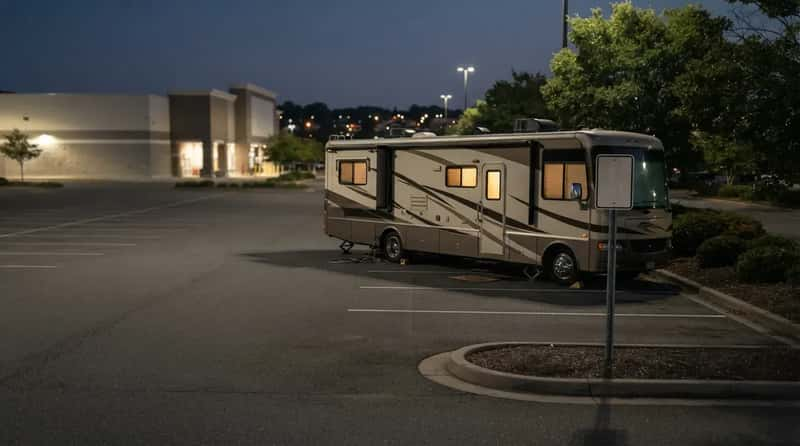
Veterans never trust a rumor about where overnight parking is allowed. Retail chains such as Walmart have long let many stores host RVs, but the policy is set store by store and can be overridden by local ordinances. A friendly lot last year can carry a “No Overnight Parking” sign this year.
So they look for posted signs first, then walk in and ask a manager. They also read recent app reviews, since a note from last week beats a blog post from 2019. Public land has its own limits too. BLM dispersed camping, for example, generally comes with a 14-day stay limit.
Here’s the opinion that starts arguments. Plenty of first-timers treat big-box parking lots as the smart budget move, but many veterans call them the most overrated night of the trip. They point to the bright lights, the traffic, and the idling trucks that never seem to stop.
And the next check involves something most drivers never look at until it’s too late…
#11 – Look Up Before You Pull In: The Overhead Surprise
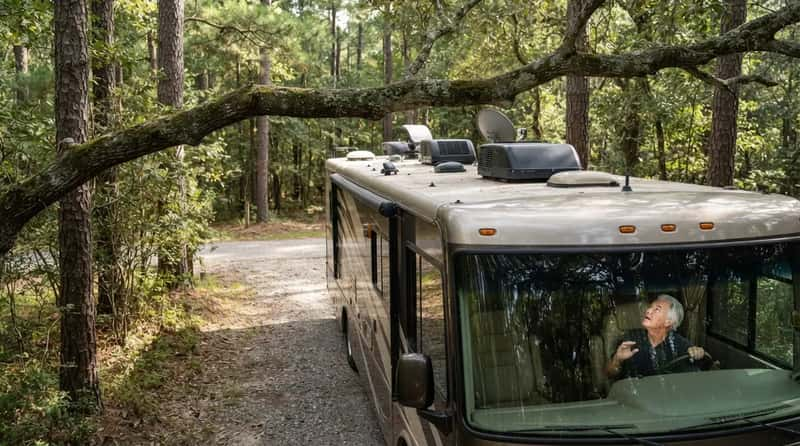
Seasoned owners look up before they look anywhere else. A motorhome’s roof is crowded with air conditioners, vents, antennas, and sometimes solar panels, and one low branch can rip off equipment you can’t even see from the driver’s seat. Many Class A rigs stand somewhere around 12 to 13 feet tall, so the clearance is thinner than it feels.
They study the branches themselves, too. Dead limbs can drop in wind, and sap and pine needles are a messy overnight bonus. The habit repeated most often is simple: know your exact height, write it down, and stick it where you can see it from the driver’s seat. Then check for low branches, wires, and signs on the way in, and for dead limbs directly overhead, not just beside you.
Fast Facts
- Many Class A motorhomes measure roughly 12 to 13 feet from the ground to the top of the roof gear.
- The tallest point is often a rooftop air conditioner or vent, not the roofline you see from the cab.
- A sticky note with your exact height, rooftop gear included, saves guesswork on every approach.
- Dead limbs directly overhead are a bigger overnight risk than live branches off to the side.
Roof damage is costly, but what’s underneath the tires can cost you even more, and it’s #10…
#10 – The Soft-Ground Trap That Turns Into a Tow Bill
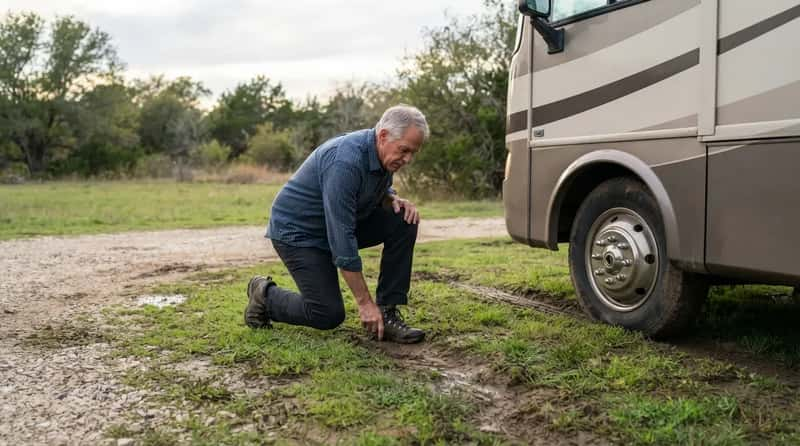
The scariest part of soft ground isn’t parking on it. It’s trying to leave. A loaded motorhome can weigh well over 15,000 pounds, and grass that feels firm at noon can swallow a tire after one rain shower. Sand, fresh gravel, and shoulders with loose edges can do the same thing.
Veterans walk the spot on foot before they drive onto it. They press a heel into the ground and look for ruts, wet patches, or tracks from other vehicles that sank. When they’re unsure, they take the pavement or hard-packed gravel and skip the prettier spot. A tow for a stuck rig can easily run into hundreds of dollars, and that’s before any damage.
Next up is a check that has nothing to do with the ground, and it’s one many people skip…
#9 – Signal Bars and Forecast: The Two-Minute Check Everyone Skips
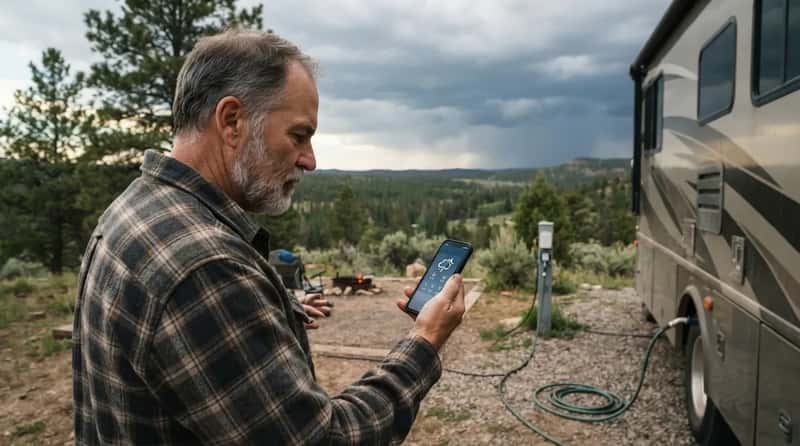
Veterans check their phone before they check the grill. A site with zero signal and a storm on the way is a very different night than a site with one bar. They look at the overnight forecast for wind, storms, and temperature, and they confirm they can actually receive weather alerts where they’ll be parked.
Temperature matters too. If the forecast dips near freezing, owners think about water lines and hoses, since frozen plumbing is one of the classic RV headaches. Camping apps and recent reviews often mention signal quality, so they read those before arriving and then confirm with their own phone.
If a front is rolling in, they decide in daylight whether this is a spot to stay or a spot to leave. Waiting until the wind picks up is when the bad calls get made.
But the quietest problems tend to hide in the tanks and the batteries, as #8 shows…
#8 – The Tank and Battery Math That Ruins the Morning
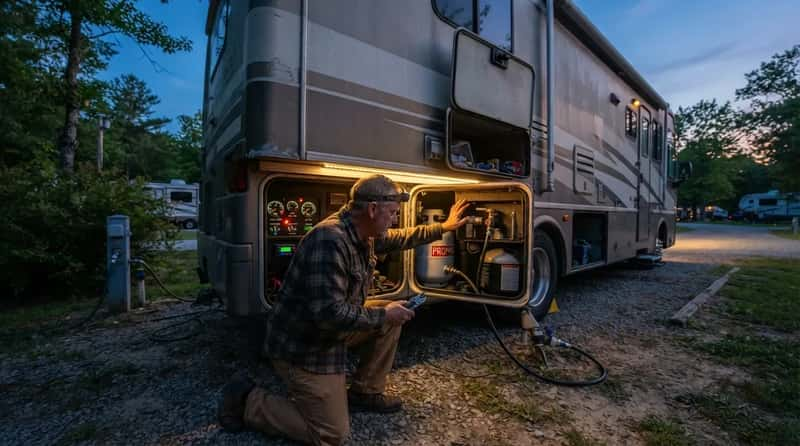
Running out of something at 10 p.m. is a preventable mistake. Before settling in, veterans check fresh water, gray and black tank levels, battery charge, and propane, because the dump stations and fuel stops they’d need are often closed after dark.
The battery check is the sneaky one. A furnace fan draws power all night, and traditional lead-acid batteries are commonly advised not to be drained much below about half, since deep discharges shorten their life. So owners estimate how much power the night will use and whether they’ll wake up to a dead house battery and a cold cabin.
The next check takes a lap around the rig, and what veterans find there can change their plans…
#7 – The Walk-Around That Catches What the Drive Did
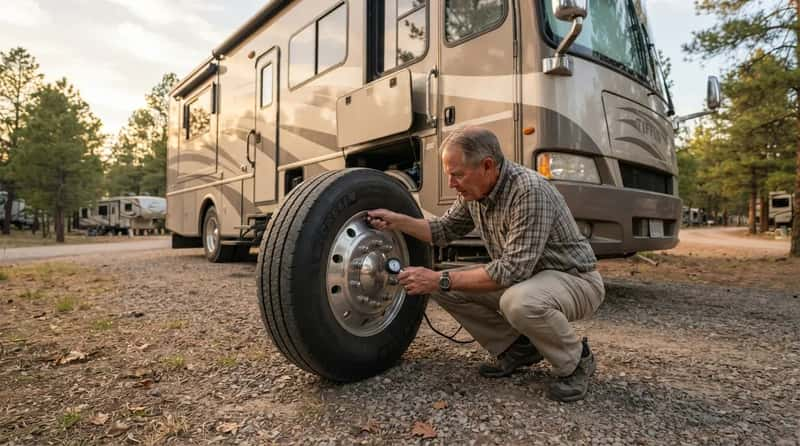
After a long day, veterans do a slow lap. That lap often finds what the road quietly did to the rig, such as a bulging tire, a dangling cable, a loose compartment door, or fluid on the ground where there wasn’t any this morning. It’s the cheapest inspection in the whole hobby.
Tires get the most attention. Owners check pressure when the tires are cold and look at the sidewalls for cracks or bulges. They also read the date code, since tire guidance commonly calls for replacement within roughly 5 to 10 years regardless of tread depth. A rig can look brand new and still be riding on old rubber. While they’re at it, they look under the engine and tanks for drips and give steps, jacks, and latches a quick tug.
Worth Knowing
- The DOT code on the sidewall ends in four digits: the first two are the week and the last two are the year the tire was made.
- A code ending in 2423 means the 24th week of 2023.
- “Cold” pressure means the tires haven’t been driven on, or have sat for a few hours.
- Use the pressure listed for your rig’s load, not the maximum number molded into the sidewall.
Once the rig itself checks out, the focus shifts to something more human: the people parked around you, in #6…
#6 – The Neighbor Test: Why Generator Etiquette Is a Big Deal
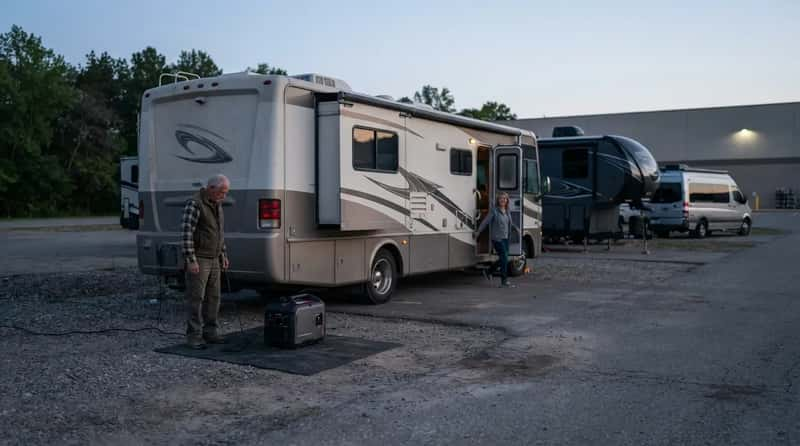
Veterans know that how you’re perceived matters as much as where you park. Many campgrounds enforce generator quiet hours, often covering late evening into early morning. In parking lots, one noisy generator can be enough to get a business to ban overnight RVs for everyone.
So they check who’s nearby and whether they’ll be a nuisance. They think about generator noise, bright interior lights, and slide-outs that grind loudly at 6 a.m. Here’s another opinion that divides owners. Plenty argue that running a generator in a shared lot is the single most selfish thing you can do, and the main reason friendly lots disappear.
The next check has nothing to do with people, but it can still wreck your gear…
#5 – Sun and Wind: The Forecast Your Awning Cares About
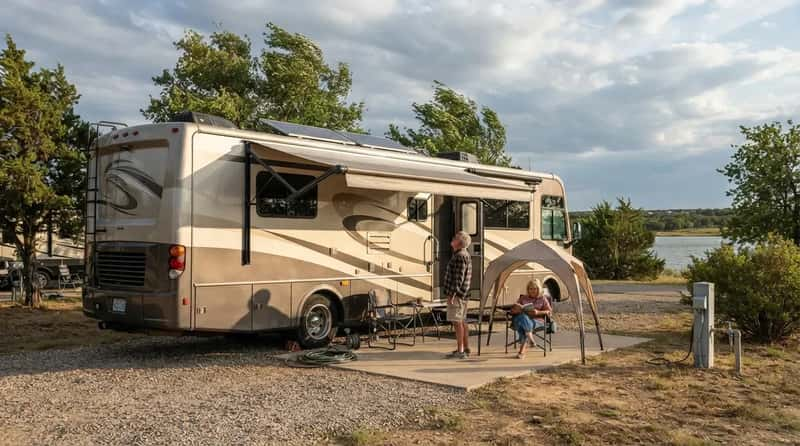
An awning acts like a sail, and veterans treat it that way. A sudden gust can bend the arms or tear the fabric in seconds, and manufacturers commonly advise retracting awnings in wind or when no one is watching the rig. Many owners simply roll it in at night, no matter how calm the sky looks.
The sun matters too. Veterans think about where it will rise and which side of the rig will take the heat. In summer, they try to shade the bedroom side. In winter, they often aim to catch the morning light instead. The same thinking applies to solar panels, which perform better when trees and buildings aren’t blocking them.
Quick Compare
- Summer: Shade the bedroom side so the cabin stays cooler at sunrise.
- Winter: Face the big windows toward the morning sun for free warmth.
- Solar: Open sky beats a pretty tree-lined spot.
- Awning: Roll it in overnight, whatever the sky looks like.
It sounds small, but one bent awning is often enough to make an owner park differently forever.
Still, nothing here is as serious as the next check, which can’t be seen at all…
#4 – The Invisible Threat: CO and Propane Alarms
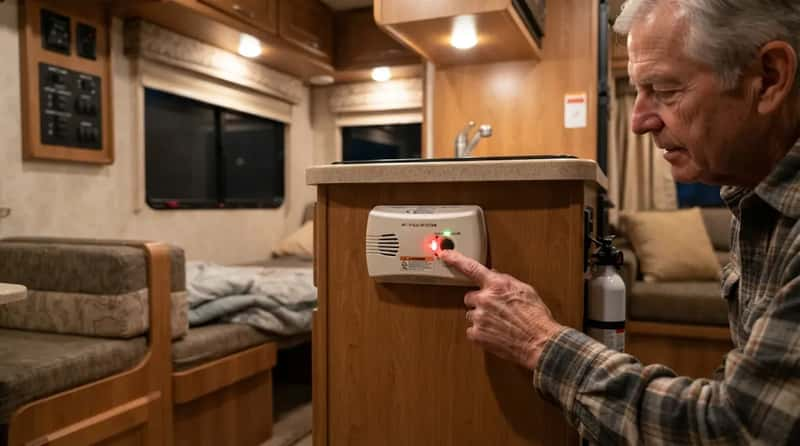
Carbon monoxide has no smell and no color, and veterans test their alarms precisely because they can’t rely on their senses. Before sleeping, they press the test button on the CO alarm and the propane detector. They also confirm that the batteries or power supply are working.
They think about exhaust as well. Generators and engines produce CO, and fumes can drift into open windows, including from a neighbor’s generator parked close by. So owners avoid running one near sleeping areas and keep vents clear of snow or debris.
And if you think that’s serious, wait until you see how much damage a quiet patch of dry ground can do in #3…
#3 – Dry Washes and Low Spots: The Flood That Starts Miles Away
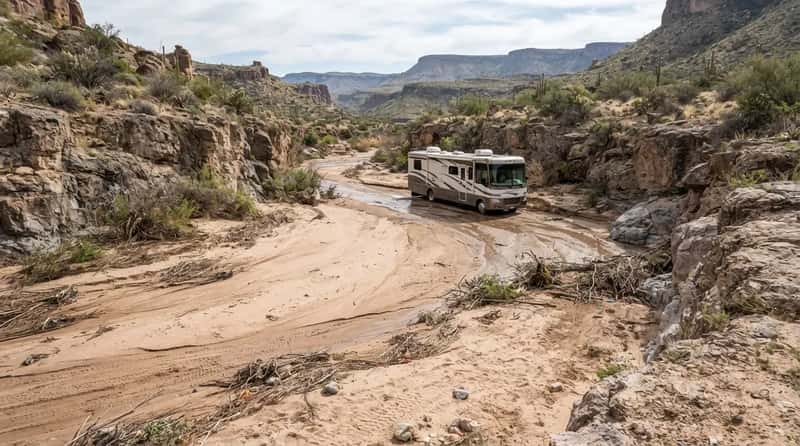
Some of the most dangerous spots look the calmest. A dry wash or low spot can seem like a perfect flat pad, with soft sand and a gorgeous view. But flash floods can be triggered by rain falling miles upstream, where you can’t see or hear the storm.
Veterans look for the warning signs. They check for drift lines, debris caught in branches, and smooth channels cut into the ground. They avoid parking below dams or in the bottom of canyons when storms are forecast. If there’s any chance of heavy rain, they pick higher ground even when the view is worse.
Even a safe spot is a bad one if you can’t leave it, which brings us to #2…
#2 – The Five-Minute Exit Plan Nobody Talks About
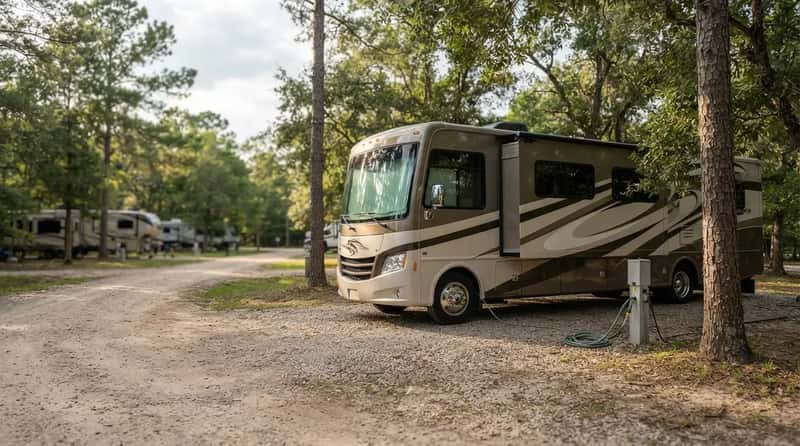
Veterans always ask one question: how fast could I be gone if I had to leave? They park so the rig can pull straight out, ideally nose forward, without backing up in the dark or squeezing around other vehicles.
That shapes how they set up. They keep the keys in a consistent place and avoid spreading gear all around the outside of the rig. Many keep levelers and hoses simple so they can pull them in quickly. A storm, a sketchy visitor, or a sudden police knock can mean you need to move, and a half-deployed camp makes that much harder.
But the most important check of all can’t be found on any list or app, and it’s #1…
#1 – The Gut Check That Beats Every App
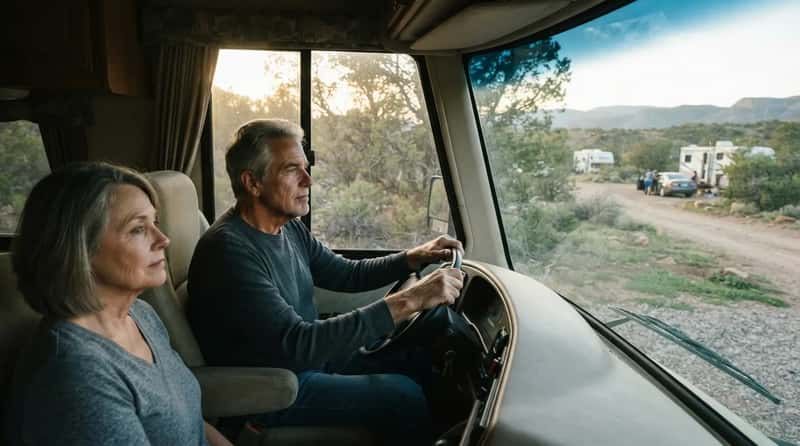
The last check isn’t technical. It’s a feeling, and many veterans say they’ve left a perfectly legal, perfectly level spot just because it felt wrong. They sit for ten minutes with the engine off and watch who comes and goes, how the lighting looks, and what the ground is covered in.
Warning signs are often small. They include broken glass, groups lingering in cars, piles of trash, or a general sense of being watched. Veterans also stress arriving before dark whenever possible, since daylight makes every other check on this list easier. Reviews and ratings help, but they can’t replace what you see and sense with your own eyes.
At a Glance
- The sit test: Ten minutes, engine off, eyes open.
- Watch: Who arrives, who leaves, and who never seems to go anywhere.
- Look: Lighting, litter, and whether other travelers chose to stay.
- Decide: If the first reaction is unease, drive on while there’s still daylight.
None of these checks is complicated, and that’s exactly the point. Veterans run through them almost automatically, and most take less time than making coffee.
If the gut says leave, they leave, even if dinner is already on the stove. The cost of moving is a little time. The cost of ignoring the feeling can be far higher, and every veteran has a story about the night they learned that the hard way.