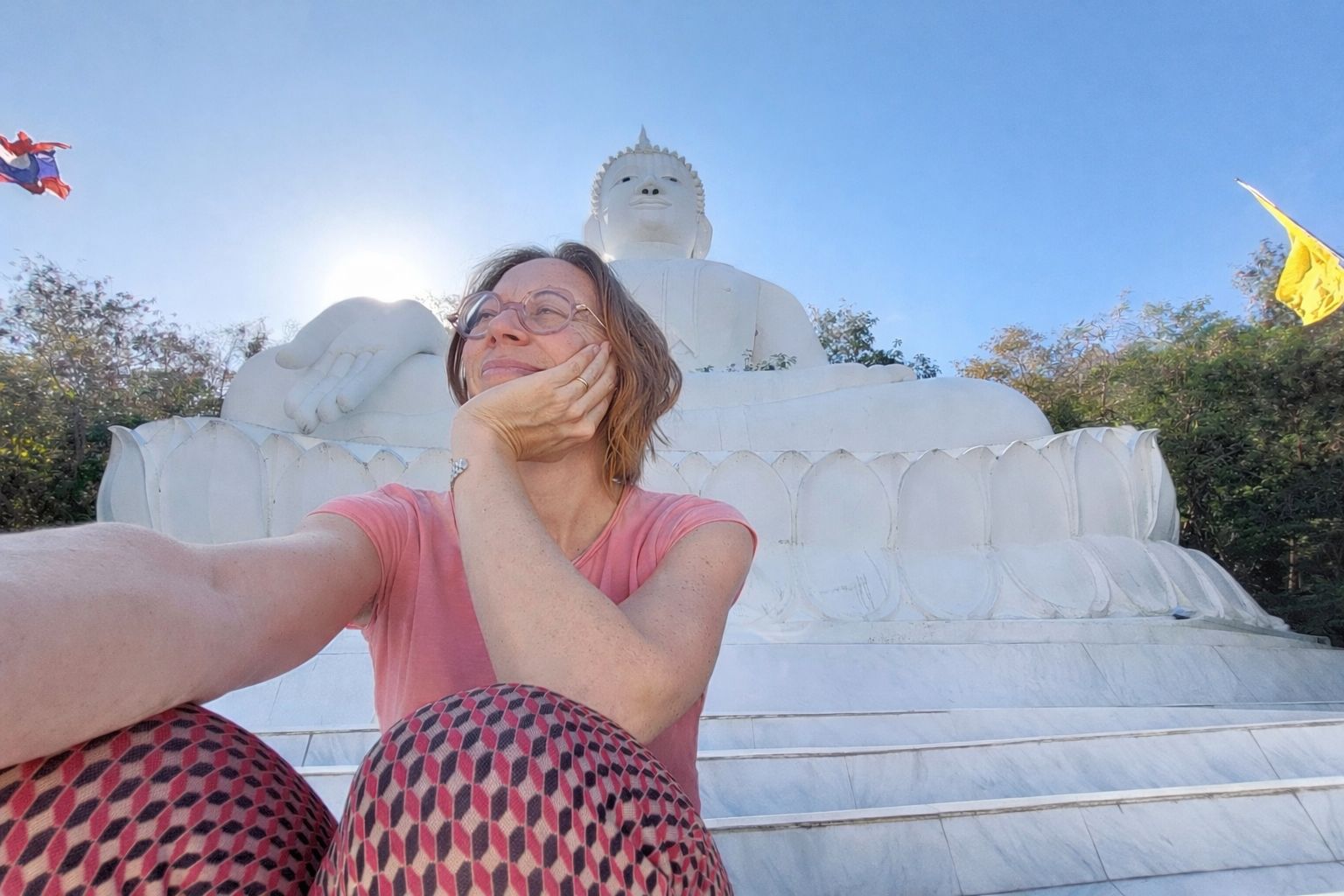
Road-tripping through central Thailand, the pace seems to slow on its own. This happens most clearly along the stretch connecting Khao Yai National Park to Bangkok, when the jungle thins out, traffic fades into the background, and a solitary mountain appears on the horizon. Embedded in its green flank, almost suspended, a large white Buddha statue looks out over the plain.
This is Wat Thep Phithak Punnaram, a temple that doesn’t assert itself through opulence (no gold, only white plaster), but through the effort required to reach it. It makes for an ideal pause if you’re returning from Thailand’s most famous national park, before heading back to the capital and on to other destinations. Necessary or not, the stop is absolutely worth it: of all the temples I’ve seen in the country, this is the one that struck me the most—not so much for sheer beauty, but for its singular character, helped along by a name that feels borrowed from one of Zelda’s shrine, adding a playful note to the experience.
The Lower Temple: A Living Village
At the base of the mountain, at the sanctuary’s entrance, the space feels animated, colorful, layered, and surprisingly informal. Colored lanterns hang from the trees, often lit in the evening or during festivals. Peacocks roam freely, crossing the paths with distracted elegance, sometimes fanning their tails with no concern for visitors. Smaller shrines and statues are scattered across a series of open courtyards, alongside offering areas, shaded benches, and open-air pavilions where people stop to rest.
The lower temple doesn’t present itself as a fixed route, but as a collection of spaces meant to be inhabited. Even the simplest details—a broom leaned against a wall, a bowl of water left out for animals—contribute to a sense of authenticity that feels unmanufactured. The impression is that of arriving in a small village that quietly regulates itself under the benevolent, watchful gaze of the Buddha.
The presence of monks in vivid orange robes and local worshippers is discreet but constant, especially early in the morning. Religious practice blends seamlessly with routine: cleaning, arranging, praying. As for admission, the situation remains deliberately fluid. Sometimes a donation is suggested; other times, no one asks for anything. It’s never a significant amount, nor does it condition the visit. The real price is the climb itself—the energy required to reach the top. A physical cost that makes the experience more memorable than any ticket ever could.

The Ascent to the Buddha: An Epic, Hypnotic Gesture
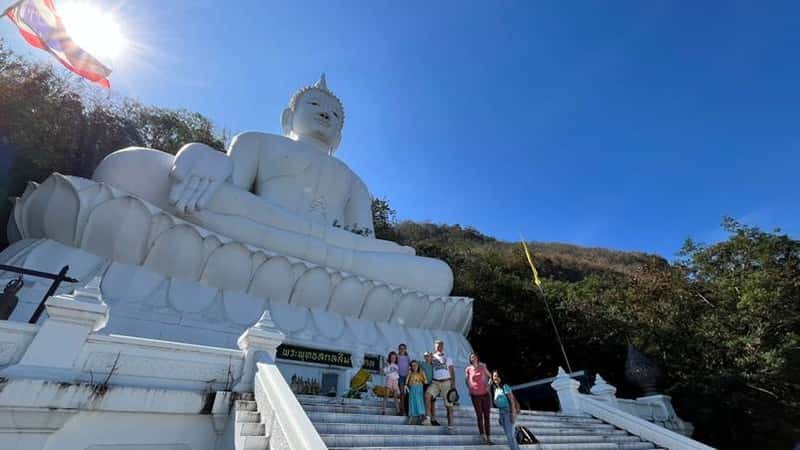
The large, gleaming white Buddha set into the mountainside calls visitors upward. Reaching the top is, unsurprisingly, demanding. From the parking area begins a long staircase that rises straight toward the sky—more than 1,200 steps. This is no casual walk: the elevation gain is substantial, especially during the hottest hours, when temperatures easily exceed 90°F, and the humidity offers little mercy.
The ascent is continuous, broken only at regular intervals by shaded rest areas that provide compelling views over the temple below and the vast green sea of forest stretching endlessly around it.
Each step sets the rhythm, turning the climb into a mechanical gesture that gradually clears the mind and induces a meditative state—surely intentional on the part of whoever designed this place, aiming for spiritual milestones alongside physical ones. The effort is not a side effect; it is integral to the experience. The climb becomes an intentional act, a quiet preparation for the deep sense of spirituality that awaits at the summit.
At the Top: Silence and Distance
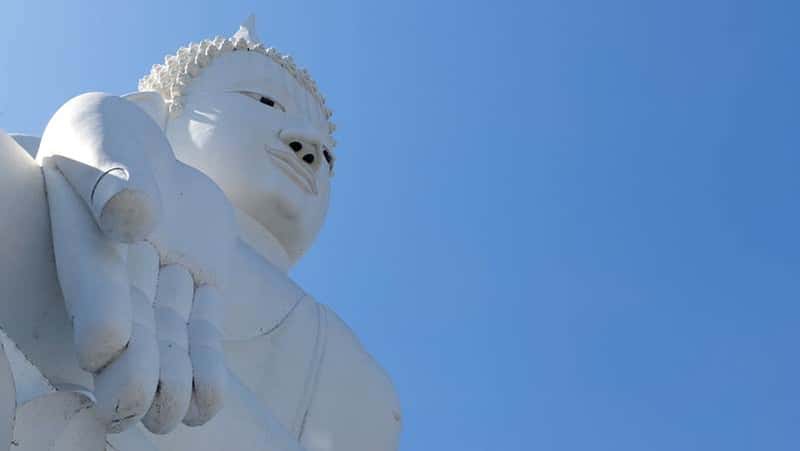
Eventually, the steps come to an end. At the top, the first thing that struck me was the sudden silence. I stopped paying attention to the sound of my breathing and the rhythm of my steps, and was instead enveloped by stillness—a moment that brought an immediate sense of peace. The massive white Buddha statue, rising more than 90 feet tall, dominates the space with a calm, benevolent presence that doesn’t demand attention, but naturally receives it.
The small sacred terrace is essential and powerfully symbolic. Rows of metal bells hang from light beams, rung one by one by visitors; nearby stands a simple yet densely layered altar of offerings—lotus flowers, marigold garlands, incense sticks, bottles of red soda left as gifts to the spirits—arranged at the feet of the Buddha. Beyond it all, nothing obstructs the view: the landscape stretches uninterrupted for miles and miles of forest, barely traced by invisible roads and the slow movement of low clouds.

Practical info at Wat Thep Phithak Punnaram
The temple grounds are generally open daily from early morning to late afternoon, roughly between 6:00 a.m. and 6:00 p.m., with no fixed ticketing system—donations are voluntary. There’s no formal restaurant at the site, but small stalls near the entrance often sell bottled water, soft drinks, and simple snacks, which are best picked up before starting the climb.
It’s wise to eat beforehand and bring water, especially given the heat and the physical effort required. Restrooms are available near the lower entrance area, but not at the top, reinforcing the idea that once you begin the ascent, the experience is meant to be uninterrupted and intentionally focused.
A Necessary Pause
In its simplicity, Wat Thep Phithak Punnaram tells an epic story. It functions as a conscious pause along the journey, a transitional place between nature and city. Just a couple of hours—climb, stop, descent—are enough to feel its effect. And it offers a distilled lesson worth carrying forward: that the combination of silence, effort, and temporary distance from the noise of the world is profoundly beneficial to both body and soul.