
Most passengers think the cabin steward is just someone who refreshes towels and folds toilet paper into a triangle. Turns out, by the time you’ve left for your second breakfast, they’ve quietly built a detailed profile of exactly who you are.
Your sleep schedule, your relationship dynamic, your habits, whether you’re a first-timer or a seasoned cruiser – it’s all in there. The clues are everywhere in your cabin, and you left every single one without realizing it.
#10 – How Organized Your Cabin Is the Moment They Walk In

The state of your cabin on day one tells your steward everything they need to know about the week ahead. A cabin with clothes put away and suitcases stowed signals a seasoned traveler who needs minimal management.
One buried in open suitcases signals someone who’ll need more hand-holding – and more of the steward’s time. Experienced stewards say they can predict a passenger’s entire week just from how the cabin looks at first turndown.
The moment your bags are still blocking the aisle on day two, you’ve been mentally tagged as a high-maintenance cabin.
Cruise cabins are tight, even the nice ones, so bags piled by the door make everything harder. Tuck luggage into a corner or under the bed and the whole week runs smoother.
It’s one of the simplest signals a guest can send, and most people never think twice about it. But that’s nothing compared to what the steward clocks the second they glance at your bathroom counter…
#9 – What’s Sitting on Your Bathroom Counter

Your bathroom counter is practically a biography. Stewards aren’t snooping – they’re cleaning – but what’s laid out tells them exactly what kind of traveler you are.
They know what time you wake up based on when the shower runs. They can also tell if you’re fighting with your travel companion just from how the beds are arranged.
Worth Knowing
- Skincare and grooming products hint at a routine your steward will quietly build service around.
- Damp towels reveal exactly what time showers happen, without you saying a word.
- Extra toothbrushes or razors can signal more guests are staying in the cabin than booked.
- Over-the-counter medication on display often shows a steward that someone’s feeling under the weather.
Prescription medications left out in plain sight – especially quantities of them – are one of the first things stewards silently register.
It’s not judgment. It factors into how carefully they clean around specific areas of the room.
Guests who habitually leave things out signal they’ll need extra attention all sailing long. What you leave on the nightstand, though, is where it gets genuinely uncomfortable…
#8 – Valuables Left Out in the Open
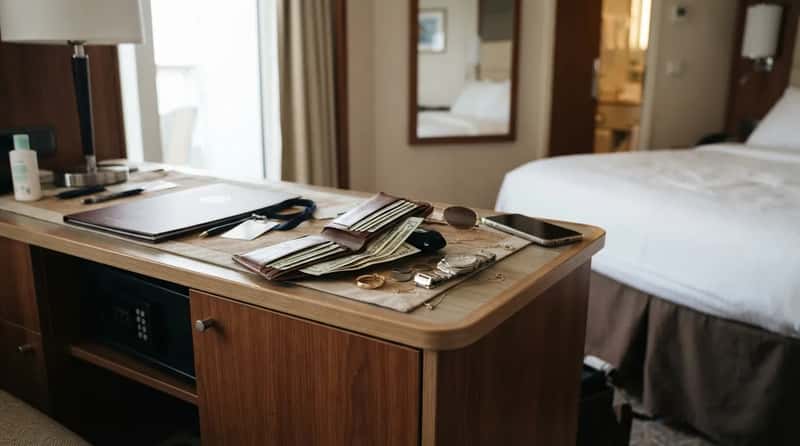
This one stresses out your steward far more than you’d ever guess. Some guests leave watches, cash, or jewelry sitting right out on the desk without a second thought.
It rarely occurs to them that this puts everyone in an awkward position. Stewards often say it’s genuinely stressful cleaning a room with cash on the nightstand, since anything missing later becomes their problem to explain – even if they never touched it.
Leaving cash or valuables out doesn’t signal trust – it puts the steward’s entire career at risk from a single false accusation.
Most cruise lines quietly recommend the in-room safe for exactly this reason. A dresser drawer, a closet, or the safe is the safer call every time.
The next thing they notice is something you do every time you leave the room – and most passengers get it wrong…
#7 – Whether You Use the Door Sign Consistently
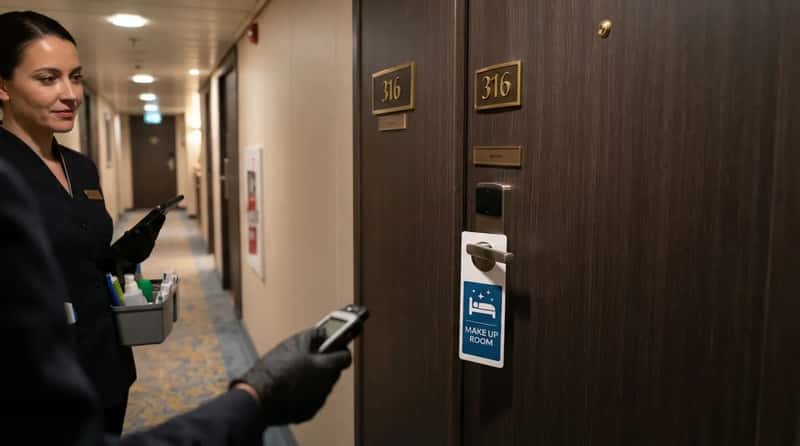
That little “Do Not Disturb / Make Up Room” card on your door isn’t just a formality. To your steward, it is their entire schedule.
If you’re heading out, flip it to “Make Up Room” so they know it’s a good time to pop in. If you’re napping or having a lazy morning, keep it on “Do Not Disturb.”
The key is consistency. Mixed signals – or forgetting to use the sign at all – leave your steward guessing and throw their whole routine out of sync.
A steward managing 18–20 cabins cannot afford to guess. Every cabin without a clear sign is time lost, and on a ship where a steward might have just a few hours to service an entire deck, every minute counts.
By the second day, your steward has already noted exactly how reliable you are with that sign. Next up: what your schedule silently communicates…
#6 – Your Daily Schedule (Without You Ever Saying a Word)

You don’t have to tell your steward when you leave the cabin. They already know.
Guests who are always in the cabin at 9 a.m. get mentally filed under “afternoon service.” Guests who leave at 7:30 for the buffet get pegged as “morning cleans.”
At a Glance
- Most stewards service the same block of cabins every day of the sailing, so day-one habits tend to stick.
- A guest’s usual exit time becomes their unofficial “slot” for the rest of the week.
- Breaking the routine, even once, can bump a cabin to the back of that day’s list.
- Predictable guests are almost always the first cabins serviced each morning.
A steward covering twenty or more staterooms lives and dies by predictability. Guests who lock into an almost identical routine from day one make the entire shift easier to plan.
By the second morning, most stewards have already built your daily routine into their shift schedule – without asking you a single question.
The guests who communicate their schedule early, even just by habit, end up with faster, better-timed service all week. The ones who don’t leave the steward guessing – which usually ends in an awkward knock at the wrong moment.
But your schedule is just logistics. What they notice next is far more personal…
#5 – The State of Your Relationship

This one surprises people. Your steward isn’t reading your diary – but your cabin is.
Two towels left on opposite sides of the bathroom, a book on one side of the bed and nothing on the other, tension in how items are deliberately kept apart – the cabin tells the story. They can tell if you’re fighting with your travel companion just from how the beds are arranged.
A couple that has slept on opposite sides of the bed with items clearly separated is one of the most common silent signals veteran stewards describe noticing.
They won’t say a word to you about it. But they notice, every single time they walk in.
By the time you’ve kicked off your shoes on embarkation day, your steward has already built a working profile of who you are – your habits, your health, your mood, and whether your relationship is holding together. Next: whether you’re a first-timer or a seasoned cruiser is obvious to them within hours…
#4 – First-Timer vs. Veteran Cruiser

Experienced cruisers reveal themselves instantly. And so do first-timers – just in very different ways.
Repeat cruisers leave a clear path for housekeeping, communicate their schedule early, and tip on day one instead of day seven. By the time you’ve changed for dinner, the steward has already mapped what you need.
Quick Compare
- First-timer: suitcases stay open, steward greeted as anonymous staff, no clear routine.
- Veteran: bags unpacked fast, steward’s name learned on day one.
- First-timer: door sign used inconsistently, if at all.
- Veteran: door sign flipped like clockwork every single time they leave.
First-timers tend to treat the steward like a hotel housekeeper they’ll never see again. That mistake costs them all week.
A guest who doesn’t acknowledge the steward’s introduction on day one is quietly marked as someone who won’t be easy to serve well.
Stewards remember repeat passengers with almost supernatural precision – preferred towel style, curtains open or closed, even which side of the bed they sleep on. But even without history, the way someone carries themselves in the cabin tells the story.
The simple act of learning your steward’s name changes the entire dynamic. But there’s one thing stewards notice that has nothing to do with how you act – and everything to do with what you’ve already told the cruise line…
#3 – Special Occasions You Flagged at Booking

Most guests forget they mentioned it. The steward absolutely did not.
Special-occasion notes get attached to a booking long before a guest ever reaches the gangway. Stewards receive that information before they even meet you.
A good steward will decorate a cabin, arrange towel art, or make sure a bottle of bubbly is waiting on ice – without being asked twice. Most guests have no idea this information flows straight to the steward’s pre-sailing briefing.
The steward walking into your cabin on day one may already know it’s your 30th wedding anniversary – and has planned accordingly.
Anniversary, birthday, honeymoon – it’s all in the system, and a good steward acts on it before you’ve even unpacked. Most passengers are genuinely surprised when a personal touch appears that they’d completely forgotten they’d requested.
The next signal they read is one you send without thinking, every single time you step out…
#2 – Whether You Treat Them Like a Person

This is the one stewards talk about most – and the one passengers least expect to be on the list. The same guest who’s warm and chatty with the cruise director can turn cold and dismissive the second a housekeeping cart rolls by.
The politeness gap between “visible” crew and “behind the scenes” crew is one of the most quietly hurtful patterns on the entire ship. Stewards remember exactly which guests treated them like furniture and which ones treated them like people.
The people who take the time to say good morning, that’s who we remember. The rest kind of just blur together.
Cruise ship cabin steward, on working the same deck for a full sailing
By the second day, every steward on the ship knows which passengers treat them like people and which ones treat them like furniture.
The service gap that follows is real, quiet, and completely invisible to the guests on the wrong side of it. A name, quick eye contact, a genuine “morning” on embarkation day – it changes everything.
And the #1 thing housekeeping notices? It’s not a habit, a mess, or a tip. It’s something far more revealing…
#1 – Exactly Who You Are as a Traveler – Before You’ve Said Anything

By the second morning, before you’ve made a single request, your steward has already assembled a complete picture. They’re essentially forensic analysts of vacation behavior, piecing together your habits, preferences, and private moments from the evidence left behind each day.
They remember repeat passengers with almost supernatural precision – your preferred towel arrangement, whether you like the curtains open or closed, even which side of the bed you sleep on.
The cabin, in the hands of a veteran steward, is essentially a complete dossier – assembled without asking you a single question.
Stewards are often the first point of contact for guests, so flexibility and a friendly attitude are key. The ones who proactively source what you need before you ask are the ones who’ve been reading the room since day one.
Your schedule, your valuables, your relationship, your organization, your manners – it all feeds into a working model that shapes your entire week at sea. The passengers who understand this don’t just get a cleaner cabin. They get a fundamentally better cruise.
The Bottom Line
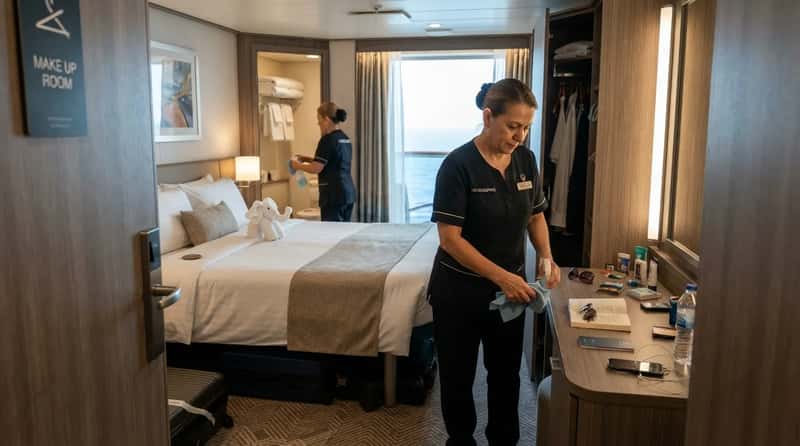
Most passengers assume their cabin steward is focused on towels and trash. Turns out, by day two they’ve silently catalogued your schedule, your relationship dynamics, your experience level, your habits, and whether you treated them like a human being.
The cabin is, essentially, a file on you – and you filled it in yourself.
Fast Facts
- Stow your bags out of sight by day one.
- Flip the door sign every single time you leave the cabin.
- Learn your steward’s name and use it.
- Keep cash and valuables in the safe, not on the nightstand.
None of it costs a thing, and the difference it makes to your week is anything but small.
Have you ever noticed your steward anticipating something before you asked? Drop it in the comments – we’d love to know what they picked up on.
Bonus: The One Move That Flips Your Entire Week

Forget waiting until the last night to tip. The single most effective thing you can do is meet your steward face-to-face within the first hour on board and hand them a folded bill directly, on top of your prepaid gratuities.
This isn’t about buying favors – it’s about turning you from “unknown cabin” into “a guest worth prioritizing” before the first cart even rolls by.
- Introduce yourself by name and ask for theirs – use it every time you see them.
- Hand over a folded $10-$20 bill right then, not on the last night.
- Immediately tell them one specific preference (ice at 4pm, extra pillow, robe size) so they have something concrete to act on.
- Flip the door sign correctly from that very first interaction so your routine is set from hour one, not day three.
Guests who do this in the first hour consistently describe faster response times, small unprompted extras, and a steward who remembers their name for the rest of the sailing – all from a two-minute interaction most passengers skip entirely.