Most people picture Yellowstone as one long postcard. Roll the windows down, point the car at a geyser, and let the scenery do the rest. Rangers see a different version every day: a full parking lot, a stalled road, and someone walking toward an animal with a phone held out.
The warnings below come straight from the park’s own published rules, and the same mistakes keep ending in fines, jail time, and emergency rooms. Some are purely practical. Others may change how you plan the whole trip. And the last one, saved for the end, names a danger that has nothing to do with claws.
#12 – Four Million Visitors Means Your “Quiet Trip” Is a Myth

Yellowstone is not a hidden gem. It welcomed 4,762,988 recreation visits in 2025, which is more than the population of Louisiana. That landed within a few percent of the all-time record of 4,860,242, set in 2021.
Since 2015, the park has topped 4 million visitors every year except 2020 and 2022, the pandemic year and the year of the June flood. So don’t expect to have a geyser basin to yourself in July. The biggest surprise isn’t the crowds, though. It’s the money, and it shows up right at the gate…
#11 – The $100 Gate Surprise Some International Visitors Never See Coming

For most U.S. drivers, entry is simple. A private vehicle pass costs $35, covers everyone in the car, and lasts seven days. No timed-entry reservation is required to drive in. You just need the pass.
Fast Facts
- Private vehicle pass: $35, good for seven days
- One pass covers everyone riding in the car
- Non-U.S. residents 16 and older: extra $100 per person
- The surcharge is waived with an Annual or America the Beautiful Pass
Visitors from abroad face a different bill. The surcharge is per person, not per vehicle, so a family of four from overseas can pay far more than a family of four from Ohio.
The park keeps 80% of what it collects in entrance fees, which is part of the argument for the change. Whether it feels like smart funding or a tourist tax depends on who you ask. Either way, you’ll want to know before you reach the booth. Next comes something your GPS won’t tell you.
#10 – The Park Is 2.2 Million Acres, and Your GPS Is Lying About the Drive

Yellowstone isn’t one attraction. It’s a sprawling landscape of 2.2 million acres across Wyoming, Montana, and Idaho. There are five entrances: West, North, Northeast, East, and South. The main road system is a roughly 142-mile figure-eight called the Grand Loop.
Here’s the catch. A short hop on the map can eat an hour or more. The roads wind through animal habitat, speed limits are low, and traffic can crawl behind a single stopped car.
The smartest itinerary is usually the shortest one. Pick one or two regions per day instead of chasing every famous name. And before you commit, there’s a tech problem waiting inside the gates…
#9 – Your Phone Will Likely Quit Right When You Need It

Many visitors assume live GPS will carry them through the day. Cell coverage across much of the park is limited and patchy. A mapping app that works at the hotel can go blank in the middle of a valley.
Download offline maps before you enter, and screenshot any reservations you made outside the park. The entrance station typically hands you a printed park map, and it’s worth keeping on the dashboard. If your phone dies, that paper may be your only guide.
Worth Knowing
- Save offline maps before you reach the gate
- Screenshot hotel and tour confirmations
- Keep the printed park map within reach
- Ask a visitor center about bear activity before a hike
Signal matters for safety, too. Park guidance tells hikers to ask at the nearest visitor center about bear activity before they hit a trail. That’s easier to do in person than by text. Now to the problem that shows up on the road itself…
#8 – One Parked Car Can Freeze Traffic for Miles

You’ve seen it in videos. A bison strolls across the road and cars stop in every lane. The park says the safest view of wildlife is often from inside your vehicle. The trouble starts when drivers stop in the middle of the road, jump out, and crowd the animal.
Rangers sometimes work these jams on foot. If a roadside ranger asks you to return to your car, do it right away. The reason is blunt: bears and bison can easily outrun you.
The next stop is the animal many visitors most want to see, and the rule people break just to see it…
#7 – The Wolf Everyone Wants Is Legally Off-Limits at 100 Yards

Wolves are the park’s most hunted-for sighting. Visitors must stay at least 100 yards from bears, wolves, and cougars. That’s about the length of a football field. Wolves are most often seen in places like Lamar Valley and Hayden Valley, and almost always at a distance.
That distance is the point, and it’s why serious wildlife watchers show up with spotting scopes and binoculars. Optics will always give you a better view than approaching the animal would. It’s illegal to willfully approach or remain near wildlife, including birds, if it disturbs or displaces the animal.
So that perfect close-up might actually be a violation. And the animal that gets people hurt most often looks like the calmest one in the valley…
#6 – “Bear Country” Includes the Old Faithful Parking Lot

Many visitors think bears live deep in the backcountry. The park says otherwise. All of Yellowstone is grizzly and black bear country, from remote trails to the boardwalks and parking lots around Old Faithful. Keep at least 100 yards from bears at all times, and never approach one for a photo.
On trails, the park’s guidance is specific. Hike in groups of three or more, carry bear spray, and know how to use it. Sudden encounters cause most bear-related injuries to people, so making noise in thick cover matters.
And if you do meet one, don’t run. Bears are fast sprinters, and running can trigger a chase. Next up: the animal visitors consistently underestimate…
#5 – The “Docile” Bison Is Why 25 Yards Is a Hard Rule

Bison look like slow, shaggy cattle. They’re not. Visitors must stay at least 25 yards from all other animals, including bison and elk. That’s roughly two and a half school buses. The animals are wild and dangerous no matter how calm they appear.
If an animal drifts toward you, back away to keep a safe distance. In fairness, animal attacks in Yellowstone are relatively rare and almost always preventable.
The viral clips you’ve seen are the cases where that distance vanished. Now let’s talk about what happens to people who ignore the signs…
#4 – One Step Off the Boardwalk Can Mean Seven Days in Jail
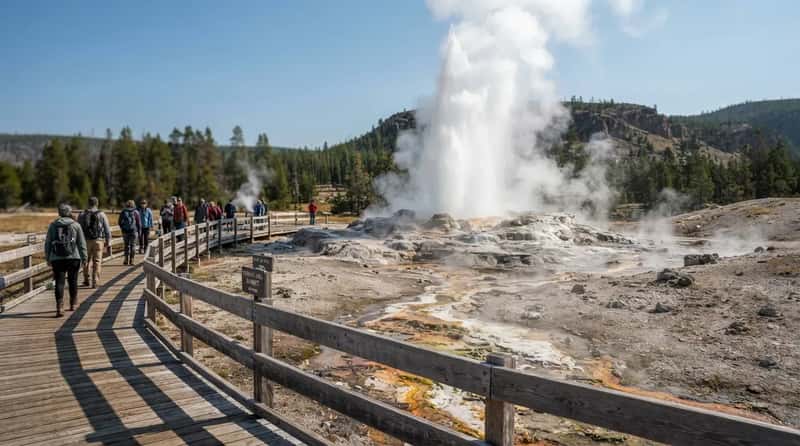
These rules aren’t friendly suggestions. In 2024, a visitor from Washington state was sentenced to seven days in jail for thermal trespassing at Steamboat Geyser in Norris Geyser Basin. Others have been similarly sentenced. Leaving the path to get a better photo can cost you a week behind bars.
The park is clear on the law. Foot travel in thermal areas must stay on boardwalks or maintained trails marked by official signs. Those paths aren’t random. They’re placed at a safe distance from dangerous features.
At a Glance
- 2024 case: seven days in jail for thermal trespassing
- Location: Steamboat Geyser, Norris Geyser Basin
- The rule: stay on boardwalks or signed, maintained trails
- The risk: hot spring water can reach 200 degrees Fahrenheit or hotter
The people who step off are overriding a safety map drawn by people who know the ground. And that map exists because of what’s under it…
#3 – The Ground Looks Solid, but Scalding Water Is Just Underneath

The scenery around a hot spring can fool you. Almost all of Yellowstone’s geothermal features are surrounded by a thin crust. It may look like solid ground. The same extremely hot water that gushes through geysers sits just below the surface.
Hot spring temperatures can reach 200 degrees Fahrenheit or hotter. The rules go further than staying on the path. It’s illegal to swim or bathe in any water entirely of thermal origin.
Throwing any object, even a rock or stick, is prohibited because it can clog vents and change water flow. Toxic gases can build up in some areas, so leave immediately if you feel sick. The next entry gets personal for dog owners…
#2 – Even a Leashed or Carried Dog Is Banned From the Boardwalks

Dog owners are often shocked by this one. Pets aren’t allowed in thermal areas or on boardwalks, even on a leash or carried in arms, strollers, or backpacks. Elsewhere, pets have limits too. They must stay within 100 feet of roads, parking areas, and campgrounds at all times.
The policy exists to protect pets from being burned or killed in hot springs. In 2021, a 20-year-old sustained thermal burns trying to rescue her dog from a hot spring. One slip turned a family trip into an emergency.
It’s a tough rule on a road trip, but it comes from real rescues gone wrong. And the biggest surprise comes next…
#1 – The Deadliest Thing in Yellowstone Isn’t a Bear

Ask anyone what’s most dangerous in the park and you’ll hear “grizzlies.” The scientists who monitor the park’s volcano point somewhere else: the hot, near-boiling hydrothermal waters all around you. Since the late 1800s, around 20 people have died from interactions with thermal areas, more than have been killed by grizzlies.
The park’s own safety messaging backs this up. Hot springs have injured or killed more people in Yellowstone than any other natural feature. More than 20 people have died from burns after entering or falling into a hot spring.
Why It Stands Out
- It runs against the “bears are the biggest threat” instinct
- Thermal areas have caused about 20 deaths since the late 1800s
- Hot springs have hurt more people than any other natural feature
- The danger hides under a thin crust that looks like solid ground
The animals get the headlines. The quiet, steaming pools with a thin crust around them are the real story.
Yellowstone’s biggest risks aren’t the ones people brag about. A bear can be in the parking lot, a bison is never as calm as it looks, and a dog on a boardwalk is a violation. Which of these surprised you most, and which one do you think visitors will always ignore?