


Most travelers see a charge on a hotel bill and assume it is carved in stone. It usually isn’t. A surprising number of those line items are judgment calls made by the person behind the front desk, and guests who ask politely often walk away with a smaller bill.
No chain has an official “over 60 discount on fees.” But older guests often bring patience, a calm voice, and a willingness to simply ask, and at a busy counter that goes a long way. The same fee that gets a flat “no” on a reservation line can quietly disappear at the right desk with the right sentence. Some of these are long shots, and we’ll say which. A few have real rules behind them, and the first one is on almost every bill in America.
#13 – The Resort Fee for a Gym You Never Entered

Resort fees are the most argued-over line on a hotel bill. They commonly run from about $25 to $70 or more per night, and they are almost always charged per room, not per person.1 2 On a week-long stay, that adds up to a few hundred dollars for a pool towel and a fitness room you may never see.
Start by asking what the fee includes, then say kindly that you won’t be using those things. Some hotels will waive or reduce it on the spot. It doesn’t always work, but it costs you one sentence. The next item gives you far better odds.
#12 – The Resort Fee After the Pool Was Closed
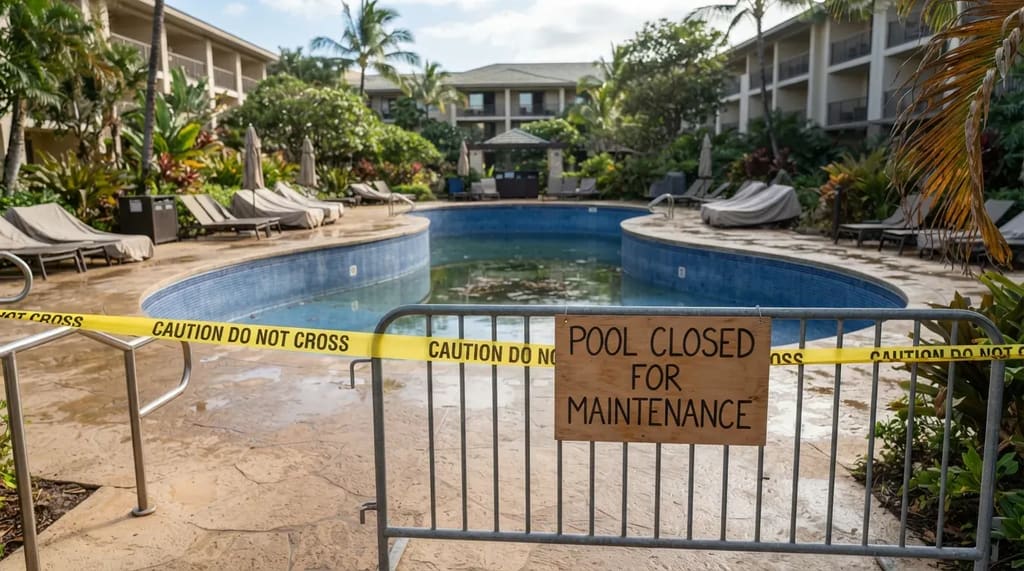
If you paid for amenities that weren’t available, you have a real complaint. A broken Wi-Fi network, a closed pool, or a shut gym all count. Ask the front desk to waive or reduce the fee when a specific amenity was unavailable.
Speak up before checkout, and be precise. A vague “this was terrible” gets a shrug. “The pool was closed for three days, can you remove the fee for those nights?” gets a calculator. Name the amenity, name the nights, and ask for a specific fix.
Worth Knowing
- Speak up during the stay, not weeks later by email.
- Name the exact amenity that was unavailable.
- List the specific nights it was out of service.
- Ask for a partial credit if a full waiver feels unlikely.
#11 – The Fee That Vanishes on a Points Booking

Here’s a rule that surprises people. Hilton Honors and World of Hyatt award stays do not include resort fees.3 4 Pay with points, and a charge that would have cost hundreds can simply be gone.
Sometimes the fee still shows up on a points reservation anyway. Politely ask the desk to check it. Plenty of retirees are sitting on years of card points without realizing this perk exists. The next two charges depend on something even simpler: whether the hotel is full.
#10 – The Early Check-In Fee That Costs Them Nothing

Some hotels charge extra to get into a room before the standard afternoon time. Others hand it out for free. The difference usually comes down to how many rooms are ready and how many guests checked out that morning.
If you land at 10 a.m. after a red-eye or a long drive, ask whether a clean room is available. Contacting the desk on the day of arrival often works best, because staff can see what is actually open. An empty, clean room earns the hotel nothing. Keep your tone warm, and skip the “I’m entitled to this” approach, which is the fastest way to hear “no.”
#9 – The Late Checkout Fee Hotels Quietly Skip

Late checkout charges are another pure judgment call. When a hotel has a slow Sunday, holding a room for two more hours costs very little. On a sold-out weekend, the answer will probably be no, and no phrasing will change it.
If a flight leaves at 6 p.m., say so. Agents respond to a concrete reason much better than a general wish. Offering to be out by a firm time, like 1 p.m., also helps. If a fee is quoted, ask whether it can be dropped for a shorter extension. Next up is a charge that quietly adds up on longer trips.
#8 – The Parking Fee Nobody Warned You About
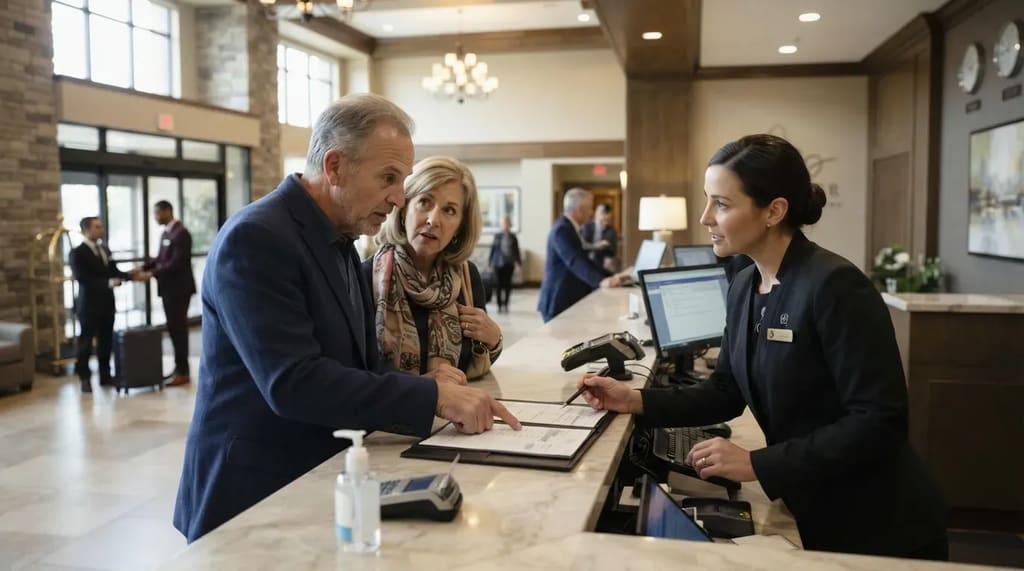
Parking is one of the biggest surprise charges at city hotels. In some downtown areas, overnight rates can rival the price of the room. Sometimes it is folded into a resort fee, and sometimes it is billed separately on top of one.
Front desk staff sometimes have discretion here, even for guests with no elite status. Ask whether self-parking is cheaper than valet, whether there is a discounted rate for multi-night stays, or whether you’re already paying for it somewhere else on the bill. Even a partial reduction is worth one question. But the sneakiest double charge comes next.
Quick Compare
- Self-parking: usually the lower price, and the best place to ask about multi-night rates.
- Valet: more convenient, often costs more, and a tip is typically extra.
- Bundled in the resort fee: confirm you aren’t also being charged separately.
#7 – The Wi-Fi Charge Hiding Inside a Fee You Already Paid

Wi-Fi is the classic case of paying twice. If it is listed as a standard amenity and also sits inside the resort fee, that’s double billing. It’s a fair thing to raise at the desk.
Keep it calm and factual. You’re not accusing anyone, you’re asking the bill to match the booking. Agents can usually see what the reservation promised. If they can’t fix it themselves, ask who can. A polite request for the manager works better than repeating yourself louder. And speaking of mismatches, the next one has actual federal rules behind it.
#6 – The Fee That Only Appeared at the Front Desk

A charge you never saw while booking is on shaky ground. Since May 12, 2025, the FTC’s rule requires hotels and other short-term lodging to show the total price up front and in advertising.5 That includes mandatory resort and destination fees.
The rule has limits. It doesn’t ban any fees or cap what a company can charge.1 It targets hidden ones. If a fee first surfaced at the front desk, you may have solid footing. Compare the check-in bill with the screenshot of your booking total, and if the numbers differ, ask the desk to explain before you sign. Next, a charge people accept far too quickly.
Fast Facts
- The FTC rule took effect on May 12, 2025.
- It covers short-term lodging, including hotels.
- Mandatory fees must be included in the advertised total price.
- It does not ban or cap resort fees.1
#5 – The Cancellation Fee After a Health Scare

Life happens, and sometimes a trip falls apart. A hospital visit, a spouse’s illness, or a sudden family emergency can leave you facing a non-refundable charge for a room you can’t use. Hotel policies are strict on paper, but many properties will bend when the call is honest.
Hotel staff generally have more say over direct bookings than over reservations made through third-party sites. So call early, stay polite, and ask what they can do instead of demanding a refund. A future-stay credit is a realistic win. Up next is a fee that punishes you for leaving.
#4 – The Early Departure Penalty Nobody Reads

Some hotels charge a fee if you check out earlier than booked. It’s often buried in the fine print of the reservation, and most guests don’t notice it until the final bill.
If you’re leaving early because of bad weather, a medical reason, or a room problem, say so when you tell the desk. Don’t wait until checkout. Ask them to note the reason on the account, and ask whether the fee applies. Policies vary a lot between brands and individual hotels, so this one is truly “ask and see.” Staff have more room to be generous when the reason is clear and the guest is courteous. The next charge catches people traveling with family.
#3 – The Extra-Person Fee When Grandkids Join the Trip

Many travelers over 60 bring grandchildren along. Some hotels add a nightly charge for extra guests, a rollaway bed, or a crib. Others let children stay free in the same room. The rule differs by hotel, and sometimes by the day.
Ask the desk whether the fee can be waived for a young child, or whether a different room type includes extra beds. A room already set up for four can beat a two-person room with add-ons. Compare before you book, and ask again when you arrive. Then watch for one more small line on the bill.
Related Stories From Travelbinger



#2 – The Minibar Charge for a Drink You Never Opened

Few bill errors cause more arguments than the minibar. Some rooms use sensors that register an item as soon as it’s lifted from its shelf. Move a bottle to make room for your own medication or snacks, and a charge can appear.
If you see one, say plainly that you didn’t consume the item. Most hotels will remove a disputed minibar charge rather than fight over a few dollars, especially when you raise it at checkout and not weeks later. Check your folio before you leave the building, and ask for a printed copy. A calm, specific question handles most of these in under a minute. And now for the one with the best paper trail.
#1 – The Room Rate That Drops When You Ask in Writing

The biggest charge on any bill is the room itself. Many chains and independent hotels offer senior rates, and they aren’t always shown by default online. Asking before you arrive is the smartest move, and doing it in writing gives you proof.
Here’s a simple routine. Screenshot the booking page showing your total price, then contact the hotel’s front desk directly a few days before arrival. Ask whether a senior rate applies and whether the resort fee can be reduced or removed. Staff tend to respect a clear, polite record. There’s no promise it works everywhere, but it puts you in the best position to hear yes.
At a Glance
- Before booking: screenshot the total price page.
- A few days out: contact the hotel directly, not a call center.
- Two questions: is a senior rate available, and can the resort fee come down?
- At check-in: keep the reply handy in case the bill differs.
The Bottom Line: No hotel hands out these waivers automatically, and some will say no. But fees like resort charges, parking, and late checkout often come down to discretion, timing, and tone. Being calm, specific, and early is a real advantage at any front desk. The FTC’s total-price rule helps with the fees you didn’t see coming, even though it doesn’t ban them.
The bill that arrives at checkout is rarely the final word. Sometimes it’s just the opening offer. Which of these has a front desk actually waived for you, and which one flatly refused?
- Resort Fees After FTC Rule: https://blog.best.so/resort-fees-federal-rule-2026-hotel-hidden-charges/
- Resort Fee Per Room: https://withautopilot.com/blog/hotel-resort-fee
- World of Hyatt Terms: https://www.hyatt.com/help/terms/world-of-hyatt
- Points Guy Resort Fees: https://thepointsguy.com/glossary/what-is-a-resort-fee
- PIRG FTC Junk Fees Analysis: https://pirg.org/edfund/articles/junk-fees-finally-new-protections-against-surprise-charges-for-event-tickets-hotels/