A first checked bag now costs $45 each way at Delta and Southwest, and at United if you prepay. A couple flying round trip with one suitcase each hands over $180 before anyone chooses a seat.
Several of the charges on this list can still be shrunk, switched off or refunded at the check-in desk, provided you know which rule the agent is working from. The agent won’t always bring it up first.
The list climbs from small savings to the one that matters most, a service federal law says airlines can’t charge for at all. Stay for #1.
First, a $5 difference that shows up only at the counter.
#14 – The $5 Premium for Paying at the Counter
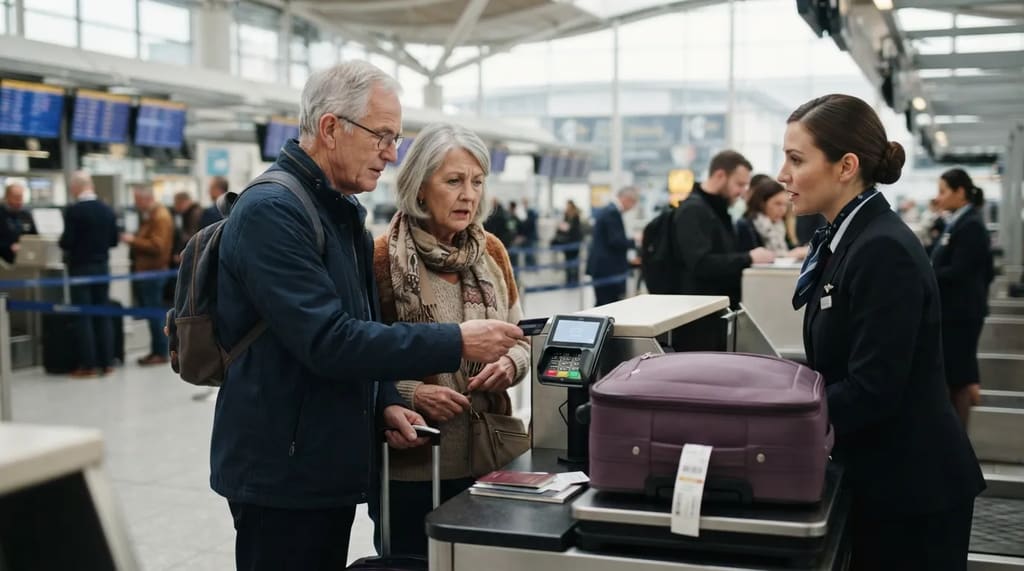
United charges $45 online or $50 at the airport for a first checked bag, and $55 online or $60 for a second. American charges $50 if you wait too, so settling up at the desk costs about $5 per bag, each way.1
The cutoff for the cheaper price differs by airline, and that’s where travelers get caught. American gives its lower price online up to two hours before departure, while United and JetBlue want payment at least 24 hours out.
Southwest and Delta each publish one standard price, so there is no early-payment discount to chase on either. On a United flight, the time to pay for the bag is the day before, not the morning of.
Pay online at least 24 hours before departure. A couple with one bag each saves $20 on a round trip, which is four bags at $5 apiece.
Budget airlines run the same clock on a different bag, and the one that fits in the overhead bin is where their prices jump.
#13 – Carry-On Charges on Ultra-Low-Cost Airlines
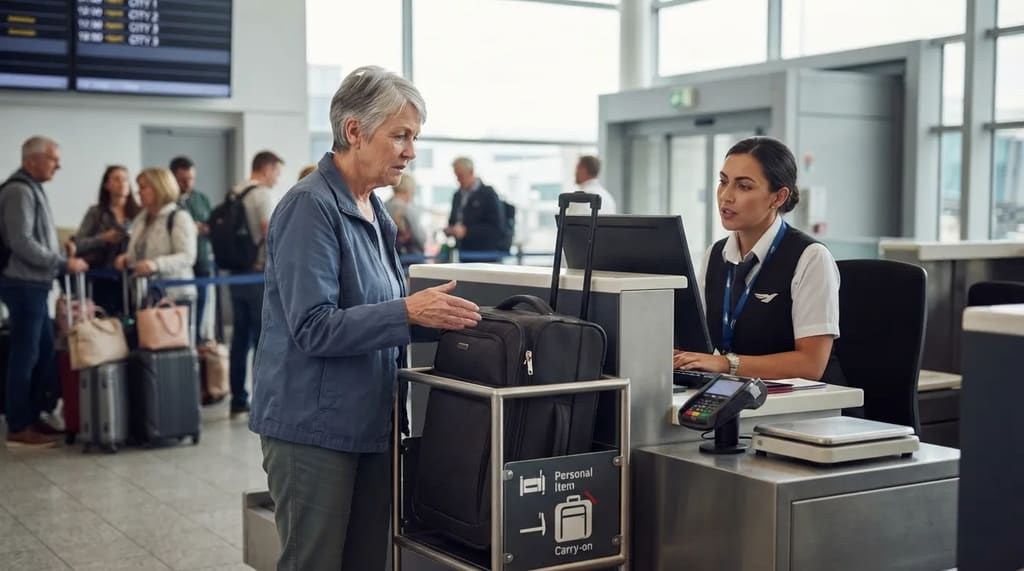
On an ultra-low-cost airline, the fare you see usually buys a seat and one small personal item that fits under the seat in front of you. A full-size carry-on is a separate purchase, and it’s cheapest when you add it during booking.
The gate is the most expensive place to settle the question. If the agent decides your bag is too big for the free allowance, the charge is applied on the spot.
Measure your bag against the airline’s personal-item limit at home with a tape, not by eye. Then do the total before you book.
Budget carriers such as Spirit list a first checked bag at roughly $30 to $50 when it’s bought during booking, which adds $60 to $100 to a round trip for one traveler before any carry-on charge. A rock-bottom fare with bags added is often no cheaper than a standard fare on a larger airline.
For any trip with a suitcase, the cheapest-looking ticket is rarely the bargain.
The next charge has nothing to do with bags. It’s about where you’ll sit, and on one big airline the answer now arrives only at check-in.
#12 – The Seat You’re Handed at Check-In
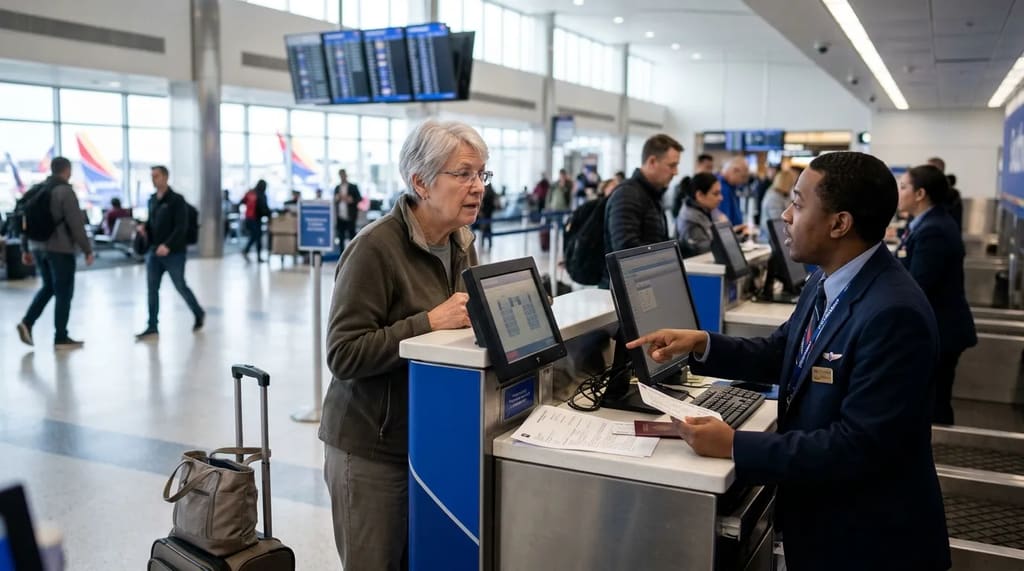
Southwest moved to assigned seating for flights from January 27, 2026,2 and now offers Preferred and Extra Legroom seats on top of standard ones. Its basic fare gets a seat assigned at check-in, typically toward the back, with no changes allowed.
That matters if you need an aisle, a short walk to the lavatory or an exit that’s easy to reach. The paid seats cost more than standard spots, so the free seat is whatever remains after the buyers have chosen.
If seat location matters, choose it at booking instead of leaving it for check-in.
If a medical need drives the request, call the airline ahead of time. That’s the standard way to arrange a seat that meets your needs.
Basic fares are where seat choice disappears, and at one major airline they’ve also gained a surcharge on every checked bag.
#11 – Basic Economy’s $5 Bag Surcharge at American
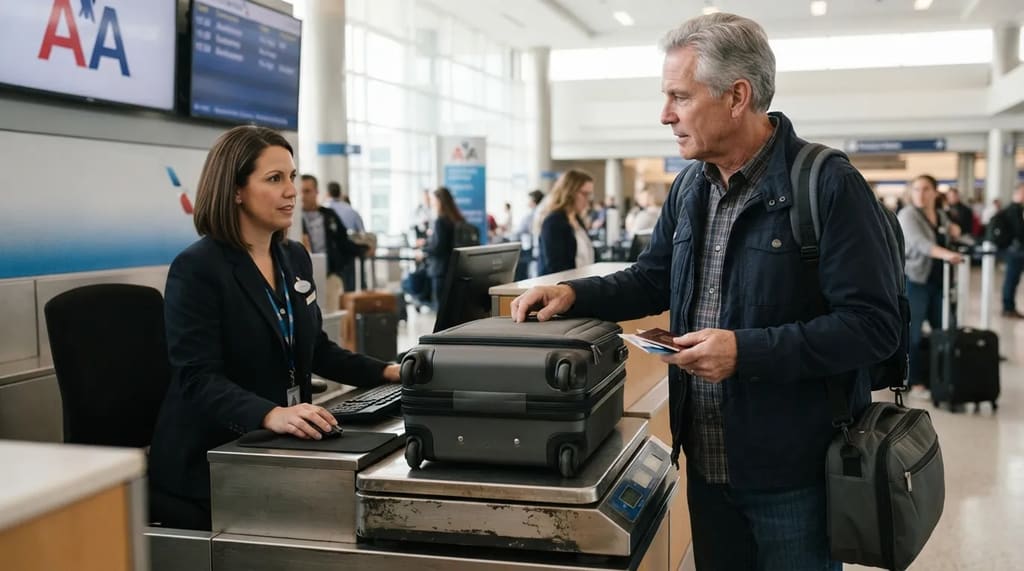
American adds $5 on Basic Economy tickets, which The Points Guy called a first among US carriers. That puts a Basic first bag at $50, or $55 if paid late, with a second bag at $60.1
At other big carriers, the penalty for Basic is usually different. The checked bag fee is typically the same as in standard economy, but the ticket often loses seat selection and changes.
Either way, the discount on the fare comes with a list of things you’d otherwise have. So do the arithmetic before you click.
At American, Basic Economy adds $10 per bag on a round trip. A Basic fare has to undercut the regular fare by more than that surcharge, plus whatever you’d pay to pick a seat, or it isn’t a discount at all.
A bag that clears the price test still has to clear the scale, and the scale is where a $5 gap becomes a $100 one.
#10 – The $100 Fee for the 51st Pound
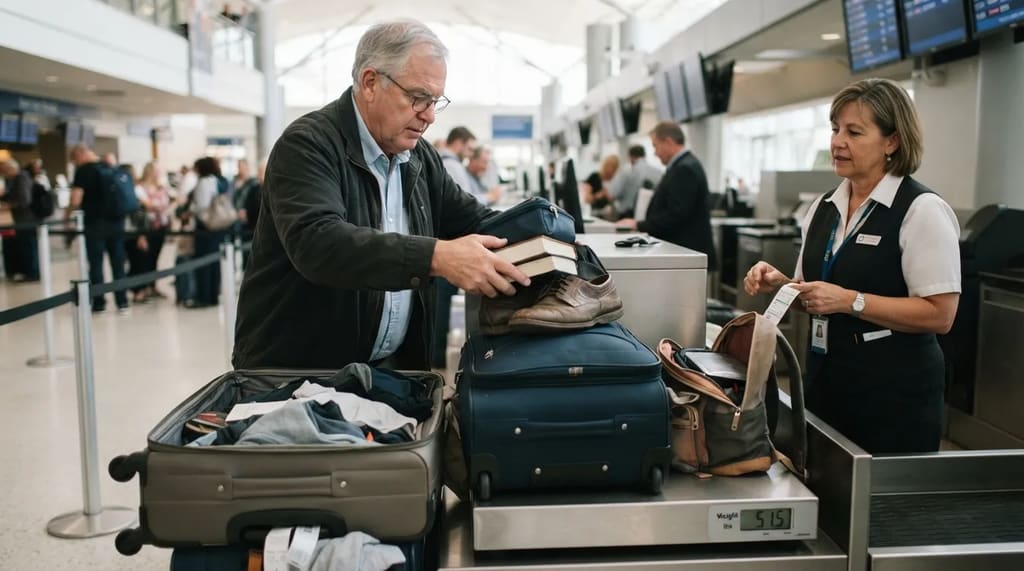
At Delta and United, a bag from 51 to 70 pounds draws a $100 fee, and one from 71 to 100 pounds draws $200. American is built differently, since it starts at $30 for 50 to 53 pounds, then charges $100 up to 70.
Add that to the base fee and the damage is plain. A 55-pound bag on United costs $145, the $45 base fee plus $100 for weight.
That’s twenty times the counter premium in #14, paid for a few pounds of shoes and paperwork. At the desk, the fix costs nothing.
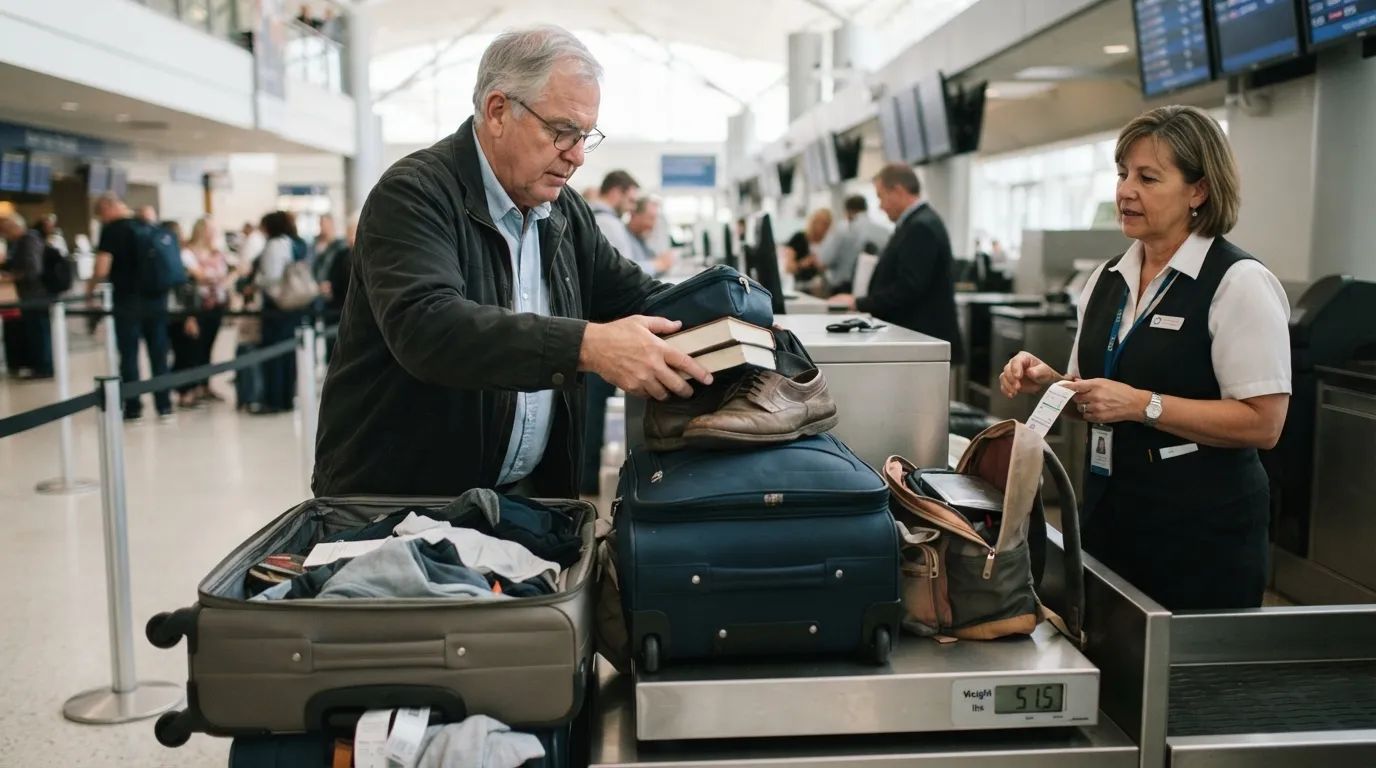
Ask the agent to let you open the bag and move heavy items, such as books, shoes and toiletries, into your carry-on or personal item. Get the bag to 50 pounds or less.
If you’re at 51, the fix takes thirty seconds. Hauling a stuffed suitcase around is hard work at any age, so lightening it pays twice.
Weight isn’t the only measurement, though. A bag that passes the scale can still fail the tape.
#9 – The 62-Inch Rule Nobody Brings a Tape To
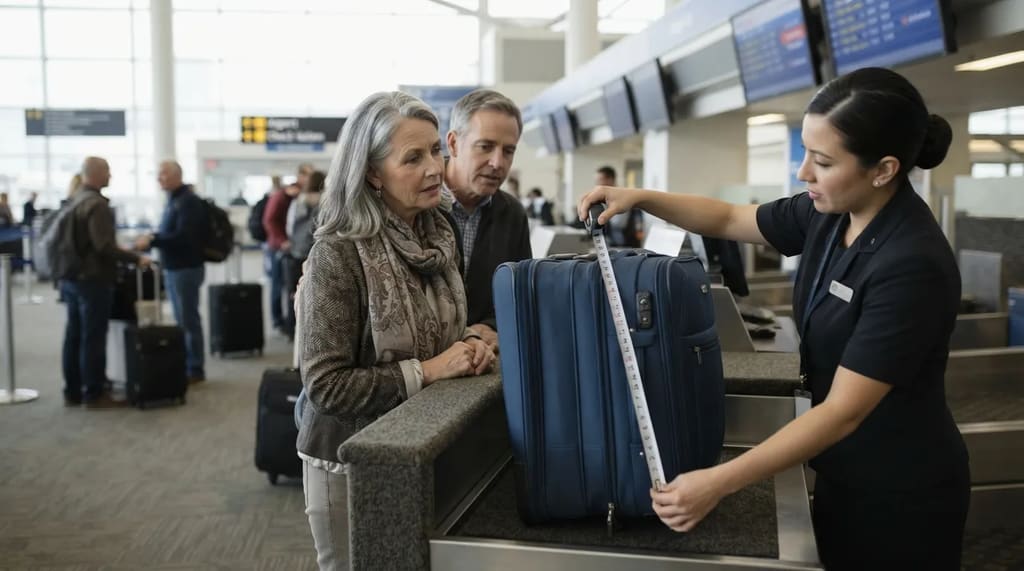
Suitcases get weighed far more often than they get measured. Most airlines allow 62 linear inches and 50 pounds for a checked bag, and linear inches means length plus width plus height, wheels and handles included.
The penalty is steeper than the weight fee. Delta charges $200 for a bag of 63 to 80 inches, and United charges $200 from 63 up to 115 inches.
American starts lower, at $30 for 62 to 65 inches, then charges $200 above 65. A suitcase with its expansion zipper open is the usual culprit, because it adds inches that never show up on the label.
At a Glance
- Usual ceiling: 62 linear inches, length plus width plus height
- Delta: $200 for 63 to 80 inches
- United: $200 from 63 up to 115 inches
- American: $30 for 62 to 65 inches, $200 above 65
Measure all three sides; 62 inches is the usual ceiling. Zip the expander shut before you leave for the airport, and measure again if you’ve borrowed a bag.
Size is only half the story, because the number of bags matters as much as how big they are.
#8 – The Second Bag and the $200 Third
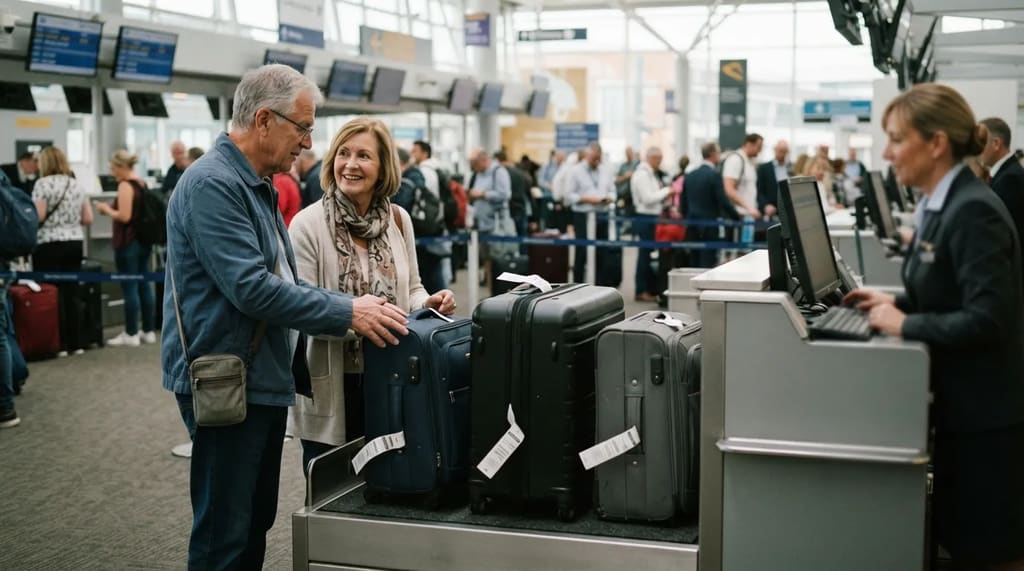
At Delta, the first checked bag costs $45 and a second bag is $55 on most domestic routes. A third checked bag now costs $200, up $50 from previous pricing.3
Those are per-direction prices, so a traveler flying alone with two bags pays $100 each way. Now look at a couple.
If each person checks one bag, both pay the first-bag rate, $45 apiece, or $90 per direction instead of $100. Each bag still has to stay under 50 pounds, so splitting works best when one suitcase is stuffed and the other is half empty.
That makes the payoff a repacking plan. Check one bag per traveler instead of two bags for one.
At Delta, that saves $10 each way and $20 on the round trip, with no change to what you carry.
Southwest travelers face this math with a twist, because for years the second bag cost nothing at all.
#7 – Southwest’s Bags Don’t Fly Free Anymore
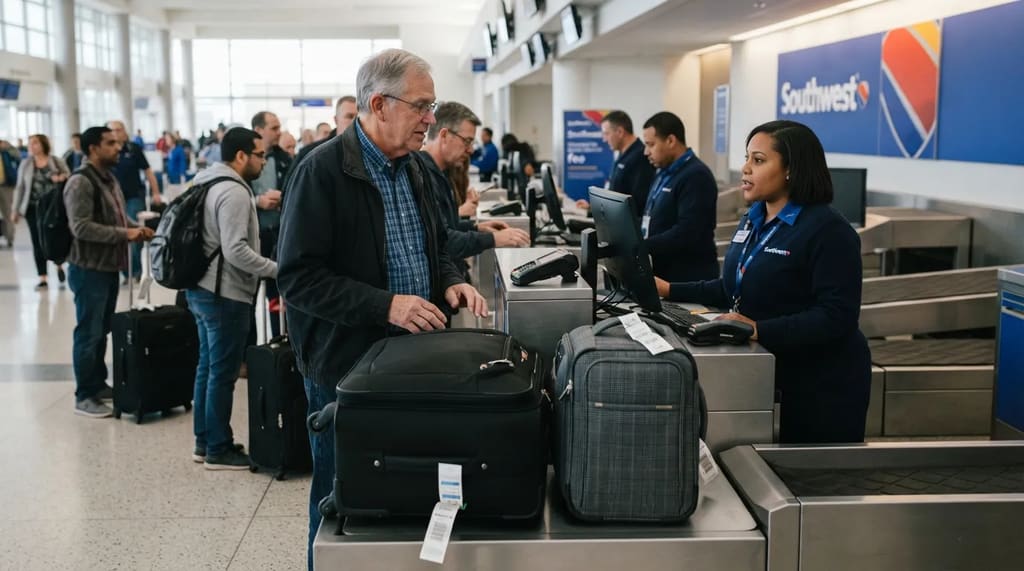
Southwest’s long-running free-bag perk ended. For flights booked, ticketed or voluntarily changed on or after May 28, 2025, the first bag cost $35 and the second $45.
As of April 2026, Basic fares carry fees of $45 for the first bag and $55 for the second.4 Which fare you buy now decides the bill.
Basic, Choice and Choice Preferred customers pay those fees, while Choice Extra passengers still get two bags free, as do some customers through status and other benefits. Two bags each way at $45 and $55 comes to $100, or $200 round trip, and that’s the figure to weigh against Choice Extra’s higher fare.
Southwest is no longer the automatic pick for a traveler with luggage. Compare the total price with your bags included.
Quick Compare
- Basic, Choice, Choice Preferred: $45 first bag, $55 second bag
- Choice Extra: two bags free
- Two bags, one traveler: $100 each way, $200 round trip
The same Basic fare that charges for bags also hands you the check-in seat from #12.
One card in your wallet can waive the first of those bags for you and several companions, though only some trips make it pay.
#6 – The Credit Card That Waives the First Bag
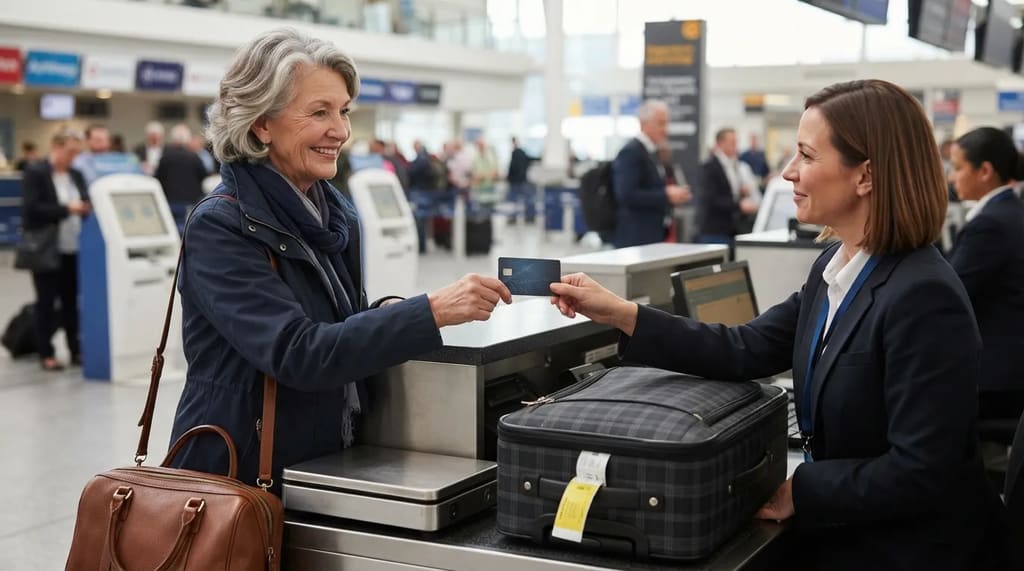
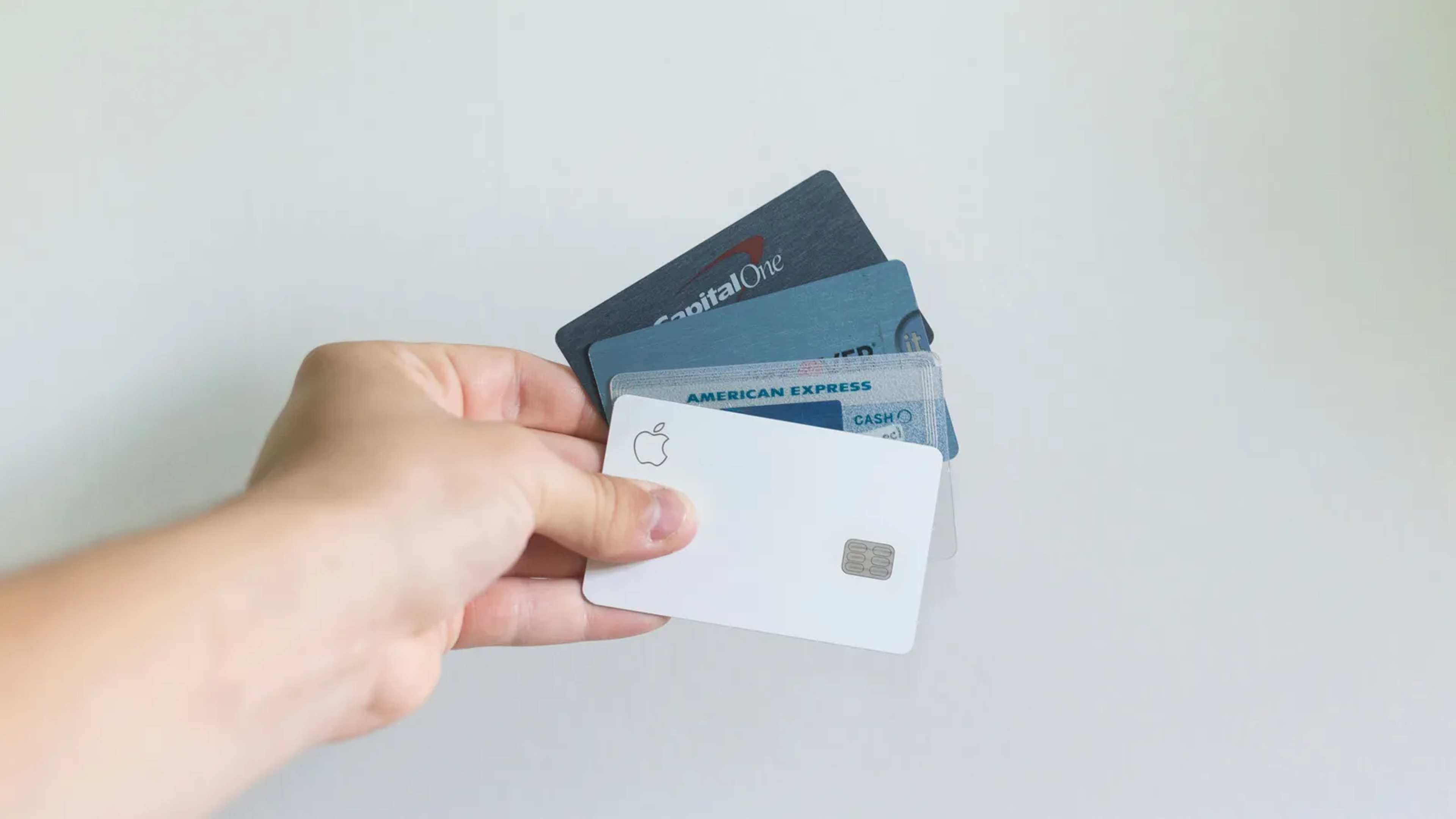
Most major carrier cards, including United Explorer, Delta SkyMiles Gold, Southwest Rapid Rewards, Alaska Airlines Visa and American AAdvantage, waive the first checked bag fee for the cardholder and often for companions on the same reservation. Southwest’s personal cards extend it to up to eight additional passengers.
Run the numbers for a couple on Southwest. Four checked bags at $45 on a round trip is $180, while the Rapid Rewards Plus card is listed at $99 a year.
A $99 card beats $180 in bag fees on a couple’s round trip. That doesn’t make the card right for everyone.
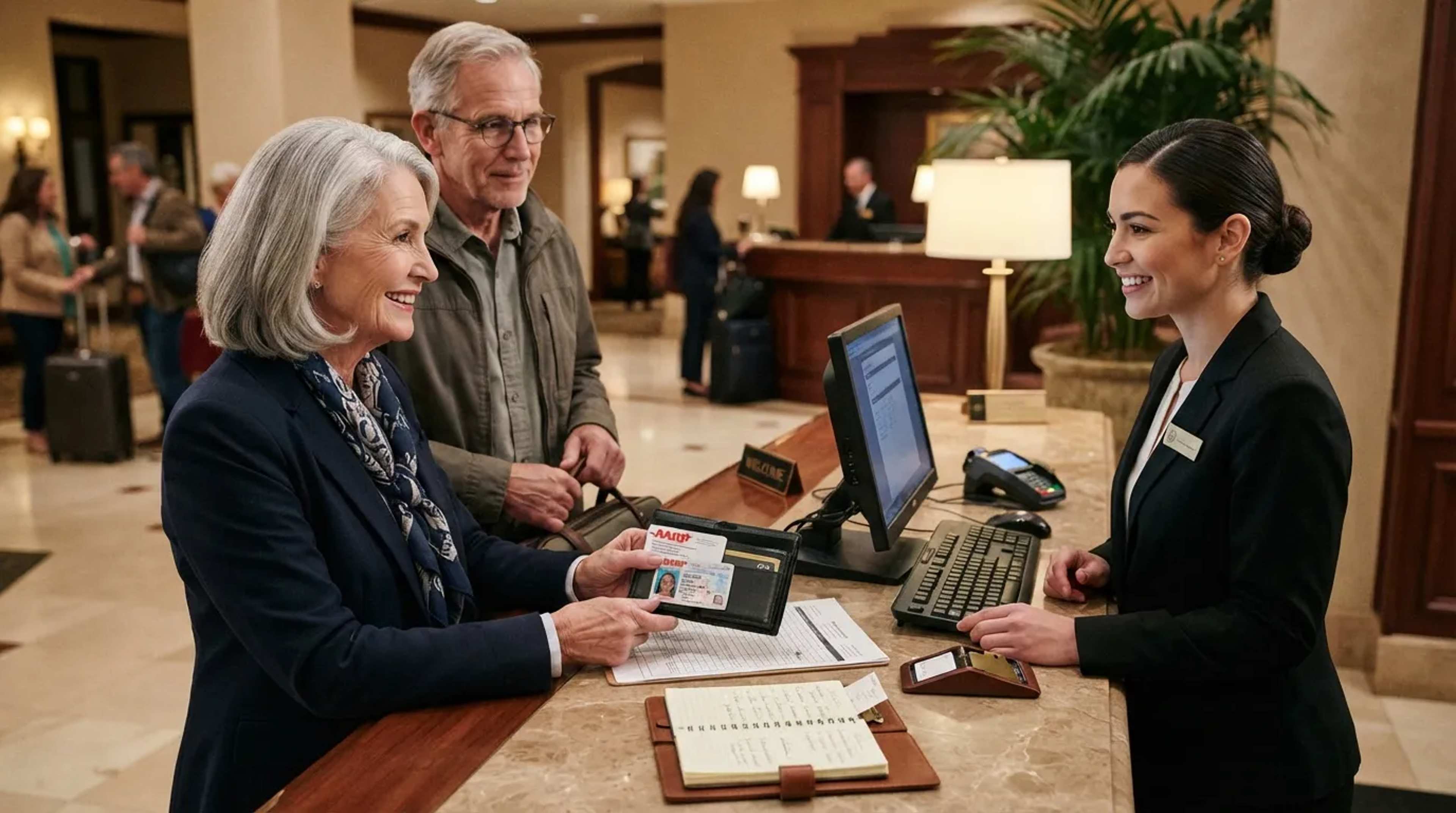
If you fly once a year, a card opened for one trip and then forgotten is just another annual fee. Check the issuer’s current fee and waiver terms before applying, and put the card or loyalty number on the reservation before you reach the desk.
Cards help on domestic routes. Cross an ocean and the first bag is often free before any card gets involved.
#5 – The Free Bag on Long International Flights
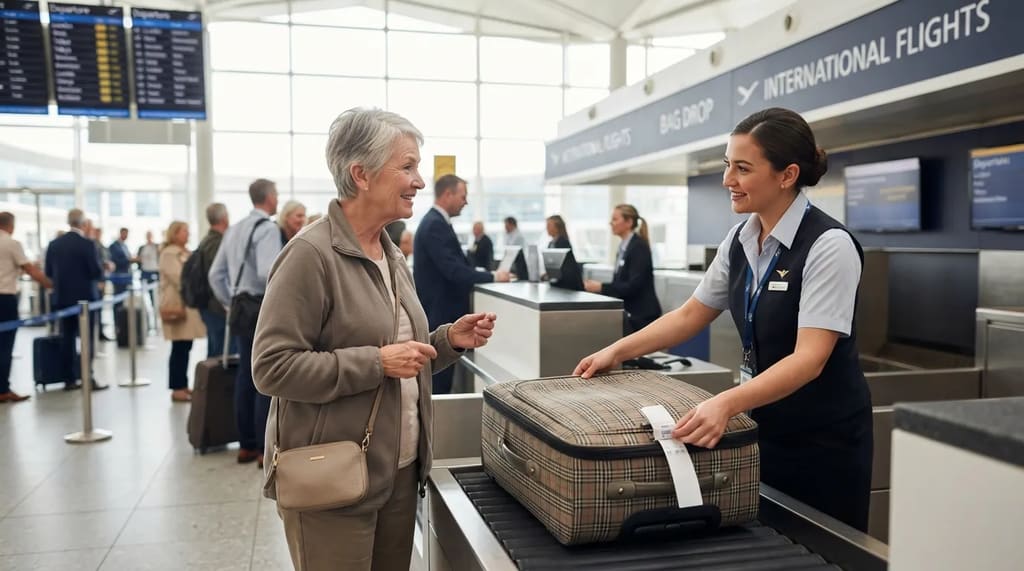
Cross the Atlantic or the Pacific and the bag math changes. Delta, United and American routinely include a free checked bag on transatlantic and transpacific routes while charging a fee domestically.
The catch is that inclusion depends on the fare and route you bought. If your trip starts with a domestic flight, ask the agent which allowance applies to each leg before you pay anything.
Check the fare rules before paying a domestic-style bag fee. Don’t carry that assumption over to budget airlines.
European budget carriers charge roughly €25 to €45 for a bag, depending on route and timing.
Sometimes the fee isn’t about what you’re carrying at all. It’s about something you paid for and never got.
#4 – Refunds for Extras You Paid For and Didn’t Get
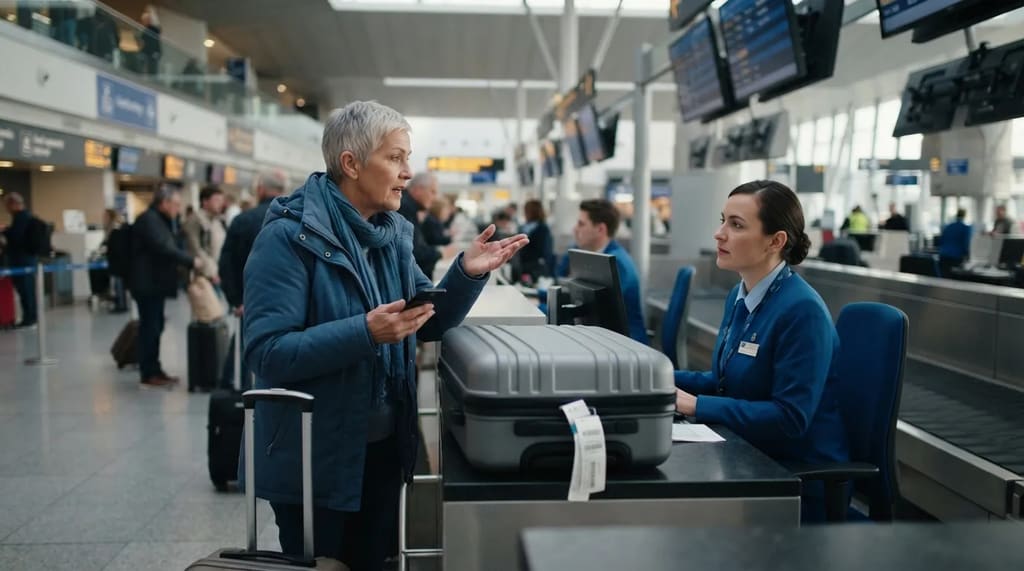
The DOT’s automatic refund rule has been in force since October 28, 2024, and covers cancelled or significantly changed flights, badly delayed bags and extra services a passenger bought but didn’t receive. The rule’s examples include Wi-Fi that isn’t provided.
Before it, bag fee refunds depended heavily on each airline’s own policy. Now a checked bag that arrives more than 12 hours late on a domestic flight means the bag fee comes back to you.5
The ticket side has thresholds too. A significant change includes a domestic arrival three hours or more late, or six hours on an international trip.5
Fast Facts
- Rule in force since October 28, 2024
- Late bag: more than 12 hours on a domestic flight
- Late arrival: 3 hours domestic, 6 hours international
- Credit card refunds: within 7 business days
- Other payment methods: within 20 days
If you turn down the alternative the airline offers, you’re owed cash, with credit-card purchases due back within seven business days and other payments within 20.
If the airline offers a voucher instead, state clearly that you are owed a cash refund and decline the credit. Ask for your original form of payment, not a voucher.
If you booked through a travel agent, refunds for ancillary services such as checked bags must be sought from the airline operating the flight. Three charges are left, and the best ones are still ahead.
#3 – The Medical Device That Doesn’t Count as Your Carry-On
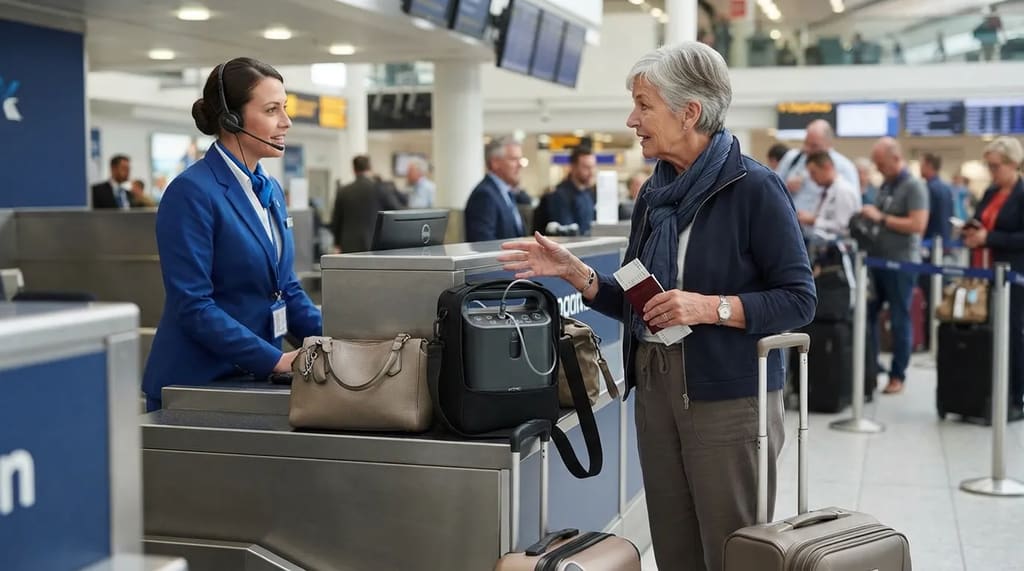
Most carry-on arguments at the gate come down to one question. What counts as your one bag and your one personal item?
Medical equipment sits in a different category. Under federal disability rules, airlines generally don’t count a medical device such as a CPAP machine against the carry-on limit.6 7
Related Stories From Travelbinger
The same goes for portable oxygen concentrators, as long as the model is FAA-approved.7 Airlines must allow approved models on board, and you’re expected to bring enough charged batteries to cover the whole trip, delays included.
So when an agent starts eyeing the size of your bags, say plainly that one of them is a medical device. Say “medical device” before the agent starts counting bags.
Pack it in a case that’s easy to open, keep it out of the checked bag, and carry a doctor’s note or prescription copy if you have one. A device that stays with you can’t be lost, crushed or sent to the wrong city.
The next item goes a step further, because it skips the bag count and the scale altogether.
#2 – Canes, Walkers and Wheelchairs Travel Without a Bag Fee
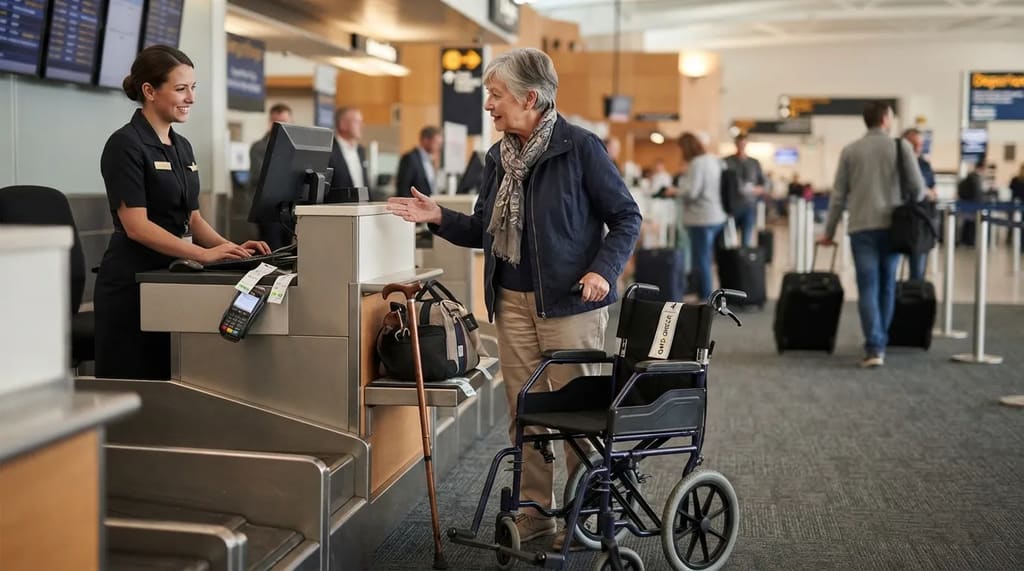
Airlines can’t charge to carry a wheelchair, walker, cane or crutches. These items also aren’t counted against your bag allowance, so they don’t trigger the $45 first-bag fee or push another suitcase into second-bag pricing.6
If you use your own folding wheelchair, you can usually keep it with you until you reach the aircraft door. Ask the agent to gate-check it, and it should be waiting for you at the aircraft door when you land.
If it arrives damaged, the airline is responsible for repairing or replacing it. Take photos and report the damage before you leave the airport.
Tell the agent which devices are mobility aids when you check in. They shouldn’t see a charge, and the device shouldn’t count as a bag.
One more service sits above every other fee on this list. It’s the only item where the correct price is zero, and the law already says so.
#1 – Wheelchair and Mobility Assistance Is Free by Law
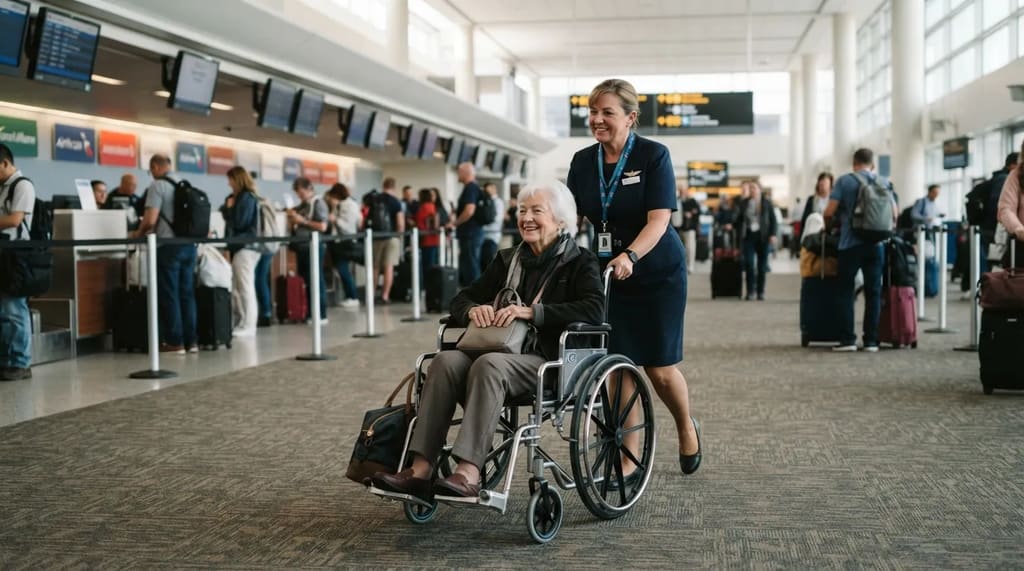
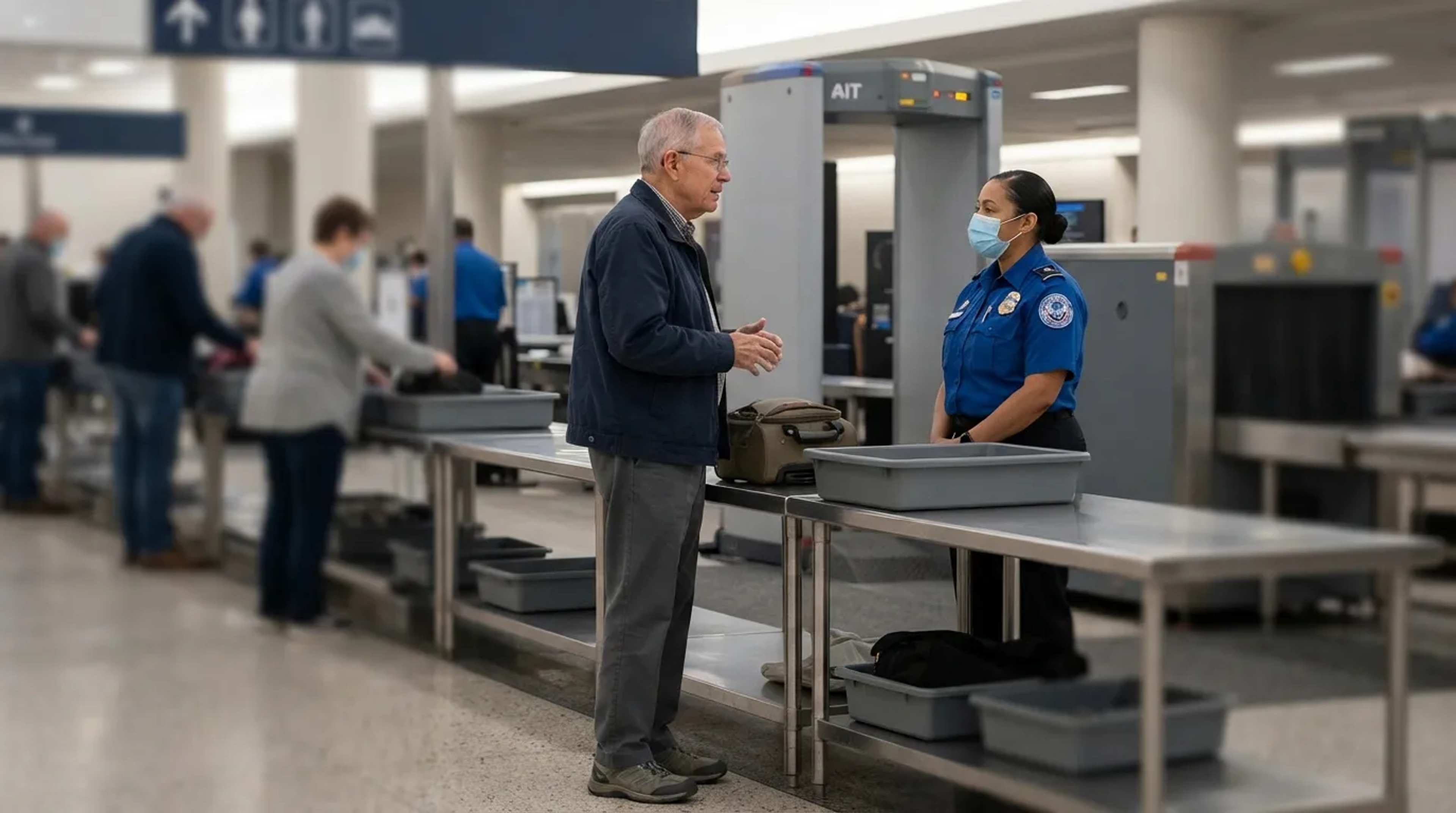
Federal law bars airlines from charging for disability assistance in the airport. Under the Air Carrier Access Act, help getting through check-in, security, the gate and a tight connection comes at no cost to you.
That includes help boarding and getting off the plane. You don’t have to be unable to walk to qualify, since a passenger who can manage a few steps but not a half-mile terminal can ask for a wheelchair just to the gate.
Age alone isn’t the test, but need is. If the walk from the curb to a far-off gate is more than you want to do, you’re allowed to ask, and the airline can’t bill you for the help.
Why It Stands Out
- The price is zero, set by the Air Carrier Access Act
- Covers check-in, security, the gate, connections and boarding
- You don’t need to be unable to walk to ask
- Best requested when you book, or at least 48 hours ahead
Request it when you book, or at least 48 hours ahead when you can. Show up without notice and the airline must still make reasonable efforts to help, though you may wait longer.
If the help doesn’t arrive, ask the airline for its Complaint Resolution Official, who must be available at the airport in person or by phone.8 Ask for the help. It costs nothing, and no agent can add a fee for it.
Every other charge on this list is a rule you work around. This is the rare one where the law already stands on your side.
The Fee That Was Never Yours to Pay
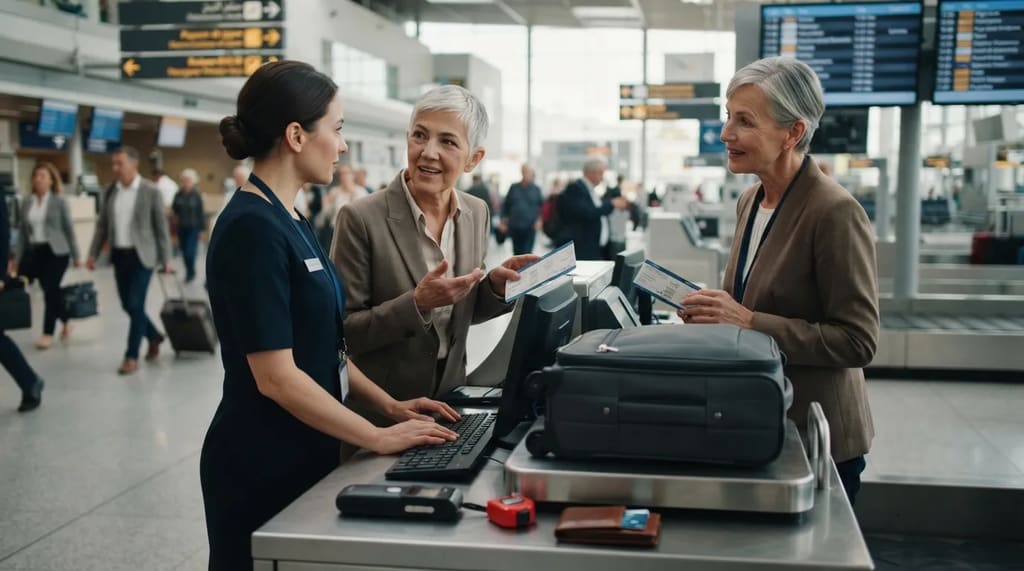
Fourteen charges, and most of them were avoidable by a few minutes of planning. A prepaid bag, a lighter suitcase, a card in your wallet or a refund request out loud can change the total.
The biggest wins came from knowing which rule applied. A scale, a tape measure and the right fare page do more than any coupon.
The last three weren’t about saving $5 at all. They’re about the equipment and help that make travel possible, and federal rules treat those differently from baggage.
Next time an agent quotes you a number at the counter, take a breath and ask which rule it comes from. Sometimes the right answer is less, and sometimes it’s nothing.
- American Checked Bag Policy: https://www.aa.com/web/i18n/travel-info/baggage/checked-baggage-policy.html
- Southwest Assigned Seating: https://www.southwest.com/customer-enhancements/assigned-seating/
- Delta Bag Fee Increase: https://www.cbsnews.com/news/delta-bag-check-fee-jet-fuel-iran-war/
- Southwest Baggage Fees 2026: https://www.lugless.com/airline-baggage-fees/southwest-baggage-fees/
- DOT Automatic Refund Rule: https://www.transportation.gov/briefing-room/biden-harris-administration-announces-final-rule-requiring-automatic-refunds-airline
- DOT Disability Bill of Rights: https://www.transportation.gov/airconsumer/disabilitybillofrights
- DOT Assistive Device Brochure: https://www.transportation.gov/sites/dot.gov/files/docs/AirTravel_with_an_Assistive_Device-Digital_Brochure_0.pdf
- DOT Wheelchair and Guided Assistance: https://www.transportation.gov/individuals/aviation-consumer-protection/wheelchair-and-guided-assistance