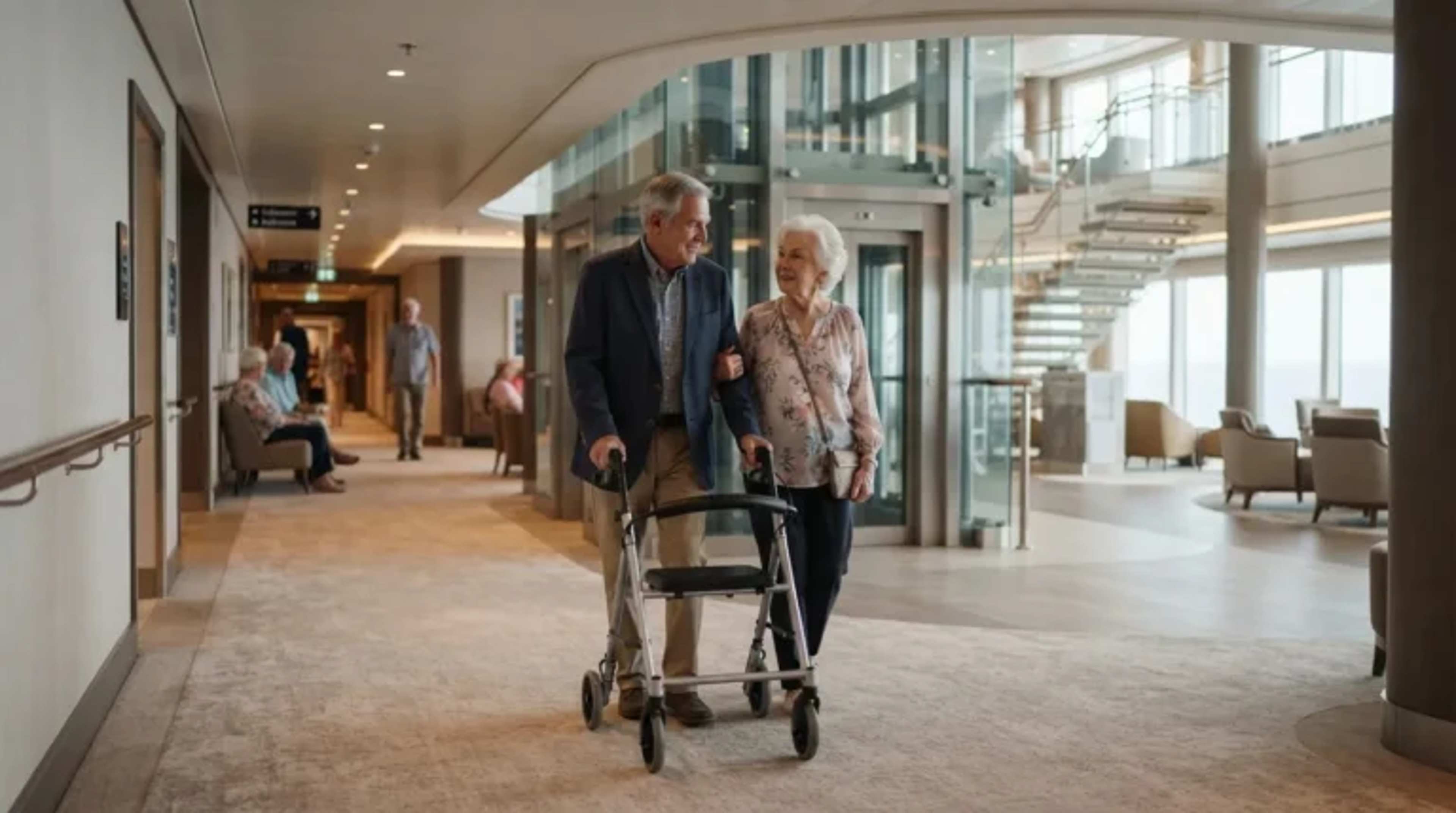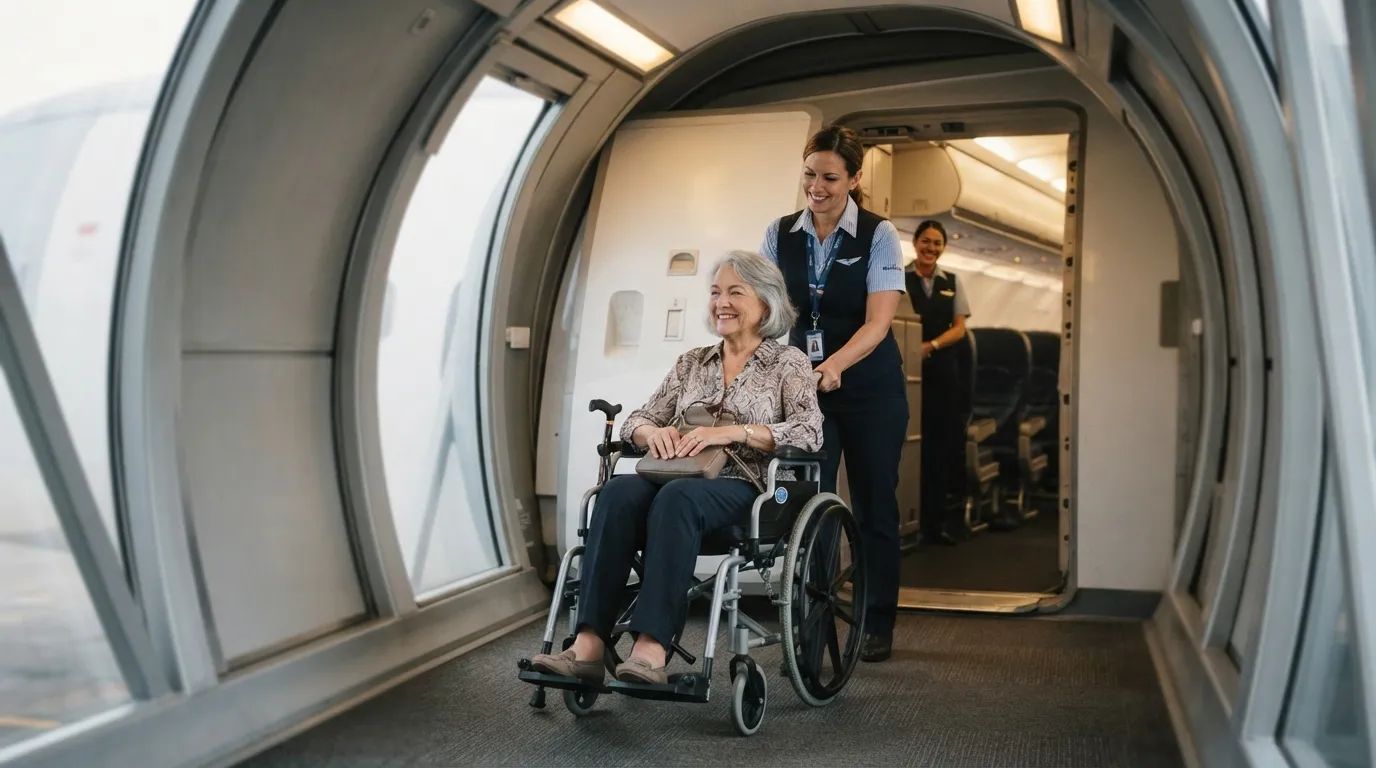
Most travellers over 60 picture airport assistance as one wheelchair and a quick wave at the gate. The reality is a lot bigger than that.
Assistance teams are trained to run more than a dozen distinct services, many of them legally guaranteed and completely free – yet most seniors never use half of them because nobody explains what’s actually on offer.
The system starts the moment your car pulls up to the curb and doesn’t stop until you’re back on solid ground. A few of these will surprise even frequent flyers.
#14 – Curbside Meet-and-Greet From the Second You Arrive
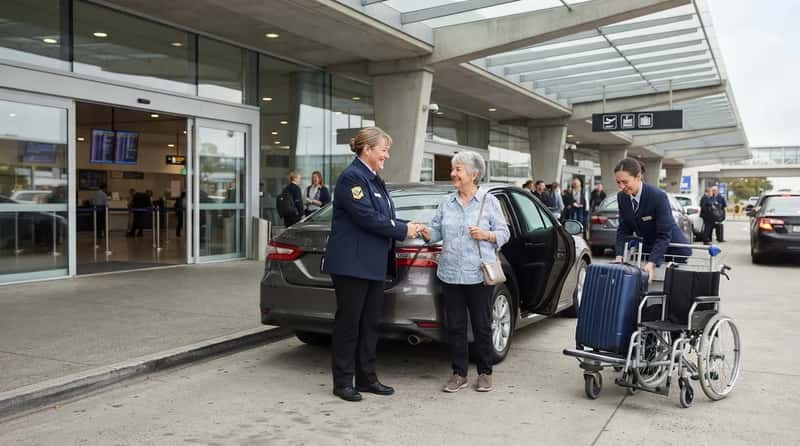
Most people think airport assistance starts at the check-in desk. It actually starts outside, at the curb.
Many airports dispatch staff to help passengers straight from their car – through ticketing, security, and all the way to the gate. Some will move you by cart or wheelchair before you’ve even set foot inside the terminal.
This curbside handoff is one of the most underused services available – most travellers don’t know to ask for it.
Notifying the airline in advance means the right staff and equipment are waiting when you arrive. One phone call before your trip triggers the whole chain.
But curbside pickup is just the opener. What happens at the check-in desk is where things get genuinely useful – and that’s what #13 is all about.
#13 – Priority Check-In and Boarding Pass Handling
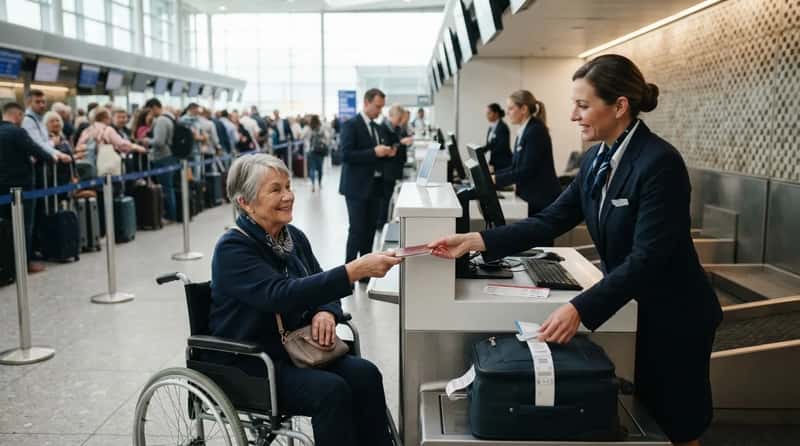
Standing in a long check-in queue isn’t mandatory once you’re over 60. Most people just don’t know that.
At the airport, seniors can skip the main queue entirely by heading to the special-assistance counter. A dedicated staff member handles check-in, baggage, and boarding passes there.
That single desk visit bypasses the standard queue entirely. It isn’t a business-class perk – it’s available to anyone who requests assistance in advance.
Telling the airline about mobility needs when booking lets them arrange the right support – wheelchair service, an escort, or priority boarding. Request it early, and the system meets you there.
Check-in sorted. But then comes the part that quietly defeats a lot of senior travellers – and #12 tackles it head-on.
#12 – Full Luggage Handling From Drop-Off to Arrival
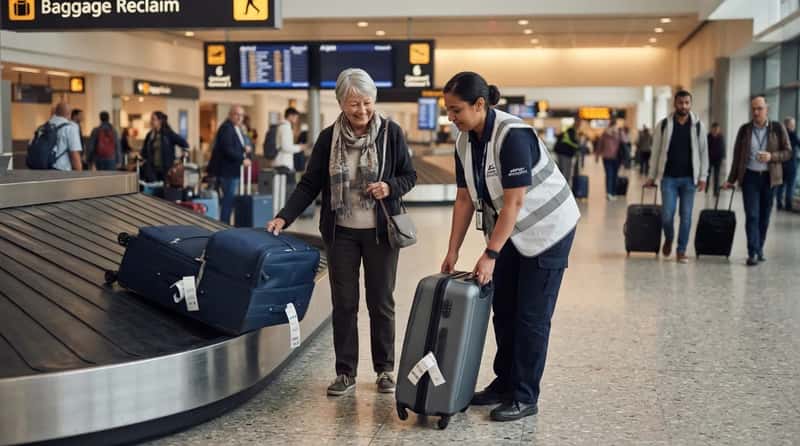
Dragging a suitcase across a terminal isn’t part of the deal once you’ve requested assistance. Neither is wrestling it off the carousel alone.
Baggage handling runs through the entire assistance service – a team member manages your bags at drop-off and coordinates their retrieval on the other end.
Most people don’t realise the same team that greets you curbside is authorised to handle your bags the entire way.
An assistant helps at check-in and manages your luggage, and some airports even allow bag drop without queuing. That’s two problems solved in one step.
Wait until you see what assistance teams handle at security – because #11 changes everything for travellers with medical implants or mobility aids.
#11 – Dedicated Security Support Through TSA Cares
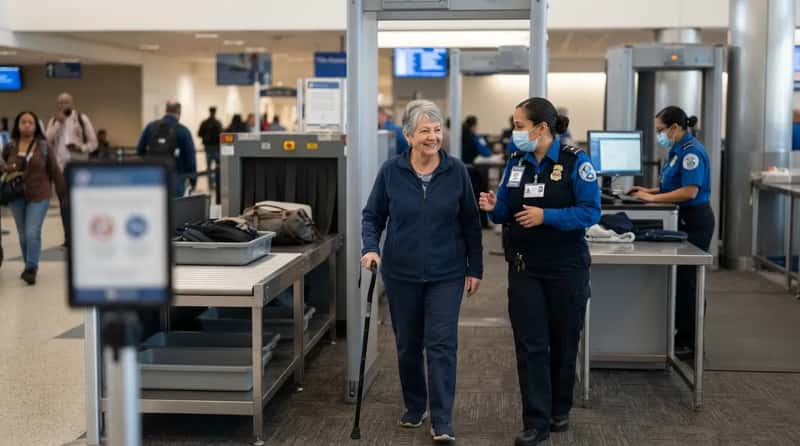
Security is the part of air travel that stresses senior travellers most. It doesn’t have to be.
For older travellers with implants, joint replacements, or mobility aids, checkpoints can be genuinely difficult. TSA Cares provides a specially trained Passenger Support Specialist on request – someone who knows how to work with travellers who have disabilities or medical conditions.
Fast Facts
- Program: TSA Cares Passenger Support Specialist
- Phone line: Individuals should request passenger assistance at least 72 hours in advance by contacting our TSA Cares passenger support line at (855) 787-2227.
- Hours: Weekdays: 8 a.m. – 11 p.m. ET Weekends/Holidays: 9 a.m. – 8 p.m. ET.
- Cost: Assistance is provided free of charge and can be arranged in advance by calling 855-787-2227, sending an email, or by submitting a request online.
Requesting a Passenger Support Specialist costs nothing and can be arranged with a single call to TSA Cares 72 hours before your flight.
If you have a hip replacement, a pacemaker, or simply can’t stand in the scanner, telling the officer lets them accommodate you. One sentence at the checkpoint changes the entire experience.
But security is only the midpoint. The next service – #10 – covers the part of the airport most seniors find genuinely exhausting.
#10 – Electric Cart Transport Across Long Terminals
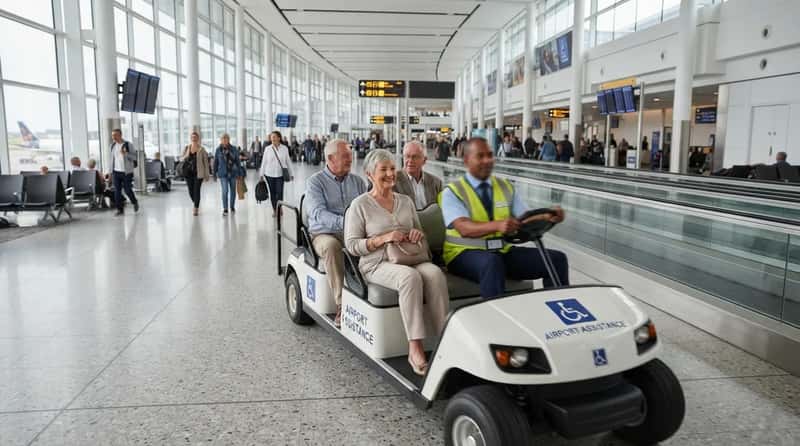
Modern airports are enormous. Walking half a mile to a gate after security is a real problem, and assistance teams know it.
Larger airports run motorised carts for gate-to-gate transport, and they’re not reserved for passengers in wheelchairs. Anyone who’s requested mobility assistance can use one.
A motorised cart can cut a 20-minute terminal walk down to under five – a detail most travellers over 60 have never been told exists for them.
Cart and escort services matter most during layovers, terminal changes, or busy travel periods, when long walks and crowded gates get overwhelming. This is the service that turns a hard journey into a manageable one.
What assistance teams handle at the gate is where things get quietly powerful – and that’s exactly what #9 covers.
#9 – Priority Boarding With Full Escort to Your Seat
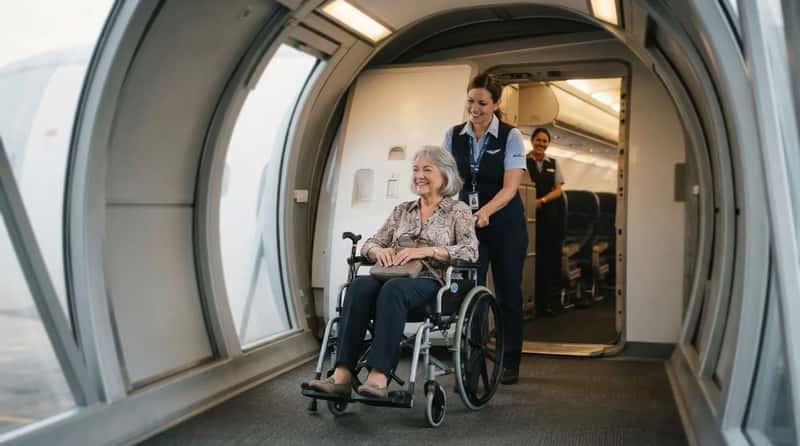
Boarding when you move slowly, use a walking aid, or just need extra time is far less stressful than most people realise – if you’ve requested assistance.
Seniors who request wheelchair or mobility help board early, with a full escort from check-in to gate. Early boarding means first access to overhead storage and time to settle before the crowd presses in behind you.
No medical documentation is required – just the initial request.
An attendant can walk you to the gate or the full length of the jetway if needed. You’re never left to figure it out alone.
Once you’re on board, assistance teams hand off to cabin crew – but #8 reveals what happens when the flight itself needs an extra layer of support.
#8 – Aisle Chair Boarding for Passengers Who Cannot Walk the Aisle
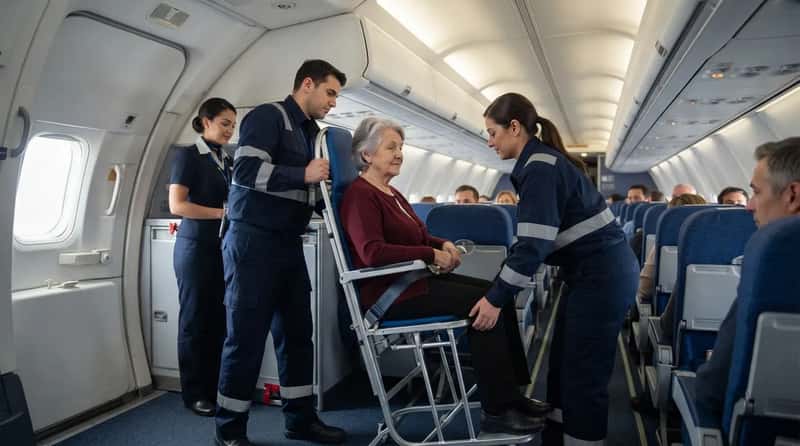
This one surprises almost every family that discovers it. If someone can’t walk down the aircraft aisle, there’s a specific piece of equipment built exactly for that.
A typical assistance journey covers help at the terminal entrance, escort through check-in, support through crowds and lines, priority screening, an escort to the gate, and aisle-chair boarding if it’s needed.
An aisle chair is a narrow, specialised wheelchair built to fit aircraft aisles – something most families only learn about after a difficult boarding experience.
The transfer on board is handled with specialised equipment, including a lift where needed. The equipment exists, the service exists – it simply has to be requested.
What comes after landing is where the system truly completes itself – and #7 covers the post-flight side most guides forget entirely.
#7 – Post-Flight Escort From the Aircraft Door to Arrivals
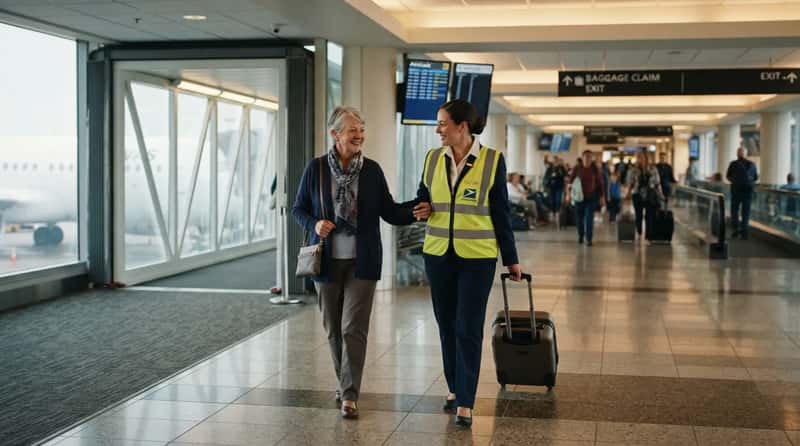
Landing isn’t the end of the journey. For many seniors, that’s exactly when fatigue hits hardest – and when the assistance team is supposed to reappear.
Guided assistance runs from check-in through security, boarding, and the walk to your seat – and when you land, the escort meets you at the aircraft door and takes you to baggage claim or your next gate.
Most travellers don’t know this post-flight leg is included in the same request they made at booking – it doesn’t require a second call.
Once staff are notified, you’re supported from your seat through disembarkation, all the way to the arrivals hall and baggage claim. It’s a full door-to-door system.
The connecting-flight support is where things get truly underestimated – and #6 is the one service most families wish they’d known about sooner.
#6 – Connection Management Between Gates and Terminals
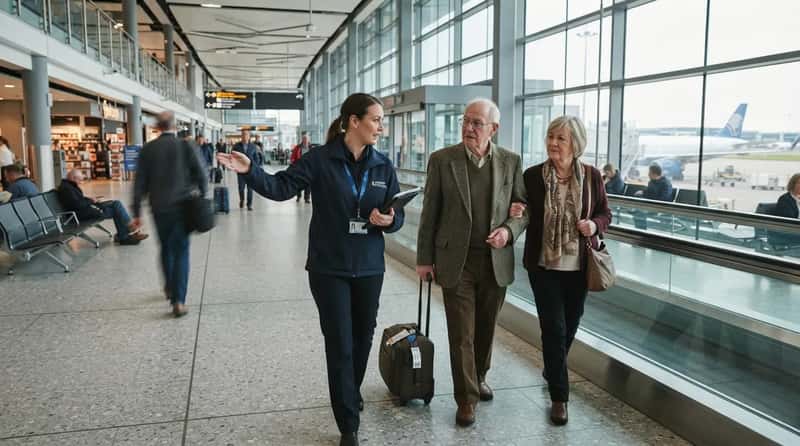
Tight connections at big hub airports are one of the leading reasons senior travellers miss flights. Assistance teams are specifically trained to prevent it.
Meet-and-greet agents escort elderly travellers between terminals, use priority security and immigration fast-track lanes, and manage the logistics needed to reach the right gate safely.
This coordination function is one of the most valuable – and least advertised – parts of the whole service.
Arrival support covers immigration, customs, baggage claim, and guidance or escort to the next gate during a layover. The team doesn’t disappear after the first flight – they follow through.
But what about travellers who need support that goes beyond physical mobility? That’s where #5 quietly changes the game for a lot of families.
#5 – Hidden Disability Support and the Sunflower Lanyard
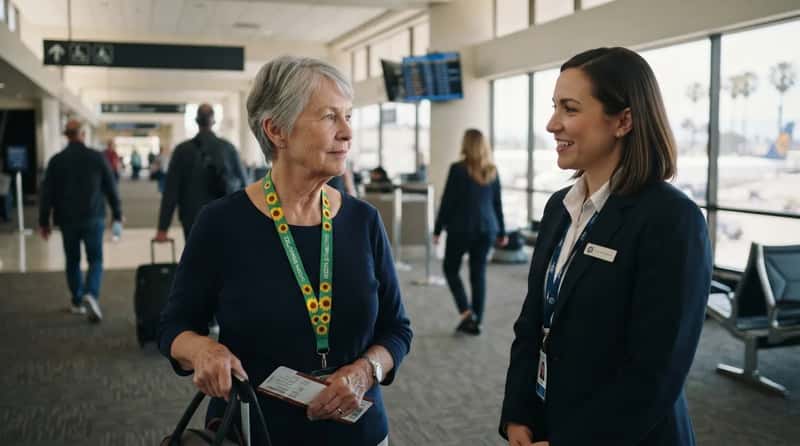
Not every condition is visible. Anxiety, early-stage dementia, and hearing loss don’t show up in how someone walks – and assistance teams are increasingly trained to notice.
A Sunflower lanyard signals to staff that a passenger needs extra time and patience, particularly useful for hidden disabilities. It’s discreet, internationally recognised, and prompts staff to slow down and communicate more clearly.
Worth Knowing
- The scheme was created in 2016 by a collaboration with Chris Lyon – OEM, Gatwick Airport and various charities.
- Santa Barbara Airport is proud to be one of 200+ airports across the world to participate in the Hidden Disabilities Sunflower Program.
- Anyone who feels they have a hidden disability can request one. There are no prerequisites for asking for or wearing a lanyard.
- Displaying the symbol does not permit travelers to move ahead of others in lines.
The passenger never has to explain their condition at every checkpoint.
It works for elderly travellers, people with physical or temporary mobility issues, and conditions like anxiety or dementia. The lanyard is free, needs no medical paperwork, and is available at most major airports.
Next is a service built specifically for cognitively vulnerable travellers – and #4 is the one most families only discover after something’s already gone wrong.
#4 – Cognitive and Dementia Support During Screening and Boarding
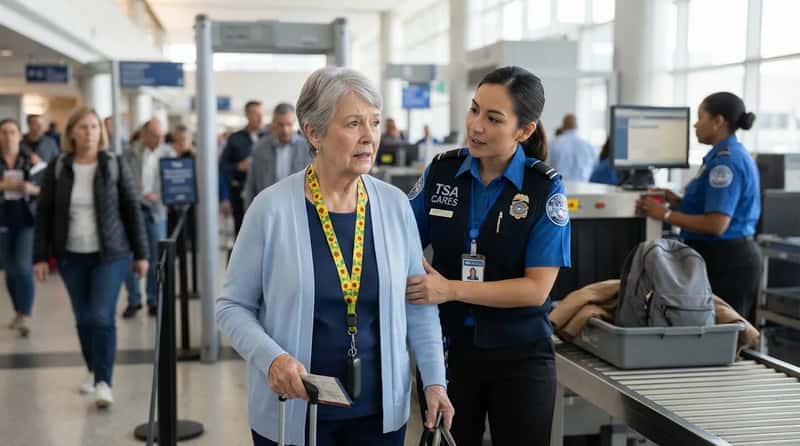
This is the service families most wish they’d known about earlier.
Families travelling with a parent who has dementia or memory loss can request TSA Cares assistance directly. A Passenger Support Specialist stays with the traveller through the checkpoint, easing confusion before it turns into stress.
This isn’t just about physical mobility – it’s built specifically for passengers whose cognitive state makes airports disorienting.
Combine the Sunflower lanyard, a pre-flagged booking note, and a TSA Cares request, and you’ve got a three-layer safety net – entirely free. Most families have never been told all three tools work together.
The next service covers unaccompanied seniors flying solo – and #3 is the one that genuinely changes confidence levels for travellers going it alone.
#3 – Escort and Companionship Services for Solo Senior Travellers
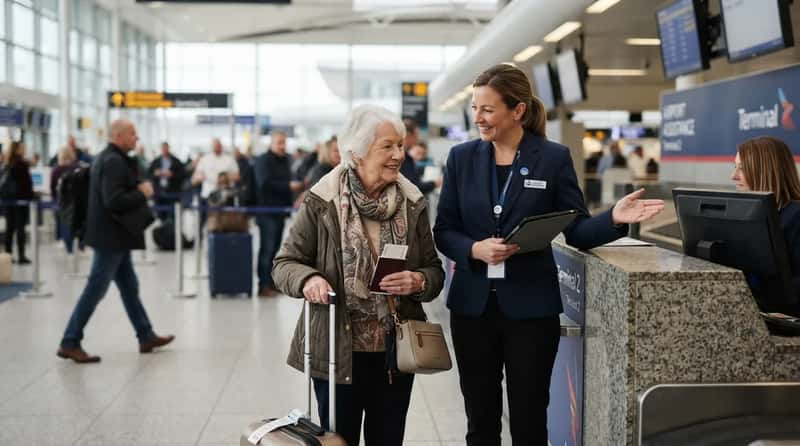
Travelling alone past 60 doesn’t mean navigating an airport with zero support. The escort service exists for exactly this.
Trained companions provide emotional support and guidance from check-in to boarding for seniors flying solo. They’re there to ease the challenges that come up along the way, so the trip feels secure rather than overwhelming.
This isn’t just a logistical handhold – it’s a genuine point of contact through what can be an isolating experience.
Some airports pair travellers with volunteers who guide them to ticket counters, gates, baggage claim, and transportation. At certain airports, multilingual volunteers are available too.
The second-most powerful service on this list is coming – and #2 is the one that turns a fragmented, stressful trip into something that actually works end to end.
#2 – Full-Journey Coordination: One Request Covers Everything
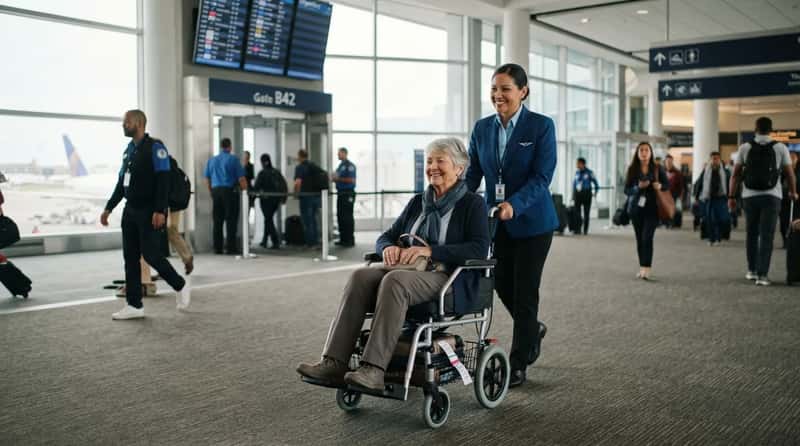
Here’s what most travellers and their families get wrong: they think every service has to be requested separately. It doesn’t.
Requested correctly, airport assistance becomes one complete door-to-gate system – check-in, security, gate navigation, boarding, and post-flight help, all included.
A single advance request, made at booking, can activate the entire chain.
Submit the request at least 48 hours ahead so the airport and airline have time to guarantee support. From there, the airline coordinates directly with the airport and the assistance provider – one conversation covers the whole journey.
The final service – #1 – is the one that underpins every other item on this list, and most people have no idea it’s a legal right, not a favour.
#1 – It’s All Free, Legally Guaranteed, and Requires No Proof of Disability
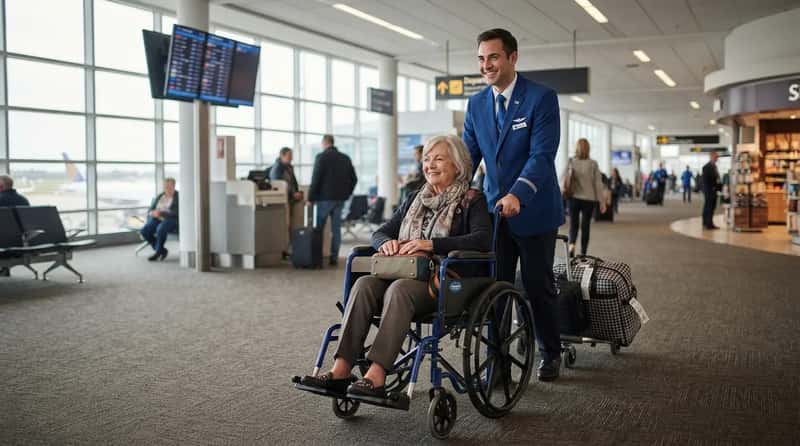
This is the most important thing on the entire list.
Wheelchair assistance and mobility support must be free, regardless of ticket class, on both domestic and international flights. Airlines are legally required to provide it to eligible passengers without charging a cent.
At a Glance
- Covers every ticket class, from economy to first
- Applies to both domestic and international flights
- No proof of disability or doctor’s note required
- Backed by the Air Carrier Access Act in the US, with similar rules in the EU
You don’t need to prove a disability. You don’t need a doctor’s note – you ask, and by law, they must provide it.
This isn’t a favour – it’s a legal service that starts at check-in and runs through security, boarding, and the walk to your seat. The Air Carrier Access Act in the US, and equivalent rules across the EU and other major markets, make it a right, not a reward.
The Bottom Line
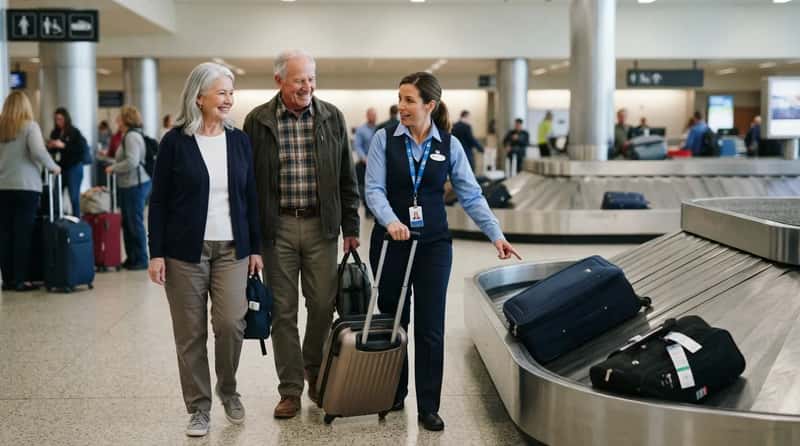
Most travellers over 60 still picture airport assistance as one wheelchair and one gate agent. The reality is fourteen distinct services, most of them free and legally guaranteed, running from the curb to the baggage carousel.
From curbside meet-and-greets and full luggage handling to cognitive support, aisle chairs, and post-flight escorts, the system already exists end to end – it just has to be activated.
The single biggest mistake is not requesting it at booking. One phone call, made early enough, covers the entire journey – and turns a stressful trip into one that’s actually looked after.