A week of parking at a Florida cruise port can cost anywhere from about $175 to $280, and that money is gone before the ship leaves the dock. Port Everglades garages work out to $175 for seven days, while a 7-night sailing from PortMiami can run $224 to $280 once arrival and departure days are counted.1 2
Parking is only the first line on a bill that quietly builds around embarkation day. Here are 15 fees and slip-ups that catch travelers over 65 in Miami and Fort Lauderdale, counted down from small annoyances to the one that can wreck a budget.
The costliest item on this list is one no port will ever send you, and it has nothing to do with parking. But the trouble starts even earlier than the garage, with a luggage tag.
#15 – Luggage Tags Left Until You Reach the Curb
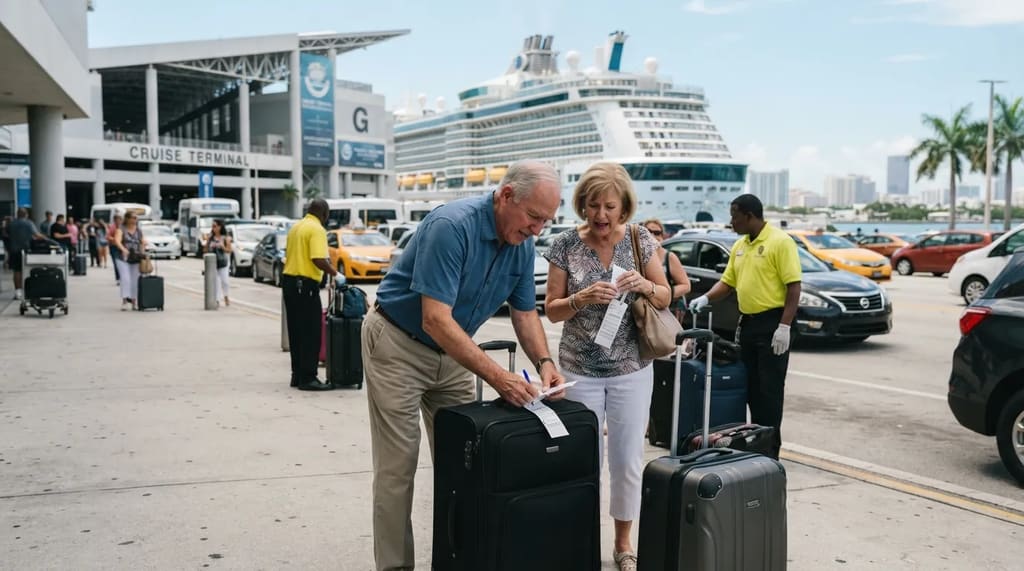
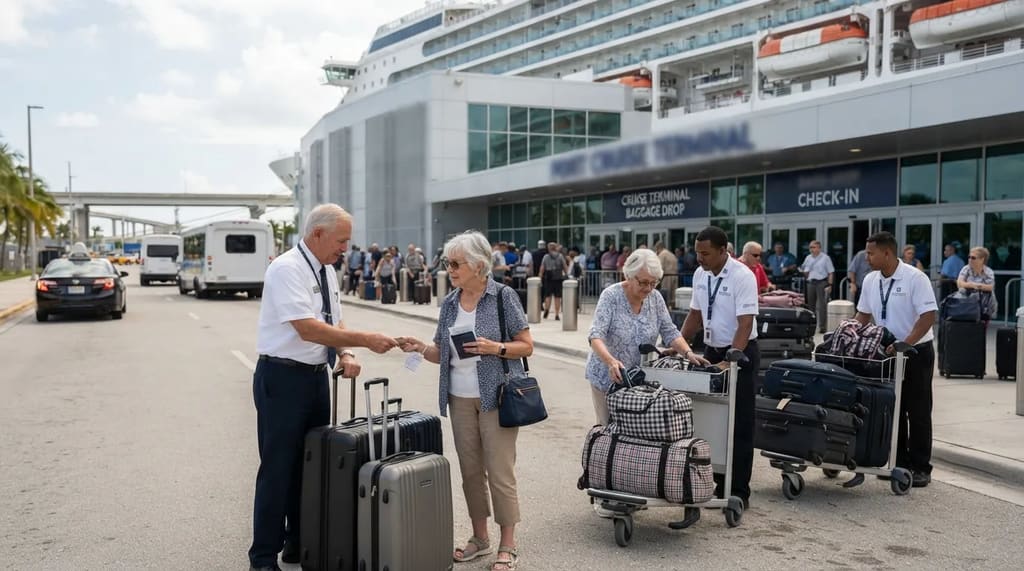
Your cruise line provides luggage tags to print at home, showing your name, ship, deck and cabin. At PortMiami the terminal is printed on them as well, because the porters sort by it.
Porters can supply or correct a tag at the curb. That is slower than handing over a bag that is already labeled, and you end up fumbling with a pen and tape while the line of cars behind you grows.
Print the tags a few days ahead and attach them at the kitchen table. Carnival’s current guidance also caps checked bags at 50 pounds and sets size rules.3
So weigh a packed suitcase on the bathroom scale before it goes in the trunk.
The tag gets the bag to the right ship, though it does nothing about the tip owed to the person who carries it.
#14 – Porter Tips That Sit Outside Your Gratuities
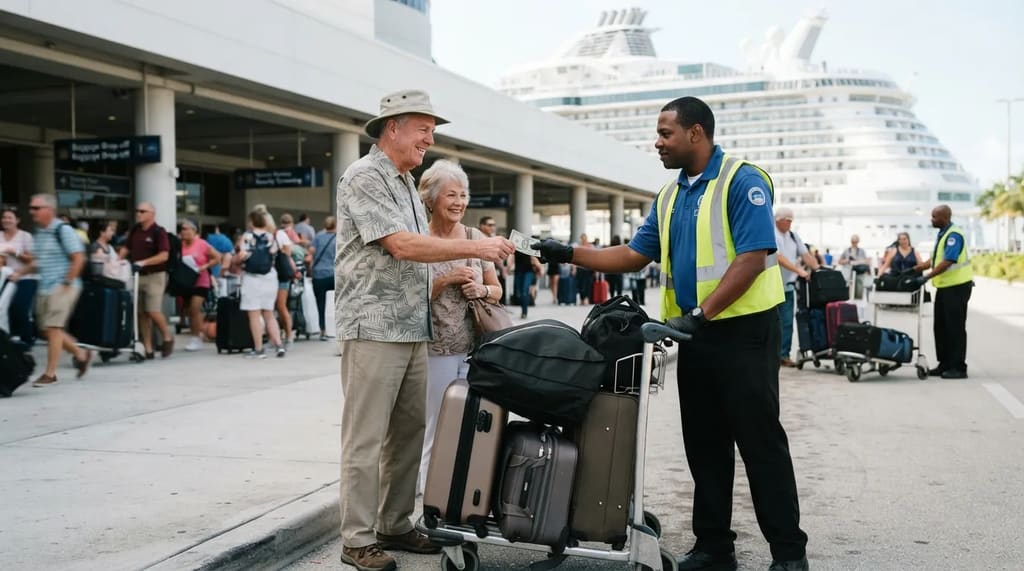
Porters are not cruise line employees, so their tip is not part of the gratuities you pay the cruise line. A typical tip at the terminal is $2 to $5 per bag.
For a couple with four bags, that comes to roughly $8 to $20 in cash at the curb. It is the smallest charge in this article, and it is worth paying, because the alternative is dragging luggage through the terminal yourself.
Carry a few small bills for the porter and a credit card for the garage. At least one current Miami port guide reports that debit cards are not accepted for parking.
A debit card alone could leave you stuck at the exit gate on the way home, with a line of cars growing behind you.
Cash in hand helps only if you pull up to the right curb, and the port has several, each assigned to particular lines.
#13 – The Wrong Terminal Letter at PortMiami
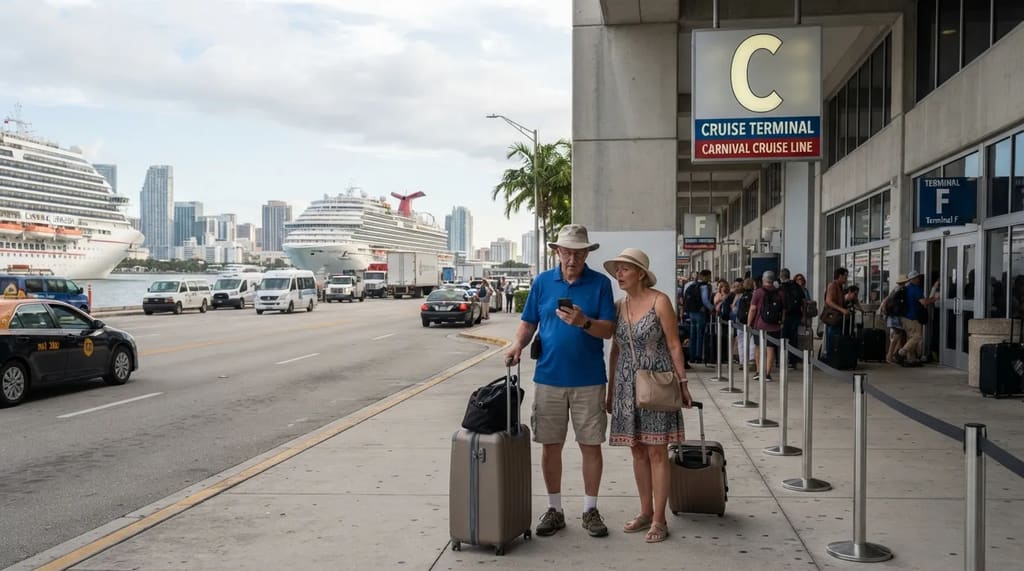
PortMiami has ten active cruise terminals, and each one serves specific cruise lines. A line can also change terminals from one sailing to the next, so your memory of last time is a poor guide.
Carnival, for one, does not always use a single Miami terminal. Take the letter from your boarding documents or the cruise line app, and give it to your driver rather than just the port’s administration address.
A mistake is hard to fix on foot. The roads between terminals are working port roads with cargo traffic, so walking with luggage is not practical.
The answer is to return to the drop-off lane, order another ride and give the correct terminal letter.
Even the right curb will not help if the wrong bottle is tucked into your carry-on.
#12 – Spirits and Beer in the Carry-On
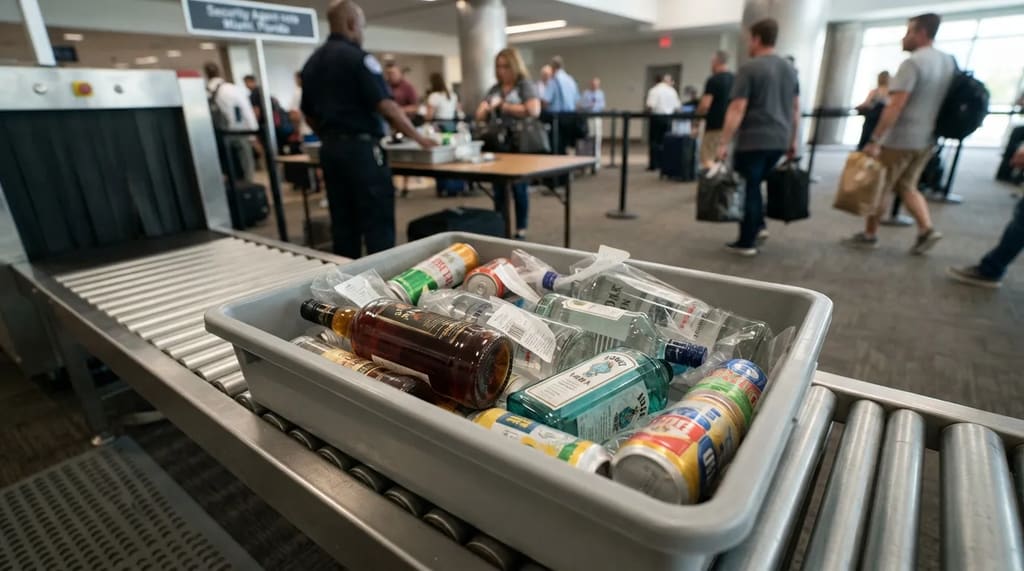
Spirits and beer are not allowed in carry-on luggage on the big lines. Anything confiscated at security is either thrown away or held until the end of the cruise.
A bottle you were proud of finding in the duty-free aisle can end up in a bin at the terminal. If the item is held, you also pay in time.
You get a receipt and collect it on the final morning at a desk in the luggage hall. That adds about fifteen minutes to a disembarkation you were hoping would be quick.
It is not worth the gamble. Read your own line’s alcohol policy in the boarding documents, and buy what you want on board under that line’s rules.
Whatever clears security, the car you left in the garage keeps running up a charge by the day.
#11 – Parking Days Counted at Both Ends
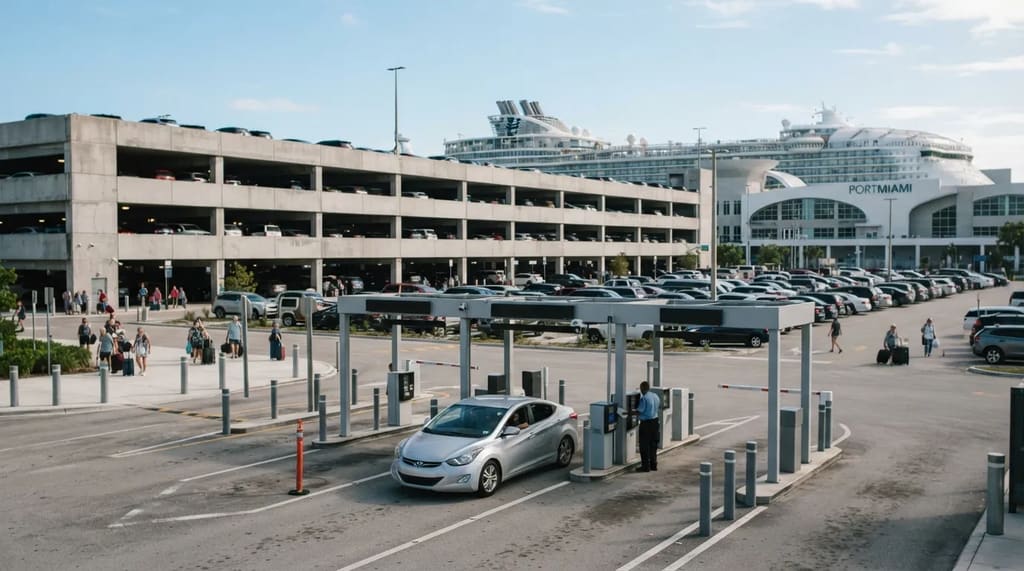
At PortMiami you pay for every day, including the day you arrive and the day you leave. A Saturday arrival for a seven-day cruise with a return the next Saturday is billed as eight days.
Shorter sailings feel this more. A 4-night Bahamas cruise at $28 a day comes to roughly $112 to $140, because the extra arrival and return days are a bigger share of a short trip.
Port Everglades counts differently. It bills in 24-hour cycles from the time printed on your entry ticket rather than by calendar day.4
Keep that ticket with you during the cruise, since you pay at a kiosk or exit barrier when you return.4
Quick Compare
- PortMiami: billed by calendar day, so arrival and return days both count.
- Port Everglades: billed in 24-hour cycles from your entry ticket time.
- Short sailings: a 4-night cruise at $28 a day runs roughly $112 to $140 at PortMiami.
The meter is not the only variable, because the daily rate itself changes from one Miami garage to the next.
#10 – Garage Rates That Change by Terminal
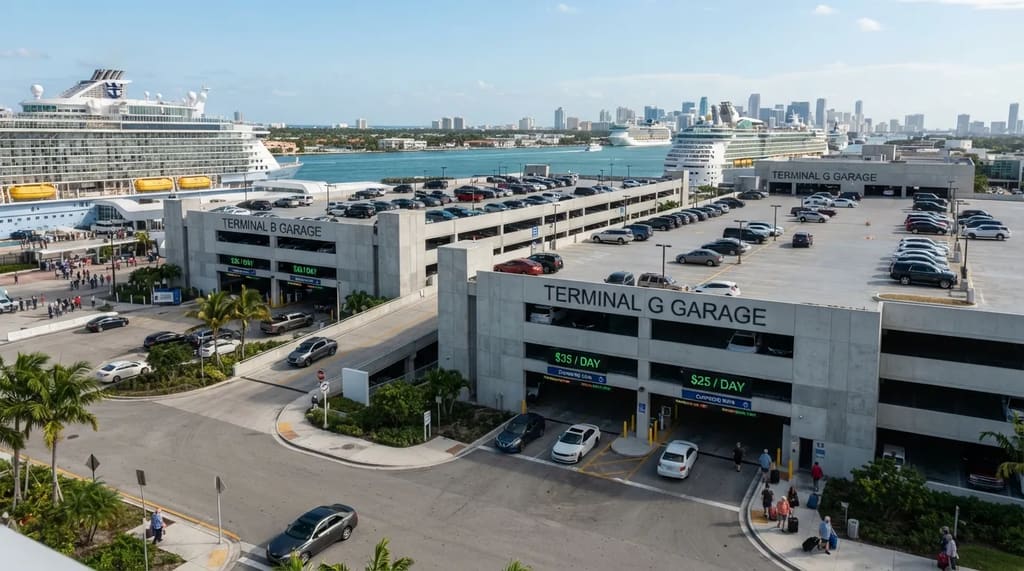
Recent Miami-Dade County listings show $35 per day at Garages AA and B, and $25 per day at Garages C, D, G, J and K.5 Other recent guides list $28 at several of the standard garages.
So the number has moved. Confirm it on the county’s port page before you leave.
Royal Caribbean’s garage is a separate case. Its rates are set through the line’s own Miami parking site, so the port’s page will not give you that figure.5
Port Everglades looks simpler, with recent listings giving its own garages and lots a flat $25 daily maximum. Some 2026 guides still show $20 a day for standard vehicles, so a quick check of the port’s website is worth it.
The longer the cruise, the louder that meter ticks.
#9 – Paying Port Garage Prices on a Long Cruise
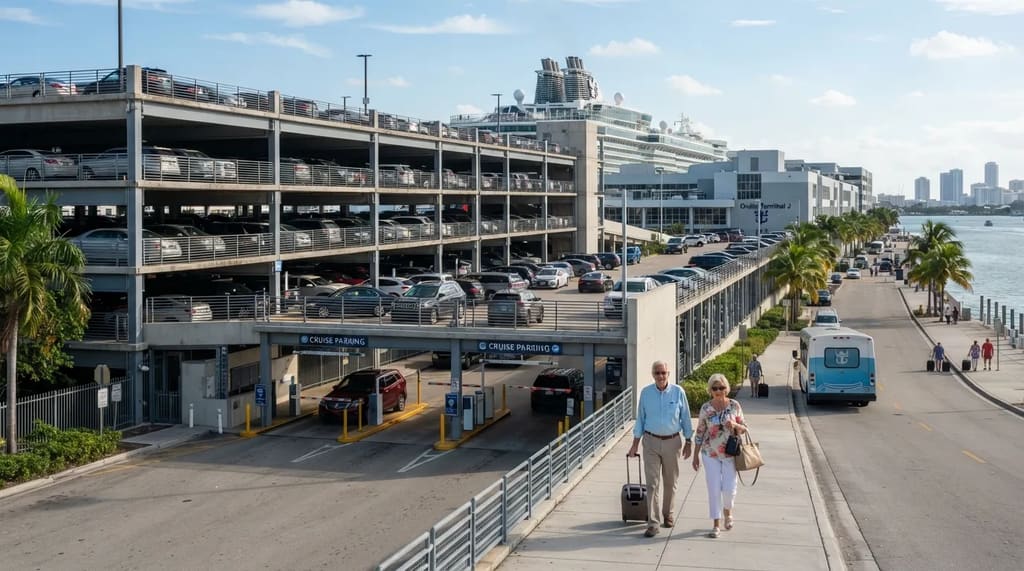
Off-site lots a few minutes from PortMiami run about $8 to $16 a day with a free shuttle, which is forty to fifty percent below the port garages. Private lots near Port Everglades typically charge $5 to $10 a day with a shuttle to the terminal curbside.
One verified lot with a dedicated cruise shuttle was listed at about $13.45 this fall. On a three- or four-night cruise the saving is perhaps a few dozen dollars, and a shuttle ride may not be worth that.
Beyond a week, the difference starts to matter. At roughly $25 a day, a two-week stay approaches $350, and an airport hotel package with free parking and a shuttle is usually cheaper.6
Compare the all-in total, not the advertised daily rate. Also check the shuttle’s hours for your return day, since one Port Everglades off-site lot lists its free shuttle as running from 7 AM to 2 PM.
Both the garage and the lot assume an ordinary car, and a high van or a trailer falls under different rules.
#8 – Oversized Vehicles and the Height Limit
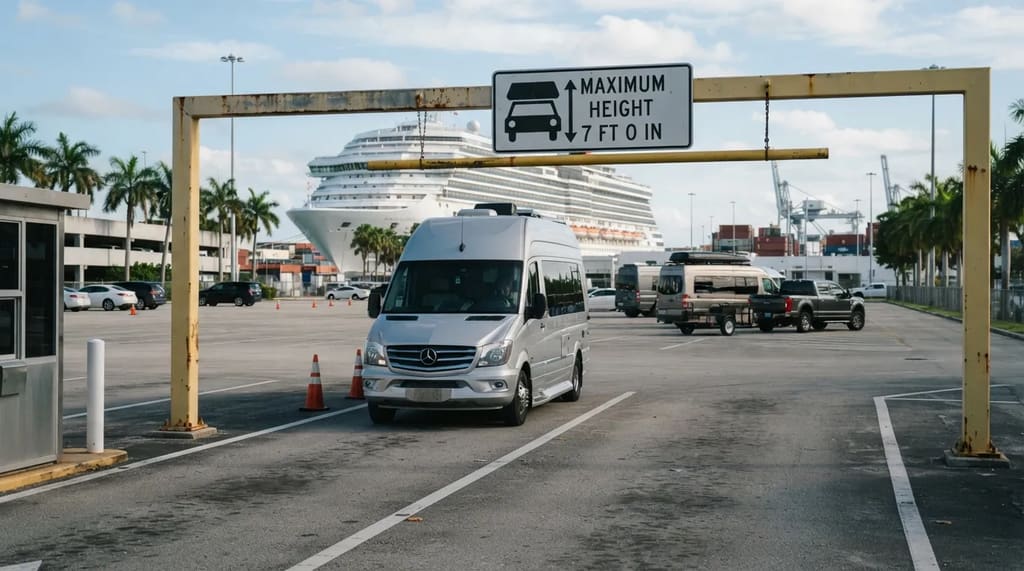
At PortMiami, oversized vans, RVs and vehicles with trailers use Surface Lot E, at $25 a day for one space and $50 for two.1 6 The extra space is the reason the cost doubles.
Port Everglades prices these vehicles higher than cars. One recent guide lists a $35 daily maximum for oversized vehicles, while another puts the rate at $25 and says the covered garages have a strict 7-foot clearance.
If you drive a conversion van, a pickup with a cap or a car with a roof carrier, measure it. Then call the port’s parking office before the trip, because the special parking is limited, has a maximum length of 24 feet, and depends on availability.
A tall vehicle at least announces itself at the gate, whereas the placard hanging from your mirror is often assumed to buy something it does not.
#7 – Assuming a Disabled Placard Waives the Parking Fee
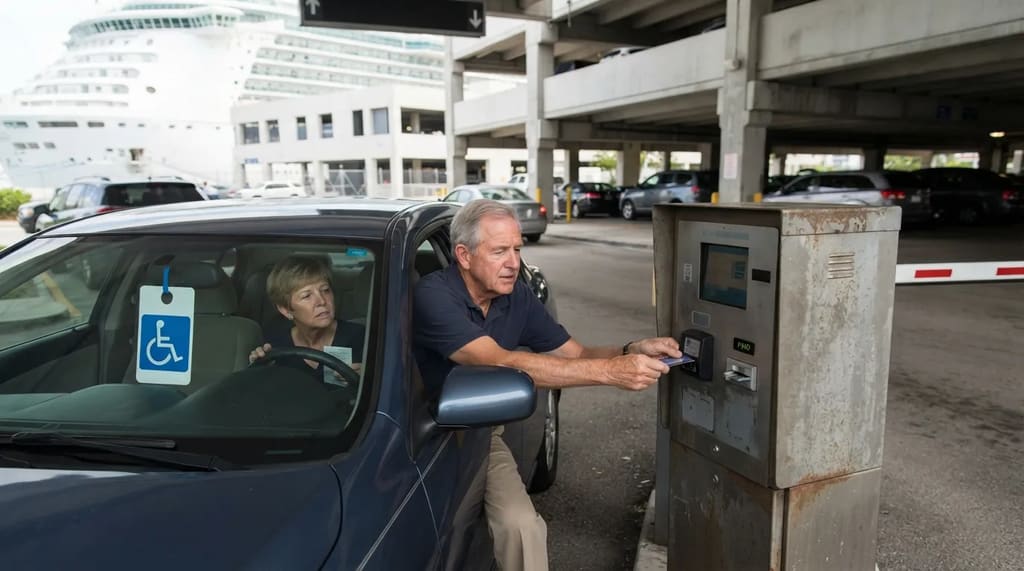
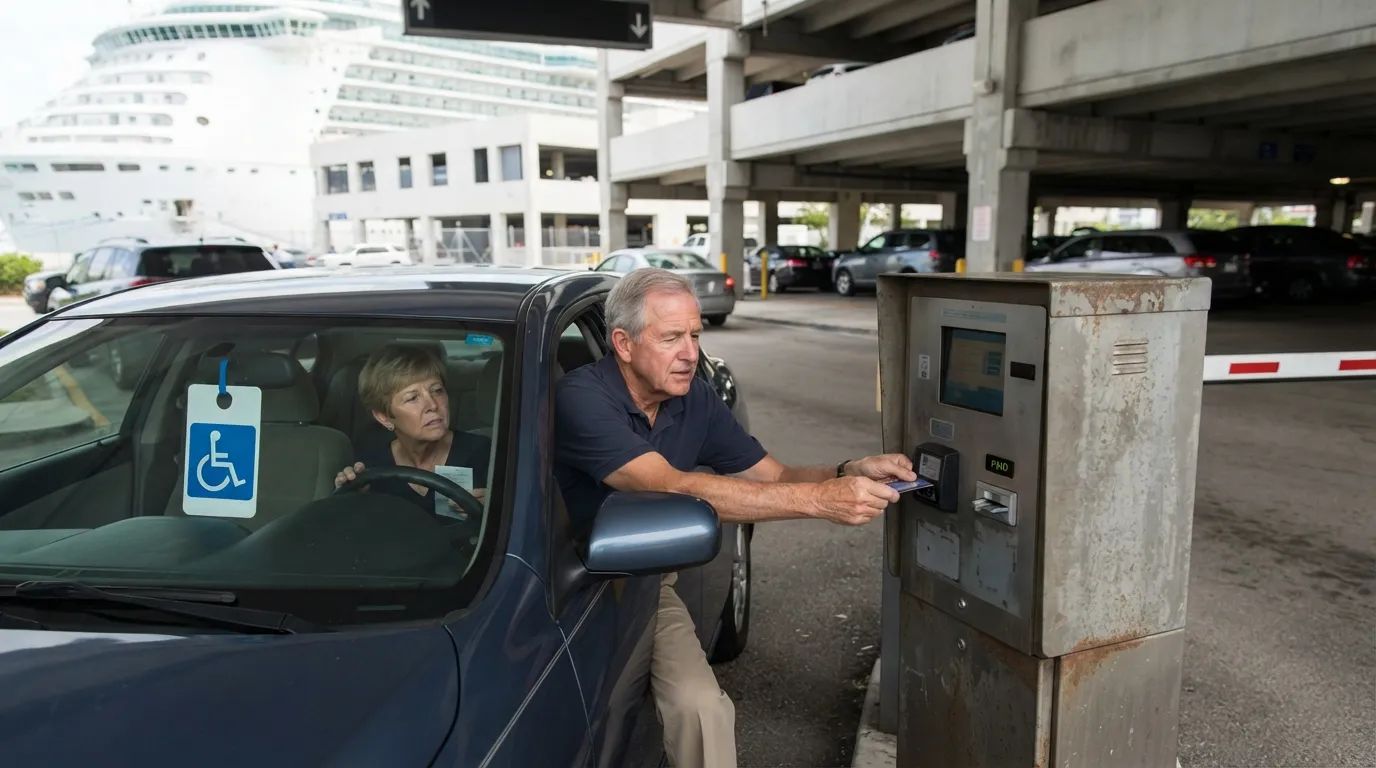
At Port Everglades, a standard disability placard lets you use accessible spaces but does not waive the daily parking fee.4 The placard helps with where you park, not with what you pay.
That still has value, because accessible spaces mean a shorter walk. At the port’s garages you park, take the elevator and arrive at your terminal, so a space near the elevator makes the stretch with luggage much easier.
Budget the full daily rate unless the port tells you otherwise in writing. If you assume a waiver at either Florida port and are wrong, you will find out at the exit gate on the last morning.
Getting to the port is its own price tag, and the cruise line’s offer is rarely the cheapest one.
#6 – Paying Cruise Line Prices for Airport Transfers
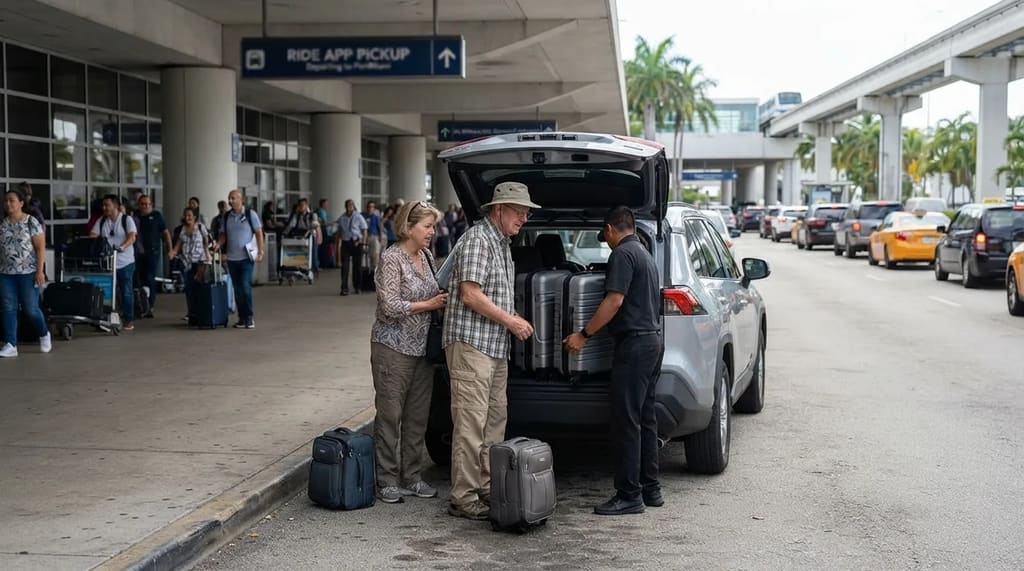
Cruise lines sell airport transfers directly. Carnival, for example, charges $22.99 per person from Miami International and $36.99 per person from Fort Lauderdale to PortMiami on embarkation day.
Those fares are per person, so they add up fast for a couple. A ride app is often the cheaper choice for a group.
A standard car takes two large cases and two carry-ons. Four people with four large suitcases need a larger vehicle that costs roughly double, which is still cheaper than four cruise line transfers.
Follow the signs for ride-app pickup at Miami International, and allow ten minutes to get there with luggage. Port Everglades is just 1.8 miles from Fort Lauderdale-Hollywood International.
The drive from Fort Lauderdale to PortMiami takes about an hour, though another guide puts it at 30 to 40 minutes in easy traffic. Either way, plan around the slower number.
At a Glance
- Carnival transfer to PortMiami: $22.99 per person from Miami International.
- From Fort Lauderdale airport: $36.99 per person to PortMiami.
- Port Everglades: just 1.8 miles from Fort Lauderdale-Hollywood International.
- Fort Lauderdale to PortMiami: about an hour, so plan for the slower estimate.
Plan the ride home as carefully, because neither PortMiami nor Port Everglades offers luggage storage. A ride delivers you to the curb, but the walk from there to the gangway is a separate matter.
#5 – Waiting Until the Curb to Ask for Wheelchair Help
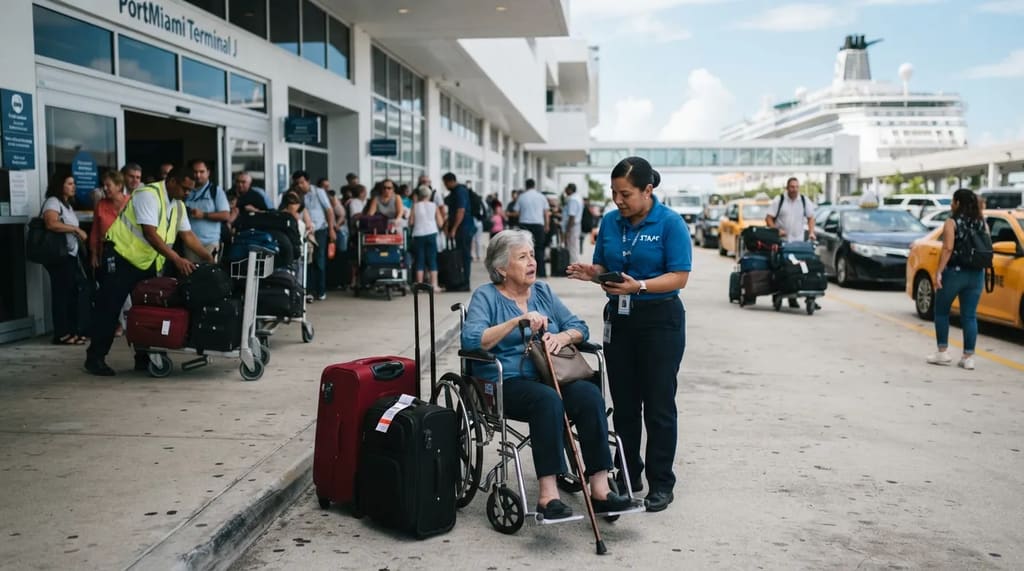
Wheelchair assistance is arranged through the cruise line, not the terminal, and should be requested when you book rather than on the day. Terminal staff can help, but the dedicated service belongs to the line.
Do not expect the porter to cover it. A porter moves luggage, while passenger mobility assistance is a separate service.
Scooters and chairs need their own advance notice. They travel free and are not counted as luggage, but the line needs the dimensions in advance for cabin access.
Make that call when the booking is confirmed, not in the week before sailing. Then ask again at the curb so staff can meet you on arrival.
Staff can wave you to the front of a line, and that line still ends at a desk where your papers are checked.
#4 – Birth Certificates and IDs That Do Not Match
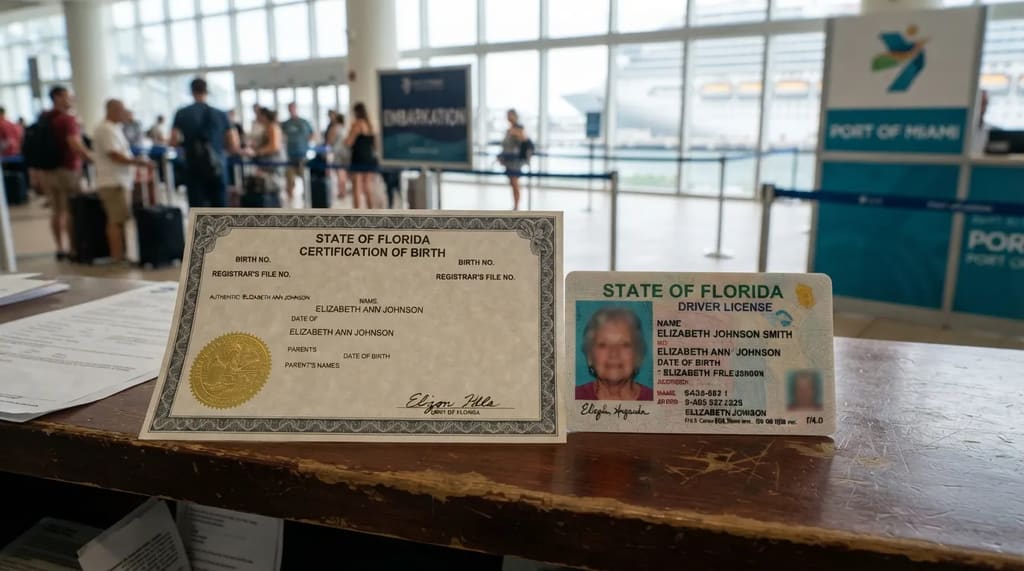
For a cruise that starts and ends at the same U.S. port, Royal Caribbean accepts an original, state-certified birth certificate (no photocopies) together with a state ID or driver’s license. Holland America says a clear photocopy can be used on most closed-loop cruises, so the rule differs by line and you should read yours.7
Celebrity notes that the name on both documents must match each other and match the reservation. If your legal name has changed, AAA advises bringing supporting papers such as a marriage certificate or court order.
Worth Knowing
- Royal Caribbean: original state-certified birth certificate, no photocopies, plus a state ID or driver’s license.
- Holland America: a clear photocopy works on most closed-loop cruises.
- Celebrity: names on both documents must match each other and the reservation.
- Passport: Celebrity says it must be valid for six months after your cruise ends.
A hospital birth record does not substitute, since the certificate must be issued by a government vital statistics office. Order a certified copy well before the trip rather than searching the attic the night before.
Celebrity strongly recommends a passport. If yours is current, bring it, since it covers more situations than the paper alternatives.
Related Stories From Travelbinger



Paper in order does you no good if the ride carrying it arrives after the ship has gone.
#3 – Flying In on Sailing Day
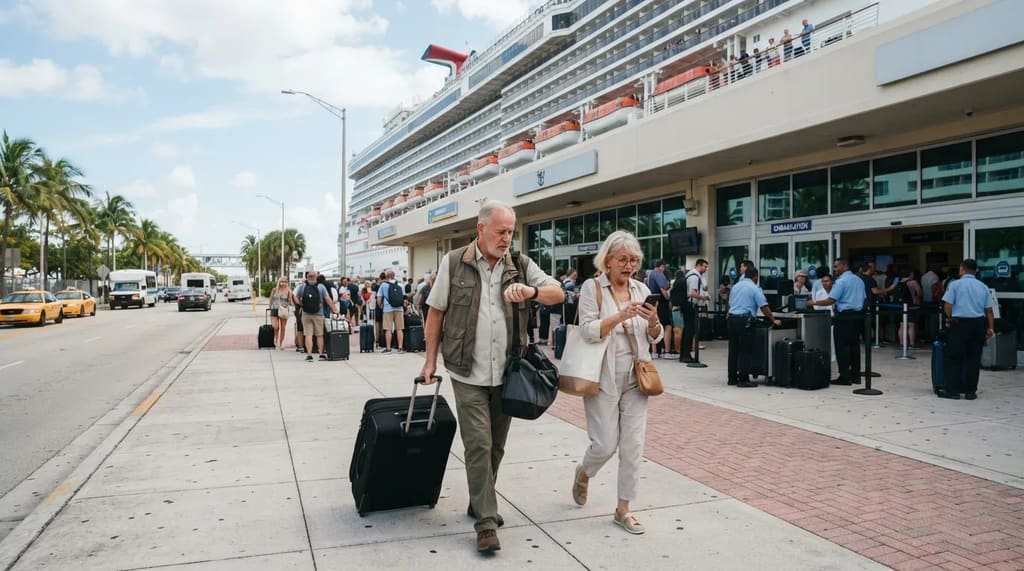
Embarkation day is the one day of the trip when a late ride can cost you the ship. A morning flight delayed by an hour leaves little room, because the drive, bag drop and security all still come after landing.
Guides advise arriving inside the boarding window and leaving a margin for traffic, luggage drop and the security line. That margin is hard to keep when the airline controls your arrival time.
A hotel night before sailing is the simple fix. At Port Everglades, one option is to add a hotel night as a pre-cruise buffer and pay $20 per person for the port transfer,2 and hotel park-and-cruise packages in Miami can cost $0 to $150 with the room.
That cost is small next to a forfeited fare. Cruise lines generally do not refund a passenger who misses the sailing, so check your line’s rule before you book a same-day flight.
Even a ride that arrives on time delivers you to a ship whose luggage service may not reach your cabin until evening.
#2 – Medication Packed in the Checked Bag

From the moment the porter takes your bag, it is out of your hands until it appears outside your cabin door. Checked bags handed to a porter can take until evening to reach the cabin.
Anything you need before about 5pm belongs in the bag you carry. That includes every prescription, because a dose due at four o’clock is not something you can fetch from a suitcase in a luggage hall.
Keep medication and documents in a carry-on. I would go further and carry the whole trip’s supply of daily medicines there, in their original bottles, with a printed list showing dose and time.
Pills in your carry-on cover a late suitcase, though they do nothing about the bill that follows a visit to a clinic in a foreign port.
#1 – Assuming Medicare Will Cover You at Sea

No port sign lists this charge, and it is the largest in this article. Original Medicare generally does not pay for health care received outside the United States, which includes a clinic in a Caribbean port.8
Coverage on a ship in foreign waters is limited and depends on the details, so do not assume it. Medicare Advantage and Medigap plans differ, so ask your own plan in plain terms what it covers abroad.
A separate travel medical policy is the usual answer, and its cost is small beside the parking bills earlier in this piece. Compare what each policy says about treatment abroad and medical evacuation.
Read the conditions on existing health problems, because some policies waive that exclusion only if you buy soon after your first payment.
Every other mistake here costs a few dollars or a few hours. This one can cost more than the cruise itself, and no gate agent will warn you about it.
Where a Cruise Budget Really Leaks
The ship itself is a fixed price, and the money moves at its edges. The garage, the ride from the airport and the paperwork at the terminal are all charged separately and rarely appear in the fare.
Treat the days before and after sailing as part of the trip and plan them as carefully as the itinerary. A few dollars at the curb, a hotel night before departure and one phone call to your insurer can matter more than the cabin category.
Which part of the trip to the ship, whether the parking, the airport ride or the paperwork, has given you the most trouble on a past sailing?
- Cruise Day Guide PortMiami Parking: https://cruisedayguide.com/guide/miami/parking
- Port Everglades Parking Guide: https://www.triplypro.com/blog/port-everglades-parking
- Carnival Luggage Restrictions: https://thecruisecabin.com/carnival-luggage-restrictions-what-you-can-and-can-t-bring/
- Port Everglades Billing Model: https://grandsailor.com/shore-side-strategy/port-everglades-cruise-parking/
- PortMiami Terminal Guide: https://www.jacksonjetsetting.com/blog/miami-cruise-port-embarkation-guide
- Miami Tourism Cruise Port Guide: https://www.miamitourism.org/miami-cruise-port/
- Royal Caribbean Passport Guide: https://www.royalcaribbean.com/guides/do-you-need-a-passport-for-a-cruise
- Medicare Interactive Traveling: https://www.medicareinteractive.org/understanding-medicare/medicare-covered-services/medicare-coverage-overview/traveling-with-medicare