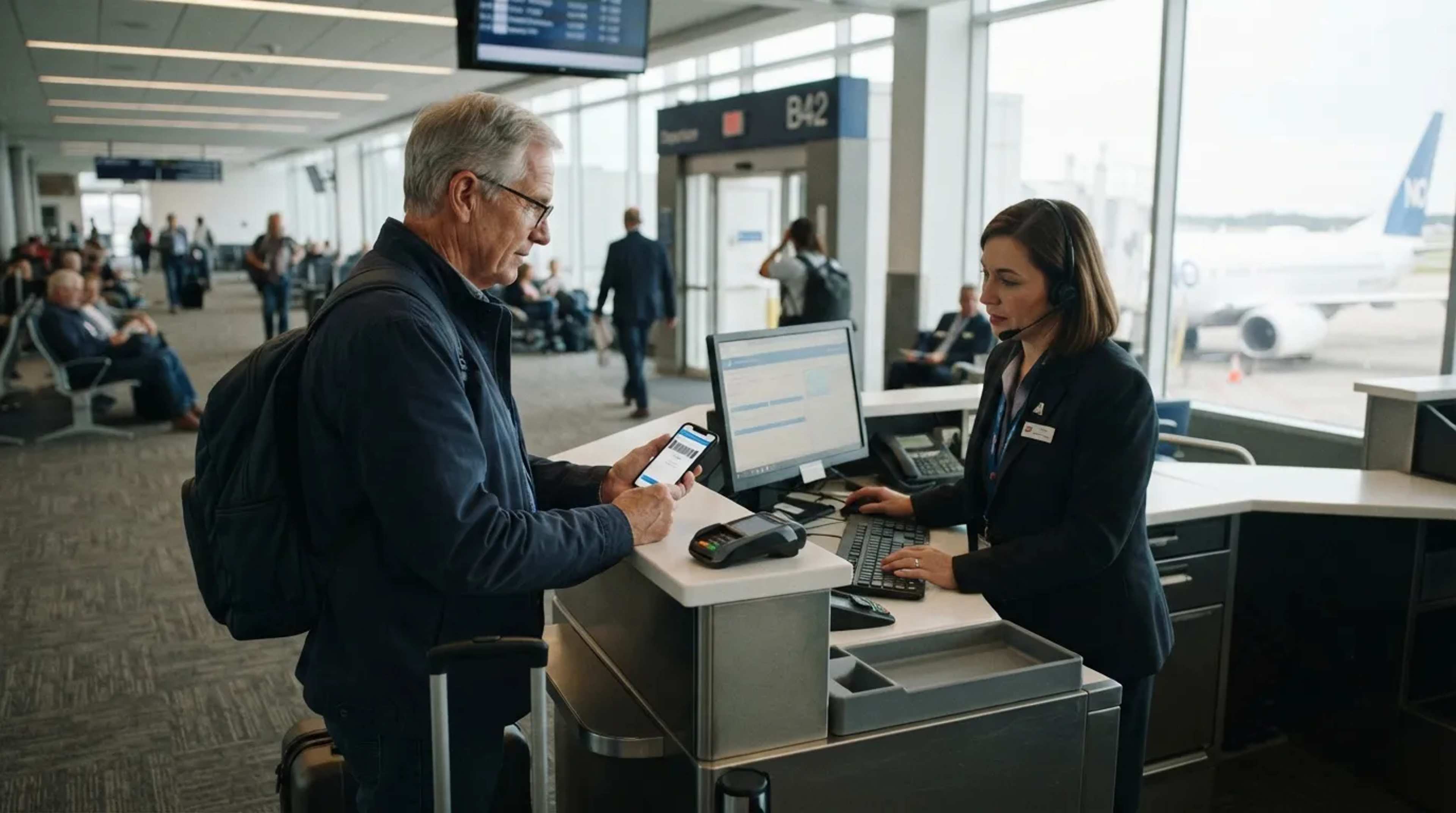
Walk up to a gate at 66, ask an agent to drop a fee, and you will most likely lose the money and a little patience. Most major U.S. airlines no longer offer a blanket senior discount, and some now charge about $45 for a first bag.
Still, real waivers exist, tucked behind disability rules, frequent-flyer status and refund rights instead of a birthday. The last one rests on federal law, and the list starts with two senior fares that are already gone.
#15 – Senior Fares Southwest and British Airways Dropped
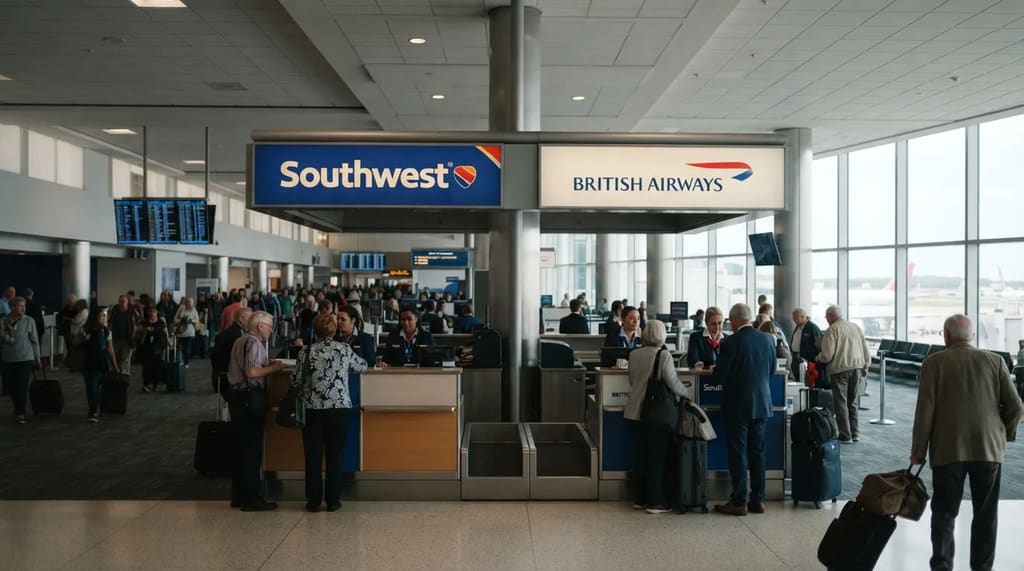
Southwest retired its senior fares in 2019, and British Airways ended its AARP discount in January 2026. That leaves nothing to ask for at either counter.
These two still pop up in “senior perk” lists across the web. If a list shows either one, it is out of date, and a phone call built on it will not produce a discount.
Southwest does offer every passenger, including those over 65, a no-change-fee policy. That helps, but it comes from airline policy, and your birthday has nothing to do with it.
Save your questions for the carriers that still sell a senior fare. Delta does, and it keeps that fare off its own website.
#14 – Delta’s Phone-Only Senior Fare on Domestic Routes

Delta offers senior discounts on certain domestic markets for passengers 65 and older. The catch is where the fare lives.
The airline’s own fares-and-discounts page says certain discounts “are not available at delta.com.” Booking is by phone only, so a website search will never show the price you are hunting for.1
That makes this the one senior fare where asking is the whole method. It is worth a call on a domestic trip with dates you cannot move, because an agent can tell you in a minute whether your route has one.
The answer may well be no, since the discount covers only certain markets. Even then, you know before you book online.
American places its version in the booking engine itself, under a passenger type the airline does not promote.
#13 – American’s Unadvertised Senior (65+) Passenger Type

American’s booking engine can offer a “Senior (65+)” passenger type on some routes, but the airline doesn’t promote it on its site. The fare is reported at 10% to 15% off.
The discount shows up mostly on international routes, primarily to Latin America. A domestic trip to visit family is less likely to turn one up.
Where Delta wants a phone call, American and United both put the option in the search form. Select the senior passenger type, run your dates, and compare the result with the public fare on the same flights.
If no lower fare appears, you have lost nothing. The answer will be the same at the airport counter as it is on the screen.
#12 – United’s Dropdown and the Basic Economy Exclusion

United has offered a senior discount on select routes for passengers 65 and older. You find it by choosing “Senior (65+)” from a dropdown on united.com.
The discounts are put at 5 to 25 percent, and the best deals are reported on Latin America. The condition that matters is that Basic Economy is excluded.
Basic Economy is the lowest fare on the page and usually carries the tightest limits on seats and changes. A traveler hunting for the cheapest ticket never reaches the senior price.
If you were going to buy Basic Economy anyway, skip the dropdown, because there is nothing for it to discount. If you would rather pay a bit more for a regular economy fare, run the search both ways and compare the totals.
Quick Compare: Where the Three Senior Fares Hide
- Delta: certain domestic markets, booked by phone only, not on delta.com.
- American: a “Senior (65+)” passenger type in the booking engine, reported at 10% to 15% off, mostly on international routes.
- United: a “Senior (65+)” dropdown on united.com, discounts put at 5 to 25 percent, Basic Economy excluded.
Air France takes a different route, selling its senior discount as a yearly pass for a fee.
#11 – The €49 Air France Pass for Europe

Air France’s Senior Pass is available from age 65 for €49 a year. It advertises up to 30 percent off, but only within Europe, and US routes are excluded.2
Some descriptions of the pass also add flexible tickets and free checked baggage.
It is a membership, not something you get just by asking, so the gate agent has nothing to waive. A traveler flying from the US to Paris once gets no discount on that leg, which makes the €49 hard to justify.
The pass makes sense only if you expect several flights inside Europe in the same year. Even then, compare each fare with the ordinary price, since “up to 30 percent” describes the best case.
Air India publishes its senior discount openly, with no pass to buy.
#10 – Air India’s Published 10 Percent Off at 60

Air India publishes a 10 percent discount for passengers over 60, and taxes and fees are charged in full.2 That means the 10 percent comes off the fare alone, so the saving on your final total is smaller than the percentage suggests.
On a long international ticket the fare is usually the bigger part of the price, so the discount can still be worth taking. Compare the final total, with taxes included, against the ordinary fare on the same flights before you decide.
Unlike Delta’s phone-only fare, this one is meant to be found by anyone who looks.
#9 – The $78 PreCheck Fee Paid for Shoes
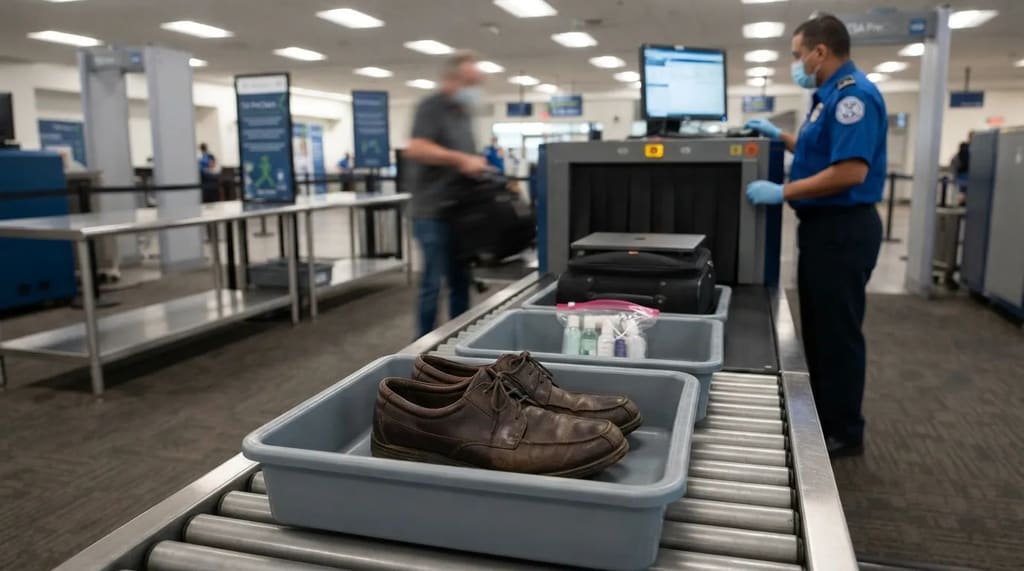
In July 2025, TSA eliminated the requirement to remove shoes at security checkpoints for all travelers. Before that, the exemption applied only to children 12 and under and adults 75 and older.
Plenty of travelers bought PreCheck mainly so their shoes could stay on. That reason has ended.
Enrollment still runs roughly $78 to $85 for a five-year membership, depending on the enrollment provider. There is no senior discount, since the fee is the same for all ages.
What you are paying for now is the rest of the lane: belts, light jackets, laptops and liquids stay in place. If you fly once or twice a year, skip the fee, but if you fly monthly, the lane can still earn its keep.
The membership fee buys a lane, but the checkpoint has a separate rule that costs nothing and begins at 75.
#8 – Checkpoint Rules That Change at 75
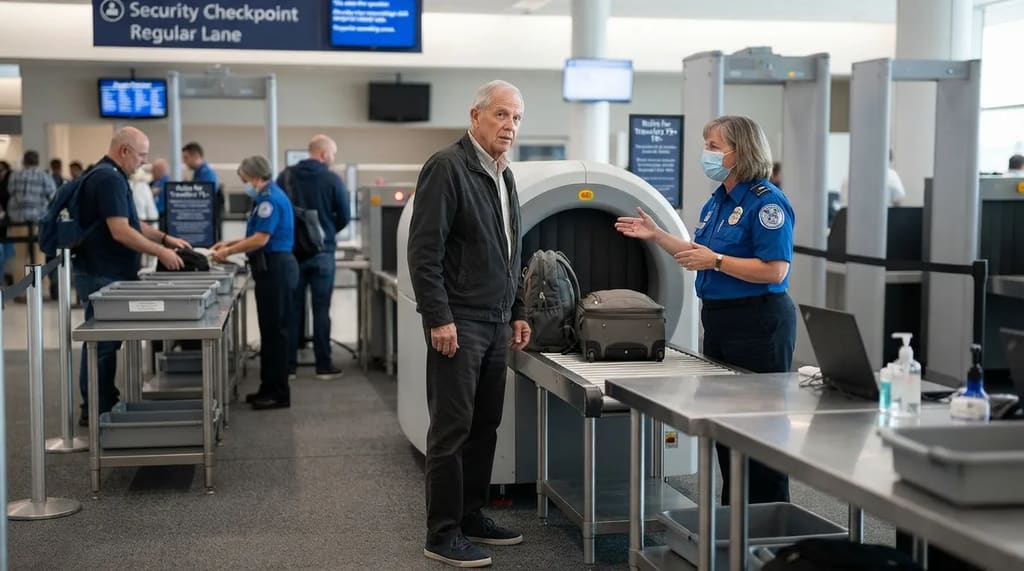
The birthday that matters at the checkpoint is 75, not 65 or 70. TSA’s page for travelers 75 and older says you may leave your shoes on, but light jackets must come off for Advanced Imaging Technology screening.3
Between 65 and 74, standard screening applies in full. Now that shoes stay on for everyone, the practical gain at 75 is smaller than it used to be.
If the officer doesn’t offer it, say you’re 75 or older and ask for modified screening. The perk has limits, because if you alarm during screening, you may still have to remove your shoes or accept a pat-down.3
Turning 75 does not enroll you in PreCheck. It changes the rules in the regular line only, so belts, laptops and liquids still come out unless you hold the membership.
A separate program is open at any age. TSA Cares is a free program that gives travelers with disabilities, medical conditions or other special circumstances dedicated help through security screening.
None of this touches the seat fee, which frequent-flyer status can remove without any request from you.
#7 – Seat Fees Erased by Frequent Flyer Status

Even low-level status can erase the seat fee line entirely. Airline status isn’t tied to age, but many frequent-flying retirees have it.
The airline applies status from its own records, so nobody at the gate can grant it on request. Nobody has to ask if you already hold it.
Worth Knowing Before You Pay for a Seat
- Status comes from your flying history, not your birthday.
- Your frequent-flyer account is the first place to look, and it takes about a minute.
- If the account shows no status, the gate cannot create one.
- A retiree who flew often in recent years may already hold a perk no counter will offer.
The first check before paying for any seat should be your own frequent-flyer account. If it shows nothing, move on to the rules that depend on need, starting with the child who got assigned a seat a row away.
#6 – Seat Fees When Flying With Grandchildren

Many people over 65 fly to see grandchildren, and that comes with gear. It can also come with seat fees when a child is assigned a row away.
The Department of Transportation lists Alaska, American, Frontier, Hawaiian and JetBlue as committing to seat a child age 13 or younger next to an accompanying adult at no additional cost for all fare types, subject to limited conditions. Those conditions decide whether the promise holds for you:
- The child and adult generally need to be on the same reservation.
- The aircraft cannot have been swapped for a smaller plane, and the seat layout must physically permit the arrangement.4
- The guarantee covers one child next to one adult, so a second child can be seated separately.
No federal law requires any of this. The DOT proposed a rule in August 2024 that would ban family seating fees for children 13 and under, but it has not been finalized.
The commitments are voluntary, so a grandparent flying one of the five airlines should book the grandchild on the same reservation to keep the promise intact. United is not on the list, but its Basic Economy page says up to two children under 12 can sit next to the first adult on the reservation at no charge, selected after booking.
#5 – Fees for Walkers, Scooters and Wheelchairs
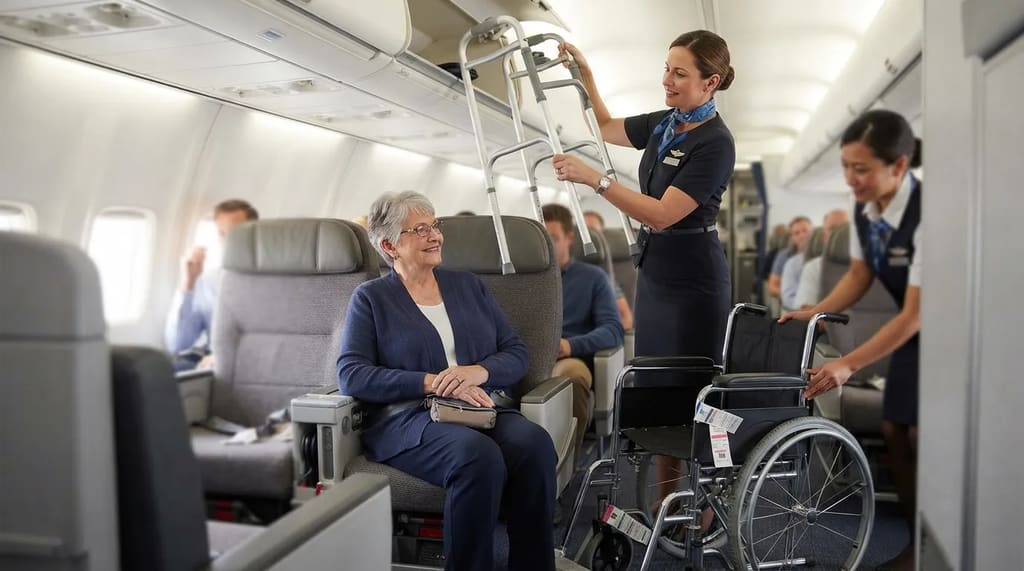
US carriers waive fees that other passengers pay, including free transport of wheelchairs, scooters, walkers and other assistive devices. Trained service animals also travel free.
The $45 first-bag fee that some carriers charge does not apply to the device itself. Airlines also cannot charge extra for wheelchair assistance, stowage of mobility devices, or the use of an on-board wheelchair.
Fast Facts: What Should Never Show Up as a Charge
- Transport of wheelchairs, scooters, walkers and other assistive devices.
- Wheelchair assistance and stowage of mobility devices.
- Use of an on-board wheelchair.
- Travel with a trained service animal.
The help does not end at the aircraft door. The DOT’s list of rights includes help moving to or from the lavatory, with an on-board chair if requested.
If an agent tries to bill you for any of this, the charge is not allowed. A polite request to check the policy usually settles it.
That same disability law also covers something airlines love to sell: getting on the plane first.
#4 – Free Pre-Boarding Instead of Paid Priority Boarding
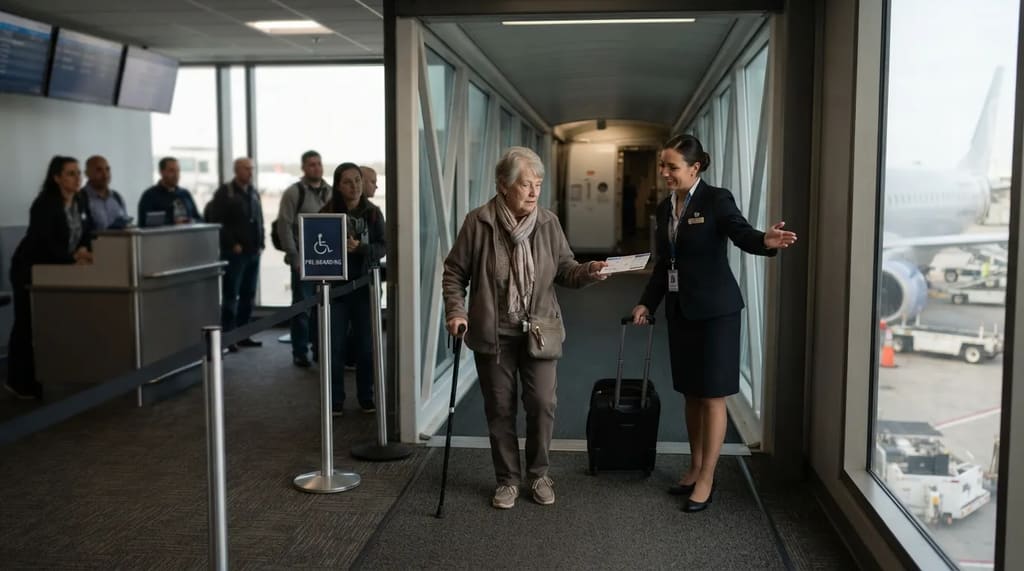
Priority boarding is something airlines sell. Pre-boarding for passengers with disabilities is something they owe.
Under Air Carrier Access Act rules, a passenger who tells the gate agent they need extra time or help to board is entitled to board ahead of the general line. No add-on purchase is involved, and speaking up in person is the entire method.5 6
Age on its own does not qualify. A healthy 70-year-old who just likes a quieter aisle has no claim, while a traveler of any age with a bad hip, shaky balance or a painful walk down the jet bridge does.
The payoff is simple: time to stow a bag and find your seat without a line of people waiting behind you. If you were about to buy a priority boarding add-on mainly for that breathing room, ask the agent first.
Boarding is only half the fight, because the seat itself can come with a price tag.
Related Stories From Travelbinger



#3 – Free Seat Accommodations for Mobility Needs
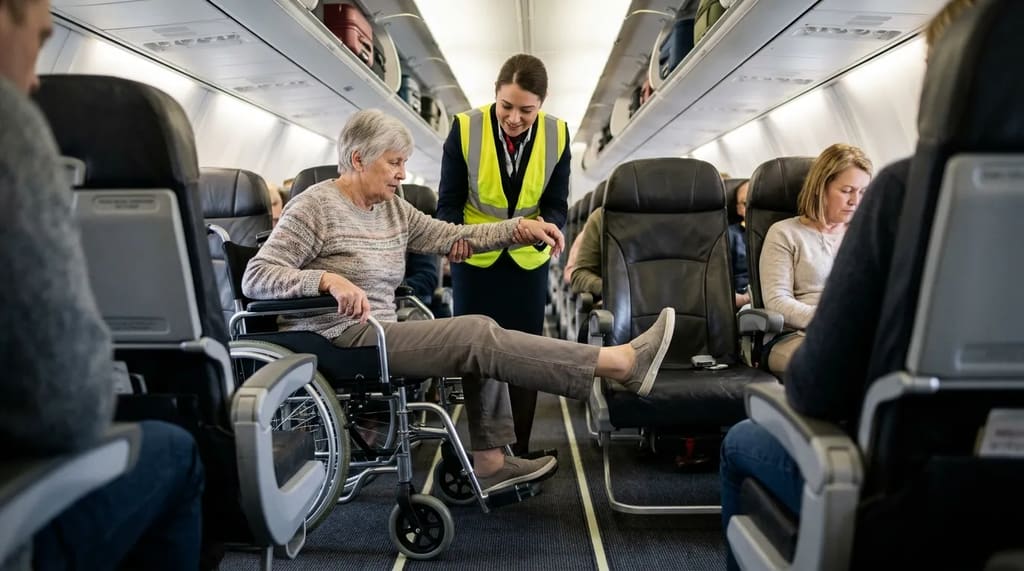
Airlines love to sell the seat with extra legroom or an aisle. For some passengers with disabilities, that seat is not a luxury, and federal rules say the airline must provide it without a fee.
Examples in the DOT’s rules include a seat with a movable aisle armrest for a passenger who needs to transfer from a wheelchair, and a seat with extra legroom for a passenger whose leg will not bend. Airlines cannot charge for services the rules require.
These accommodations answer to a defined need, not a preference. Wanting more room because you like it is not the same as needing it because your leg will not bend, and the agent will treat the two differently.
Tell the airline when you book instead of waiting for the gate, since the seat you need may already be taken by then. If an agent quotes a fee for a seat you need because of a disability, politely ask them to check the accommodation policy.
Everything so far depends on need or status. The next two depend on something much simpler, and the last one is the strongest of all.
#2 – The 24-Hour Free Cancellation Window

Buy a ticket, spot a better fare an hour later, and most travelers assume they are stuck. They are not.
U.S. rules require airlines to either hold your fare for 24 hours without payment or let you cancel within 24 hours of booking without a penalty. The window applies when you booked at least a week before departure.7
It holds even on cheap, nonrefundable fares, which is exactly where a change of mind usually costs the most. The penalty simply vanishes if you act in time.
At a Glance: The 24-Hour Rule
- Airlines must hold the fare for 24 hours or allow penalty-free cancellation within 24 hours.
- It applies when you booked at least a week before departure.
- It covers nonrefundable fares too.
- There is no age check and no gate agent involved.
That is a good reason to book when you see a price you like, then keep shopping for the rest of that day.
But the strongest protection of all kicks in when the airline is the one that breaks the deal.
#1 – Automatic Refunds for Fees You Paid and Never Got

Under the DOT’s automatic refund rule, which airlines had to follow starting in October 2024, an airline must refund your ticket when it cancels a flight or significantly changes it and you decline the alternative. You should not have to file a claim.
A significant change generally means a schedule shift of three hours or more on a domestic flight, or six hours on an international one. A different airport, an added connection or a downgrade in class of service can count too.8
The same rule covers fees for services you paid for and never received. A checked-bag fee, for example, must be refunded if your bag is not delivered within 12 hours of a domestic arrival, with longer windows on international trips.8
Refunds must go back to your original form of payment, and credit card refunds are due within seven business days. An airline can offer a voucher, but the choice to take cash is yours.
Age plays no part here, so a 25-year-old and a 75-year-old get the same refund. If the money does not arrive on its own, ask the airline, and if that fails, file a complaint with the DOT.
So the real discount for flyers over 65 is not a birthday trick at a counter. It is knowing which rules follow your needs, which follow your status and which follow everyone, then asking for the right one.
- Delta Senior Discount Guide: https://retirehub.org/senior-discounts/delta/
- Senior Airline Discounts 2026: https://seniorsite.org/savings/13-best-discount-airline-tickets-for-seniors-verified-deals
- TSA Screening 75 and Older: https://www.tsa.gov/travel/tsa-cares/screening-passengers-75-and-older
- DOT Family Seating Dashboard: https://www.transportation.gov/airconsumer/airline-family-seating-dashboard
- DOT Traveling with Disability: https://www.transportation.gov/individuals/aviation-consumer-protection/traveling-disability
- Air Carrier Access Act Summary: https://pva.org/research-resources/disability-rights-advocacy/air-carrier-access-act/
- DOT Airline Refunds: https://www.transportation.gov/individuals/aviation-consumer-protection/refunds
- Federal Register Refund Rule: https://www.federalregister.gov/documents/2024/04/26/2024-07177/refunds-and-other-consumer-protections