
The headline has a catch, and it’s better news than it sounds: no hotel chain erases a fee just because you turned 65. What does shrink, for a polite question at the right moment, is a set of optional and negotiable charges that pile up fast on a long stay.
On a $200 night, Hilton’s senior rate takes off at most about $12, while a resort fee typically runs $20 to $50 a night. That mismatch is the whole story, and it explains why the real savings hide where most people never look.
The cheapest step on this list, a phone call before you book, is tied to the largest charge on it. The smallest saving comes first, and it sits in a box most travelers never open on Hilton’s booking page.
#15 – The Senior Rate Box Hiding on Hilton’s Booking Page

Hilton does have a real senior discount, but you have to open the Special Rates option in the search box on hilton.com and check Senior Rate. Skip that box and you only ever see the standard price.
Hilton’s own offer page lists up to 6% off the Best Available Rate for guests 65 or older, with proof of eligibility at check-in and a limit of two rooms.1 The discount was 7% until July 2025.2
On a $200 night, 6% comes to $12, and the amount varies by hotel. Bring photo ID, because the desk can ask for proof of age when you arrive.
Fast Facts
- Where to click: Special Rates, then Senior Rate, on hilton.com
- Minimum age: 65
- Discount: up to 6% off the Best Available Rate
- Limits: two rooms, with proof of age at check-in
A $12 saving is worth the thirty seconds it takes, but it does nothing about the fees stacked on top of the room. That discount reaches only guests who are 65, and the other chains set the line at different ages.
#14 – The Age Line Every Chain Draws Differently

Choice and Wyndham start at 60, Marriott and Hyatt at 62, and Hilton at 65. Best Western and Extended Stay America start at 55.2 3
- 55: Best Western, Extended Stay America
- 60: Choice, Wyndham
- 62: Marriott, Hyatt
- 65: Hilton
Because the cutoffs sit up to ten years apart, a 62-year-old who is shut out at Hilton can still qualify at Marriott, Hyatt, Wyndham and Choice. Motel 6 advertises a senior rate but does not state an age on its offer page, so ask when you call.
Best Western requires proof of age at check-in, and Wyndham asks for valid ID, so carry your license even if you booked online. A discount that cannot be verified at the counter is one you will pay full price for.
And a membership card can open a lower rate years before any of those ages arrives.
#13 – The AARP Card That Works Before the Senior Age
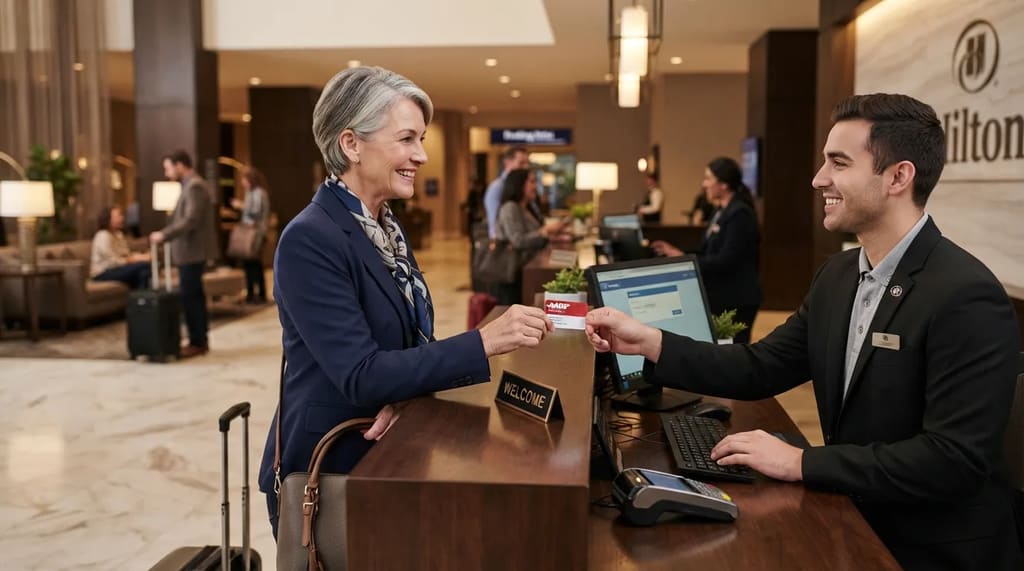
ConsumerAffairs notes that an AARP member may qualify for hotel discounts whatever a chain’s regular senior age happens to be. If you haven’t reached the age but belong to AARP, mention it when booking, because you may get the discount or a rate better than the senior one.2
Whether Hilton still takes part is disputed. One 2026 guide reports that Hilton’s AARP rate was discontinued, while another 2026 guide still claims up to 10% off at participating Hilton properties.
Compare the senior price with loyalty, AAA, AARP and promotional rates, since one of those could be cheaper. Price them on your actual dates and take the lowest.
Marriott sells its senior rate from the same menu as its other rates, and you don’t have to be an AARP member to book it. So if you are 62 or older and stay mostly at Marriott, a card buys you nothing there.
Both kinds of rate cut the room price only, so neither helps with the awkward hours before your room is ready, when the real question is where the suitcase goes.
#12 – The Free Bag Drop That Beats a Paid Early Room

Kiplinger says most hotels store bags free until check-in. That makes it the simplest request in this piece, because there is no fee to waive.
Picture arriving at 10 a.m. with the room promised for mid-afternoon. A stored bag lets you eat lunch or take a walk without paying anything for an early room.
Storage also does not depend on how full the hotel is. An early room needs a clean, empty one, and a stored bag needs only a closet.
For a gap of a few hours, I would take the free storage and skip the paid early arrival.
#11 – The Early Check-In Fee a Clerk Can Quietly Drop

Early check-in is an optional fee, as late checkout is. A clerk has more freedom to drop an optional charge than a mandatory one that was disclosed in your booking.
The fee varies greatly by location, and your loyalty status or the hotel’s availability may help you avoid it. That is why the same request gets different answers at different hotels.
Quick Compare
- Bag storage: usually free, so nothing to waive
- Early check-in: optional, so a clerk can drop it
- Resort fee: mandatory once disclosed, so the hotel may decline
A slow midweek night in February gets a yes far more often than a sold-out holiday weekend. If your arrival time is flexible, you can choose to come on the quiet day.
Tell the desk your arrival time when you reserve or call a few days ahead, so it can plan around you. Unless you have flown overnight and need a bed, I would not pay for the room early.
#10 – The Late Checkout Fee Nobody Ties to Age

Late checkout is an optional fee, and elite status in a hotel loyalty program may let you avoid it, along with internet fees. Without status, you are relying on the hotel’s goodwill.
Ask at check-in rather than at the last minute, so the desk can plan around you. A request at 10:45 on departure morning leaves the clerk nothing to plan with.
No chain ties a late-checkout waiver to a guest’s age, so it rests on how full the hotel is and how the request is made. A calm, patient request at a busy counter goes a long way.
Staying later in the room does nothing for the Wi-Fi charge, which follows its own rules.
#9 – The $10-to-$20 Nightly Wi-Fi Charge

Kiplinger reports that a lot of hotels charge $10 to $20 per night for Wi-Fi.4 Over a five-night stay, that is $50 to $100 for something most phones can do without.
Kiplinger’s suggestion is to sign up for the hotel’s loyalty program, which is free in most cases, and you generally get privileges such as free Wi-Fi immediately. The sign-up takes a few minutes and does not depend on your age.
Some programs, including IHG’s and Marriott’s, have waived charges for services like Wi-Fi. Some hotels will also waive fees if you say at check-in that you won’t use the Wi-Fi, gym or pool they cover.
Of everything here, joining a free program is the easiest fix for this charge, easier than arguing at the desk.
#8 – The Daily Parking Charge That Can Top the Senior Discount
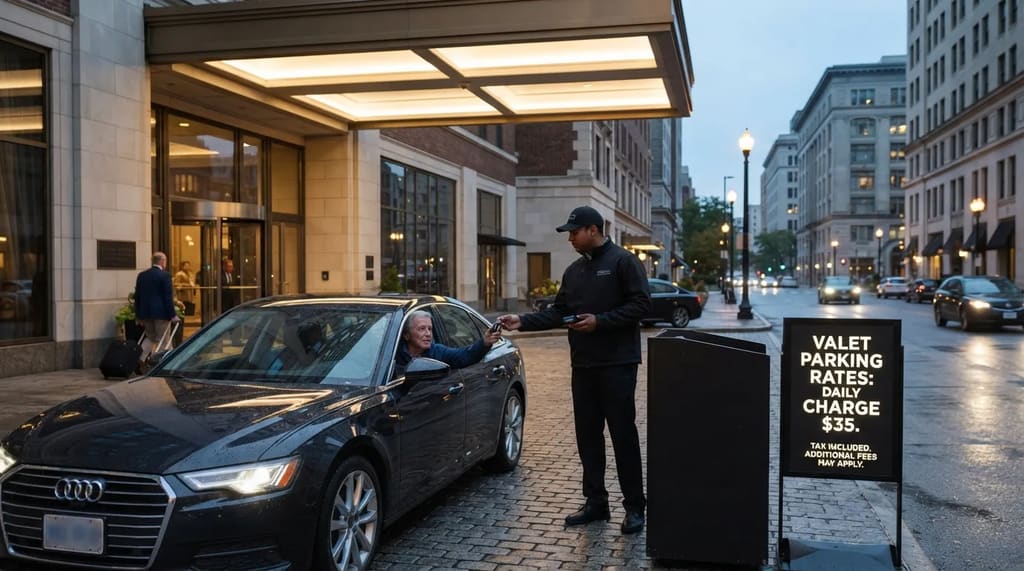
Kiplinger says hotels in major cities charge $25 to $35 a day for parking, and some have mandatory valet, so there is a tip on top.4 On a four-night stay, that is $100 to $140 before any tips.
Before you arrive, use Google Maps to get a street view of the area and look for nearby garages. You can also look for free-parking promotions, and in most large cities there is usually free street parking from Saturday evening to Monday morning.
A front desk clerk is usually empowered to waive parking charges to keep a guest satisfied. If the clerk can’t, politely asking for a manager sometimes works.
If you are driving into a big city, price the parking before you choose the hotel. One day of it can outweigh the $12 that Hilton’s senior rate takes off a $200 night.
Parking posts to the room bill, while the hold placed on your card at check-in can run well past anything you will spend.
#7 – The Incidentals Hold Quietly Sitting on Your Card
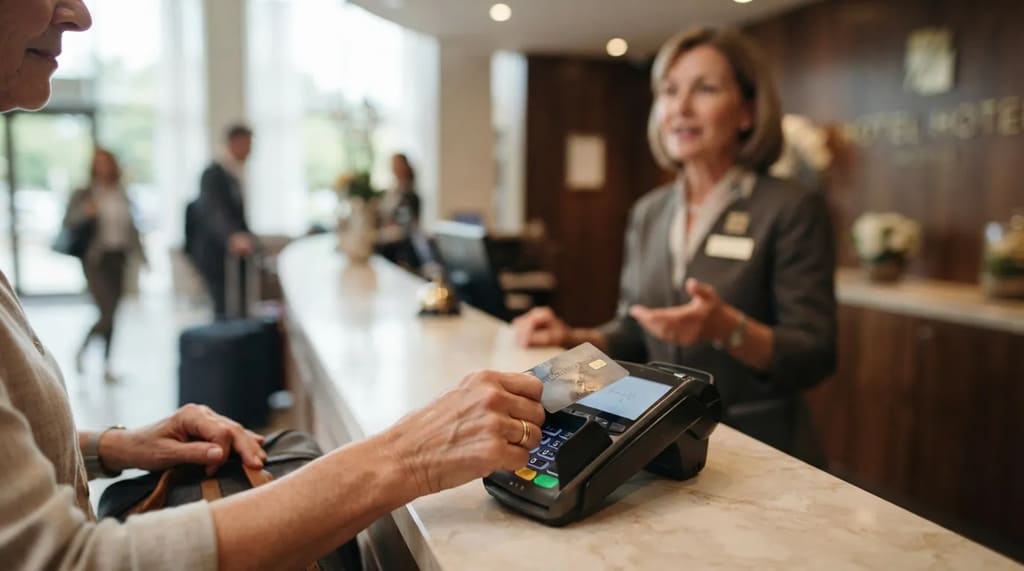
At check-in, ask what the hold amount is, when it releases, and whether it can be reduced. Most desks answer in a sentence if you ask before handing over the card.
Write down the names of any staff members you speak with and which fees they agree to waive. A name and a date turn a spoken promise into something you can point to at checkout.
A hold is not a charge, but it still reserves part of your credit limit or your account balance until it releases. On a debit card, that can leave less cash for the rest of the trip.
Worth Knowing
- Three questions: how much, when it releases, and whether it can be lowered
- Debit card: the held amount comes out of your spendable cash
- Credit card: your checking account stays untouched
- Paper trail: note the staff name and date for any promised waiver
If you have a credit card, use it for the hold so your checking account stays untouched.
#6 – The Safe, Minibar and Auto-Tip Lines on Your Bill

Safe rental fees, minibar sensor errors and auto-added gratuities are among the line items that desks regularly remove when a guest asks. They are small, and each one is either a mistake or an extra you did not choose.
Ask before checkout whenever possible, while hotel staff can still investigate and correct the folio. Once you have left, the same request becomes a dispute with a billing department.
Ask for the itemized bill the night before you leave and read every line. A charge for a safe you never opened is easy to explain, and a clerk can fix it in a minute.
Some of these extras never reach the bill at all if you ask for a rate that already includes them.
#5 – The Flat Nightly Rate That Folds Fees In

Some properties will fold Wi-Fi, parking and resort fees into a flat nightly rate if you ask. With fewer separate charges, the hotel has less to authorize on your card.
You can often avoid fees by calling ahead and asking about packages, many of which include waivers for things like Wi-Fi and parking. A package that covers parking is worth more than a waiver you have to win at the counter, given the daily rates in major cities.
The hotel can still say no to a disclosed mandatory fee. Optional charges like a Wi-Fi package can often be waived with a polite request, while mandatory ones like a resort fee are better chosen around when you book.
Packages differ by property, whereas a loyalty account travels with you to every hotel in the chain.
#4 – The Resort Fee That Elite Status Erases

NerdWallet says travelers with hotel elite status are sometimes exempt from resort fees. Hyatt Globalist members get resort fees waived on all stays, including paid ones, not just award nights.
Bankrate notes that Hilton Gold status, available through the Hilton Surpass credit card, can wipe out nightly resort fees. A card with an annual fee is a financial decision, so weigh it against your own travel before applying.
A status match lets one loyalty program grant equivalent status based on your standing with a different brand, and applying before a trip can bring upgrades and late checkout. It is free to try and costs only the time to fill out the form.
If you take one or two hotel trips a year, I would not chase elite status for this. It makes sense mainly if you already spend many nights with one chain.
Status takes years to build, but the same waiver arrives at once when a night is paid for with points.
#3 – The Resort Fee That Disappears on Points Stays

Kiplinger reports that Hilton and Hyatt hotels waive the resort fee if you book a stay with loyalty points or a free-night award.5 At Hilton, the waiver applies to reward stays booked entirely with points and to free night certificates.
That qualifier matters, because a booking that mixes points and cash may not get the same treatment. Check the reservation total before you confirm.
Related Stories From Travelbinger



The waiver comes from how you book, not from your age or elite status. A 70-year-old paying cash at a resort-fee hotel still pays the fee, and a 45-year-old using an award night does not.
If you hold Hilton or Hyatt points, spend them on a night at a resort-fee hotel rather than at a no-fee one. The fee comes off along with the room rate.
Cash bookings keep the fee unless it was missing from the price you were shown.
#2 – The Charge That Wasn’t in the Price You Saw
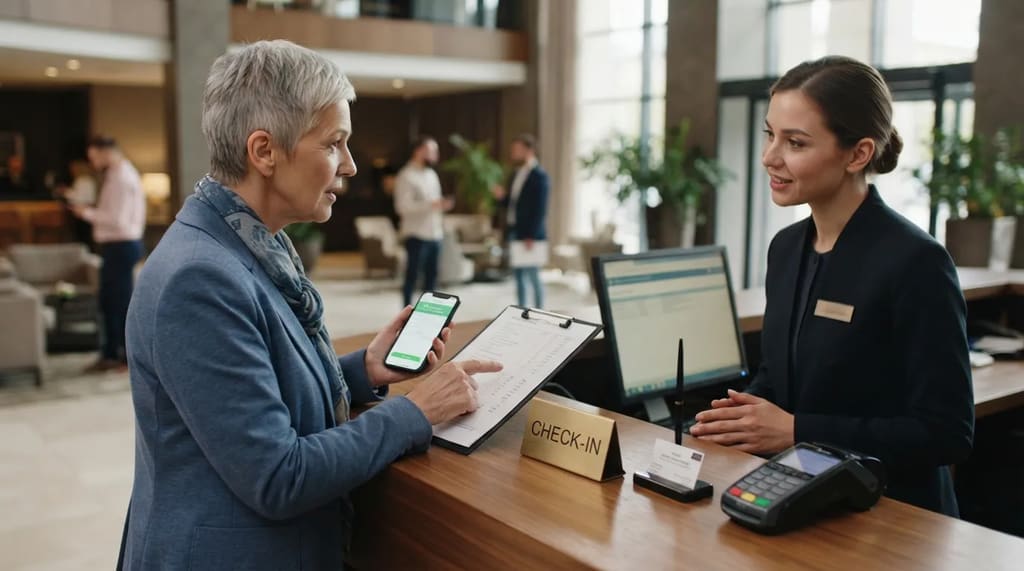
Since May 12, 2025, the FTC’s Rule on Unfair or Deceptive Fees has required businesses that advertise short-term lodging to state the total price upfront. A required resort fee must be included in that total.6
Taxes may still appear separately. Optional extras like parking may also be added afterward.7
If a mandatory fee wasn’t in the upfront price, raise it at the front desk first and keep the booking confirmation showing the total you agreed to. Compare the check-in bill with a screenshot of your booking total, and ask the desk to explain any difference before you sign.
If the total wasn’t clear, you can dispute it at check-out, contact customer service, or file a chargeback with your card company. You can also file a complaint at reportfraud.ftc.gov, but check your card issuer’s chargeback deadlines before relying on that route.
What remains is the fee that was shown clearly and still feels wrong for the stay.
#1 – The Resort Fee Itself, the Biggest Line on the Bill

This is the $20 to $50 a night from the start of this piece, and it dwarfs the $12 the senior rate saves. ResortFeeChecker.com lets you look up what a property charges before you book.5
A clearly disclosed resort fee is hard to reverse, and the federal rule doesn’t ban it. The hotel may decline when the fee is mandatory and was disclosed before booking.
Your case is stronger when the fee covers things you cannot use. If you don’t expect to use the amenities, ask the hotel to remove the fee,5 and if the gym is closed for repairs, you may be able to make a case.
Call the front desk, not the central reservation line, and politely ask if the resort fee can be waived or reduced. Screenshot the booking page showing your total, then contact the front desk a few days before arrival and ask whether a senior rate applies and whether the resort fee can come down.
If the clerk cannot budge, politely asking for a manager sometimes helps. Of all the calls on this list, this is the one that can save real money, and it is aimed at the biggest line on the bill.
Sort the Charge Before You Ask

Age by itself rarely changes a hotel bill, but knowing which kind of charge you are looking at does. A senior rate trims the room price, an optional fee is a matter of goodwill, and a mandatory fee is decided mostly at booking.
At a Glance
- Senior rate: trims the room price only, and Hilton’s runs up to 6% for guests 65 and older
- Optional fees: early check-in, late checkout and Wi-Fi depend on goodwill or loyalty status
- Mandatory fees: a disclosed resort fee, typically $20 to $50 a night, is mostly settled at booking
- Fees missing from the upfront price: raise them at the desk, since the FTC rule has covered lodging since May 12, 2025
That means the most useful moment to ask is before you arrive, with a screenshot in hand and the right question for the right charge. The front desk can only say yes to what it knows you want.
Which charge on your most recent hotel bill would you now ask about, and at what point in the trip would you bring it up?
- Hilton Senior Rate Offer: https://www.hilton.com/en/offers/senior-rate-2000000292/
- Clark Howard Senior Hotel Discounts: https://clark.com/travel/hotels-senior-discounts/amp/
- Senior Hotel Discount Ages: https://seniorsite.org/resource/19-best-hotel-discounts-for-seniors-from-budget-to-luxury
- Kiplinger Annoying Hotel Fees: https://www.kiplinger.com/article/spending/t059-c011-s001-10-annoying-hotel-fees-and-how-to-avoid-them.html
- Kiplinger Pesky Travel Fees: https://www.kiplinger.com/personal-finance/travel/pesky-travel-dining-and-shopping-fees-and-how-to-avoid-them
- Barnes & Thornburg FTC Alert: https://btlaw.com/en/insights/alerts/2025/ftc-finalizes-junk-fees-rule-new-pricing-disclosure-requirements-take-effect-may-12-2025
- Cooley FTC Rule Analysis: https://www.cooley.com/news/insight/2024/2024-12-20-ftc-finalizes-junk-fee-rule-aimed-at-live-event-ticket-and-short-term-lodging-fees