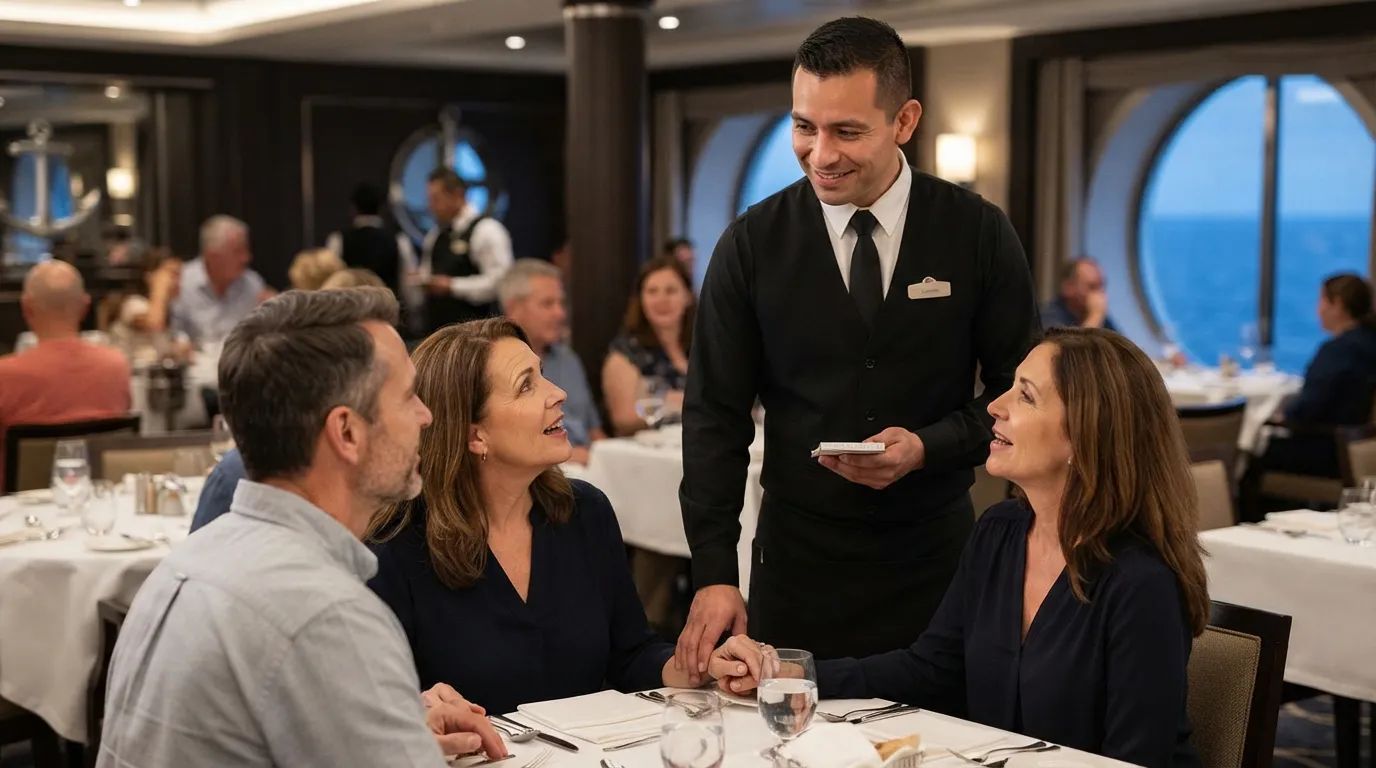
You probably think your steakhouse dinner starts when the bread basket lands. The staff would politely disagree. By the time you open a menu, the host and your server have often already formed a read on your table, and it began with the walk to your seat. Cruise crews work long contracts and see a flood of new faces every week, so they get very good at reading people fast.
None of it is cruel, and none of it is printed on the menu. But a few of these judgments are surprisingly small, some are oddly fair, and one says more about life behind the scenes than about the guests. Here is what cruise reporting and crew accounts say they notice, starting with a verdict that lands before you even reach the door.
#15 – The No-Show Verdict That Starts Before You Arrive
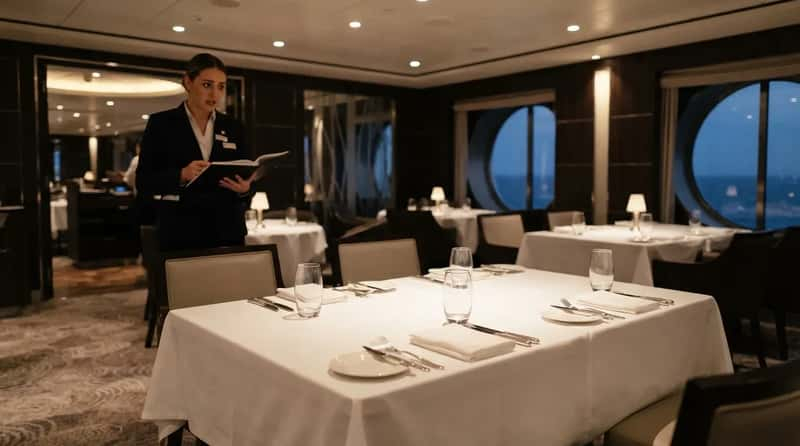
The first judgment happens before you reach the host stand. Sometimes it happens before you leave your cabin.
Specialty restaurants run on reservations, and cruise lines have started enforcing them. Reports say Norwegian Cruise Line has charged a $10 per person fee to guests who don’t cancel or modify a booking at least two hours ahead and then don’t show. Under an older policy, guests had to cancel up to 24 hours before or pay the cover charge. To staff, an empty table is a lost seat on a full night.
A table that arrives on time reads as organized. A table that drifts in 25 minutes late reads as one that may throw off the kitchen’s rhythm all evening. Most people never realize the host is already keeping track.
But that’s nothing compared to what your outfit tells them in the first three seconds in #14…
#14 – The Outfit Verdict Nobody Announces
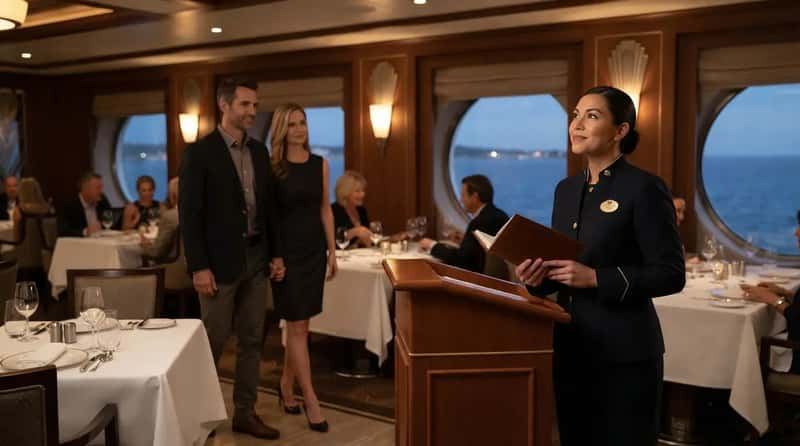
Your clothes get graded the moment you step up to the host stand, and no one says a word about it.
Specialty rooms often hold a stricter standard than the main dining room, and the way different sources describe it is telling.
Quick Compare
- The unwritten rule: Ship Tea says to dress one notch above whatever the main dining room requires that night.
- The posted rule: Celebrity lists smart casual as required for main dining, specialty dining and the theatre.
- The room effect: Steakhouses and French rooms often out-dress the main dining room.
Disney’s Palo and Remy are known for enforcing their dress codes, and guides warn guests to expect it. Some cruisers say that’s a reason to skip them. Even one guide admits the upcharge plus the dress code might put some people off.
Yet an outfit is easy to fix. The next judgment is much harder to take back…
#13 – The Allergy Mention That Arrives Too Late
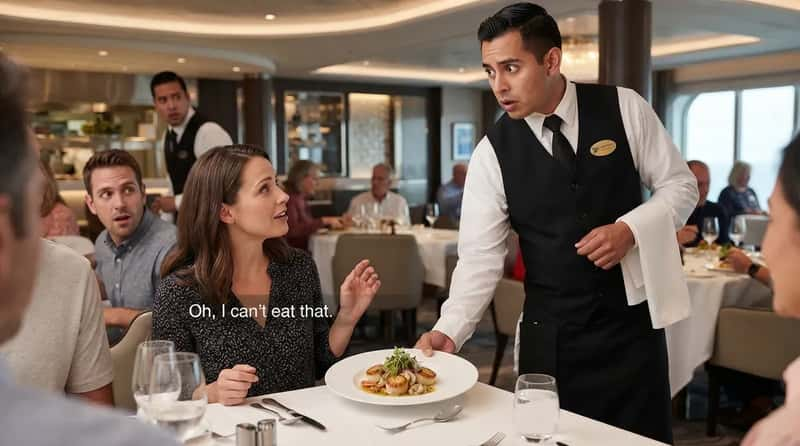
Waiters quietly dread one sentence: “Oh, I can’t eat that.”
It’s a tricky moment for staff. By then the dish is on the table and the kitchen has already moved on. Royal Caribbean’s blog notes that a special need noted in your booking is visible to crew, and a food allergy is something both the waiter and the chef see before you walk in.
Even so, the waiter will always ask, because not every special need is disclosed ahead of time. The smart move is to tell the restaurant when you book, not when you arrive.
- Staff read “told us in advance” as a careful table.
- They read “mentioned at the last second” as a risk to manage.
And that’s before we get to the one gesture many crew members say they can’t unsee in #12…
#12 – The Finger Snap That Secretly Costs You
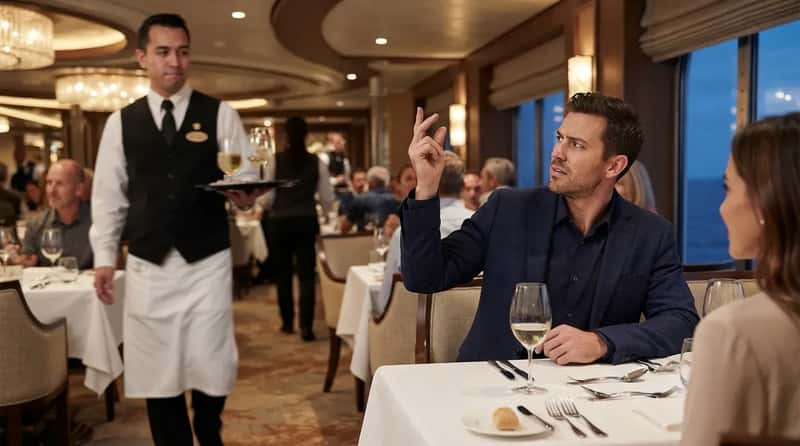
One tiny hand gesture can define your whole table.
Royal Caribbean crew member Emmy Cruises says waiters immediately notice someone snapping their fingers to get attention. Travel Binger, summarizing that report, says the behavior can get you slower service. Whether or not any server would admit to slowing things down, the impression sticks.
Here’s the blunt opinion many crew seem to share: the gesture says more about the guest than about the wait. A server working a full room usually knows you’re there.
But a much happier signal shows up when a table mentions what they’re celebrating in #11…
#11 – The Birthday Heads-Up That Changes the Evening
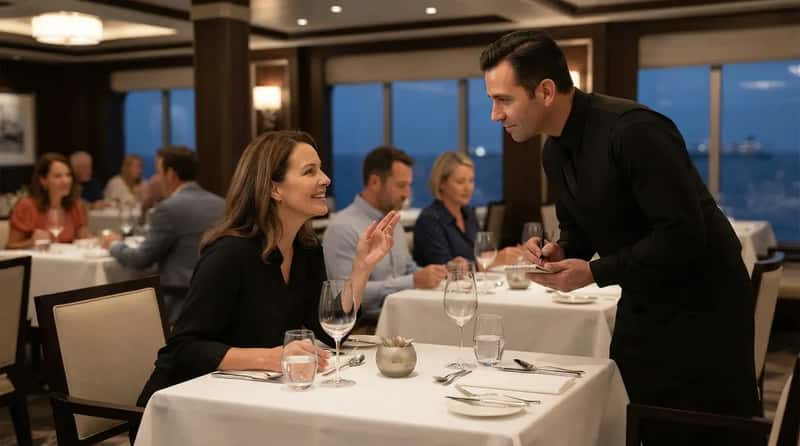
Waiters love a table with a story.
Travel Binger describes the ideal as a casual mention on night one, with the server quietly coordinating. The same outlet says that whether it’s a birthday with candles or a spouse’s favorite dessert, servers make the request happen wherever they can. It’s a small ask with a big payoff.
A surprise is one of the hardest things for a busy kitchen to deliver. A heads-up gives the server time to plan. A table that announces a celebration late can miss the moment entirely.
But the loudest signal at any table has nothing to do with food, as #10 shows…
#10 – The Phone Call That Echoes Across Five Tables

Phones at the table draw plenty of silent commentary.
Travel Binger reports that one Carnival passenger even asked the cruise line to ban phones from dining rooms entirely. The problem, per the same piece, isn’t the call itself. It’s the volume that carries across five neighboring tables.
Specialty restaurants tend to be smaller and quieter, so a loud video call stands out even more. Staff notice who’s engaged with each other and who’s scrolling. Some cruisers say that’s the real price of the cover charge: you’re paying for an atmosphere everyone shares.
- A quick, quiet text barely registers.
- A speakerphone becomes the story of the room.
Next up is a judgment tied to money, and it hits package holders hardest in #9…
#9 – The Package Holder Who Never Seems to Show
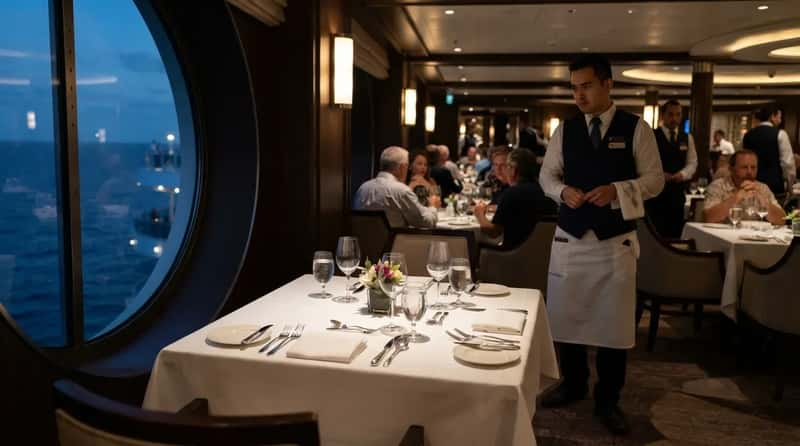
An unlimited dining package can quietly backfire on a table’s reputation.
Reports say Royal Caribbean now asks that specialty bookings, including those under dining packages, be cancelled at least 24 hours ahead to avoid a per-person charge. The fee may equal the restaurant’s cover charge. For package holders, repeated no-shows could wipe out the perceived savings.
Staff don’t need a spreadsheet to read this. Empty reservations are visible, and a booking that isn’t honored is a table someone else could have had. That’s the part that frustrates crews most.
But the price tag itself triggers its own silent judgment in #8…
#8 – The Sticker-Shock Look Staff Can Spot From the Kitchen Door
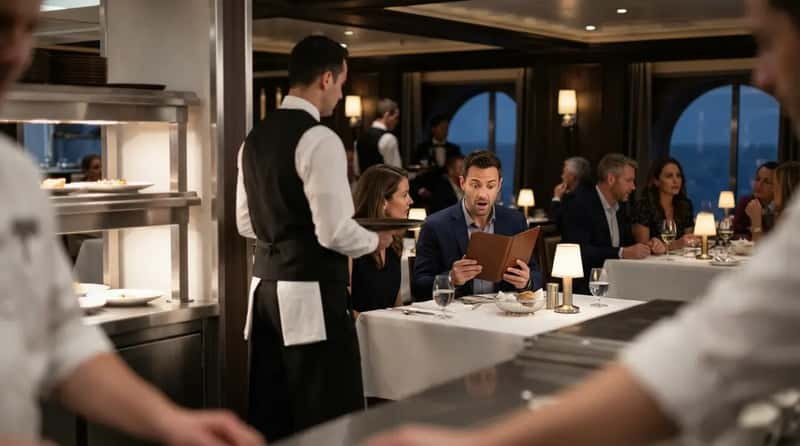
The most awkward moment is often when the cover charge finally sinks in.
Prices vary widely from line to line, and the gap can be dramatic.
Fast Facts
- Celebrity’s FAQ has listed specialty covers that range from $45 to $150 per person.
- Celebrity also states that a 20% gratuity is added at the time of purchase.
- Princess guides put its core venues at $55 to $60 per adult.
Servers can tell which guests did the math and which are surprised. Here’s a spicy take: one guide calls the included dining options genuinely good, so some cruisers argue specialty dining is the real overspend. Others say the experience is worth every dollar. Staff just notice who looks relaxed about it.
And speaking of being relaxed, the next judgment involves a name tag most people ignore in #7…
#7 – The Name Tag Test Most Guests Fail
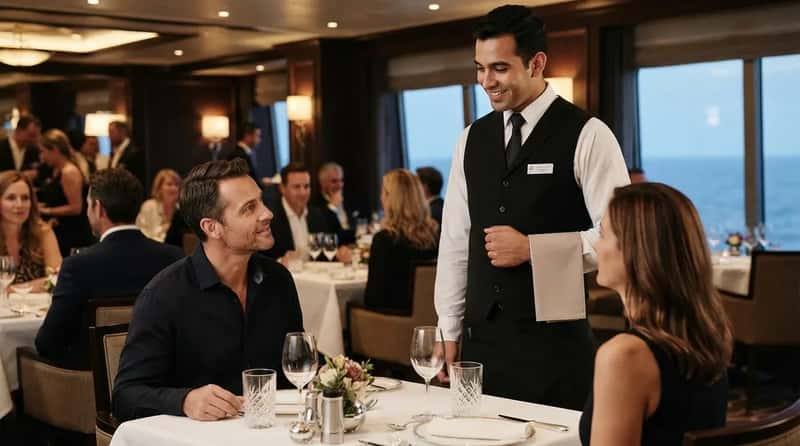
Staff notice who looks at their chest and who looks right through them.
Travel Binger’s list of server observations says waiters notice who reads the name tag and who doesn’t. Another piece adds that guests who learn their server’s name and ask where they’re from set the tone for the voyage in about two minutes.
The reward is small but real. Waiters say guests who ask their name on day one, and actually use it, are remembered fondly for the rest of the cruise. That’s free to give.
But there’s another move that signals a seasoned cruiser, and it’s #6…
#6 – The Polite “Could the Chef Do This?” That Marks You as a Regular
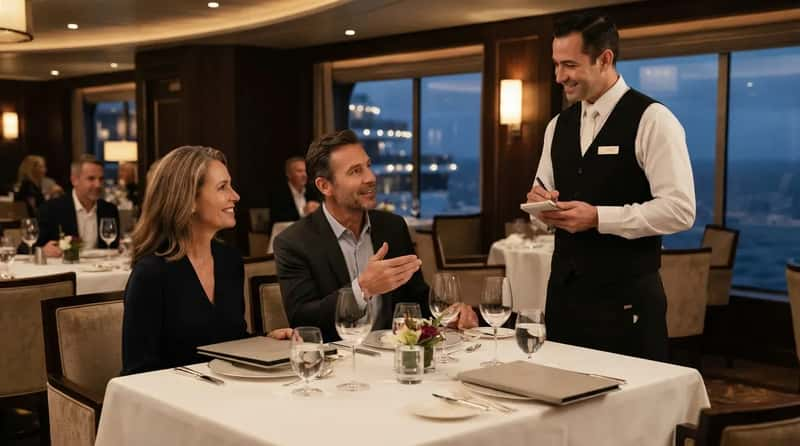
Experienced tables ask for things the menu doesn’t offer, and they ask nicely.
Travel Binger reports that a polite request of this kind often gets a yes. It also says the request tells the waiter this guest knows the ship, and such guests tend to be remembered. Those examples come from the main dining room, where menus are broader. Fixed-menu specialty venues may have less wiggle room, so staff judge the tone as much as the request.
Loyalty goes even further. Some guests ask for a particular waiter before they board, and that kind of devotion is rare in any restaurant.
- A “could you possibly” lands well.
- A demand rarely does.
Still, tone reveals something deeper, and #5 shows how fast staff pick it up…
#5 – The Way You Talk to Everyone Who Isn’t Your Server
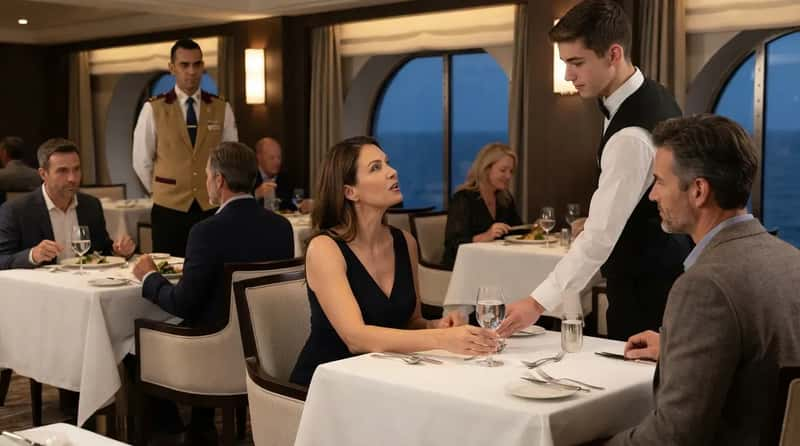
Crews watch how you treat the busboy, the host, and each other.
Cruise Critic’s bartender piece says staff often spot difficult guests early by watching how they treat staff and other passengers. That’s bar staff, not servers, but dining crews describe the same instinct. Travel Binger says dining staff notice quiet, patient requests and guests who treat crew like people.
A dining room is a small stage with a lot of watchers. You’re being read by people you haven’t even spoken to yet.
And then there’s the judgment about who isn’t even at the table in #4…
#4 – The Empty Chair Everyone Quietly Notices
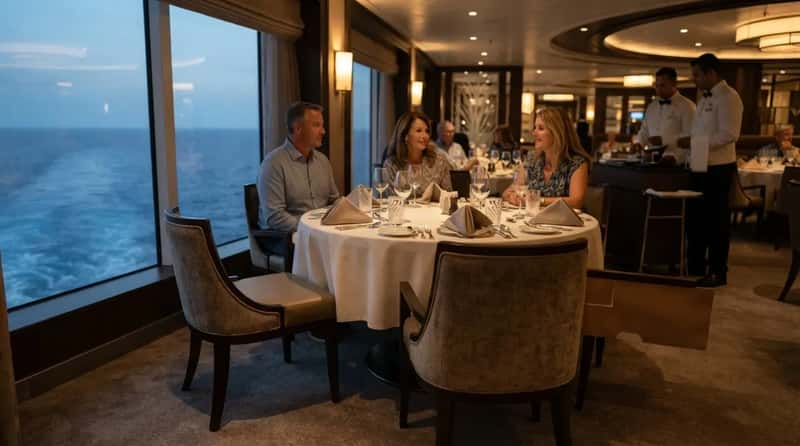
A missing guest becomes the evening’s invisible problem.
Travel Binger reports that in the main dining room, servers can’t fire courses to a half-empty table, so everyone’s meal shifts later. It adds that an empty seat gets noticed and discussed at the wait station. The same logic plausibly applies to any large party in a specialty room.
Servers can also take the heat. They hold food, delay pacing, and sometimes get quietly blamed by supervisors for a table that never fills.
- Tell your host early if someone is running behind.
- Update the reservation if the group shrinks.
But the next read goes straight to your wallet, and it isn’t always accurate…
#3 – The Money Read Staff Admit Isn’t Always Right
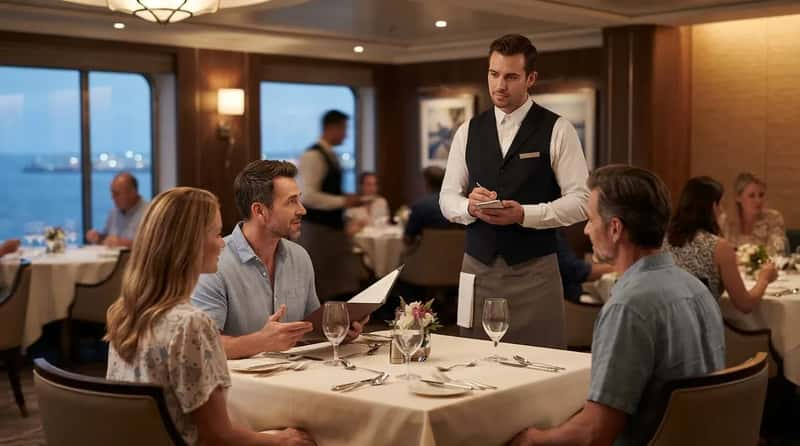
Yes, crews try to guess who will tip well.
Cruise Critic’s bartender feature says service staff can often gauge tipping likelihood from small behavioral cues, though they admit the read isn’t always exact. Bartenders also say they can spot guests pacing themselves from those determined to get their money’s worth.
At specialty restaurants the picture shifts. Celebrity, for one, says a 20% gratuity is added to specialty covers and packages at checkout. That means some of the tip guesswork is already settled. The wrong guess about your table can happen in either direction.
Next comes a split that shows up at nearly every table in #2…
#2 – The Planner Versus the Wanderer
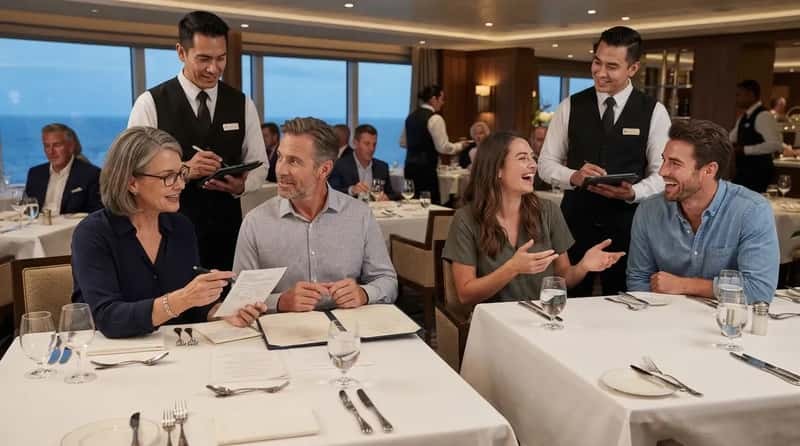
Staff sort tables into two camps within minutes.
Travel Binger reports that staff notice a clear split: some guests meticulously plan each meal while others chase spontaneity. Planners arrive with notes, reservations, and dietary details sorted. Wanderers ask what the chef is proudest of.
Neither is wrong. Planners make a kitchen’s life easier, and wanderers make a server’s night more fun. But planners tend to come out ahead when something is complicated, like a serious allergy.
But the final judgment is the one crew say matters most, and it’s #1…
#1 – The Verdict About Whether You See Them as a Person, Months Into a Long Contract
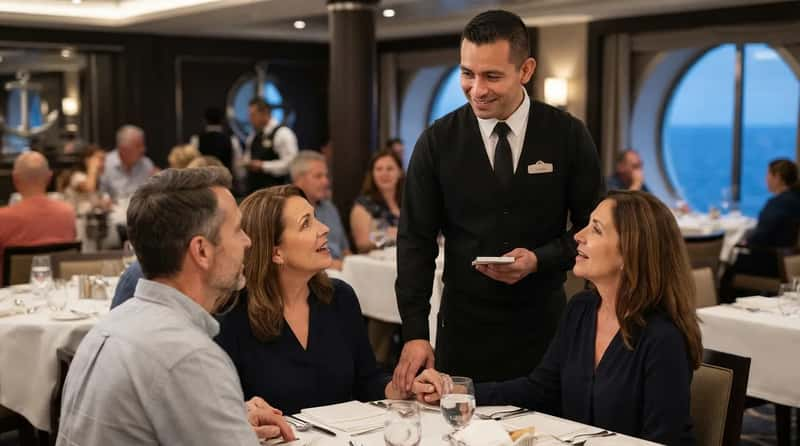
This is the judgment sitting underneath all the others.
TripMemos reports that cruise ship servers often work contracts of six to nine months, with little time off. They also often remember individual preferences by the second dinner. They track which dishes you loved and which came back barely touched, and use that to shape their recommendations.
Travel Binger puts the emotional side plainly. A server can serve three meals a day for seven days and still feel invisible to certain tables, and it’s about basic acknowledgment, not extra tipping. The biggest judgment is simply whether you see them back.
Why It Stands Out
- It’s the only judgment on this list that comes from months of fatigue, not a single dinner.
- Servers often have your preferences memorized by the second night.
- What counts here is acknowledgment, not extra money.
- It costs a guest nothing to get right.
Staff aren’t scoring you on money or manners alone. They’re reading timing, tone, preparation, and whether you treat them like a person. Show up on time, mention allergies early, dress for the room, and learn the name on the tag.
Specialty dining has real rules, such as cancellation windows and dress codes, and policies change often, so check your line’s current terms before you book. But the biggest difference usually comes from small, free gestures. Which of these judgments surprised you most, and do you think staff are being fair? Tell us in the comments.