Most travelers think they’ve got hotel breakfast figured out. They don’t.
Buffet-style breakfasts generate more than twice the food waste of a menu order, and food safety experts quietly flag hotel buffets as real risk zones. Hotel chefs say the same mistakes repeat every single morning, at budget motels and five-star resorts alike.
Here’s what the data – and the people working the buffet line – actually know that you don’t.
#15 – Arriving Right Before Closing
Showing up ten minutes before the buffet closes feels smart. It’s actually one of the worst moves you can make.
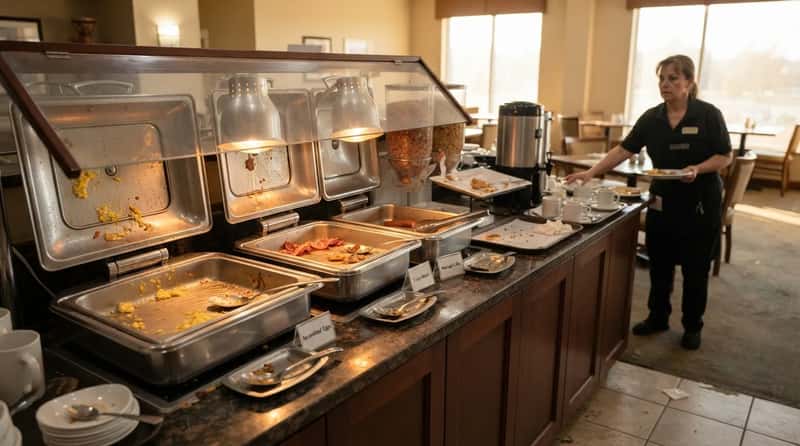
By the final stretch, hot food dries out under the heat lamps. Popular items like bacon and sausage rarely get restocked in the last fifteen minutes.
You’re basically paying full price for whatever nobody else wanted.
Assume breakfast ends at 10 AM unless you’ve confirmed otherwise, and be downstairs by 9:30 if you actually want a real meal. That extra half hour is the difference between eggs and an empty chafing dish.
But that’s nothing compared to the mistake in #14 – this one can actually make you sick…
#14 – Ignoring Lukewarm Food
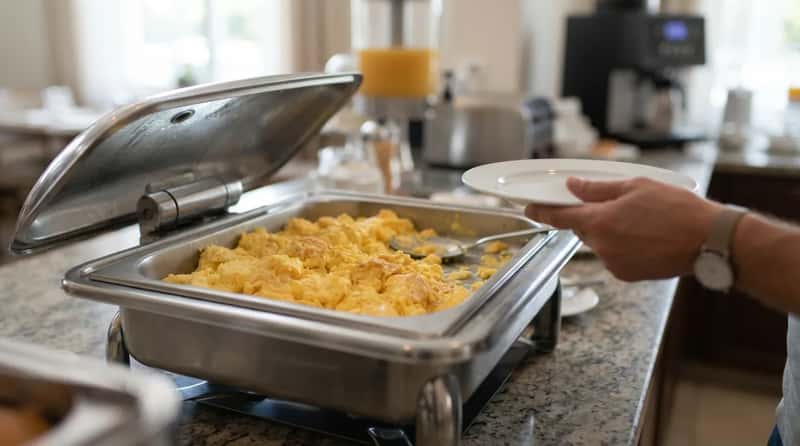
Lukewarm scrambled eggs don’t just taste off. They can genuinely make you sick, and almost nobody checks.
The CDC calls the range between 40°F and 140°F the “danger zone” – the temperature where bacteria multiply fast. Buffet food often sits in that zone far longer than the two-hour safety window.
The FDA says hot buffet items should stay at 140°F or above, and cold items at 40°F or below. If those eggs feel “warm-ish” instead of hot, they’re probably already in trouble.
Fast Facts
- Danger zone: 40°F to 140°F, according to the CDC
- Hot buffet items should read 140°F or higher (FDA)
- Cold items should stay at 40°F or below (FDA)
- Safety window: under two hours in the danger zone
Check that cold food is actually resting on ice, not just sitting in melted water. When in doubt, skip it.
And the plate you’re about to pile that food onto? That’s mistake #13…
#13 – Reusing Your Plate

It feels efficient to keep the same plate for round two. It’s actually a food safety violation that can spread illness across the whole dining room.
At home, reusing a plate is fine. In a commercial buffet, it breaks strict rules that exist for a reason.
Guests share serving utensils, and those utensils touch every plate that comes near them. One contaminated plate can pass germs to every guest who serves themselves after.
Don’t bother scraping off the leftovers either – just leave the plate in the dirty dish return and grab a clean one before heading back.
Once you’ve got that fresh plate, most guests immediately make mistake #12…
#12 – Piling Your Plate on the First Pass
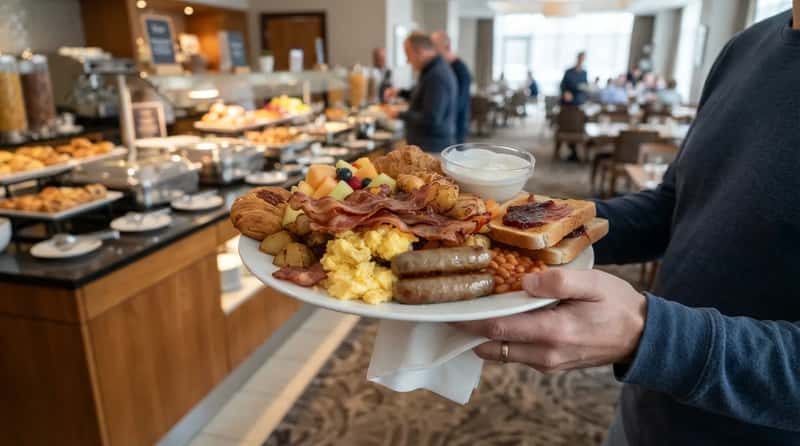
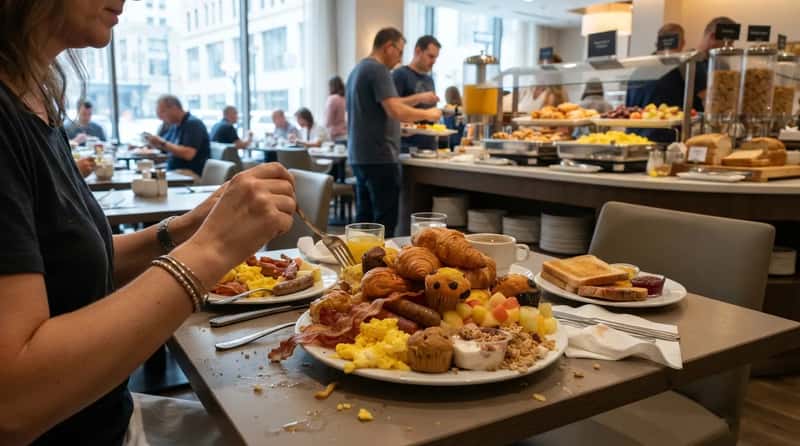
“My eyes were bigger than my stomach” might as well have been coined at a breakfast buffet. Excitement takes over, and the plate fills up fast.
One five-star hotel study found guests left behind an average of 300 grams of food per breakfast. Plate size makes it worse – people eat 45% more and waste 135% more food when handed a large plate instead of a small one.
Quick Compare
- Large plate: 45% more food eaten, 135% more wasted
- Small plate: portions closer to actual appetite, far less waste
- Average leftover per guest at five-star buffets: about 300 grams
Walk the spread first, then plate small portions of a few things you actually want. You can always go back for seconds if there’s room.
The flip side of overloading is mistake #11 – just as wasteful, but far sneakier…
#11 – Smuggling Food Out in Your Bag
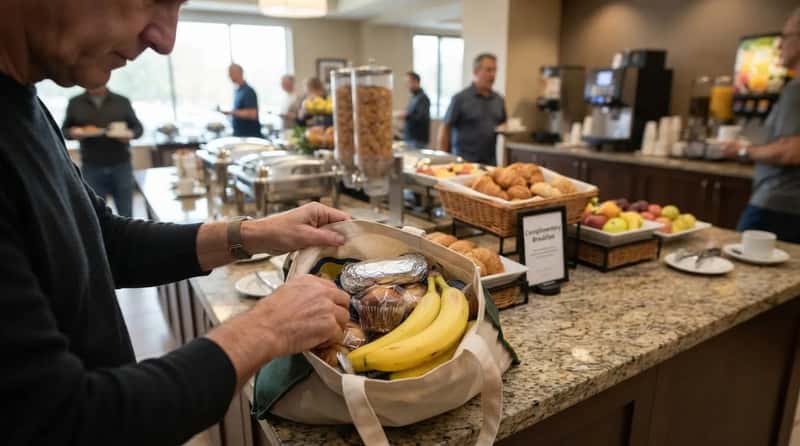
An all-you-can-eat buffet is not an all-you-can-steal event. Some guests sneak plastic bags inside totes and quietly stuff them with as much food as they’ll hold.
Nobody’s going to say anything if you grab a banana or a muffin for the road. Most hotels are fine with coffee or tea to go, too.
Filling a hidden bag is different. That food usually goes to waste anyway, and it takes food away from guests who paid for the same breakfast.
Most hotels officially ban removing food from the buffet for health code reasons. Don’t test that policy.
Don’t worry, though – mistake #10 is one almost every guest commits without even realizing it…
#10 – Not Scouting the Full Spread First
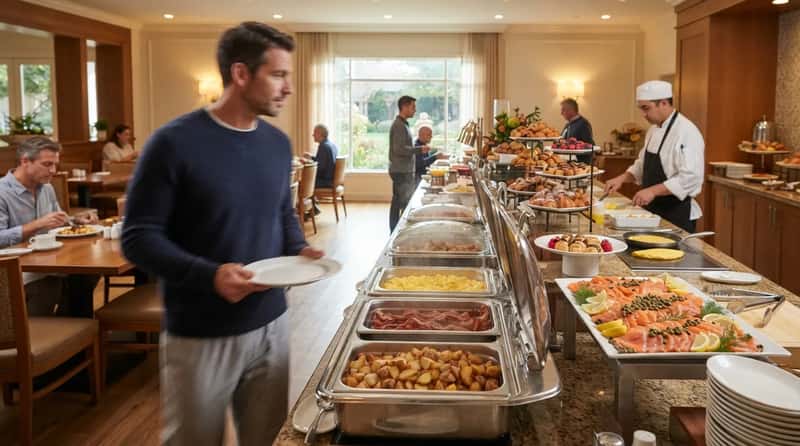
Most people walk straight to the first chafing dish and start loading up. That’s exactly how you miss the best food on the table.
Hotels often place premium items – smoked salmon, made-to-order eggs, specialty pastries – away from the entrance. The first thing you see is rarely the star of the spread.
Walk the entire room once before you touch a plate. It takes thirty seconds and saves you from filling up on the mediocre stuff up front.
Scope the whole table before you commit to anything. The best item is almost never the first one you see.
Once you know what’s actually on offer, mistake #9 decides whether your breakfast fuels your morning or wrecks it…
#9 – Loading Up on Pastries First
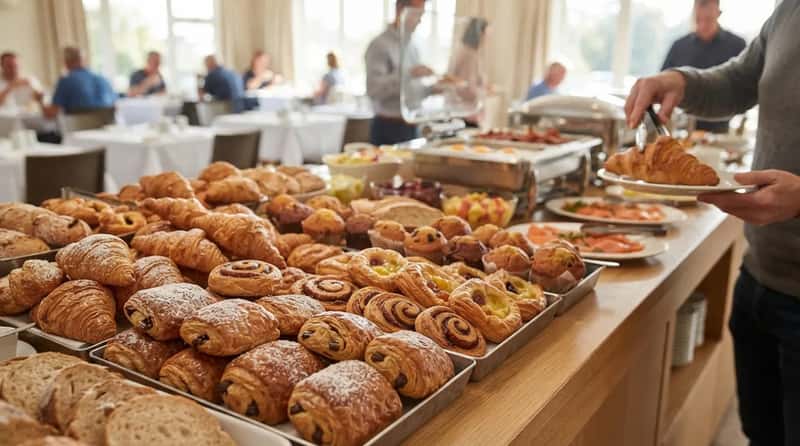
Croissants first, eggs later – that’s how most guests hit the buffet. It’s also why most guests are starving again by 10 AM.
Refined carbs spike blood sugar fast, then crash it just as fast. Pastries and sugary cereals sit at the front of the spread because they’re cheap and popular, not because they’re smart.
Start with protein instead – eggs, cheese, smoked salmon – then add fruit for fiber. Let the pastries be the finish, not the foundation.
The next mistake, #8, is one that makes hotel staff quietly cringe every single morning…
#8 – Using Your Hands at the Buffet
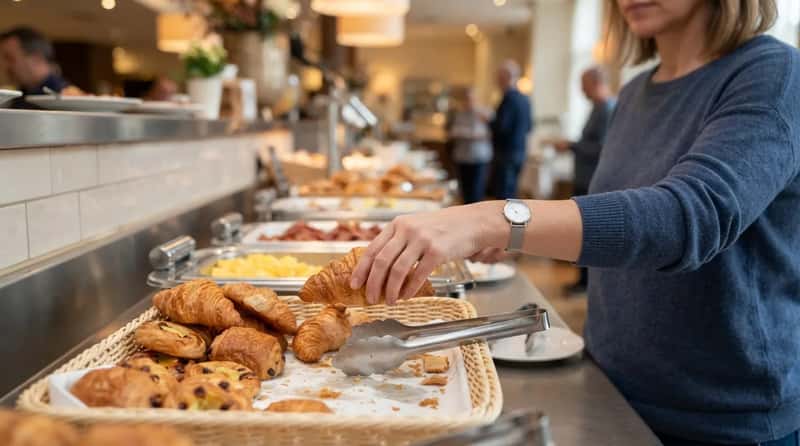
It happens constantly. A guest reaches past the tongs and grabs a roll or a piece of fruit bare-handed, over food dozens of other people are about to eat.
Use the utensils provided – always. This isn’t just etiquette, it’s basic hygiene in a shared food environment.
Tongs, juice jugs, and lids are already high-touch surfaces. Add bare hands into the mix and it’s worth wondering what’s actually on your food by the time it reaches your plate.
It takes two seconds to grab the tongs instead. That’s two seconds that protect everyone else in the room.
Mistake #7 sounds harmless – but hotel chefs say it’s a genuine pet peeve…
#7 – Hovering and Crowding Other Guests
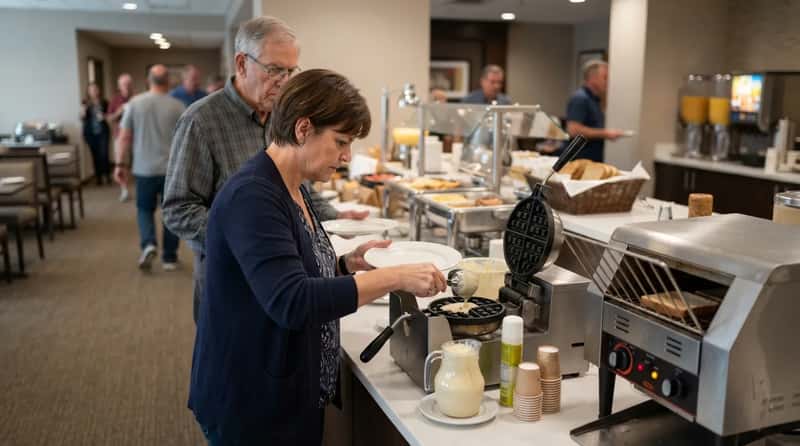
The waffle iron is occupied. The toaster is taken. So you stand six inches behind the person using it, silently willing them to hurry up.
That’s not just rude – it can actually escalate. Hovering too close or muttering under your breath has turned pleasant mornings into real standoffs.
If someone’s waiting on toast or a waffle, nothing you do speeds that up. Circle to another station or head back to your table for a minute.
The buffet feeds hundreds of people in a tight window. Patience isn’t optional here – it’s what keeps the room from tipping into chaos.
Skipping #6 won’t get you thrown out – but hotel staff will absolutely notice…
#6 – Forgetting to Tip the Staff

This might be the most overlooked mistake on the list. The breakfast team has been up since before dawn – prepping, cooking, restocking – and most guests walk out without a second thought.
A verbal thank-you is nice. A little cash is better, and in the U.S., it’s genuinely good manners if staff are working the buffet.
Worth Knowing
- Breakfast staff are often on shift well before sunrise
- A few dollars in cash is noticed, even without a tip jar
- There’s no fixed amount expected – small gestures still count
- Tipping buffet staff is standard etiquette at U.S. hotels
It doesn’t need to be an amount that makes headlines. Someone sliced your beef or brought you a new fork after yours hit the floor.
Skipping the tip after all that sends a message – and it’s not a good one.
Mistake #5 is the one that quietly ruins breakfast for everyone sitting near you…
#5 – Showing Up in Pajamas or Beachwear

Yes, it’s a hotel. Yes, you’re on vacation. But the breakfast room is still a shared public space, and rolling in wearing pajamas or a wet swimsuit affects everyone else eating there.
There’s no official dress code at most hotel breakfasts, but a neat, appropriate appearance is still expected. Skip the pajamas and the beachwear, even if you already hit the pool this morning.
This one is more divisive than you’d think – plenty of guests argue breakfast is basically an extension of their room. Most hospitality professionals disagree completely.
Wet rubber slippers are just as bad. They create a slip hazard, and nobody wants to eat next to a puddle.
Mistake #4 has nothing to do with what you wear – it’s about what you do with a plate you’ve already used…
#4 – Lingering Too Long at Your Table

The breakfast room runs on a fixed window – usually two to three hours – with a fixed number of seats. Treating your table like a private lounge during a packed rush is quietly inconsiderate.
Hotel Management data shows the busiest hours are typically 8 to 10 AM. Arrive before the rush and you’ll actually get a relaxed meal instead of a scramble for a seat.
Staying past your natural finish time in a full room doesn’t extend your enjoyment. It just eats into someone else’s.
The next mistake, #3, seems thoughtful on the surface – but it’s actually a food safety problem hiding in plain sight…
#3 – Tasting Food and Putting the Utensil Back
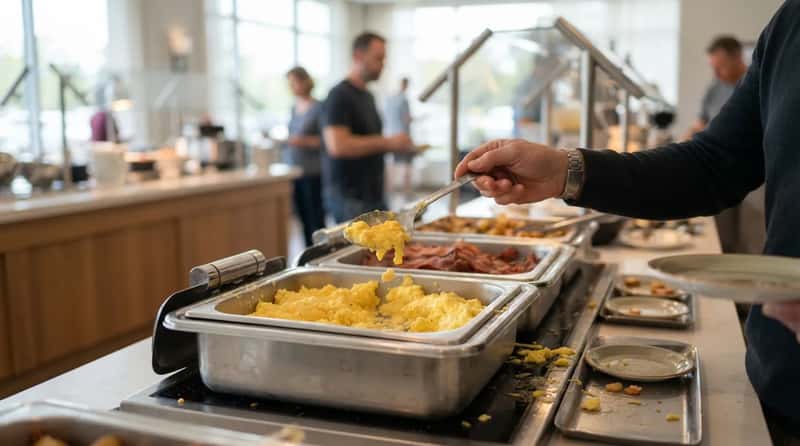
You want to check if the scrambled eggs are good before committing. So you scoop a bit with the serving spoon, taste it, and put the same spoon back in the dish.
That single move contaminates the entire tray for every guest who serves themselves after you. It’s one of the fastest ways cross-contamination spreads on a buffet line.
It’s also how allergen contamination happens between dishes – a genuinely serious risk for guests with food allergies. If you’re not sure what’s in something, ask a staff member instead of guessing with a shared spoon.
The second-most damaging mistake on this list involves a timing error most travelers make the night before they even walk into the breakfast room…
#2 – Not Confirming Breakfast Hours at Check-In
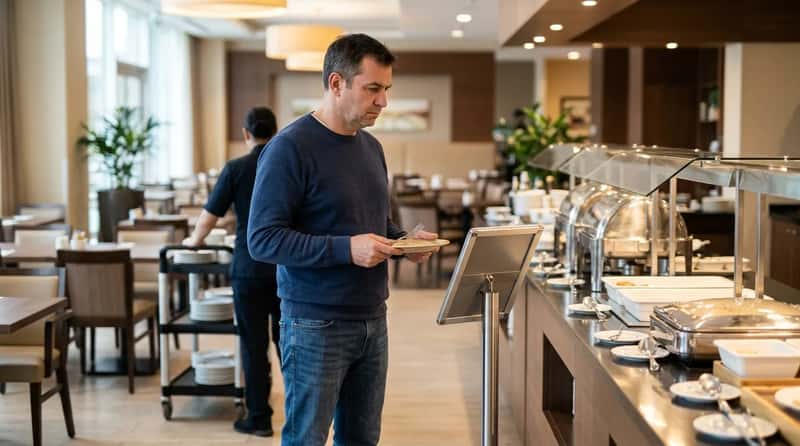
You assume breakfast runs until 10 AM. You come down at 9:50 and the buffet is already being cleared away.
This happens to more guests than hotels will ever publicly admit. Confirm breakfast hours right at check-in – front desk staff can sometimes flag the kitchen ahead of an early departure.
Most chains push the cutoff back thirty minutes on weekends – Hampton runs 9:30 to 10 AM, Marriott full-service runs 10:30 to 11 AM. These times still vary by property, so don’t assume.
Quick Compare
| Chain | Weekend Cutoff |
|---|---|
| Hampton Inn | 9:30 – 10:00 AM |
| Marriott (full-service) | 10:30 – 11:00 AM |
If your checkout falls before breakfast even opens, ask the front desk the night before for an early-departure breakfast bag. It beats skipping the meal entirely.
And now, the #1 mistake – the one that ties every other error on this list together, and the one most guests never see coming…
#1 – Treating the Buffet Like It Was Built Just for You
This is the root of almost every mistake above. The “I paid for this, so it’s mine” mindset is what drives plate overloading, bag stuffing, seat hogging, and ignoring food safety rules altogether.
Because breakfast is usually baked into the room price, guests feel entitled to “get their money’s worth.” That instinct is understandable – and it’s exactly what the data says is wrong.
Buffet-style breakfasts generate more than twice the food waste per guest compared to menu orders. That waste starts with entitlement and ends in a trash bin.
The guests who get the most out of hotel breakfast treat it like what it actually is – a shared space, not a personal buffet built just for them. Arrive on time, take what you’ll eat, use the utensils, tip the team, and be decent about it.
The Bottom Line
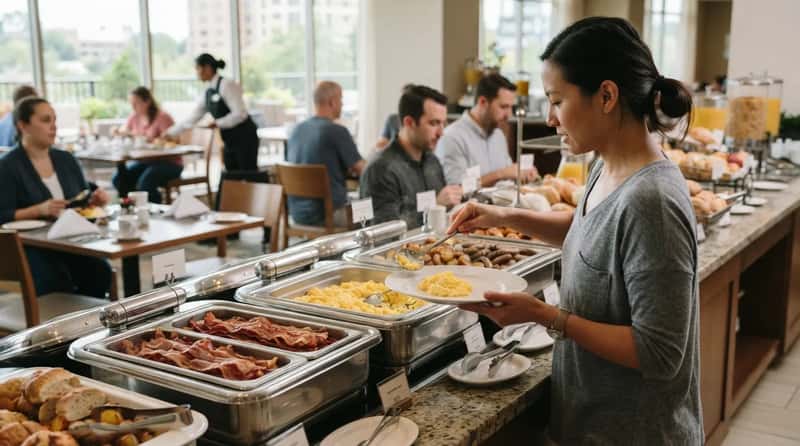
Most hotel breakfast mistakes aren’t about ignorance. They’re about mindset.
Buffet-style breakfasts waste more than twice the food of menu orders, and food sitting in the temperature danger zone for over two hours becomes a genuine health risk. The fixes are almost embarrassingly simple.
Arrive with time to spare. Scout the spread before you plate anything. Grab a fresh plate each trip, tip the team, and stop treating a shared dining room like your own private pantry.
Every mistake on this list is avoidable. Fix even half of them, and your next hotel breakfast will feel like a completely different experience.
#16 – The 30-Minute Window Most Guests Miss
Every mistake above is about what to avoid. This one is about the single best move you can actually make.
- Come down within the first 30 minutes after the buffet opens, not near closing – every tray has just been filled and made-to-order stations have zero line.
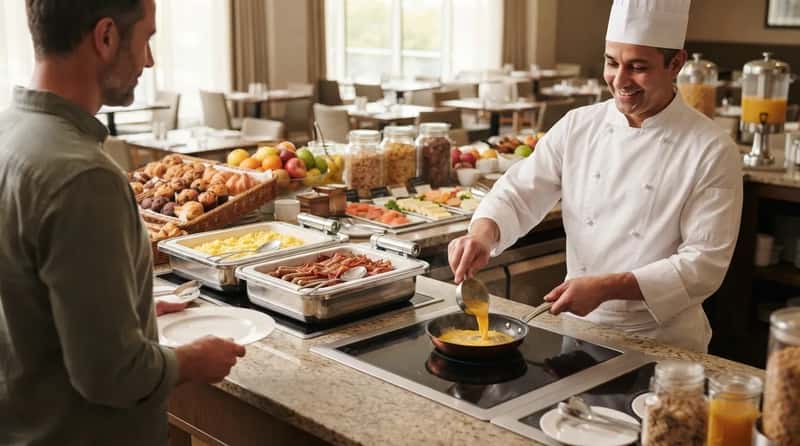
- Ask the chef directly for something not on the buffet. Many hotel kitchens will quietly make a fresh omelet, oatmeal bowl, or plate of eggs if the ingredients are already on hand.
- Check your loyalty status before you go down. Top-tier elite members at chains like Marriott Bonvoy, World of Hyatt, and IHG One Rewards often get daily breakfast as a standing benefit – even at properties where breakfast isn’t normally included in the room rate.
- If you forgot to book under your loyalty number, ask the front desk to retroactively apply your elite benefits before you check out. It’s often still possible.
Most guests never combine early timing with a direct ask to the kitchen. Do both, and you’ll eat better than almost anyone else in the room.