


Ask most travelers over 60 what’s hardest about a group tour and they’ll say the walking. Guides say the real trouble is quieter, and these are the 15 mistakes they see most.
They hide in deadlines, paperwork, seat rules and silence. Some cost money, a few put the whole trip at risk, and the one at #1 isn’t about your legs.
#15 – The “Moderate” Rating Nobody Reads
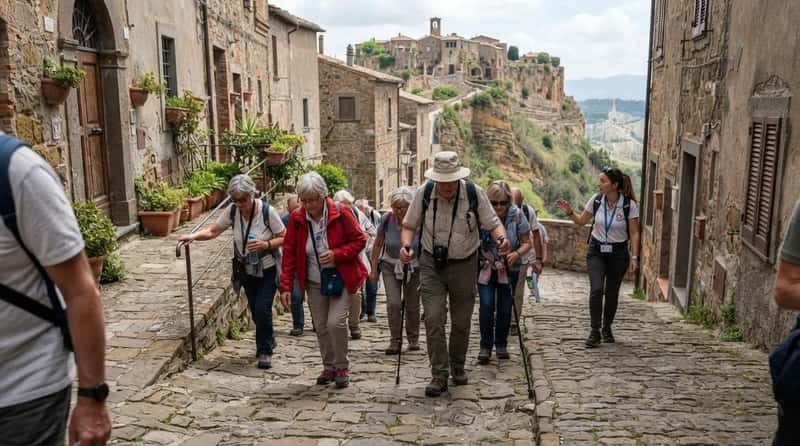
One word in the brochure catches more travelers off guard than any hill.
Most tour companies grade trips by how much walking they involve. Guides say people skim past that line, then learn what “moderate” means in a hill village built before cars.
Cobblestones, steep lanes and sprawling ruins can all hide in the fine print. A rating rarely tells you how many hours you’ll be on your feet.
- Ask how many hours of walking a typical day includes.
- Ask whether a lighter option exists at each stop.
But the next mistake looks tiny, and it can cost forty people their afternoon.
#14 – Treating “Five Minutes” as a Suggestion

On a coach tour, the clock doesn’t belong to the guide.
Departure times are often tied to timed attraction entries, restaurant reservations, ferry crossings and hotel check-in windows. Miss one and the whole day can slide like a row of dominoes.
Guides say the five minutes you spend finishing a coffee can quietly cost forty people a stop later on. Lateness rarely hurts only the person who’s late.
“Be there” and “be ready to leave” mean different things, and first-timers often miss the gap. That’s why some guides now say “wheels roll at” instead.
Worth Knowing
- Ask your guide what the departure time means: seated, or just arriving.
- Set a phone alarm 10 minutes before the meeting time.
- Note a landmark at each stop, such as a fountain or a gate, so you can find the bus fast.
- Save your guide’s mobile number on day one.
Being on time matters. What you do right after the flight matters even more.
#13 – Cramming Day One After a Long Flight
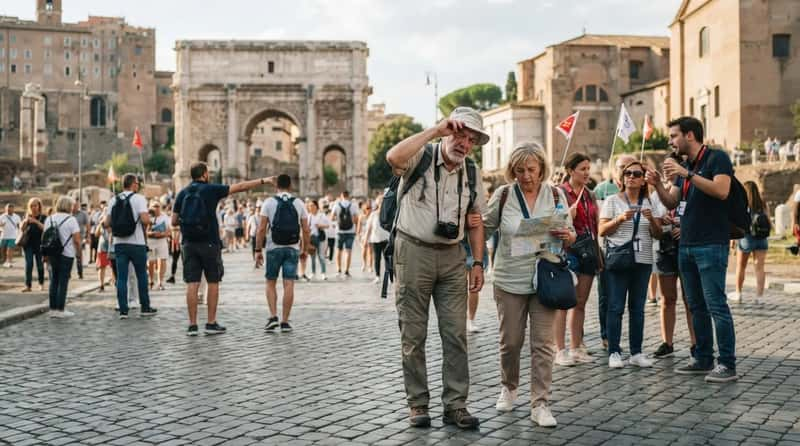
The “light” first day may be the smartest one on the itinerary.
Many travelers assume a short nap will fix a long-haul flight, so they plan a full sightseeing day on arrival. Guides say that’s one of the most common and avoidable scheduling mistakes in international group travel.
Day one looks easy on paper, but experienced guides know it sets up everything after it. Forcing a full sightseeing day after a long flight tends to backfire.
Rest is the cheap fix. The next mistake is the expensive one, and it has a deadline most people miss.
#12 – Buying Travel Insurance After the Window Closes

The costliest mistake on this list is decided within weeks of your first deposit.
Senior travel insurance typically excludes preexisting conditions, but a waiver can bring them back into coverage. You usually have to buy that waiver within 14 to 21 days.1 2
The clock starts at your first payment on a flight, tour or hotel, not when you finalize the itinerary. Miss the window and you usually lose waiver eligibility for that trip, with no way to add it back later.2
Windows differ by insurer, and some are shorter than 14 days. Read your policy’s terms for the exact limit.
And there’s an even bigger assumption about coverage that catches travelers at the worst possible moment.
#11 – Assuming Medicare Will Follow You Abroad

Your Medicare card usually stops working at the border.
Original Medicare generally does not cover care outside the United States and its territories, except in very specific situations.3 Medicare Advantage plans usually follow the same narrow rules, though some offer optional add-ons.3 4
Some Medigap policies do cover emergencies abroad. But they carry a lifetime limit of $50,000 for foreign emergency coverage.4 5
Many senior travel resources recommend separate travel medical insurance. It can cover evacuation, cancellation and major emergencies that Medicare misses.5
Coverage isn’t the only health detail that gets overlooked. The next one is about your legs.
#10 – Sitting Still Through Every Long Coach Day

Long coach days carry a risk that rarely makes the brochure.
Older adults face a higher-than-average risk of deep-vein thrombosis, when blood clots form in the veins, usually in the legs. Staying planted in your seat for hours is the habit that matters most.6
Treat every rest stop as a reason to stand and walk. Don’t wait for the guide to announce a stretch break.
Talk to your doctor before departure about what’s right for you. Then tell your guide if you need more frequent stops.
Fast Facts
- Walk around at every rest stop, even if it’s only a few minutes.7
- Flex and rotate your ankles while seated.6
- Sip water through the day, and dress in loose, comfortable clothing.
- Ask your doctor whether compression socks make sense for you.7
The next mistake takes two seconds to make, and it’s far easier to prevent than to fix on the road.
#9 – The Pill Bottle in the Wrong Bag

One misplaced pill bottle can derail a whole tour day.
Guides say a missed dose is far easier to prevent than to fix on the road. Keep a day’s supply in the bag that stays with you, not in luggage stowed under the bus.
Meal timing matters too. Dinner in Madrid can start after 9 p.m., which doesn’t suit travelers on meal-linked medications.
Schedules in some countries simply don’t match a medication routine. Ask about typical dinner hours before you book.
Dinner is also where the next mistake surfaces, long after it could have been fixed.
#8 – Mentioning the Allergy at the Table

The waiter usually can’t improvise a group meal.
Group menus are cooked in bulk, so allergies and restrictions need to be flagged well in advance. By the time you’re seated, the kitchen has already committed.
Many travelers say they wish they’d spoken up at booking, not at the table.
Group dinners usually run on a fixed schedule. That leaves little room for a substitution on the spot.
Speaking up early is a theme. But the next mistake is one you can only make alone, in your bedroom, with a suitcase.
#7 – Packing the “Just in Case” Outfit

Your suitcase can quietly become the most stressful member of the tour.
A tour operator that works with older travelers lists overpacking as a common mistake. Heavy suitcases create stress at airports, hotels, train stations and cruise terminals.
The bag you can barely lift soon becomes the thing you think about most.
- Do a practice lift at home: carry the packed bag up a flight of stairs.
- Remove anything you packed only “just in case.”
Luggage is personal. The next mistake affects dozens of strangers.
#6 – Never Asking How Big the Group Is

Group size changes the whole experience, and many travelers never ask.
A group of 50 means longer waits at restaurants, slower boarding and less personal attention. Every extra person adds time to every single stop.
One guide for older solo travelers says group size and single supplement policy are the two factors that matter most.
Brochures push the lowest price, yet many travelers say they’d happily pay more to skip the bathroom queue at every rest stop. Whether that trade-off is worth it is up for debate.
Even in a small group, one daily contest causes more tension than anything else on the bus.
#5 – Treating Row One as Permanent Property

The front seat has started more arguments than any sightseeing stop.
Many tours rotate seats daily so everyone gets a turn near the front. Guides say the arguments start when someone treats row one as permanent property.
Policies differ, though. Many large-group operators rotate seats, while others let people claim a seat on day one and keep it all week.
Quick Compare
- Daily rotation: everyone gets a turn up front, but you have to move every morning.
- Claim-and-keep: a predictable spot all week, but the front rows stay taken.
Guides say smoother travelers ask about the rotation policy first, rather than after being asked to move on day three. One question on day one prevents an awkward conversation later.
Seats are a small turf war. The next mistake is a bigger one, and it comes from someone who thinks they’re helping.
#4 – Playing the Unofficial Drill Sergeant

Guides say the self-appointed “helper” almost never helps.
Some tourists appoint themselves the unofficial marshal, hanging back to tell strangers to keep up. It sounds helpful, but guides say it almost never is.
A related habit is treating the schedule as a suggestion box. Guides describe pressure to skip stops, extend lunch or rearrange a whole day because one person changed their mind.
What guides resent isn’t flexibility itself, it’s the assumption that bending the schedule costs nothing.
The next mistake arrives at the end of the trip, and it involves an envelope.
#3 – Tipping the Wrong Person, or Fumbling It

The last day of a tour exposes who planned ahead.
Some travelers tip the wrong person, confusing a local step-on guide with the tour director who’s been with the group since departure. Guides say the awkward moment comes on the last day, when someone digs through a purse for cash while the bus waits.
Published advice varies widely. One guide suggests roughly $5 to $20 per day for group tours, depending on group size.
On tours where gratuities are pooled, individual tips may not be appropriate, so check first. Many tour professionals also say a genuine thank-you on day one shapes service as much as the size of the final envelope.
Two mistakes remain. Guides describe them as the quietest ones, and they may matter most.
#2 – Saying Yes to Everything

Packing in more stops doesn’t make a trip better value.
Many brochures sell a packed route as a bargain. But some experienced guides argue a “see everything” itinerary is the biggest mistake in senior travel.
Fewer stops with more time, they say, make better memories than a schedule that leaves half the group exhausted.
At a Glance
- Pick one must-see per day and treat the rest as a bonus.
- Check which excursions are optional before you pay for them.
- Plan a lighter afternoon after a heavy morning.
- Sitting out a stop is a choice, not a failure.
The pressure isn’t only from the itinerary. Guides say many travelers feel pushed by the group to say yes to everything, even when their feet are saying no.
Skipping an optional excursion isn’t failing. The final mistake drives most of the others, and it’s the hardest to spot from the front of the bus.
#1 – Pretending Everything Is Fine
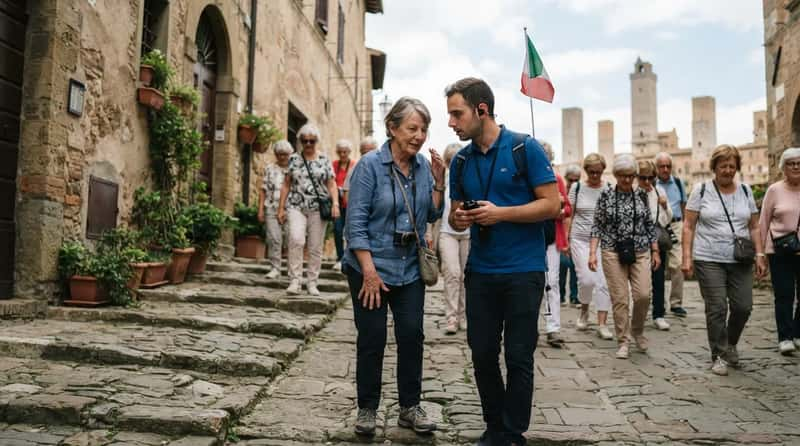
The most costly mistake on a group tour is silence.
Guides say some older travelers pull them aside beforehand to mention a bad knee, a hip replacement or difficulty with steep stairs. Others quietly swap into an easier version of a tour without telling anyone.
The CDC lists falls as a leading cause of injury among adults 65 and older.8 Guides know uneven surfaces are a real risk.
The rest of the group never knows when a guide quietly adjusts for someone. Many veteran guides say that unseen judgment call matters more than any itinerary, because it lets people keep traveling, and keep their pride, long after the trip ends.
So what do all 15 add up to? Most of these mistakes are small, and nearly all of them are avoidable.
Read the activity rating closely, buy insurance within days of your first deposit, and don’t count on Medicare abroad. Flag medications and allergies at booking, ask about group size and seat rules, and settle tipping before the last day.
Beyond logistics, guides say the biggest fix is being honest about what your body can do. Which of these did you least expect to see here, and is there one you’d argue with?
Bonus: The One-Page Guide Card Insiders Swear By

Most of the mistakes above come down to the same gap: your guide doesn’t know what you need until it’s a problem. A single sheet of paper closes that gap in about ten minutes.
Here’s how to make it work:
- Write it before you leave. Put on one page: any mobility limits (knees, hips, stairs), your medications with timing and whether they go with meals, allergies, an emergency contact, and your insurer’s 24-hour emergency phone number and policy number.
- Hand it over privately on day one. Give it to the guide or tour director before the first walking stop, not on the bus in front of the group. This is the “private word” that makes quiet adjustments possible.
- Ask two questions while you’re at it. “Which stops are fixed and which can flex?” and “Where can I sit out a section without missing the highlight?”
- Keep backups. Photograph the card and keep a paper copy in your daypack, so it travels with you instead of sitting in a stowed suitcase.
Why it works: you stay in control of what gets shared, you skip the awkward table-side or bus-aisle conversations, and your guide can plan around you instead of reacting to you.
- Forbes Advisor Pre-Existing Conditions: https://www.forbes.com/advisor/travel-insurance/pre-existing-conditions/
- Yahoo Finance Preexisting Waivers: https://finance.yahoo.com/personal-finance/insurance/article/travel-insurance-with-preexisting-medical-conditions-183106315.html
- Medicare Interactive Traveling: https://www.medicareinteractive.org/understanding-medicare/medicare-covered-services/medicare-coverage-overview/traveling-with-medicare
- AARP Medicare Abroad: https://www.aarp.org/medicare/does-medicare-cover-me-outside-the-us/
- Wellcare Medicare Travel Guide: https://www.wellcare.com/en/resources/does-medicare-cover-travel
- CDC DVT Travel Podcast: https://tools.cdc.gov/podcasts/media/pdf/DVT.pdf
- CDC Yellow Book DVT: https://wwwnc.cdc.gov/travel/yellowbook/2020/travel-by-air-land-sea/deep-vein-thrombosis-and-pulmonary-embolism
- CDC Older Adult Falls: https://www.cdc.gov/falls/data-research/index.html
