


Most older travelers assume the senior discount just happens, a ticket is all they need, and every station is built to help. None of that is guaranteed. Some of these slip-ups cost money, and a few can cost you the train.
Here’s what the published rules actually say, counted down from #15 to #1. The mistake at #1 quietly undermines every fix before it, so don’t skip ahead.
#15 – The Age Cutoff Mix-Up

Your “senior” birthday isn’t the same on every railway.
Amtrak’s senior discount generally requires you to be 65 or above, yet some guides still say 62. Britain’s Senior Railcard starts at 60.1
Cross-border trains add another wrinkle. One guide says services run jointly with VIA Rail Canada start at 60.2
Even the size of the Amtrak discount depends on who you ask. Some sources say 15% off, while others say 10%.
- Amtrak: usually 65+
- Great Britain’s Senior Railcard: 60+
- Cross-border Amtrak/VIA: reportedly 60+
Check the operator’s own page before you plan around a number. But the age mix-up is minor compared to the booking-screen trap waiting at #14…
#14 – Believing the Discount Applies Itself

A senior fare doesn’t show up unless you ask for it.
On Amtrak, you select the “Senior” passenger type when booking. Skip that step and you may never see the senior price.2
One guide notes Amtrak doesn’t ask for proof of age at booking, so the discount rests on what you enter. That honor system ends at the station. Boarding can be denied if your ID doesn’t match.
Speaking of ID, the next mistake is the one that can stop a trip cold at #13…
#13 – Leaving Your Photo ID Out of Reach
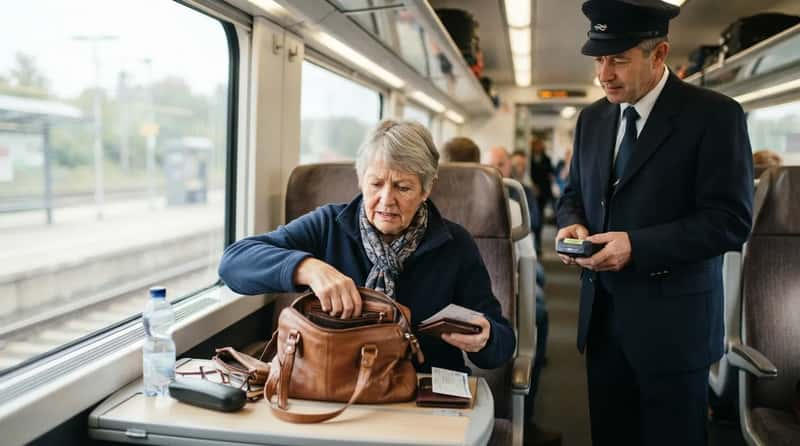
The discount is only as good as the card you can produce.
One guide says senior fares require a valid photo ID showing your birthdate, at purchase and on board. Another says it’s checked at the station.
The sources differ on exactly when, so treat your ID as something you must be able to show at any point.
One source warns that without proof, you may be charged full fare or denied boarding. That’s the risk if you can’t show an ID proving your age.
Worth Knowing
- The ID needs to be a valid photo ID that shows your birthdate
- Guides disagree on whether it’s checked at purchase, at the station or on board
- The safest plan is to be ready to show it at every step
- The risk, per one source: full fare or denied boarding
Even with perfect ID, there’s a money mistake that catches careful people at #12…
#12 – Stacking Discounts That Don’t Stack

Two discounts don’t always beat one.
Several sources say the Amtrak senior discount generally can’t be combined with other promotions, so you take the cheaper one.3 One site claims the opposite, that the senior discount stacks on top of sales.
The sources flatly contradict each other. That’s why the final total matters more than any rule of thumb.
In Britain, it’s clearer. Railcard discounts can’t be used with any other discount.1
Now for a mistake that quietly overcharges couples, coming up at #11…
#11 – Assuming Your Companion Rides Cheaper
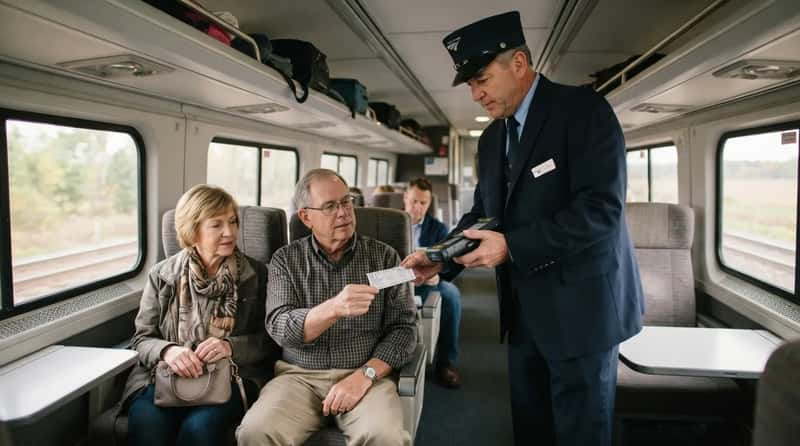
The discount belongs to one person, not the pair.
On Amtrak, your companion pays full fare unless they are also 65 or older. On Amtrak Vacations tours, both passengers pay the tour price regardless of age.
Britain works the same way. The Railcard discount applies to the holder and can’t be shared with family or friends.4
A couple with one senior traveler only saves on one ticket. Britain does have a separate option for pairs: the Two Together Railcard offers 1/3 off when travelling with a friend.
Quick Compare
- Amtrak fares: companion pays full price unless also 65+
- Amtrak Vacations: both pay the tour price, whatever their ages
- Senior Railcard: the holder only, not shareable
- Two Together Railcard: 1/3 off for two travelling together
Next comes a discount shortfall that surprises people who book overnight trips at #10…
#10 – Expecting the Sleeper Room to Be Discounted

The overnight bedroom is where the senior discount shrinks.
Several guides say the discount applies to the base fare portion, but sleeping car charges are not discounted. That means your total savings are smaller than on coach travel.
One guide estimates the base-fare savings at roughly $45 to $180, depending on route and season. Treat that as a rough estimate from a secondary site, not an Amtrak figure.
Before you cross the Atlantic with your railcard, there’s a restriction at #9 worth knowing…
#9 – Using the UK Senior Railcard at the Wrong Hour
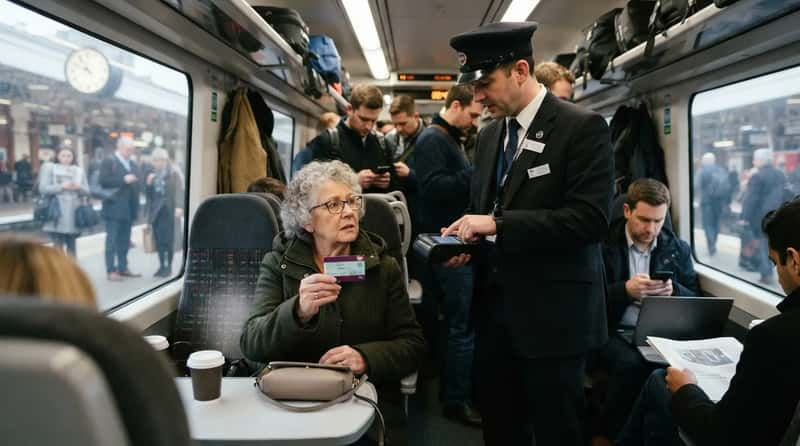
Britain’s best senior perk has a blind spot at breakfast time.
The Senior Railcard saves 1/3 on most rail fares throughout Great Britain. But it isn’t valid on weekday morning peak journeys in the London and South East area.4
That applies to trips that start and end within that area. Outside those windows, it works at any time of day, including weekends and public holidays.
The railcard has two more exclusions that trip up even regular riders at #8…
#8 – Assuming the Railcard Covers Everything
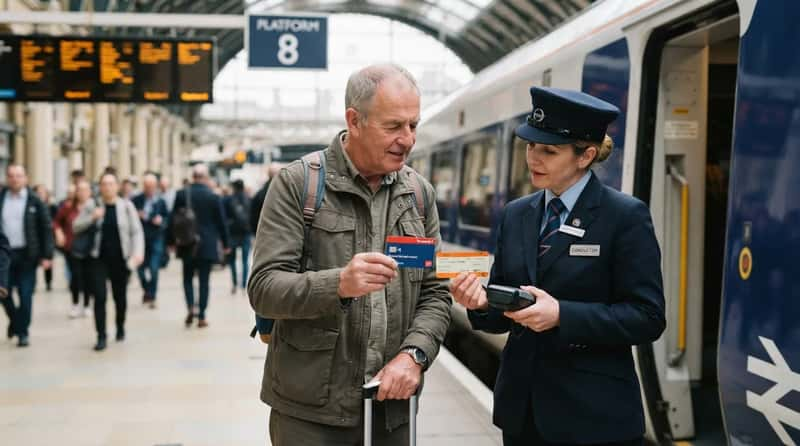
A railcard isn’t a blanket discount.
It doesn’t apply to Season tickets. It also can’t be used for discounted Eurostar tickets.
Keep the card handy, too. You may be asked to show your Railcard when purchasing discounted tickets.1
Plenty of travelers call it a no-brainer. Others argue it’s wasted money if your trips are mostly weekday-morning London hops.
At a Glance
- Covered: most rail fares in Great Britain, at 1/3 off
- Not covered: Season tickets
- Not covered: discounted Eurostar tickets
- Carry the card, since you may need to show it when buying discounted tickets
Now let’s talk luggage, where the rules are looser than your back might like at #7…
#7 – Packing Right Up to the 50-Pound Limit
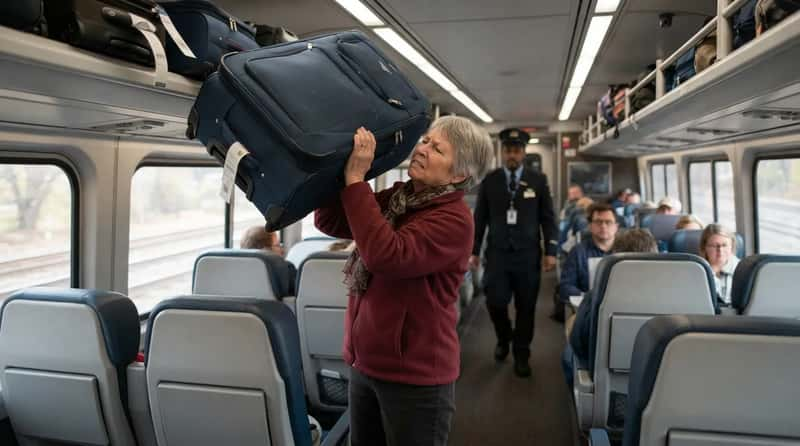
Amtrak’s bag allowance is far more generous than most shoulders.
Passengers can take two personal items, two carry-on bags, and two checked bags for free. Each carry-on can weigh up to 50 lbs.
Amtrak reportedly doesn’t routinely weigh carry-on bags. So the limit is largely on the honor system, but you still have to lift that bag, and bags over 50 lbs face a $20 overweight fee.5
But the real luggage surprise isn’t weight. It’s what happens to checked bags at #6…
#6 – Assuming Checked Baggage Is Always an Option
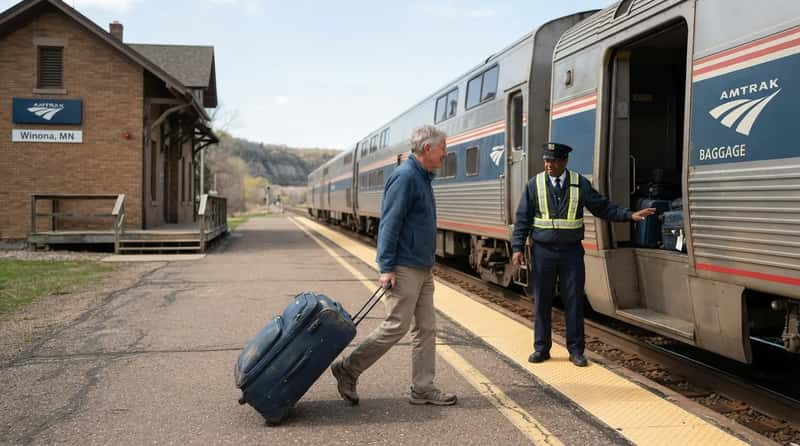
Free checked bags sound easy until the station can’t take them.
Checked baggage is not available on all routes. It’s offered only at staffed stations with baggage handling.6
Not every Amtrak train can carry checked bags at all. Confirm that both your departure and arrival stations have baggage facilities.
On the Pacific Surfliner, carry-ons are limited to slightly smaller dimensions.
And whatever you do check, one packing mistake can hurt at #5…
#5 – Burying Essentials in the Bag You Can’t Reach
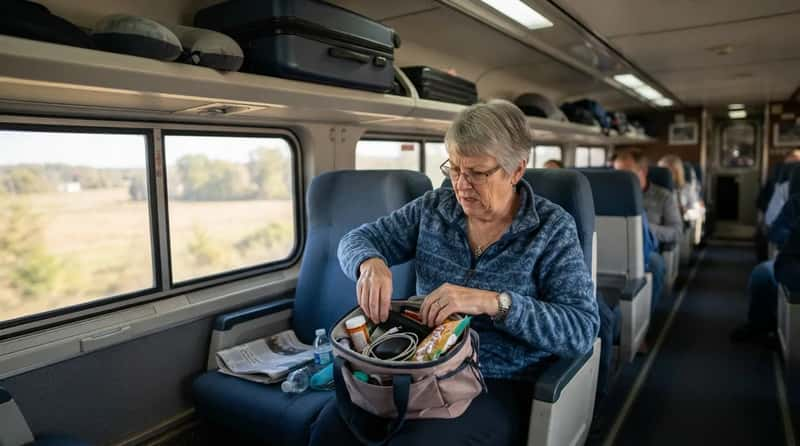
The bag in the baggage car can’t help you at hour six.
Checked bags ride separately. One guide’s table lists the baggage car as their storage location.
Medical devices count among the permitted personal items. That list includes pillows, blankets, computer cases and medical devices.
So medications, glasses, chargers and snacks stay with you. Whatever you check is out of reach until you arrive.6
Fast Facts
- Checked bags travel in the baggage car, not with you
- Personal items can include pillows, blankets and computer cases
- Medical devices are on the permitted personal item list
- Keep medications, glasses, chargers and snacks in your seat-side bag
Now the part of train travel that gets far less attention than prices, at #4…
#4 – Assuming Every Station Is Built for You

Boarding a train isn’t equally easy at every stop.
Amtrak says most stations in major cities, and many others, are accessible. Many offer level boarding, while others use portable lifts or require staff assistance.
Smaller or historic stations often have only partial access. Some require alternative boarding procedures.
Amtrak suggests reviewing your station’s accessibility page or calling 1-800-USA-RAIL.
Even at an accessible station, there’s a booking step many travelers skip at #3…
#3 – Not Reserving Accessible Space Early
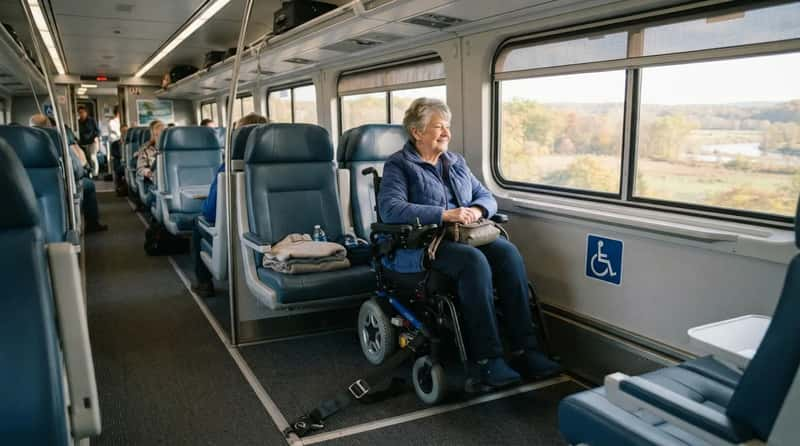
Accessible seating is limited, and it doesn’t wait for late planners.
Amtrak says accessible spaces for wheeled mobility devices and transfer seats are limited. You can reserve online, by phone, by TTY or at a ticket counter.
Amtrak asks for reservations on accessible accommodations even on trains where regular seats are unreserved. That’s according to one accessibility resource.
Amtrak also offers an online accessibility questionnaire at the start of booking.
But even a perfect reservation can unravel with one timing mistake at #2…
#2 – Arriving Just Before Departure
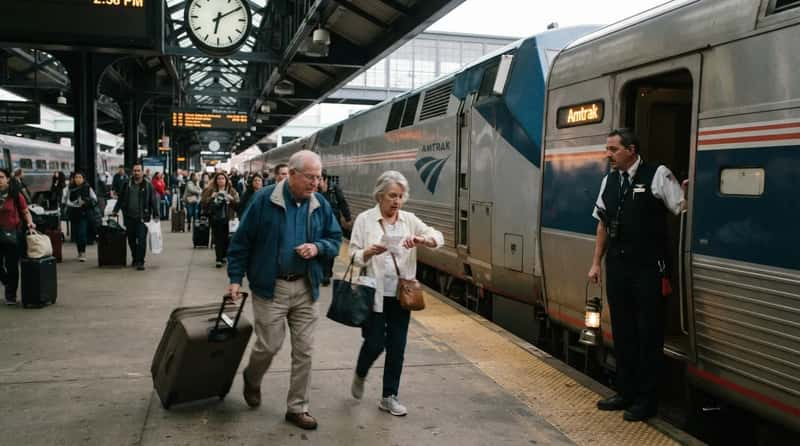
Help takes time, and the platform clock doesn’t wait.
Amtrak asks passengers who need assistance to arrive at least one hour before departure.7 Then tell a customer service representative you’ve arrived.
Courtesy wheelchairs are available at most staffed stations, and larger stations have a passenger service office. Arriving late can leave staff no time to reach you.
The last mistake is the one that quietly undermines all the others at #1…
#1 – Waiting Until the Platform to Ask for Help
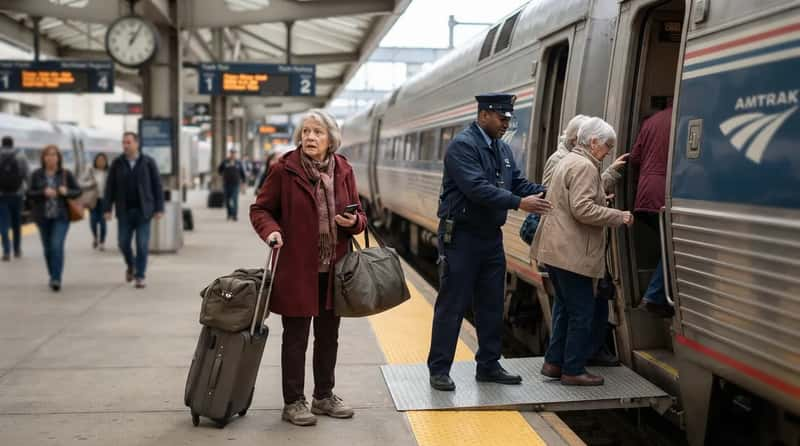
The costliest mistake is staying silent until you’re standing at the train.
Amtrak says the best way to get station assistance is a specific request when you make your reservation. On Amtrak.com, you can request a station-provided wheelchair or a uniformed staff member.7
Requests can cover navigating the station, bags, boarding, and getting to the restroom. If your station is unstaffed, notify a train crewmember.
Amtrak helps with boarding using a bridge plate, lift or ramp, depending on equipment and platform.
Fifteen mistakes, and nearly every one comes down to the same thing: assuming instead of checking. The biggest surprises weren’t exotic, just discounts that hinge on age cutoffs, traveler type, ID and fare rules, with sources that don’t even agree on Amtrak’s percentage.
The strongest advice is also the simplest. Request help at booking, reserve accessible space early, and arrive with time to spare.
Rules and prices change, so confirm with Amtrak or National Rail before you book. Which of these caught you off guard, and which one should we have ranked higher?
Bonus: The Three-Touch Trick Nobody Tells You

Don’t make just one request for help. Make three, so a missed note can’t leave you stranded.
A single request can get lost between a booking system and a busy platform. Layering it gives staff several chances to catch it.
- At booking: Make the assistance request, then write down your reservation number and the date you asked.
- A day or two before: Call 1-800-USA-RAIL and ask the agent to confirm the request is on your reservation. Do this for any connecting station too, not only your starting point.
- On board: Tell the conductor or an attendant where you’re getting off and what help you need. Ask them to pass it along so someone is expecting you.
On double-decker long-distance trains, also ask for a lower-level seat when you book. It means fewer stairs between your seat and the door.
- Senior Railcard Terms: https://www.railcard.co.uk/senior-railcard/terms-and-conditions/
- Amtrak Senior Discount: https://www.amtrak.com/seniors-discount
- Amtrak Senior Discount Guide: https://scenicrailwaytours.com/north-america/amtrak-senior-discount/
- Senior Railcard Restrictions Guide: https://uk.trip.com/trains/guide/railcard-restrictions-uk/
- Amtrak Baggage Policy Guide: https://baggagepolicies.org/amtrak-baggage-policy/
- Amtrak Vacations Baggage Info: https://www.amtrakvacations.com/trip-planning/at-the-station
- Amtrak Station Accessibility: https://www.amtrak.com/station-accessibility
