Most people picture a cruise ship doctor spending their days handing out seasickness pills and aloe for sunburn. The real job looks a lot more like quiet detective work, especially with passengers over 70. Onboard medical teams are running a mental checklist the second an older guest steps onto the gangway, watching for red flags most travelers never notice in themselves.
Some of these signs have nothing to do with a stethoscope or a diagnosis. They show up in how someone walks, what’s tucked inside their suitcase, or whether they’ve quietly skipped breakfast two mornings in a row. Ship doctors have learned to read these tiny clues fast, because out on the water, a small red flag can turn into a real emergency far quicker than it would back home.
#15 – The Anti-Nausea Patch That Mimics a Stroke

A tiny scopolamine patch behind the ear can send an older passenger straight to the medical center looking like they’ve had a stroke. Ship doctors are trained to ask about this patch almost immediately when an older guest shows up with confusion, blurred vision, or sudden weakness. It’s a small piece of gear with an outsized reputation for false alarms.
Physicians have specifically warned against casually prescribing the anticholinergic patch, since it frequently causes fatigue, one-sided weakness, and vision changes that mimic a real neurological event. On land, a quick call to a primary doctor sorts out the confusion. At sea, that same mix-up can trigger an unnecessary, and expensive, emergency evacuation, which is exactly the kind of scare doctors have learned to catch fast.
#14 – A Suitcase Full of Prescription Bottles With No List

Doctors say the biggest giveaway isn’t illness itself, it’s chaos. An older passenger who shows up with a dozen loose pill bottles and no written schedule gets treated as a walking liability the moment they check in. It slows everything down if something goes wrong and makes dangerous drug interactions much harder to catch.
Pre-travel physicians are increasingly urged to intervene before departure, checking whether medications are properly timed for the trip and writing documentation letters for any controlled substances or medical equipment being carried. Without that paperwork, a routine prescription refill in a foreign port can spiral into a multi-day ordeal. Packing chaos is one problem; a mobility scooter that physically can’t fit through a cabin door is a completely different one, and it’s next.
#13 – The Mobility Scooter That Doesn’t Fit Through the Door
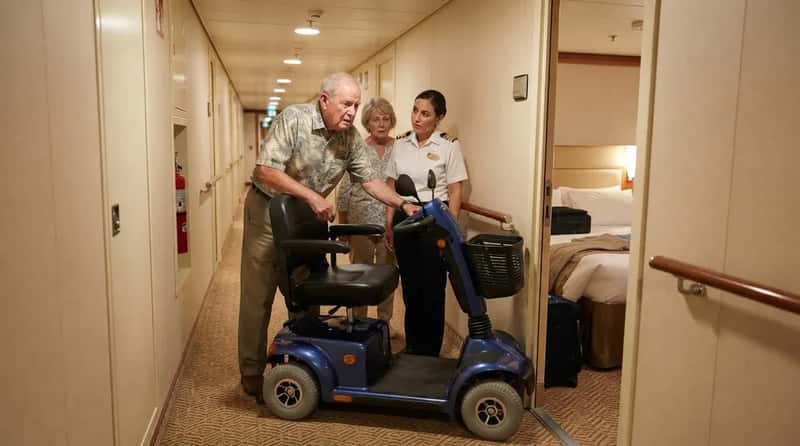
This sign shows up before a passenger even boards, and it trips up more families than cruise lines would like to admit. Cabins and hallways on most ships are built around a strict, oddly specific rule: a mobility device has to fit through a 22-inch-wide doorway and fold or collapse enough for the guest to exit safely.
Larger scooters automatically bump a passenger into a completely different booking category, and anyone disembarking on a mobility device also has to be able to handle the angle of the gangway while the ship is docked. Doctors and accessibility staff quietly cross-check equipment against itineraries long before sailing day. It’s a logistics problem on the surface, but the next sign is a medical one that shows up in almost every cabin with a CPAP machine.
Fast Facts
- Standard cabin doorways require at least 22 inches of clearance for mobility devices
- Oversized scooters typically require booking an accessible cabin category
- Guests on mobility devices must be able to manage the gangway’s slope while docked
- Accessibility staff cross-check equipment specs against the itinerary before sailing day
#12 – The Oxygen Machine Declared Weeks in Advance

Nothing tells a ship’s medical team more about a passenger’s baseline health than an early equipment declaration. Guests traveling with oxygen tanks, concentrators, or CPAP machines are asked to disclose it weeks before sailing, and doctors treat that single form as a genuine health marker.
Some cruise lines put the responsibility squarely on the passenger’s shoulders. Norwegian Cruise Line, for instance, welcomes guests who need oxygen therapy but requires them to supply their own oxygen, a policy that has caught more families off guard than almost any other rule on the ship. Equipment is easy to track on paper; behavior is harder to catch, and skipped meals turn out to be one of the quietest warning signs on board.
#11 – Skipping Breakfast Two Days in a Row

This is one sign that almost never gets reported by the passenger themselves. Onboard staff are trained to notice absence, not just obvious illness, and dining teams quietly track who’s skipped breakfast two mornings running.
It sounds like small talk, but it’s preventative care in disguise. A missed meal or two can signal dehydration, depression, low blood sugar, or a brewing infection long before a fever ever shows up on a thermometer. Appetite is a subtle clue; what happens next with insulin and sharps disposal is far less subtle.
#10 – The Insulin Kit and the Sharps Container Request
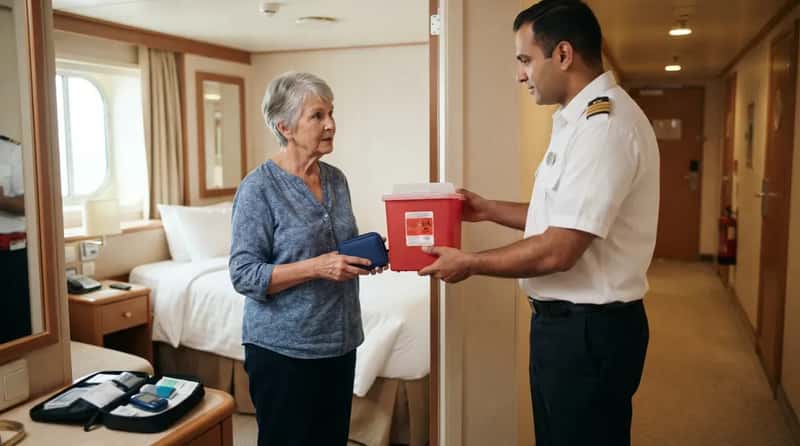
Diabetes management at sea comes with its own paperwork trail, and doctors pay close attention to how a passenger handles it. Guests traveling with injectable medication are directed to contact housekeeping directly for a sharps disposal container rather than managing it on their own.
Medical staff use that single request as an early read on a passenger’s overall self-management skills. A guest who’s organized about insulin storage and disposal tends to sail through the rest of the trip without incident; one who isn’t usually needs closer watching. Diabetes is manageable at sea. Dialysis is a completely different level of planning, and it’s the next thing doctors check for.
#9 – Dialysis on the Itinerary

For a passenger on dialysis, the ship’s medical team isn’t actually the main concern, the ports are. Cruise lines flag this need specifically because it requires shoreside coordination rather than onboard treatment.
Special-needs intake forms directly ask whether anyone in the stateroom is on dialysis, since ship infirmaries simply aren’t equipped for ongoing treatment. Doctors and the shore excursion desk work together ahead of time to confirm a treatment center is available and reachable at every single port of call. Skipping that step has stranded passengers before, sometimes for days.
Worth Knowing
- Ship infirmaries are not set up to handle ongoing dialysis treatment
- Booking forms ask upfront whether anyone in the stateroom needs dialysis
- The shore excursion desk pre-confirms a treatment center at every port on the route
- Passengers who skip this planning step have been stranded in port for days
#8 – Walking the Same Corridor Twice

Big ships are disorienting even for sharp-minded travelers, and doctors know that confusion here doesn’t automatically mean cognitive decline. Long passageways, identical doors, and constant motion can rattle just about anyone.
Staff who’ve worked cruise ships for years, including former medical personnel with more than a decade of experience, describe seeing this pattern constantly, especially on the largest ships. A passenger circling back to the same spot, or asking the same crew member for directions twice, gets quietly flagged, not for a diagnosis, but for a welfare check-in. Getting lost is one thing; not hearing the safety briefing at all is a bigger concern, and it’s next.
#7 – Missing the Emergency Drill Instructions

Hearing loss is common in this age group, and ship doctors treat it as a genuine safety variable, not just an inconvenience. Missing an announcement during a real emergency is a very different problem than missing one during a lecture.
Cruise lines have quietly built workarounds into their systems, including staterooms with vibrating alarm clocks and flashing light alerts for hearing- or vision-impaired guests. Medical and guest-access teams cross-reference who requested these accommodations against who actually shows up to muster drills. A passenger who can’t hear the announcement but never flagged it in advance is exactly who staff keep a quiet eye on.
#6 – The Quiet Request for an ID Wristband

This is one of the gentlest interventions on the entire ship, and it’s almost always aimed at early memory concerns. Crew members frame it as a courtesy rather than a diagnosis, which is exactly the point.
For guests showing early signs of memory trouble, crews have a quiet system where someone is gently encouraged to wear a wristband or lanyard printed with their name, the ship’s name, their stateroom number, and a contact line, usually pitched as a “just in case” precaution. Nobody wants to feel monitored, and selling it as convenience is how staff protect a passenger’s dignity while still protecting the passenger. It’s one of the simplest tools on the ship, and quietly one of the most lifesaving.
#5 – Wobbling on the Gangway

If there’s one physical sign that puts a ship doctor on immediate alert, it’s unsteady footing during boarding or disembarkation. A single stumble on a moving gangway is often the very first visible clue something’s off.
The numbers back up the concern in a big way. In one study of cruise passengers requiring hospitalization, 70.1% were 65 or older, and the most common cause of injury was a ground-level fall, usually resulting in a fractured femur. Researchers who reviewed the cases concluded that fall prevention should be mandatory aboard every ship. Gait issues are visible; breathing trouble is quieter, but doctors catch that just as fast.
At a Glance
- 70.1% of hospitalized cruise passengers in one study were 65 or older
- Ground-level falls were the single most common cause of injury
- The typical resulting injury was a fractured femur
- Researchers concluded fall prevention should be mandatory fleet-wide
#4 – Winded Climbing a Single Flight of Stairs

Respiratory struggle on something as simple as a single flight of stairs is a classic early warning sign, and ship doctors are trained to notice it without even asking a question. It’s one of the most common reasons older passengers end up in the infirmary.
Respiratory emergencies, including asthma attacks and flare-ups of chronic obstructive pulmonary disease, are among the most frequent medical issues seen on board, especially in older passengers. Fleet-wide research backs this up: a review of cruise medical logs found that about half of all passengers seeking care were older than 64, with respiratory infection the single most common diagnosis. Elevator dependence, frequent rest stops, and audible wheezing are all quiet tells doctors clock instantly.
#3 – Confusion That Vanishes After a Glass of Water

This is one of the sneakiest signs on the entire list, and it’s the one families are most likely to mistake for dementia. Ship doctors know better than to assume the worst right away.
In older adults, dehydration can cause confusion and sudden changes in alertness that look a lot like memory problems, but because dementia develops gradually, dehydration-related confusion tends to appear fast and improve just as fast once it’s treated. On a ship, with dry recycled air, alcohol, sun, and long excursion days, dehydration hits harder than it would at home. An elderly passenger can arrive combative and confused, get a bag of IV fluids, and return to their normal self within a few hours, which is exactly why hydration gets checked before anyone jumps to a neurological diagnosis.
#2 – The Heart Condition Mentioned Almost as an Afterthought

A pre-existing heart condition, mentioned casually at check-in or the medical center, gets far more attention from ship doctors than most passengers expect. A vague comment like “I have a little heart thing” is treated as a serious clinical clue, not small talk.
Cardiac cases dominate the serious end of shipboard medicine. Asthma, arrhythmia, angina, and congestive heart failure are consistently among the illnesses considered most life-threatening on board, and with more than 10 million passengers sailing every year, many of them elderly, cardiology consultations have become routine rather than rare. Doctors would rather overreact to an offhand comment than miss a real warning sign.
#1 – Chest Pain, the Symptom Doctors Fear Most

There’s no sign ship doctors take more seriously in a passenger over 70 than chest pain, and the reason is stark. Cardiovascular disease alone accounts for roughly 80% of all deaths that happen on board cruise ships.
Even minor, vague chest discomfort triggers a full cardiac workup rather than a wait-and-see approach, including a complete history and physical exam, a 12-lead EKG, continuous heart monitoring, a chest X-ray, and bloodwork. If those results look concerning, the next call often isn’t to a specialist, it’s to the captain, about changing course entirely. It’s the one sign no ship doctor ever downplays, and the reason travel insurance and pre-cruise physicals exist in the first place.
Fast Facts
- A full onboard cardiac workup includes a history and exam, a 12-lead EKG, continuous monitoring, a chest X-ray, and bloodwork
- Cardiovascular disease causes roughly 80% of all onboard cruise deaths
- Concerning cardiac results can prompt the captain to alter the ship’s course
- Pre-cruise physicals and travel insurance are strongly recommended for anyone with cardiac history
None of these 15 signs mean an older traveler should stay home. Most cruises for people over 70 sail through without a single medical incident. But the pattern holds: ship doctors aren’t just treating seasickness, they’re quietly reading gait, breath, hydration, and offhand comments the moment someone steps aboard, because on the water, small signs turn into big emergencies faster than they ever would on land.
The passengers who fare best aren’t necessarily the healthiest ones on paper. They’re the ones who talk to a doctor before departure, pack an organized medication list, and don’t shrug off the small stuff once they’re at sea. Did a parent, grandparent, or your own cruise experience match anything on this list? Tell us in the comments.