Picture this: you’re tired, the flight is boarding soon, and you wave a few crisp twenties at the glowing exchange booth. In one typical comparison, a bank might hand you about $920 in foreign currency for $1,000, while an airport kiosk gives you closer to $820. That’s roughly $100 gone before you’ve even left the terminal.
Plenty of seasoned travelers built their money habits in the era of traveler’s checks and bank-branch counters, and those habits feel safe. That’s exactly where the leaks hide. Consumer guides, card networks and U.S. Customs all flag the same repeat offenders, and the last two on this list can cost far more than a bad exchange rate.
#16 – The Gate-Side Cash Run That Quietly Costs You Extra
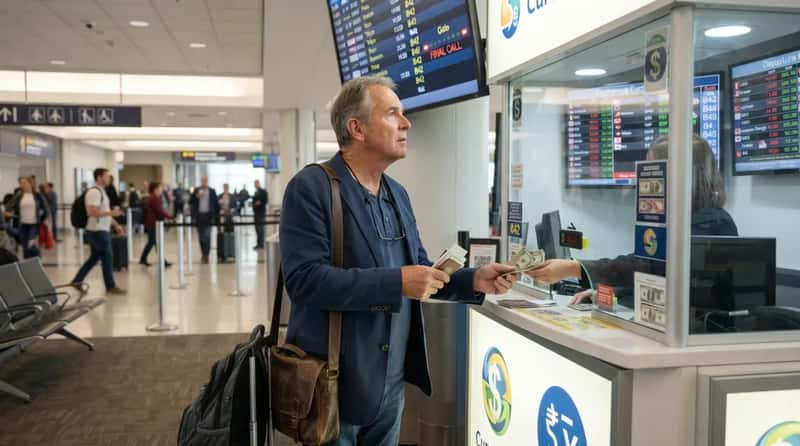
The priciest currency exchange of many trips happens minutes before boarding. Travelers often have weeks to prepare, yet end up scrambling at an airport kiosk with one eye on the departure board. That scramble has a price tag.
Airport kiosks typically offer exchange rates 5-10% worse than market rates, plus fees of $5-15 per transaction. On a $500 exchange, that can mean losing roughly $30-65 compared to better options. That’s what convenience costs when the clock is ticking.
But that’s nothing compared to what the sign hanging over the counter is really saying at #15…
#15 – Believing the “No Fees” Sign Means No Cost
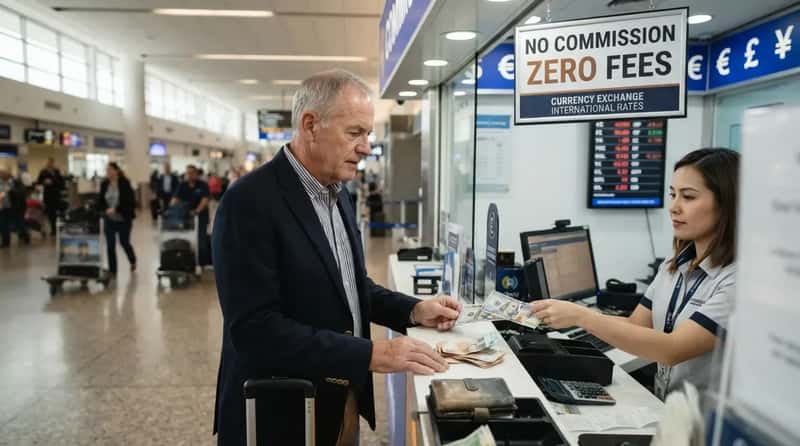
“Zero commission” is one of the most effective phrases in airport retail. It feels like a gift. But kiosks advertising “no fees” often make their profit on exchange rates marked up far above market prices. The fee didn’t vanish. It just moved into the rate.
Other booths add service charges or commissions on top of those already marked-up rates. Some counters effectively charge you twice. The friendly sign tells you what they’re not charging, never what they are.
Next comes a mistake that feels responsible, which is why it’s so costly, at #14…
#14 – Exchanging a Big Stack “Just in Case”
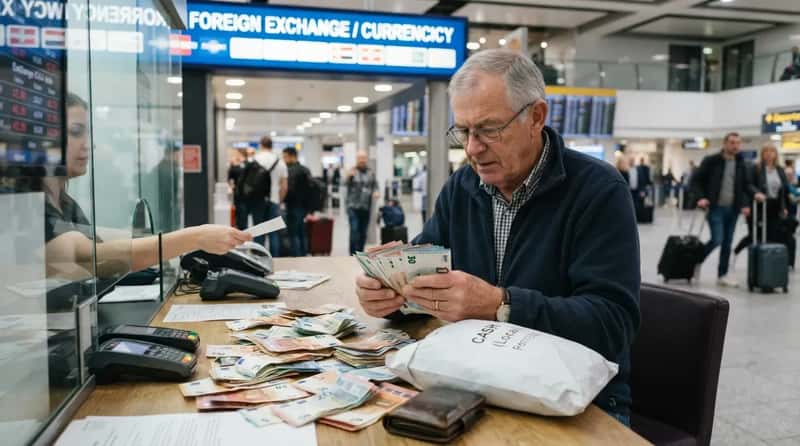
A thick envelope of foreign cash feels like good planning. It’s actually the most expensive way to feel safe. On $1,000, a 5 to 10% rate gap means an extra $50-100 out of your pocket.
Airport-focused guides suggest a much smaller approach: exchange only enough for basics like transport or a first meal. Anything beyond that is extra money paid at the worst rate you’ll see all trip. In many destinations, cards and ATMs now do the job that a bulging cash envelope used to do.
Quick Compare
- Airport kiosk: rates typically 5-10% worse than market, plus $5-15 per transaction.
- Bank counter: a markup that typically runs 2 to 3% over the interbank rate.
- Bank pre-order: typically two to three business days of notice for large orders.
- Digital multicurrency providers: described as staying within 1% of the market rate.
A big stack of bills also raises legal questions, which you’ll meet at #2 and #1. First, here’s what most people never check at #13…
#13 – Never Comparing the Booth to the “Real” Rate
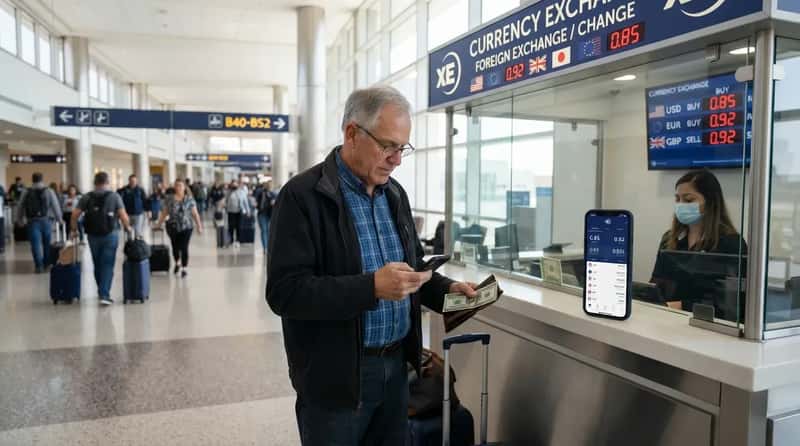
The number on the board means little without a yardstick. Airport services typically offer rates well below the mid-market rate, the real rate you can see on platforms like XE.com. Your phone can pull it up in seconds, even while you’re standing in line.
Here’s what the gap looks like. One example pairs a mid-market rate of 0.92 euros per dollar with an airport rate of 0.85, a difference of seven euro cents on every dollar. That small-looking decimal is the markup. Check it before you hand over a single bill.
And that sets up a bank-versus-bank surprise at #12…
#12 – Assuming Every Bank Offers the Same Rate
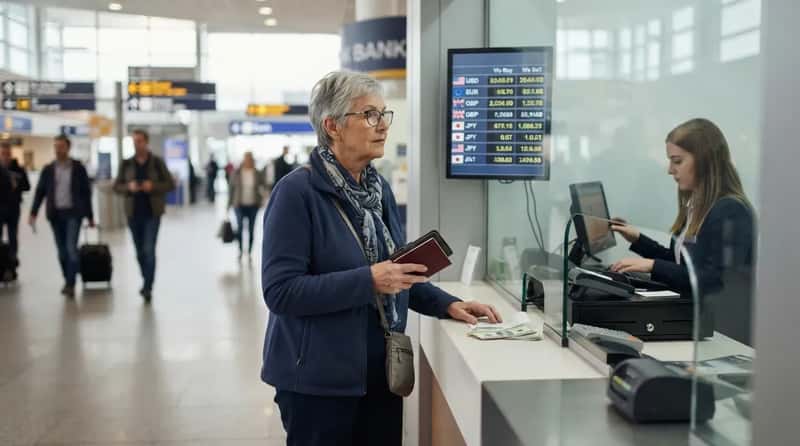
“The bank is always safer” is only half true. Rates can vary by up to 5 percent between banks, so your usual branch may not be the winner. Loyalty doesn’t always pay off at the currency counter.
The general pattern still holds. A bank’s rate typically includes a 2 to 3% markup over the interbank rate, while kiosk markups can run 8 to 10%. A bank beats the booth, but another bank may beat your bank.
Now for a hidden charge that makes small exchanges the worst deal of all at #11…
#11 – Forgetting the Flat Fee Hiding Behind the Rate
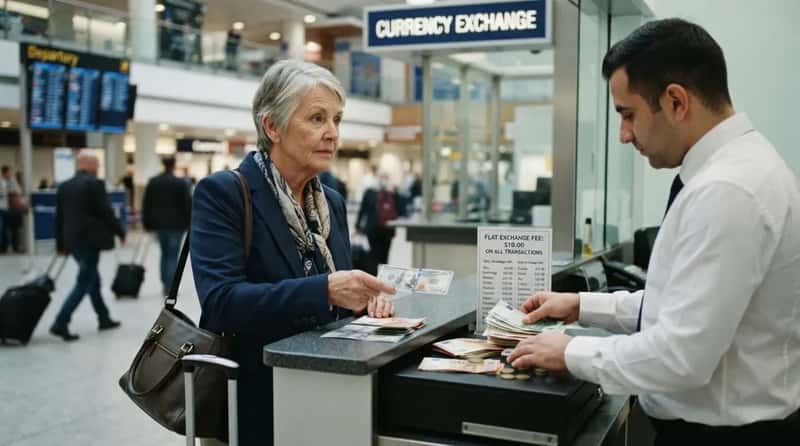
The rate isn’t the whole story. Airports typically charge an exchange fee of $5 to $15, depending on the amount. That fee lands on top of the markup, like a cover charge you didn’t see on the door.
Do the math on a small exchange. A $10 fee on a $100 exchange is a 10% cost before the rate even enters the picture. Extra fees are also sometimes disguised inside low exchange rates.
That’s why a quick “just $100 for a taxi” stop can be the worst deal at the counter. The smaller the amount, the harder a flat fee bites.
Worth Knowing
- A $10 flat fee on $100 equals a 10% cost.
- The same $10 fee on $500 shrinks to 2%.
- On $1,000, it’s just 1%, though the rate markup still applies.
- Small, repeated exchanges mean paying that fee again and again.
And the fix is simpler than most people think, at #10…
#10 – Skipping the Bank Pre-Order Everyone Forgets
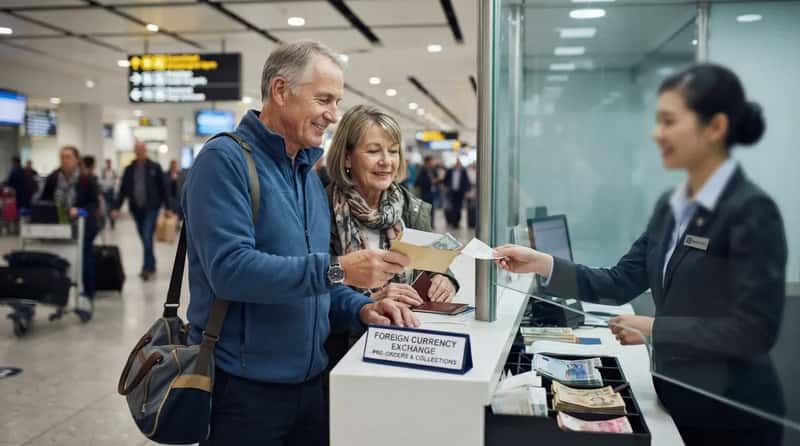
The cheapest cash is often arranged weeks before the airport. Bankrate suggests ordering currency from your bank before departure, so you land with local money already in hand. No kiosk, no countdown, no pressure.
The trade-off is planning. Major U.S. banks often want advance notice for large currency orders, typically two to three business days. That’s the entire price of skipping the kiosk. Some travelers see it as a hassle. Others see it as the cheapest ten minutes of trip prep they’ll ever do.
But the real money drain may be sitting in your wallet, at #9…
#9 – Swiping a Card That Adds 3% to Every Purchase
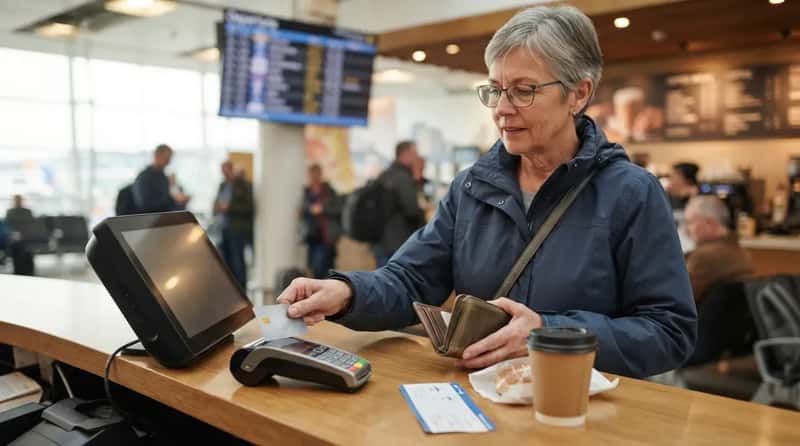
Your card may be charging a toll on every coffee abroad. Foreign transaction fees can run from 1 to 3 percent of each purchase made outside the U.S., and many people never see them itemized. They just show up as a slightly bigger bill.
Not every card does this. Capital One and Discover have zero foreign transaction fees across all their credit cards, and most top travel rewards cards skip the fee too. A trip with $3,000 in card spending at a 3% fee adds $90 in charges. That’s a nice dinner, gone.
Here’s where the card mistake gets even worse, at #8…
#8 – Pulling Cash on a Credit Card at a Foreign ATM
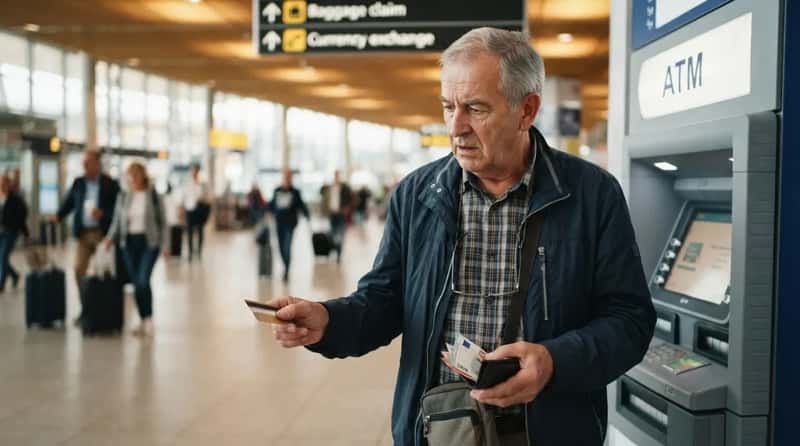
The same card that’s perfect for dinner is a bad choice at the cash machine. Even a no-foreign-fee credit card brings cash advance fees when you use it for withdrawals. The ATM treats it as a loan, not a purchase.
Cash advances can carry fees and interest, and the interest sometimes starts right away. There’s often no grace period on money pulled this way. Debit is usually the smarter tool for cash, as long as your bank doesn’t pile on fees of its own.
At a Glance
- Credit card at an ATM: treated as a cash advance, with fees and interest.
- Interest clock: it sometimes starts immediately, with no grace period.
- Debit card: usually the better cash tool, if your bank’s own fees are low.
- Dinner and shopping: that’s where a no-foreign-fee credit card shines.
The card isn’t the only thing the machine will try to upsell. Look closely at the screen at #7…
#7 – Saying Yes When the Terminal Offers to “Pay in Dollars”
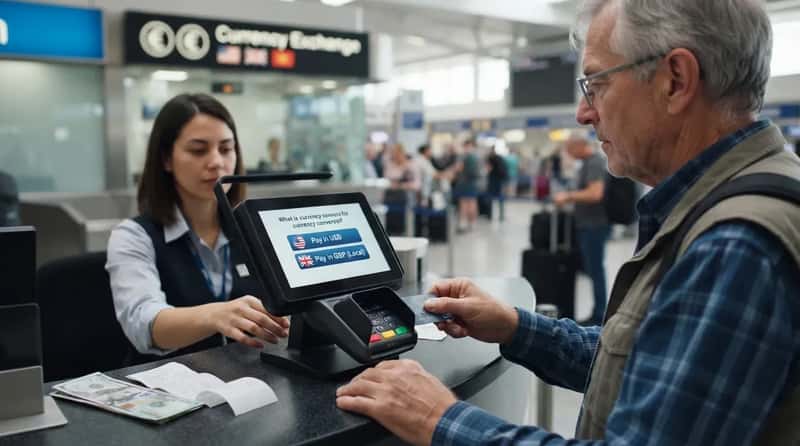
It sounds like a favor. The terminal asks if you’d like to pay in U.S. dollars, and it feels comforting to see a familiar number. That service is called dynamic currency conversion, and accepting it can mean a conversion fee of up to 7% above the going rate.
If you decline, the transaction is processed in local currency and your bank converts it. The “helpful” option is usually the pricier one. Ask the cashier to charge it in local currency before they run your card.
The same trap waits at the cash machine, at #6…
#6 – Accepting the ATM’s Own Conversion Offer
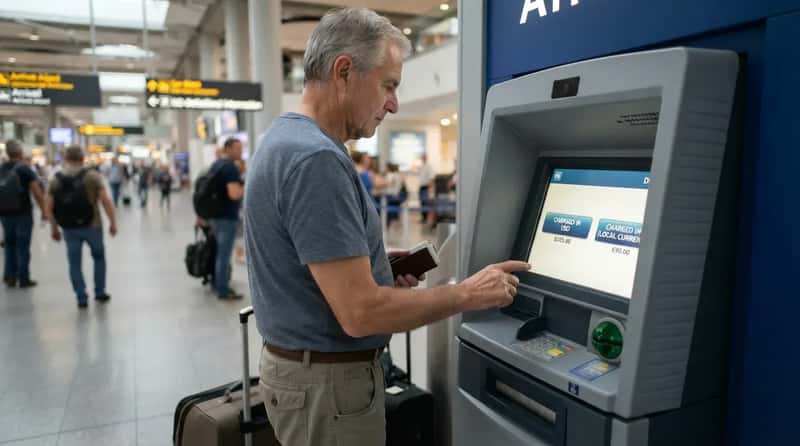
You’ve picked your amount. Then the screen asks whether you want to be charged in dollars or local currency. Dynamic currency conversion is sometimes offered at ATMs, and it’s the one to decline.
Pick the local currency. You then pay the actual conversion rate, with any terminal fee billed separately. The dollar option feels familiar, but familiarity is exactly what you pay extra for. It’s the same hidden-markup trick from #7, just delivered as cash.
And the fee stack on foreign withdrawals goes deeper than most people realize, at #5…
#5 – Not Realizing Your Bank Might Charge Twice at the ATM
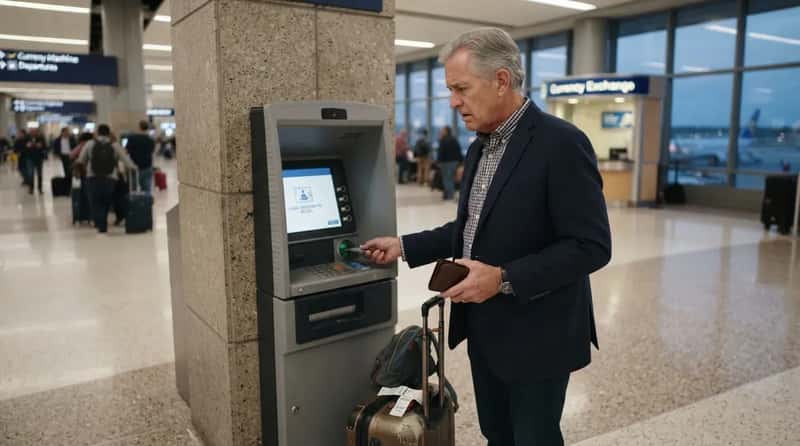
One withdrawal can trigger several charges at once. Major banks may charge $10 to $15 per foreign withdrawal, plus about 3 percent on the conversion. On $1,000, that can add up to roughly $45 or more in fees.
Some accounts avoid this. Bankrate points to Charles Schwab as one that refunds ATM fees worldwide. Yet many travelers never switch before they fly. Even then, a local ATM operator may still add its own fee at the machine.
But leftover money creates a different headache at the very end of the trip, at #4…
#4 – Sweeping Leftover Cash Back Across the Counter
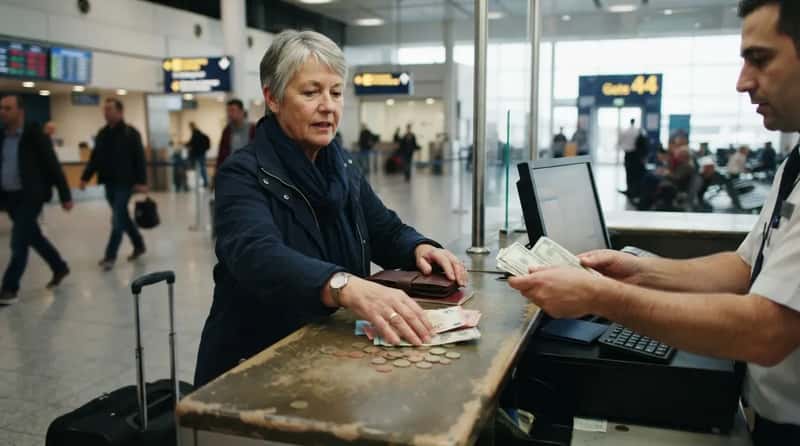
The last stop of many trips is the exchange booth again. Converting leftover foreign cash back to dollars means paying the booth’s spread a second time. You can lose money going in and lose it again coming out.
Coins add another wrinkle. Many exchange counters won’t take them, so they end up in a drawer at home as souvenirs. A smarter ending is to plan your last days to spend the cash down. A final meal and a few airport shop stops can burn through leftover bills.
Still, none of these can wreck a trip like the final three. Starting with the one that strands people, at #3…
#3 – Relying on One Card With No Backup Cash
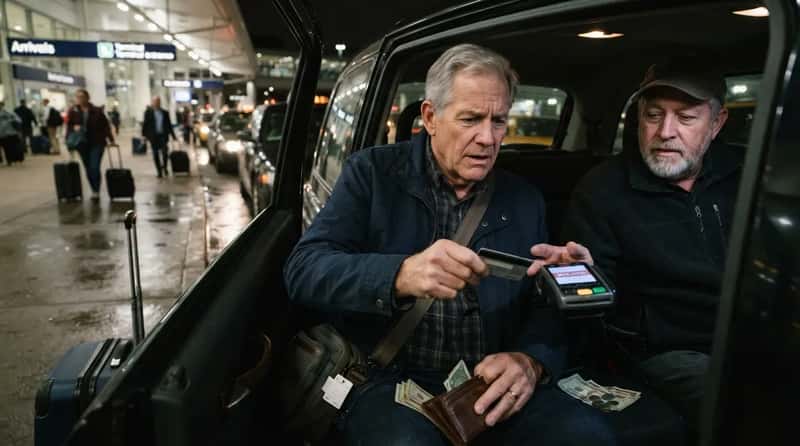
Picture a taxi line, a tired driver and a declined card. It happens more often than people admit. Cards get flagged, blocked or simply don’t work at a certain terminal.
That’s why some money guides suggest carrying a small cash cushion. Local cash also covers expenses if your debit or credit card stops working. The key word is “some,” not a thick envelope. Think of it as an emergency layer, not a spending plan.
Now the law enters the story, at #2…
#2 – Splitting Cash Between Spouses to Stay Under the Limit
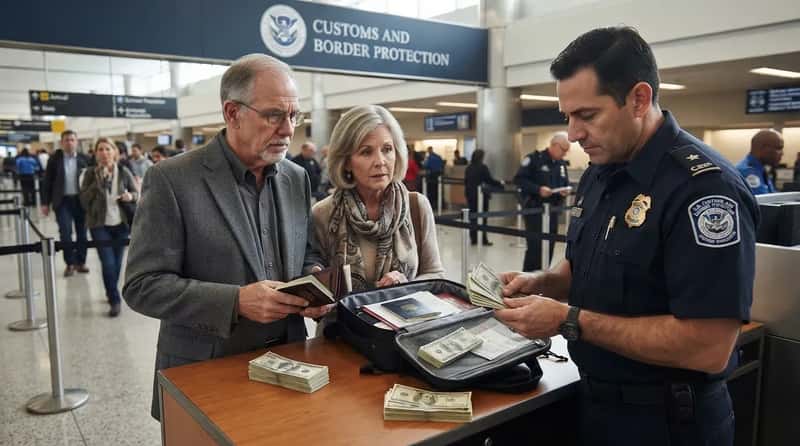
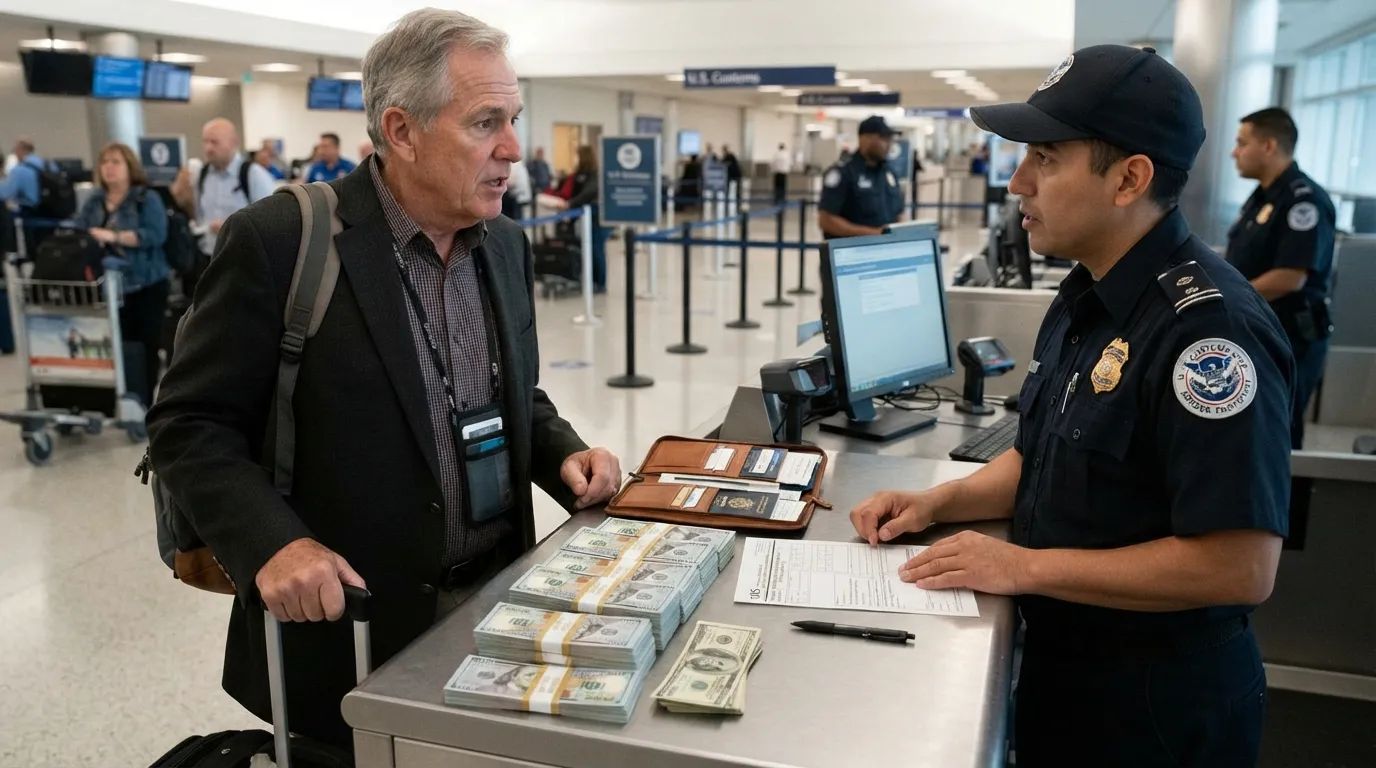
It sounds like a clever workaround. If one person carries $6,000 and the other carries $6,000, nobody’s over $10,000. Customs doesn’t see it that way. Splitting cash among companions doesn’t exempt anyone, and CBP considers the group’s total.
It can also look worse than a simple mistake. CBP can treat divided cash as an attempt to dodge the reporting requirement. A couple’s honest packing choice can end up looking like structuring, and that makes it a serious problem.
And the biggest consequence on this list comes last, at #1…
#1 – Carrying Over $10,000 Without Filing the Form
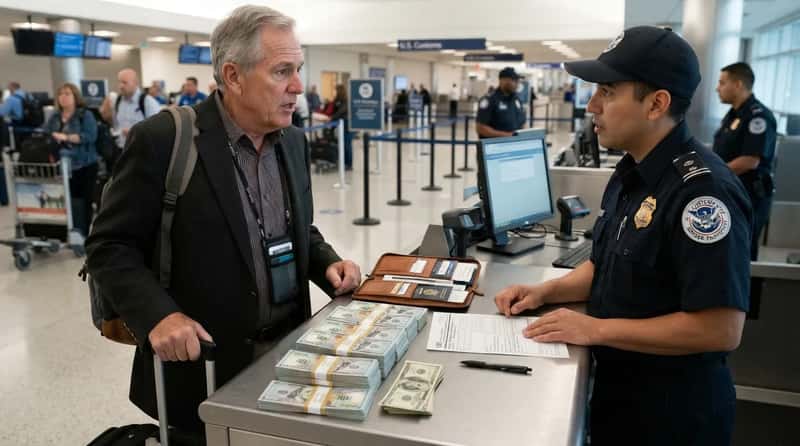
Carrying cash isn’t illegal. Transporting currency, regardless of the amount, is legal. The mistake is skipping the paperwork. If you bring in or take out more than $10,000, you must file FinCEN 105 with U.S. Customs and Border Protection.
Failing to file, even unintentionally, can let CBP seize some or all of the money on the spot. Travelers also risk missing their flight or facing potential criminal prosecution. The rule applies equally to people entering and leaving the country.
Monetary instruments count too, including traveler’s checks and bearer-form instruments such as cashier’s checks. Travelers can get a head start with the guided online FinCEN 105 form on CBP’s website. One form can protect every dollar.
Fast Facts
- The trigger: more than $10,000 in currency or monetary instruments.
- The form: FinCEN 105, filed with U.S. Customs and Border Protection.
- The direction: it applies whether you’re entering or leaving the country.
- The group rule: splitting cash among companions doesn’t exempt anyone.
- The risk: seizure of some or all of the money if you fail to file.
None of this is about being careless. These are habits built when travel money worked differently, and the booths, fees and prompts have learned to profit from them. The costliest slip isn’t a fee at all, it’s a form left unfiled.
Order cash ahead, use the right cards, pay in local currency and file when required. The best exchange rate of the whole trip is usually the one you arranged before anyone was waiting in line behind you.