
Most people assume cruise ships are built for young families chasing waterslides and late-night parties. Walk the crew corridors after hours, though, and you’ll hear a completely different story.
The guests who consistently make crew members’ jobs easier – and get treated best in return – are usually well over 60. Not because the ship caters to them, but because decades of life experience turns out to be the best training anyone could have for a week at sea.
Crew members rarely say this to a passenger’s face. But cabin stewards, dining room waiters, and guest services managers all describe the exact same pattern once you ask them privately.
Here’s what they actually say about this age group when no one is recording – and the last few reasons are the ones they bring up first, unprompted.
#17 – Keeping a Predictable Daily Routine

Younger passengers bounce unpredictably between the pool, the casino, and late-night shows, which makes scheduling a logistical headache for cabin staff trying to plan their hours.
Passengers over 60 tend to settle into a rhythm within the first day or two – breakfast at the same time, an afternoon rest, dinner at a consistent hour.
That predictability is quietly golden for stewards. A guest who follows the same routine every afternoon becomes the easiest cabin on the whole hallway to manage – a small courtesy that buys faster service and fewer interruptions all week.
It sounds like a small thing. But on a ship managing thousands of cabins simultaneously, routine is a form of quiet generosity toward the crew.
But predictable routines are just the beginning of what separates this age group from the rest. What comes next is where it gets really interesting.
#16 – Reading the Printed Daily Programme

Every cruise ship distributes a daily newsletter listing the day’s events, show times, and dining reservations – and most passengers under 50 barely glance at it.
Passengers over 60, raised on printed schedules and physical itineraries, tend to read it cover to cover. They arrive at events on time, book excursions before slots fill up, and don’t crowd the guest services desk demanding answers already printed in their hands.
Staff at information desks notice this immediately. The most common question crew fields from younger travelers – “What time does the show start?” – is one older passengers almost never ask, because they already know.
It keeps the guest services line shorter, the entertainment team less frazzled, and the whole operation running more smoothly.
That habit of preparation bleeds into something even more revealing – how passengers over 60 actually handle their money onboard.
#15 – Tipping With Intention, Not Just Automation
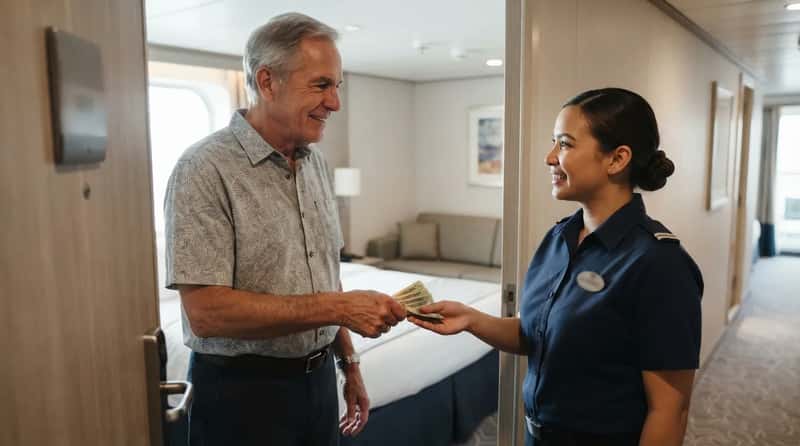
Modern cruising has made gratuities almost invisible. An automatic daily charge handles the basics, and most travelers under 40 never think about it beyond that.
Passengers over 60 grew up in a tipping culture where you looked someone in the eye, said thank you, and made sure they knew the cash was for them specifically. Many still carry cash just for that purpose and hand it over personally – something stewards notice instantly because it’s genuinely rare now.
Beyond the money itself, it’s the acknowledgment that lands. Seniors who learn names, say thank you, and give clear but polite feedback are the ones staff go the extra mile for – finding a lost item, squeezing them into a full show, or arranging help on disembarkation day.
The tip is almost beside the point. The recognition is what crew actually remember.
Fast Facts
- Most mainstream lines automatically add a daily gratuity, commonly landing between $16 and $20 per person, per day for standard cabins.
- Suite guests usually pay a higher rate, since they typically receive more individual attention from staff.
- Gratuities can usually be prepaid before sailing to lock in the rate, or adjusted at Guest Services once onboard.
- Bar, spa, and specialty dining purchases often carry a separate 18-20% charge on top of the daily gratuity.
But the way older passengers handle money is nothing compared to how they handle the crew themselves. Number 14 is where the real edge shows up.
#14 – Asking Crew Members for Advice Like They’re the Expert

Most travelers under 50 pull out their phones when they want to know what to do at the next port. Reviews, apps, YouTube vlogs – the algorithm decides the itinerary.
Passengers over 60 are far more likely to pull a crew member aside and ask what’s actually worth doing. Cabin stewards are a genuinely great resource for this, and it’s a question that rarely comes from younger travelers glued to review apps.
Stewards say it’s flattering to be treated like a trusted insider rather than just staff, and they tend to remember exactly which guests asked. That single question – “What would you do if it were your day off here?” – opens doors no app can unlock.
That instinct to treat crew as people rather than service equipment shapes everything else on this list. See number 13.
#13 – Complaining Quietly Instead of Escalating Loudly
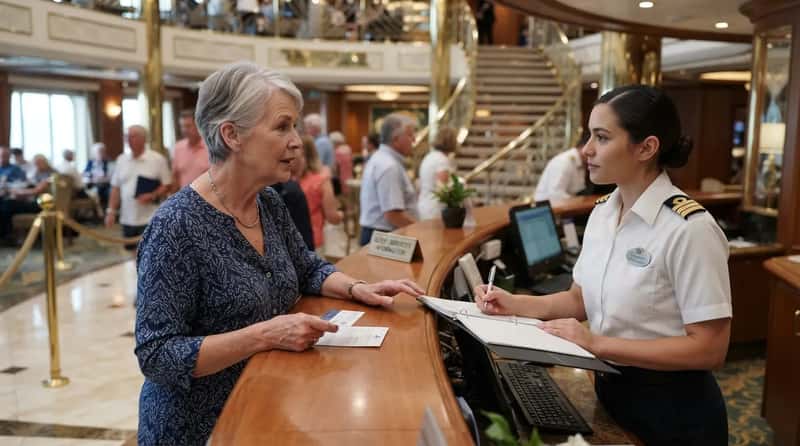
Every ship has a handful of passengers who treat every minor inconvenience like a five-alarm emergency: the wrong pillow configuration, a slightly too-warm cabin, a show that started two minutes late.
Passengers over 60, in general, are not those people. When something goes wrong, they’re far more likely to mention it once, calmly, to the right person – and wait for a fix rather than demanding an immediate scene.
Crew see thousands of faces each sailing, but they remember patterns – kindness, patience, rudeness, flexibility – especially from older guests they interact with daily. The passenger who complained once and waited patiently gets remembered far more warmly than the one who escalated to management.
Crew will go quietly out of their way for the first type. For the second type, they do the minimum required and nothing more.
But handling conflict well is only part of the story. How passengers over 60 navigate the social side of the ship is something crew bring up time and again.
#12 – Learning Crew Names and Using Them

On a megaship, it is entirely possible to spend seven nights treating every crew member as an interchangeable, nameless part of the machinery. Many passengers do exactly that.
Passengers over 60 are significantly more likely to read the name badge, use the name, and remember it the next time. One older couple on Cruise Critic shared how crew members kept checking in on them throughout the week, saying it felt like the crew already knew them and they never had to ask for anything.
When a crew member feels seen as a person, they do more – not because of policy, but because of human nature. Stewards often quietly prioritize the guests most likely to mention them by name later, a quiet, mutual arrangement most passengers never realize exists.
The guests getting the best treatment on any given sailing are almost always the ones who know their steward’s first name by day two.
That warmth extends to something even more practical – how over-60 passengers handle the dining room. Staff notice this one in the very first meal.
#11 – Arriving to Dinner at a Reasonable Time
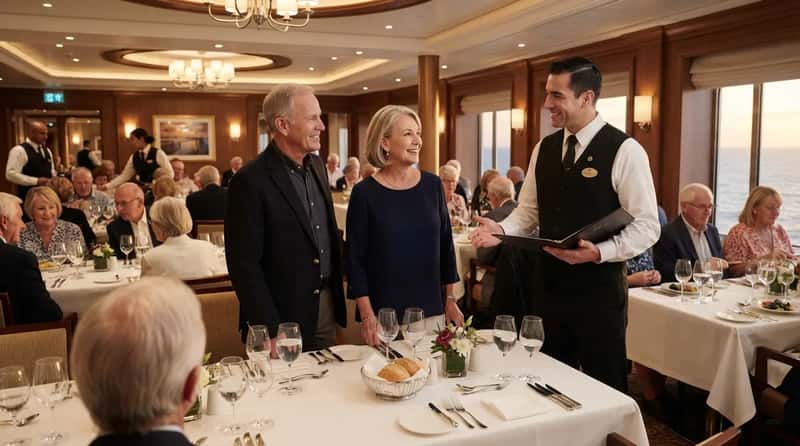
Every dining room manager knows the pattern: the hour before service ends fills up with latecomers who expect full kitchen effort for a shortened window, then complain when the kitchen is winding down.
Passengers over 60 almost universally eat earlier. They arrive when the dining room has full capacity, fresh energy, and kitchen staff who aren’t exhausted from six hours of service, and they leave before the rush.
Dining staff consistently notice when older passengers make quiet, patient requests and treat the crew like people rather than service equipment – and they respond to it. That combination of good timing and respectful interaction earns a different caliber of service.
The best meal on any ship doesn’t go to the loudest table. It goes to the early table that knows the assistant waiter’s name.
The dining room pattern is interesting. But what older passengers do at the buffet – the most chaotic space on any ship – is something staff talk about even more.
#10 – Navigating the Buffet Without Creating Chaos
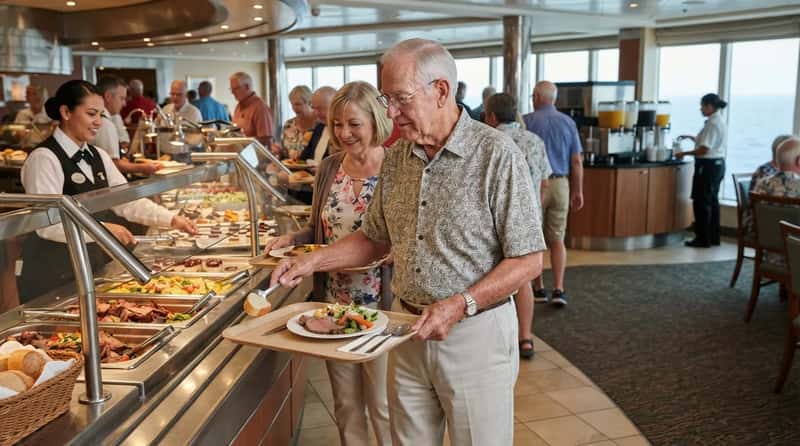
The cruise buffet is a social experiment in human patience, and it does not always go well. Passengers stacking plates at the serving stations, hovering over dishes before the previous person has moved, cutting across lines – it’s a daily reality on most ships.
Passengers over 60 tend to approach the buffet the way they approach most things: with a clear plan, in their own time, and without treating it as a competition. They eat at off-peak hours and move through the line without stopping to debate every option in place.
Crew are often trained to treat older guests the way they’d treat their own relatives, a mindset that shows up in small, unmistakable ways – a warmer greeting, a little extra patience. But that warmth flows both directions: buffet staff say the guests who treat the station like a conversation rather than a transaction are the ones who quietly get the best of what’s available.
On a busy sea day, being the calm passenger at the buffet is genuinely rare. Staff notice.
Quick Compare
- Peak-hour rush: stacking plates fast, hovering over dishes, cutting across lines.
- Off-peak calm: arriving after the rush, moving through with a plan, treating the line like a conversation.
- Result for staff: less congestion to manage, less mediation needed, more room to actually help.
That calmness under crowded conditions is a consistent thread. But it shows up most dramatically in number 9, which is where most passengers completely fall apart.
#9 – Handling Tender Port Delays Without Melting Down

Tender ports – where the ship anchors offshore and passengers take small boats to the dock – are a reliable source of frustration. Waiting in numbered groups, sitting in a lounge for your call, watching the line move at the pace of the sea genuinely tests people.
Passengers over 60 handle this better than almost any other demographic on board. They’ve lived through enough queues, weather delays, and plan changes to know that this one will also eventually resolve.
Passengers in their 60s sometimes quietly get moved up the tender queue – with no priority status and no suite, just friendly crew helping well-traveled guests who’ve been warm and patient all week. Nobody announces the system out loud, but veteran cruisers know exactly what it means when it happens.
The irony: the passengers most likely to get bumped forward in the tender line are the ones who were fine waiting.
If patience under pressure is surprising, wait until you see how passengers over 60 handle the thing most travelers get completely wrong: shore excursions.
#8 – Matching the Excursion to Their Actual Energy Level

Every ship’s shore excursion desk has seen it: passengers who book a four-hour hiking tour, realize halfway through that their knees won’t cooperate, and blame the cruise line. It’s one of the most predictable causes of both injury and complaint.
Passengers over 60 are, on the whole, far more honest with themselves about what their body can handle on a given day. They read the physical demand rating, ask questions before booking, and choose the scenic coach tour when the alternative is a six-mile coastal trail.
For seniors, shore excursions can be a highlight of the whole cruise, offering a chance to explore new ports and cultures at a relaxed pace. That intentional, realistic approach means fewer medical calls, fewer people left behind at the pier, and fewer complaints when the experience matches the expectation.
Excursion staff privately say the group that gives them the least trouble is almost always the group with the oldest average age.
Worth Knowing
- Cruise lines typically rate excursions by physical demand, using labels like “Easy,” “Moderate,” “Strenuous,” or “Extreme.”
- There’s no industry-wide standard, so a “moderate” tour on one line can be labeled “difficult” on another.
- Most booking platforms let travelers filter tours by fitness level before committing to a time slot.
- Cancelling too close to the port day can cost 50 to 100 percent of the tour price, which makes matching ability to activity level early both safer and cheaper.
The self-awareness about physical limits extends beyond excursions. It shapes how passengers over 60 handle one of the most underestimated challenges on any ship.
#7 – Pacing Themselves at Sea and Not Burning Out by Day Three

There is a recognizable pattern on any seven-night cruise: a segment of passengers goes full throttle for the first three days – every activity, every late show, every sail-away party – and by mid-cruise they’re shuffling to the buffet looking exhausted.
Passengers over 60 tend to pace differently. They rest when the ship is at sea, skip the events that don’t interest them without feeling like they’re wasting the experience, and arrive at the end of the week in better shape than they started – which is not the norm.
Cruising is one of the most popular ways for older adults to explore the world comfortably, removing much of the logistical stress of travel and allowing multiple destinations without constant rushed itineraries. Over-60 passengers seem to genuinely grasp that pacing is what makes that possible.
By day five, the crew can tell exactly who has paced well and who hasn’t. The well-paced passengers are far easier and more pleasant to serve.
Pacing is something you learn over decades. So is the thing that comes next – something crew notice within hours of boarding.
#6 – Treating the Safety Muster Drill With Genuine Seriousness
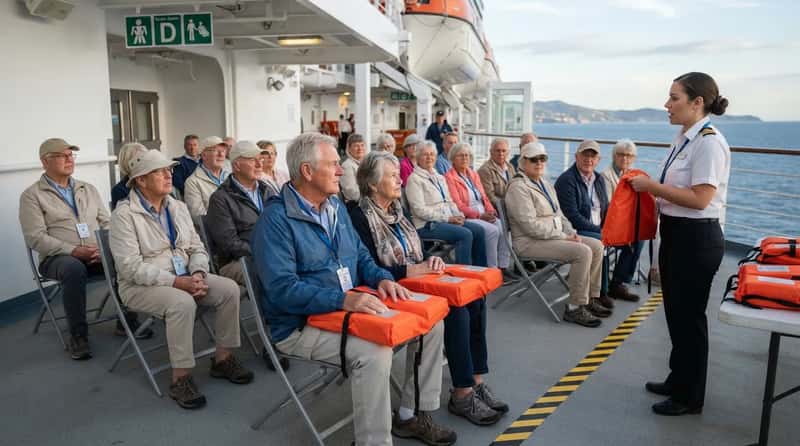
The muster drill is mandatory by international maritime law, and the industry has worked hard to make it less painful – most lines now allow passengers to complete it digitally or in small groups rather than standing on deck in the heat for forty-five minutes.
Despite that, a subset of passengers still treats the safety briefing as background noise – half-listening, chatting through it, or completing it as fast as possible just to tick the box.
Passengers over 60 are noticeably more attentive. They’ve lived through enough news cycles – ferry disasters, ship groundings, headline emergencies at sea – to know that muster information isn’t theatrical, and a ship’s entire departure can hinge on full compliance.
Staff who run the drill say older passengers are the ones who actually watch, ask questions, and locate their muster station without being guided twice. That is not as common as it sounds.
Seriousness about safety is one thing. But number 5 is what cruise staff almost unanimously say separates the over-60 group from every other demographic on board.
#5 – Communicating Dietary and Medical Needs Clearly Before They Become Problems

Every cruise line offers dietary accommodation – low sodium, gluten-free, diabetic-friendly – but only if passengers actually communicate those needs in advance and repeat them clearly at each venue.
Younger passengers tend to either not mention their restrictions until food is in front of them, or expect the system to already know. Passengers over 60, who have often managed a specific diet for years, communicate it up front, confirm it with each waiter, and do so without making it a drama.
On a well-run ship, saying “low-sodium” or “diabetic-friendly” once should follow a passenger for the entire cruise. Older passengers make that system actually work by doing their part – being clear and consistent every single time.
Galley staff and head waiters consistently say this demographic causes the fewest mid-service surprises, which keeps kitchens running smoother and everyone eating better.
That clear, advance communication is a pattern that shows up in every corner of the ship. It’s at its most obvious in the way over-60 passengers handle something most people assume is purely administrative.
#4 – Reading and Respecting the Fine Print on Bookings

Every cruise generates paperwork – cancellation policies, shore excursion terms, spa booking windows, specialty dining deposit rules. Most passengers skim it, if they read it at all, then express genuine surprise when a policy they agreed to is actually enforced.
Passengers over 60, who grew up reading contracts and correspondence carefully before signing, tend to actually know what they booked. They understand what’s refundable, what isn’t, and what needs to be flagged before the ship sails rather than after.
A calm, patient approach seems to matter more than loyalty status or tipping. Passengers over 60 who ask politely, during quieter hours, tend to walk away with more than the brochure ever promised – but that outcome is only possible for passengers who understood the brochure in the first place.
Guest services managers say the over-60 demographic generates the fewest disputes over terms they agreed to at booking – a detail that makes the entire administrative side of a sailing run more smoothly.
Fine print literacy is underrated. But what comes next is something cruise staff describe as genuinely rare across all age groups, and it may be the most useful thing on this entire list.
#3 – Genuinely Engaging With the Destination, Not Just the Ship

There is a type of cruise passenger – and they exist at every age – who barely steps off the ship at each port. They return to the same buffet, the same pool chair, the same slot machine. The destination is essentially a backdrop.
Passengers over 60 are significantly more likely to actually go ashore with a plan. They’ve often researched the port in advance, know which sites they want to see, and return with something to say about where they were.
Some cruises offer themed trips built around art appreciation, culinary exploration, or wellness, making it easy for seniors to plan a trip that aligns with their interests. Passengers who show up to the port lecturer’s talk, take notes, and then actually use that context ashore are, by a wide margin, mostly over 60.
Crew members who narrate cultural talks or lead museum visits say the quality of the questions – and the genuine curiosity behind them – is highest from this group. Every time.
Authentic curiosity is rarer than most people think. But the final two items on this list are the ones cruise staff return to again and again – the things that make the over-60 passenger genuinely different from every other group sailing. Number 2 first.
#2 – Leaving the Cabin in a Reasonable State

Cabin stewards manage ten to twenty cabins per person per sailing. The condition those cabins are left in at turndown and disembarkation is a significant factor in how physically and mentally demanding the job actually is.
The variation in passenger behavior is enormous. Stewards describe cabins left in extraordinary states of disorder – towels everywhere, food brought from the buffet and left on surfaces, belongings scattered across every available space.
Passengers over 60 aren’t universally tidy, but as a group they tend to leave significantly less chaos for their steward to manage. They consolidate personal items, hang towels if they’re still using them, and prepare cabins reasonably for disembarkation day.
Stewards say they know within the first cabin visit which passengers are going to make the week easier and which are going to make it harder. Over-60 guests almost always land in the first category.
At a Glance
- A cluttered cabin can add real minutes to a steward’s daily rounds across a full corridor.
- A quick tidy-up before turndown gives a steward extra time to handle special requests instead of catch-up cleaning.
- Disembarkation morning is typically the most compressed workload of the entire cruise, with turnaround for the next sailing beginning within hours.
And now the one that cruise staff say is genuinely the most striking – the trait passengers over 60 display more consistently than any other age group, and the one that shapes every single interaction from embarkation to the last morning at sea.
#1 – Expressing Genuine, Specific Gratitude
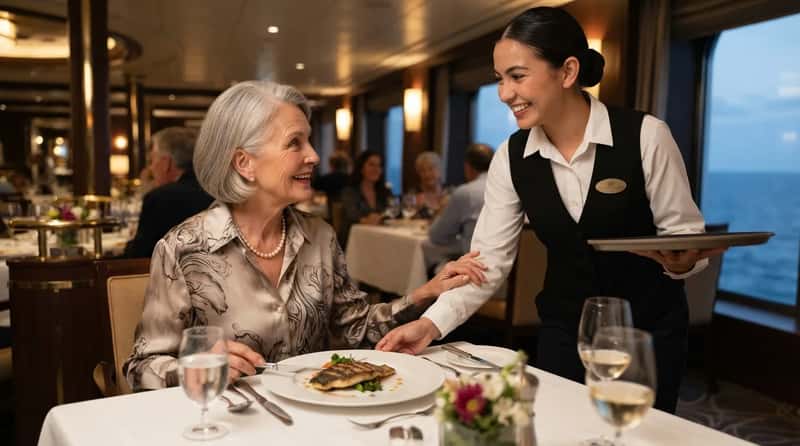
This is not about tips, loyalty points, or end-of-cruise comment cards – though older passengers handle all of those well too. This is about something simpler and far rarer: genuine, specific, in-the-moment acknowledgment directed at individual crew members for individual acts.
“That was the best fish I’ve had in years – thank you for the recommendation.” “You made this cabin feel like home – I mean that.” “The way you handled that tender situation was impressive.” These are the phrases crew members actually remember months later.
Passengers over 60 grew up in a culture that emphasized verbal acknowledgment of service – not as a performance, but as basic courtesy. It happens to the ones who showed up warm, made their requests with patience, and treated the crew like the skilled professionals they actually are.
When a crew member starts treating a guest like a beloved relative instead of a room number, that’s not a coincidence. And the catalyst, almost without exception, is a passenger over 60 who said something real and meant it.
The Bottom Line

Cruise staff aren’t handing out gold stars based on age. But the patterns are too consistent to ignore: passengers over 60 show up prepared, communicate clearly, move through the ship with genuine patience, and treat crew members like actual human beings.
That combination – preparation, patience, respect, and authentic gratitude – quietly earns better service, warmer relationships, and a more enjoyable sailing without a single upgrade request.
It turns out the most valuable thing you can bring on a cruise has nothing to do with loyalty status or cabin category. It’s everything you’ve already learned by the time you’re 60 – and the crew notice it before you’ve even unpacked.
#18 – The Bonus Tip Nobody Shares

Here’s the one move that beats everything else on this list combined: submit a written comment mid-cruise, not just at the end.
Most passengers only fill out feedback at disembarkation, when it’s too late for the crew who helped you to actually benefit during your own sailing. A mid-cruise note naming a specific crew member creates a real, timestamped record while you’re still onboard to enjoy the results.
- By day two or three, walk to the Guest Relations desk and ask to leave a written compliment on a specific crew member – use their full name and department.
- Be specific about what they did, not just that they were “great” – specific praise is what gets logged and forwarded to their supervisor.
- Ask the desk to confirm it’s been passed along that same day, not saved for an end-of-cruise batch.
- Follow up in person with a simple “I mentioned you to Guest Relations” – crew remember this instantly, and it often changes how the rest of your week is handled.
This works because most positive feedback arrives after the ship has already docked, when it can no longer shape the crew member’s treatment of you. A mid-cruise compliment does double duty: it helps their record, and it puts you on their radar for the remaining days of the sailing.
It costs nothing, takes five minutes, and is the single most underused tool available to any passenger, at any age.