Pull into a gas station today and you get a pump, a card reader and a screen trying to sell you a car wash. In the 1960s, the same stop came with a uniformed crew, a free windshield scrub and perks that sound like somebody made them up. Every item on this list was real, and almost all of it is gone.
The full-service pump is the part everyone remembers, but it was only the opening act. Some of these extras were pure charm. Others were quietly doing a very different job, and one of them helped decide whether a family made it home safely. Keep counting down, because #1 is the one that never makes the nostalgia posters.
#19 – A Uniformed Attendant Who Pumped It for You
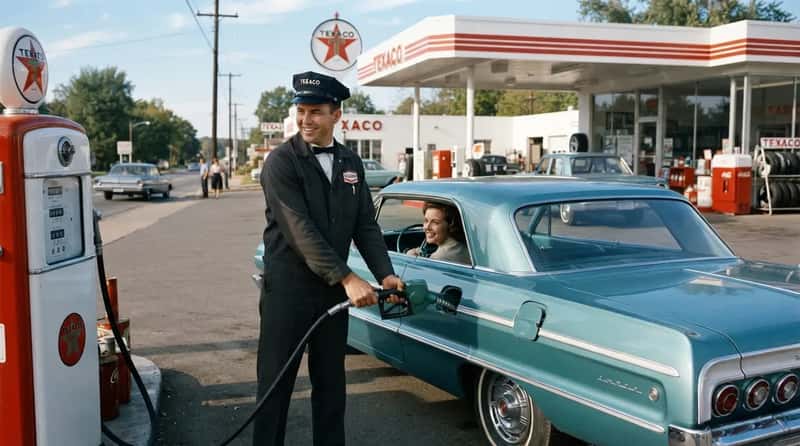
You never touched the nozzle. By the time your tires stopped rolling, someone in a cap, and sometimes a bow tie, was already walking toward your window. Texaco sold the idea with its famous line about trusting your car to “the man who wears the star.” Pumping your own gas would have felt like walking into the kitchen at a restaurant.
Self-service spread through the 1970s and slowly became the norm. Today New Jersey is the only state that still bans drivers from pumping their own gas, after Oregon loosened its rules in 2023. One state still lives in the 1960s every time you stop. And what the attendant did next at #18 happened before you could say a word…
#18 – A Free Windshield Scrub Nobody Asked For
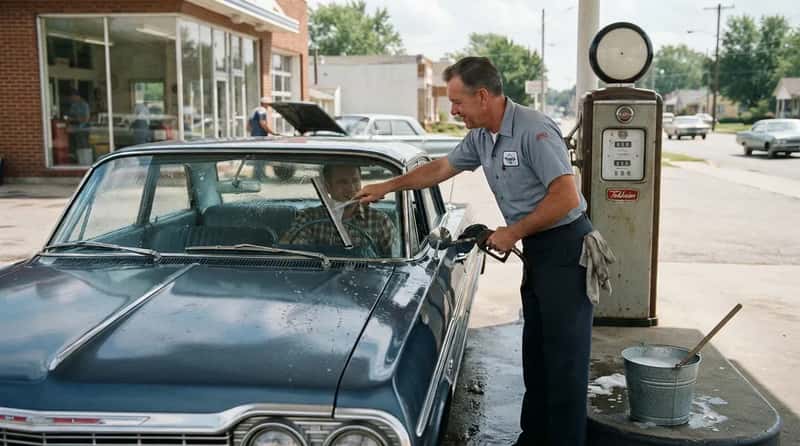
The squeegee came out on its own. Cleaning the glass was part of the fill-up, and drivers expected it the way you expect a receipt. A bucket of soapy water sat at every island, and a rag hung from the attendant’s back pocket.
It was also smart business. A clean windshield made you feel looked after, and a driver who felt looked after came back to the same pumps next week. The scrub cost the station a few cents of water and soap, and it bought a kind of loyalty money can’t easily buy now. Today you get a squeegee on a stick in a bucket of gray water, and plenty of dirty glass.
And the real checkup was still waiting under your hood at #17…
#17 – A Look Under the Hood Without Being Asked
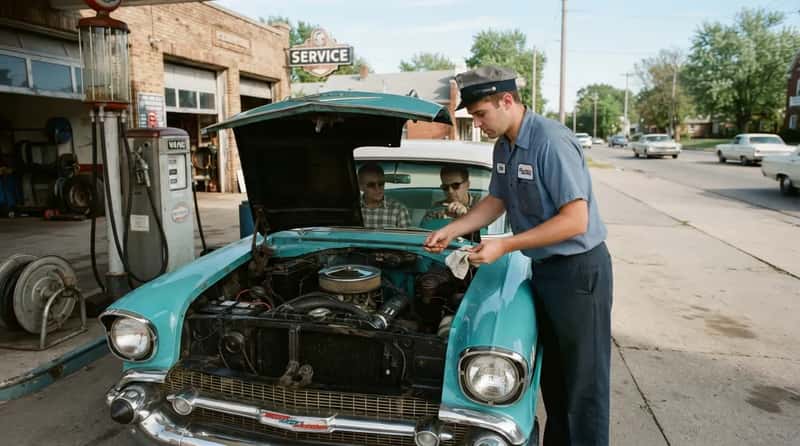
“Check your oil?” was practically part of the greeting. The attendant popped the hood, pulled the dipstick, wiped it and slid it back in. Then he peeked at the radiator and, on many cars, the battery. Cars of that era needed that kind of babysitting.
Batteries often needed their cells topped off with distilled water, and radiators needed regular checks. For some drivers, that quick look at the pump was the only maintenance the car got all month. Sealed batteries and dashboard warning lights have made the ritual unnecessary. Many drivers now go years without lifting the hood. But a freebie sat in a rack by the register at #16, and you probably still have one in a drawer…
#16 – Free Road Maps With the Company Logo on Front
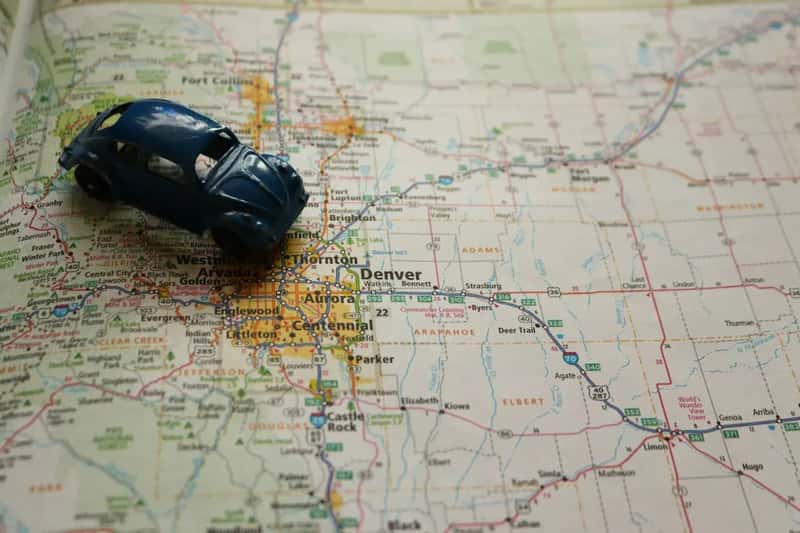
Before phones did the navigating, the glove box was stuffed with folded paper. Oil companies handed out road maps for free, with the brand’s logo front and center. Printers like Rand McNally and H.M. Gousha produced many of them for the big names.
The giveaway was cheap marketing. Every time you unfolded the map, you saw the name of the company that wanted your business. Free station maps faded in the 1970s, as rising costs and the oil crisis pushed companies to cut giveaways. Today old maps sell as collectibles, and plenty of younger drivers have never had to refold one. Wait until you see what people licked and pasted at #15…
#15 – Green Stamps That Turned Gasoline Into a Toaster
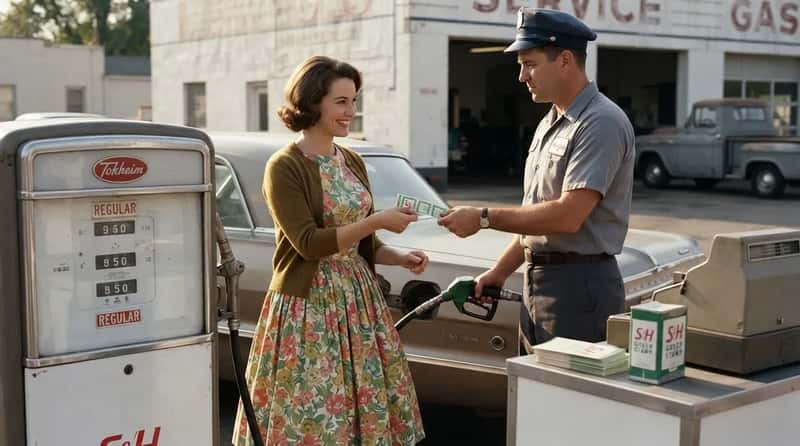
Fill up your tank and you might walk away with a little strip of stamps. S&H Green Stamps were handed out by many retailers, and gas stations were part of the story. Customers licked them, pasted them into booklets and traded full books for household goods.
It was a loyalty program decades before apps. At its peak in the 1960s, S&H was reported to issue more stamps than the U.S. Postal Service. Families saved books for months to get a lamp, a toaster or a set of dishes. Every gallon was a tiny deposit toward something real.
Fast Facts
- The company dates back to 1896, and the “S&H” stands for founders Sperry and Hutchinson.
- Stamps went into saver books, and filled books were swapped for merchandise.
- Grocery stores handed them out too, so gas stations were one stop in a bigger stamp economy.
- The 1960s were the program’s heyday, when stamp books were a common sight in American kitchens.
But one furry promotion hit even harder at #14…
#14 – A Tiger Tail Hanging Off Your Gas Cap
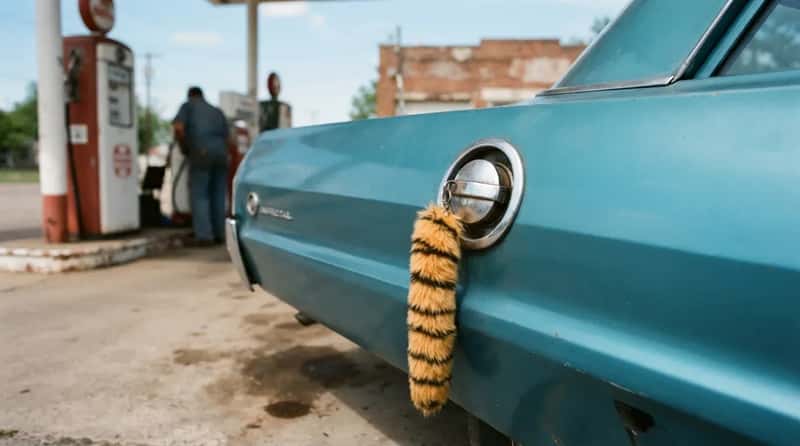
Esso’s “Put a Tiger in Your Tank” campaign went big in the U.S. in 1964, and a fuzzy tiger tail on the gas cap became the symbol. Drivers really did hang them off their cars. The slogan promised power, and the cartoon tiger made it stick.
It was one of the most famous ad hooks of the decade. A slogan about a tiger worked so well that people wore it on their cars like a flag. Today nobody wants a fur tail dangling off a fuel door. Back then, it said you were in on the joke. And a green giant was waiting at #13…
#13 – A Giant Green Dinosaur That Kids Begged to Visit
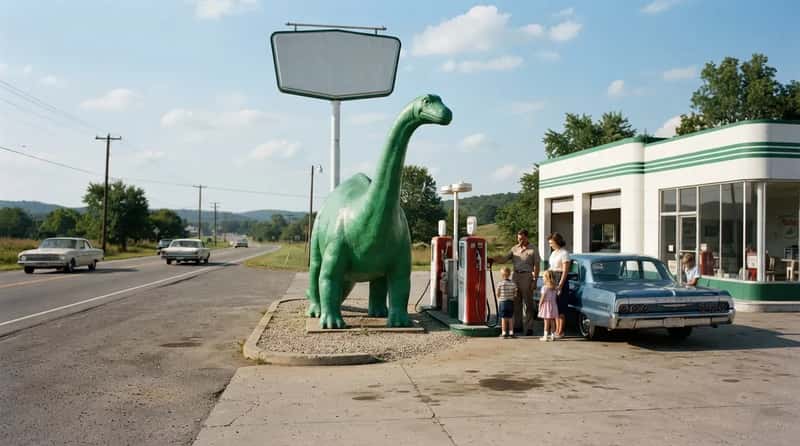
Sinclair stations had a big green dinosaur on the sign, and kids begged to stop there. The brand had used its Brontosaurus logo since 1930 and kept leaning into it. At the 1964-65 New York World’s Fair, Sinclair’s “Dinoland” put life-size dinosaurs in front of huge crowds.
The company also gave away and sold dinosaur souvenirs. A gas company turned a prehistoric animal into the reason children wanted the family to fill up there. It’s hard to imagine a modern chain getting a kid to demand a particular pump. Sometimes the ad was the destination. But the sound at #12 told the station you had arrived…
#12 – The Ding That Announced You Were There
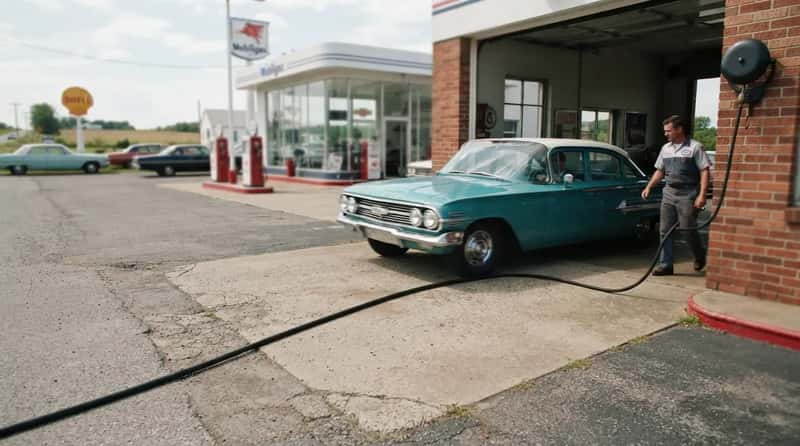
Roll over a thin black hose across the driveway and a bell rang inside the station. Nobody had to be watching the lot. Your tires set it off, and an attendant came out to meet you.
It was a simple, clever alarm. Your own tires were ringing the doorbell for service. Today you do the walking, the swiping and the waiting, with no bell in sight. That ding meant someone knew you were there. And the next freebie, at #11, is one drivers now pay for…
#11 – Free Air and Water, No Quarters Needed
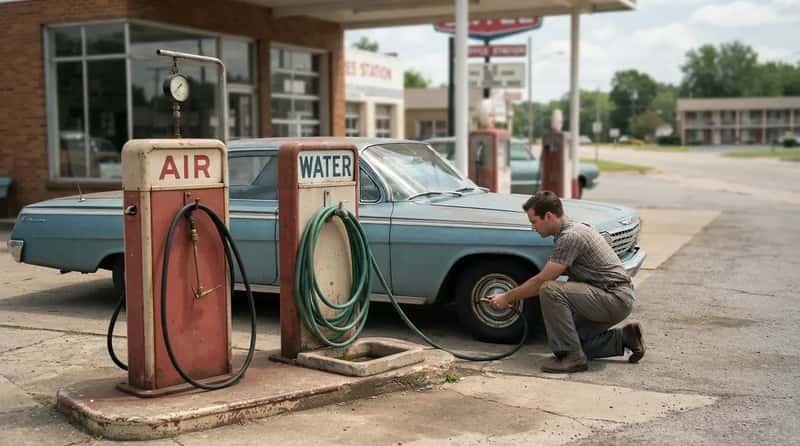
Low tire? Pull up to the air hose. It was free, and so was a splash of water for the radiator. Nobody dug through the console for coins just to fill a tire.
That now sounds like a fantasy. Plenty of stations today charge for air, and drivers swear the machine never works when they need it. Free air once told customers the station wanted them to stay safe and come back. Now it’s often a meter with a timer. The restroom at #10 came with its own strange ritual…
#10 – A Restroom Key Chained to a Giant Hubcap
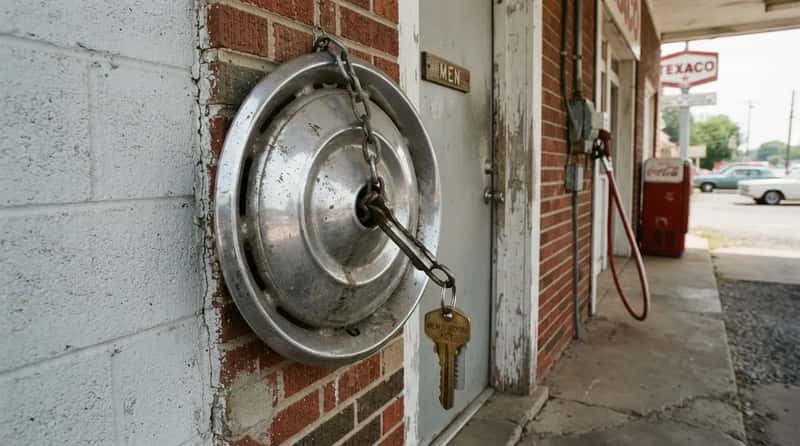
You had to ask for the restroom key, and it usually came attached to something huge. A wrench, a hubcap or a block of wood kept it from walking off. Many restrooms sat around the side of the building, locked until you asked.
It was a quirky security system that worked because nobody wanted to carry a hubcap to the car. The oversized key was the original anti-theft device for a bathroom. Today many restrooms are inside a convenience store, sometimes for paying customers only. The giant keychain was funny, and it was also practical. But the next item is the one younger drivers can’t picture at #9…
#9 – A Phone Booth Waiting Beside the Air Pump
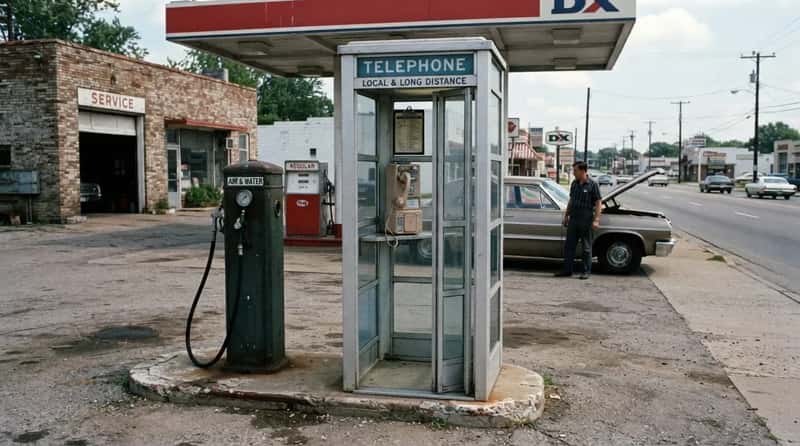
When your car died, the station phone booth was your lifeline. A local call from a pay phone cost a dime in many places, and the booth sat steps from the lot. You could call a tow truck or a relative without waiting for a stranger to stop.
The phone was part of the station’s role as a roadside safety net. Nobody could text a friend; you had to find a booth with a working dial. Pay phones are now rare, and most drivers rely on a cell signal.
Quick Compare
- 1960s breakdown: Walk to the booth, drop in a dime and dial a tow truck or a relative.
- Today’s breakdown: Pull out a phone, share your location and wait on a roadside app or a call.
- The catch: The old way worked without a signal. The new way doesn’t.
When you had no signal, the station still had a phone. Credit worked very differently at #8…
#8 – A Credit Card That Only Worked at One Brand
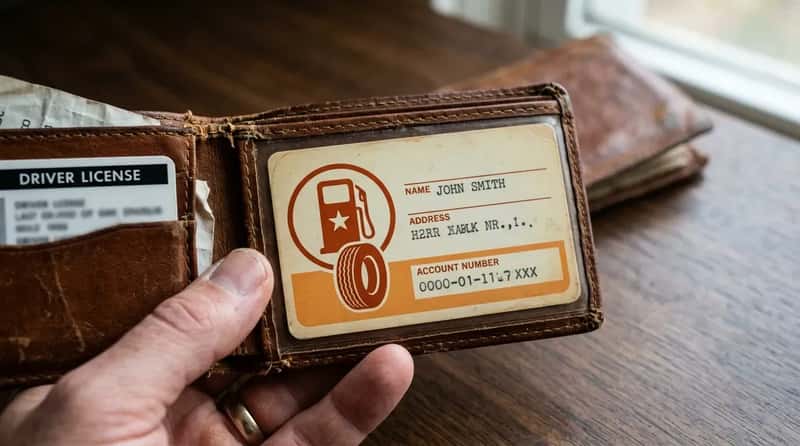
Many drivers carried a card issued by an oil company, not a bank. Gulf and other brands had offered credit to drivers for decades, and the cards were common by the 1960s. They were good at that brand’s pumps and often at its repair shops.
This was years before general-purpose bank cards became everyday money. The card in your wallet could belong to a gas company, and it only worked under that company’s sign. Today a single card works at almost every pump in the country. The oil-brand card was the original loyalty lock-in. And then came a cold drink at #7…
#7 – An Ice-Cold Glass Bottle of Soda From the Machine by the Door
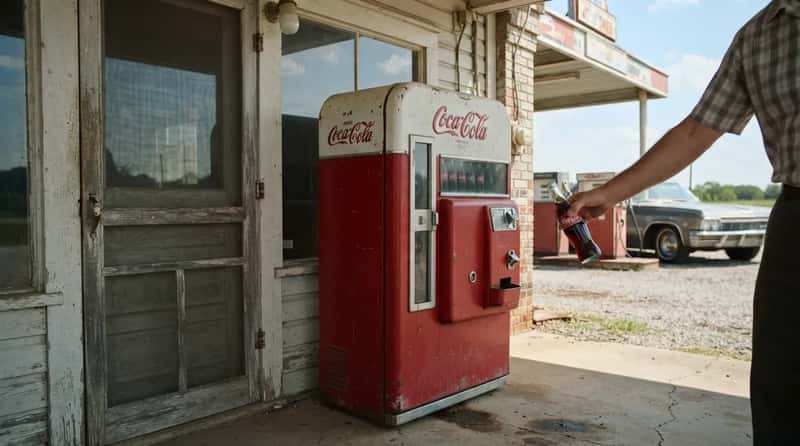
A cold bottle of Coke from a machine by the door was a classic stop. You dropped in a dime, slid the bottle out of a metal rack and popped the cap on the side opener. The drink came in glass, and the empty went back.
It felt like a small reward for a boring chore. Those machines held each bottle in place until you paid and pulled it free. Today you grab a plastic bottle from a cooler with 40 options. Old machines now sell as vintage decor. But one rental at #6 would shock a modern driver…
#6 – A Trailer You Could Rent Right Where You Fueled Up
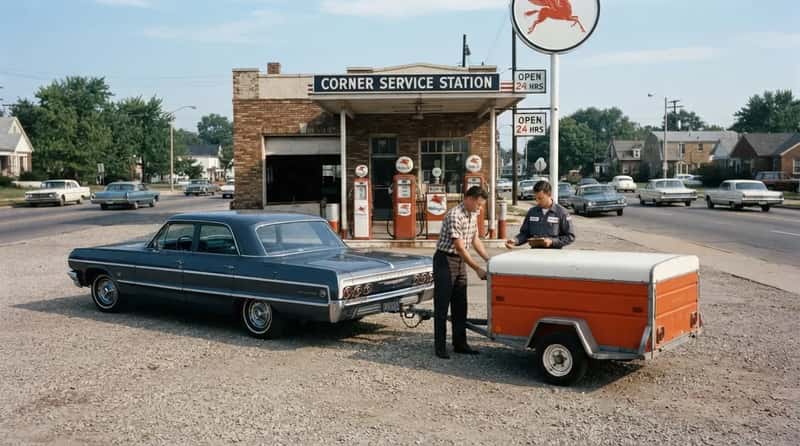
Need to move a couch? The gas station may have had a trailer out back. U-Haul, founded in 1945, built its early network by signing up independent dealers, and gas stations were natural fits. They had land, traffic and customers who already stopped there.
That is why you still see rental trucks parked at some stations. The corner station was once where a family sedan became a moving day rig. Today most rentals are booked online. The station was the original app for moving. And the biggest hidden business was inside the bay at #5…
#5 – A Real Mechanic Working Behind the Pumps
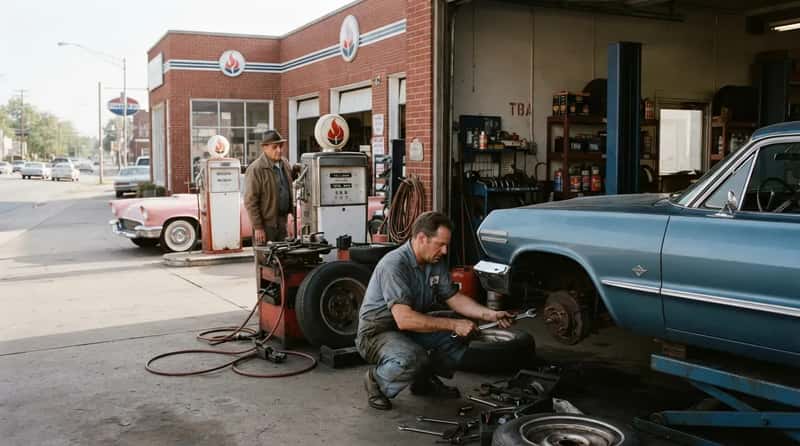
“Service station” meant exactly that. Many stations had repair bays, a lift and a mechanic ready to change a tire or grease a car. You could drop off your car for a lube job, buy a battery or have a flat patched on the spot.
The industry even had shorthand for the add-on products: TBA, for tires, batteries and accessories. For many stations, the repair bay mattered as much as the gasoline. Today most stations are convenience stores that sell snacks and fuel, and the mechanic is somewhere else. The garage was once the heart of the place. But the most human service of all was a free one at #4…
#4 – Directions From a Human GPS in a Work Shirt
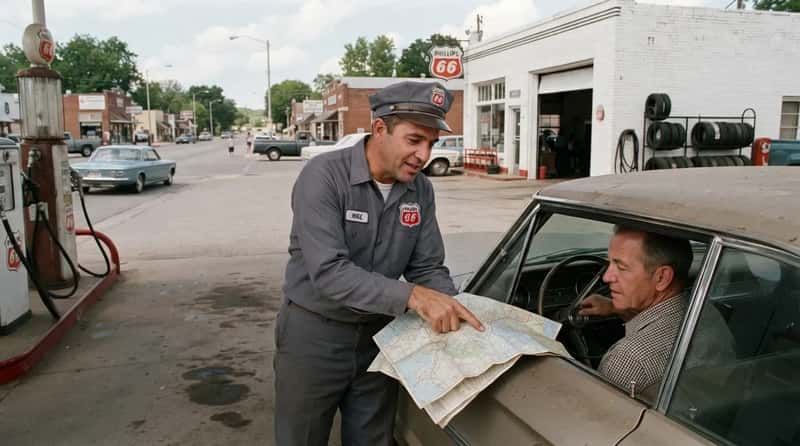
Lost? The attendant knew. Stations sat on corners and ran on local knowledge, so they were the natural place to ask which road led where. Drivers pulled in for gas and left with a hand-drawn route and a warning about the bridge.
That local advice was part of the service. The attendant was the original navigation app, and he never charged a subscription. Today a phone voice does the job and nobody remembers the guy on the corner. The old way was slower, but the answers came with local detail. And one thing about the fuel itself gets stranger at #3…
#3 – Leaded “Ethyl” Gasoline in Every Pump
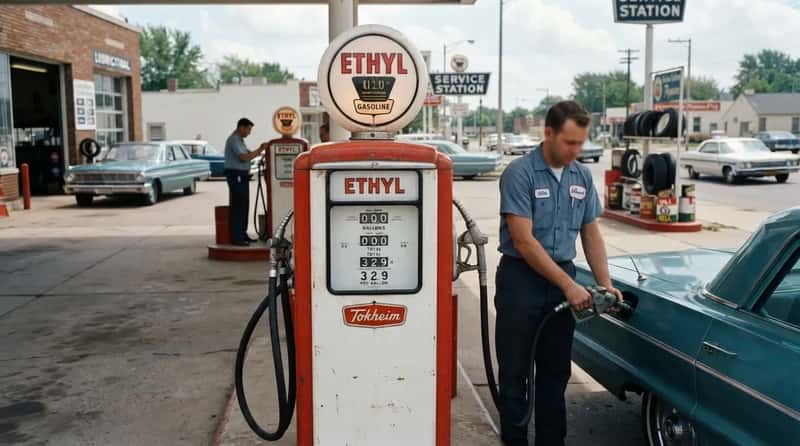
The gas in your tank had lead in it. Tetraethyl lead was added to boost performance, and “Ethyl” was a well-known name on the pump. In the 1960s, leaded fuel was simply the standard.
Regulators began phasing it down in the 1970s as catalytic converters arrived. Leaded gasoline was banned for on-road vehicles in the U.S. in 1996. Younger drivers have never smelled it, and many don’t know it existed. Every tailpipe back then was part of a much bigger story than anyone at the pump realized.
Worth Knowing
- Cars built for the 1975 model year added catalytic converters, which needed unleaded fuel.
- Unleaded pumps got narrower nozzles, so they wouldn’t fit the filler necks on those newer cars’ tanks by mistake.
- Algeria was the last country to stop selling leaded petrol, a milestone the United Nations announced in 2021.
- Leaded fuel hasn’t vanished entirely. Some small piston-engine aircraft still use it.
But the price at #2 will make you do some math…
#2 – Gas for About 30 Cents a Gallon
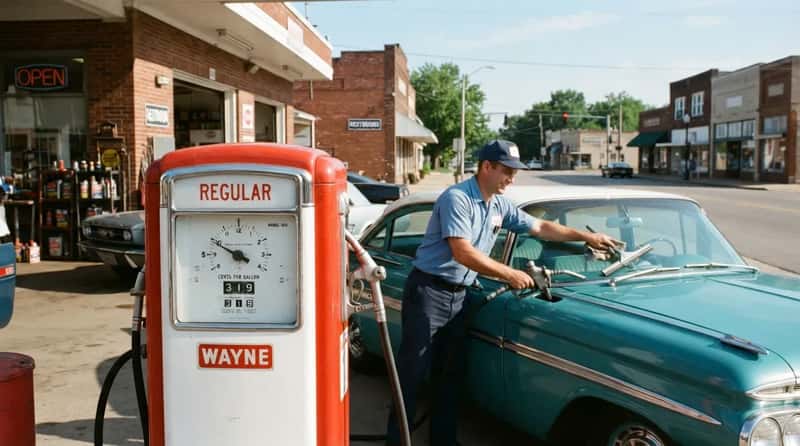
The pump price in the 1960s was roughly 30 to 35 cents a gallon, depending on the year and the place. That price came with all the services above. Price wars sometimes pushed the sign even lower on a busy corner.
Adjusted for inflation, that is roughly the equivalent of $3 to $3.50 a gallon today. So the full-service price wasn’t as cheap as the sign made it look. Then again, no one today gets a windshield wash and a free map with it. The number on the sign was only part of the deal. And the last item on this list is the one that hit hardest at #1…
#1 – A Safe Place to Stop, if You Knew Which Sign to Look For
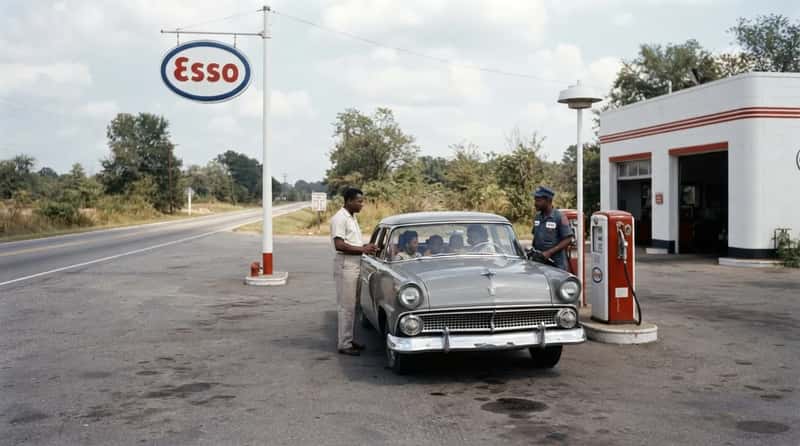
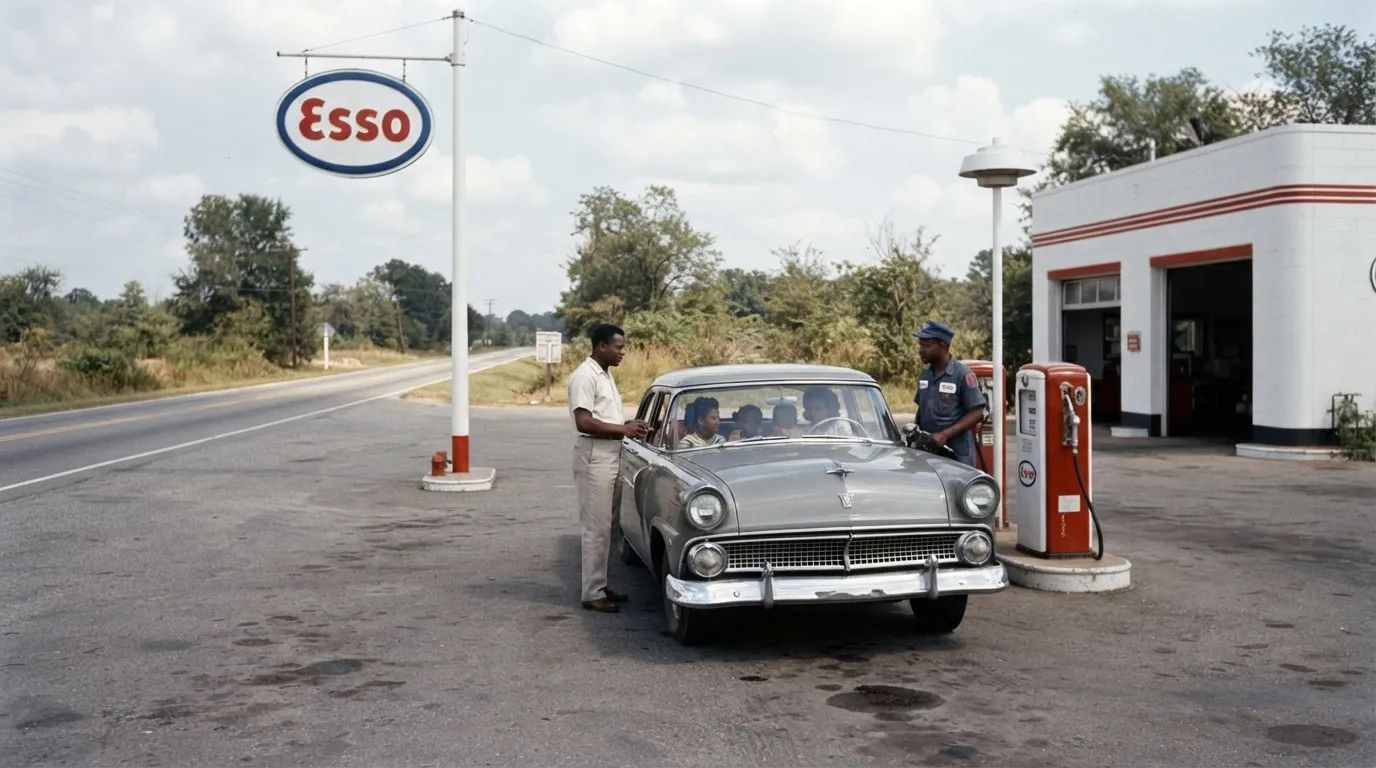
Not every station welcomed every driver. For Black travelers in the segregated era, a simple stop for gas or a restroom could be risky. The Negro Motorist Green Book, first published by Victor Hugo Green in 1936, listed businesses where travelers were more likely to be served safely.
Esso stations were among those listed, and the company was known for franchising to Black dealers at a time when that was rare. For some families, a particular gas sign was the difference between a safe trip and a dangerous one. The Civil Rights Act of 1964 outlawed segregation in public accommodations, and the Green Book stopped publishing in the mid-1960s. It’s the least comfortable item here, and the one that says the most about what a gas station meant on the road.
The 1960s gas station sold much more than fuel. It offered a person to pump, a free scrub, a map, stamps, a tiger tail and a phone when the car died. Some of it was clever marketing, and some of it was local help we’ve mostly lost.
Which one do you remember best, and which would you bring back first?