Most of the money you’ll lose to card fees abroad won’t show up on a receipt. It appears later, as small line items on a statement, usually after you’re home and the trip has faded into photos.
The charges come from different places. Some come from your card issuer, some from a shop’s payment terminal, and some from the cash machine on a busy street corner. Six of them are worth checking before you pack.
The Foreign Transaction Fee
This is the one most travelers have heard of. Foreign transaction fees cost 1 to 3 percent of each purchase, withdrawal, or other card transaction processed outside the U.S., and WalletHub puts the 2026 average at 1.59 percent.[1] A small percentage on one dinner is easy to ignore. On $5,000 of purchases with a card charging 3 percent, though, you’d owe an extra $150.[1]
Your card’s terms will tell you what you’re paying. The fee is listed in the Schumer box in the card’s terms and conditions[2], and it’s also available through your online account. Some issuers skip the charge entirely, and Capital One, Discover and USAA don’t charge foreign transaction fees on any of their cards.[1] About a quarter of credit card offers carry no such fee[3], so a fee card may be one you can leave at home.
The Dynamic Currency Conversion Markup

At a checkout terminal abroad, you may be asked whether you’d like to pay in dollars or the local currency. Paying in dollars sounds helpful, but it’s called dynamic currency conversion, and it’s mostly a way for the merchant’s payment provider to earn money. German organization Stiftung Warentest sent investigators to 11 countries where the option was offered, and in every case the price went up, by between 2.6 and 12 percent.[4]
It also doesn’t get you out of your issuer’s fee. Foreign transaction fees apply even if you’re charged in U.S. dollars in a foreign country.[5] The safer habit is to choose the local currency every time. You can usually see the dollar amount on the terminal before you accept[5], so you can still check the price without paying extra for the conversion.
The Cash Advance Fee
Pulling cash from an ATM with a credit card isn’t the same as using a debit card. The bank treats it as a loan. Card companies typically charge 3 to 5 percent of the advance or $10, whichever is higher[6], and the fee is charged up front.
The cost keeps building after the fee. Cash advances have no grace period, so interest starts growing right away.[7] The rate is typically higher than what your card charges for purchases.[8] Unless it’s an emergency, most guides suggest leaving the credit card out of the ATM and using a debit card instead.
ATM Operator and Bank Withdrawal Fees
Cash withdrawals abroad can be charged several times over. A typical withdrawal runs three fees at once: a flat charge from your home bank, often $3 to $5, a surcharge from the foreign ATM’s operator of $3 to $8, and a currency conversion markup of 1 to 3 percent.[9] Independent operators in tourist zones charge the most, often $5 to $10 per withdrawal.[9]
Flat fees hit small withdrawals hardest. A $40 withdrawal with an $8 fee costs you 20 percent.[9] Taking out larger amounts less often keeps the flat charges down. ATMs attached to a real bank branch tend to cost less than standalone machines in airports and tourist strips.[10] Your bank may also belong to a partner network, which can waive part of the bill.
The Annual Fee on a Travel Card
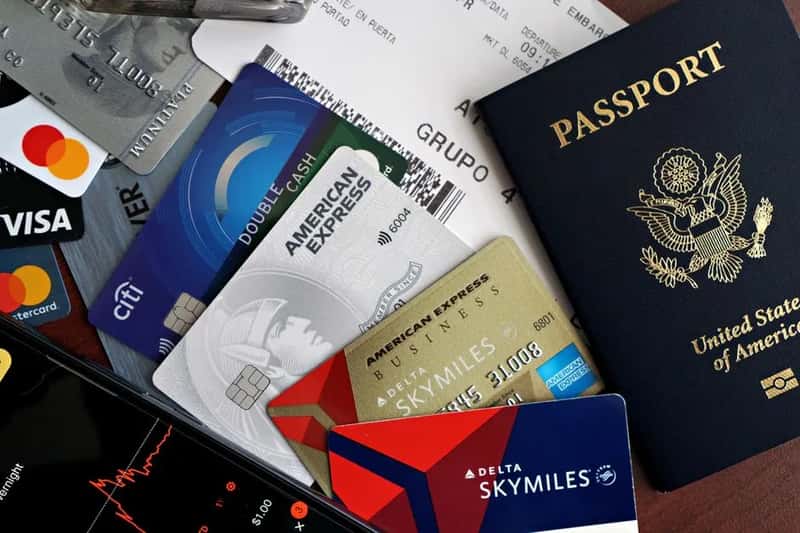
Cards with no foreign transaction fee often come with an annual fee instead. Most travel rewards cards, premium cards and many credit builder cards carry no foreign transaction fee[11], and the Chase Sapphire family, Capital One Venture, American Express Platinum and Citi Premier all waive it as a baseline feature.[11] Some of these cards charge nothing each year, while others charge hundreds of dollars.
The math is worth doing before you apply. On a $3,000 European vacation, a 3 percent fee comes to $90.[11] A card with a $95 annual fee would only pay off if you spent a bit more than that abroad, or if its rewards and perks cover the difference. If you travel once every few years, a no annual fee card that also waives foreign charges may fit better.
Fees on Online Bookings Made From Home
You don’t have to leave the country to be charged. The fee applies to every qualifying purchase, whether you’re traveling abroad or buying online from an international vendor while at home.[12] That means a hotel, tour or rail ticket booked ahead from a foreign company may carry the charge, even if you’re still at your kitchen table.
Many people aren’t sure where they stand. A 2025 WalletHub survey found that 32 percent of Americans don’t know whether their card charges a foreign transaction fee, and only 12 percent correctly identified every scenario in which it applies.[12] Checking your card’s fee before you book, and looking at how each prebooked charge posts on your statement, is a quick way to catch this one.