Located on the Ligurian coast in northern Italy, the Cinque Terre are a group of five small villages—Monterosso al Mare, Vernazza, Corniglia, Manarola, and Riomaggiore—perched dramatically between steep cliffs and the Mediterranean Sea. For centuries, these communities were isolated, connected mainly by footpaths and the sea, and shaped by a delicate balance between human labor and a difficult landscape.
Today, the Cinque Terre are a UNESCO-protected area and one of Italy’s most iconic destinations, famous for colorful houses stacked above the water, terraced vineyards carved into near-vertical slopes, and a network of hiking trails linking the villages.
Official records confirmed 4 million visitors in 2023—a record-breaking year that saw a “mass pouring” of tourists concentrated in just one square kilometer of village area. The idea most visitors have in mind is a leisurely coastal walk from town to town, sea always in sight. That image still exists—but it’s no longer the whole story.
Hiking the Cinque Terre, Italy the Hard Way
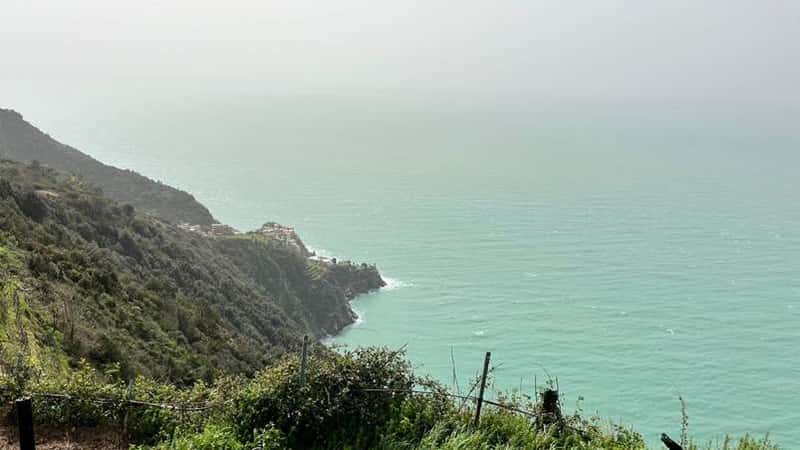
The image everyone has of the Cinque Terre is simple and seductive: a ribbon of path hugging the sea, villages stitched together by an easy coastal walk, blue water always in view. The reality, for years now, has been more complicated—and, in many ways, more interesting.
Large portions of the famous seaside trail are frequently closed to pedestrians due to landslides. This isn’t a temporary inconvenience or a recent problem. The Cinque Terre sit on fragile terrain, with steep slopes, unstable geology, and increasingly intense weather events. Rockfalls and collapses have made long stretches of the coastal path unsafe, and closures have become the norm rather than the exception. So what do you do when the postcard route is off-limits? You go up.
When the Sea Path Closes, the Mountains Take Over
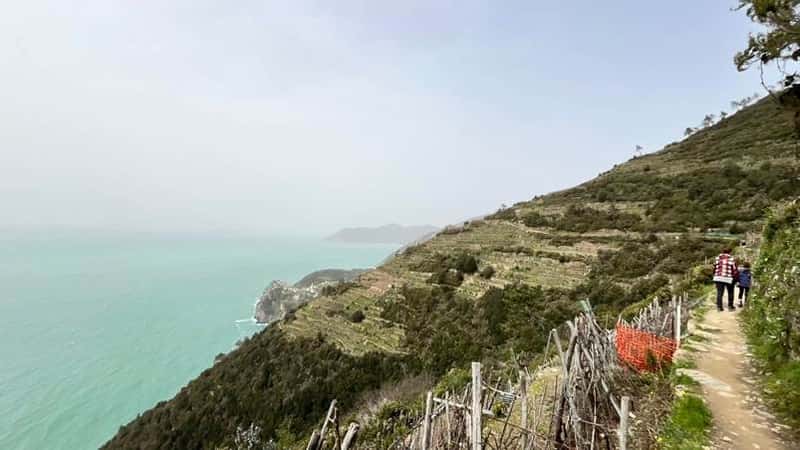
On my last visit, I stayed in Manarola, and – lucky me – I found myself exactly between two closed sections of the seaside trail to both Corniglia and Riomaggiore. Walking along the water simply wasn’t an option. The only to reach the nearby villages on foot alternative is to take the CAI trails that climb inland, connecting the villages through the hills and vineyards above.
CAI stands for Club Alpino Italiano, the Italian Alpine Club. It’s the national organization responsible for mapping, maintaining, and marking hiking trails across Italy, from the Alps to the coast. In the Cinque Terre, CAI trails are the real hiking routes, according to locals: steeper, less manicured, clearly marked with red-and-white signs and trail numbers, and designed for people who are genuinely walking—not just sightseeing. They are proper mountain paths, even when they run above the sea.
These routes are unquestionably harder. Steeper. Longer. At times, brutally physical. You gain elevation fast, often on uneven stone steps that seem to multiply as you climb. This is hiking, not strolling—and lazy children will absolutely let you know how they feel about it, probably with creative insults, long before you reach the top. But the reward is immediate and overwhelming. From above, the Cinque Terre reveal themselves in a way the coastal path never allows.
A Different Kind of Beauty
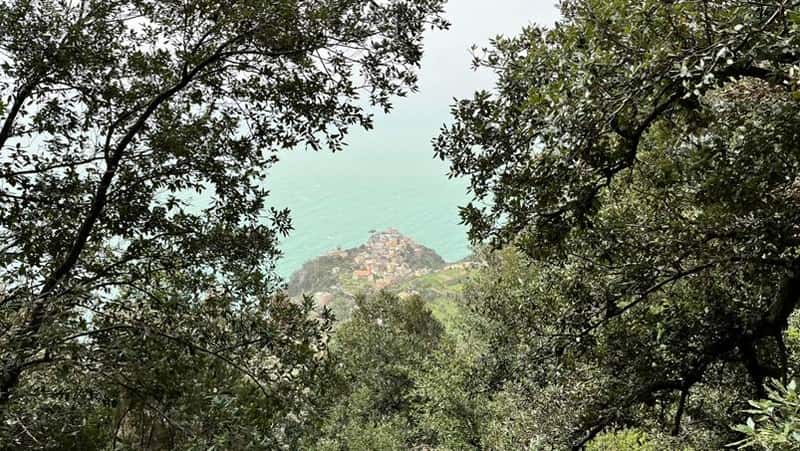
Walking the high CAI trails changes your relationship with the place. You’re no longer consuming villages one after the other; you’re moving through a landscape shaped by labor, gravity, and adaptation. From up here, you truly understand the steepness of the Ligurian ridgelines and the sheer effort behind the terraced vineyards. Those perfectly aligned stone walls are not decorative—they are the result of centuries of agricultural work carried out on almost vertical slopes.
You pass dry-stone walls – also UNESCO heritage – , olive trees, and vines clinging to terrain that looks barely cultivable. Seen from above, the Cinque Terre stop being just picturesque villages by the sea and become a cultural landscape, engineered by hand and maintained with stubborn persistence. It’s more demanding, yes—but it’s also more intimate and, in many ways, more truthful.
The Practical Alternative: The Train
Of course, not everyone wants—or can—hike at altitude. The train is the great equalizer here: fast, frequent, and efficient, connecting all five villages in minutes. It’s the easiest way to move between towns when trails are closed, when the heat is intense, or when legs simply refuse to cooperate. It’s also crowded, especially in peak season, but undeniably practical. In reality, most visitors end up combining the two: hiking where possible, training where necessary.
Getting There and Getting Around
The most common access point to Cinque Terre is by train, usually via La Spezia or Levanto, with regional trains stopping at each village. Driving is strongly discouraged: roads are limited, parking is scarce, and villages are largely car-free.
Movement within the Cinque Terre is now highly regulated. Access to certain trails—especially the coastal sections—requires tickets, and some paths operate with daily limits. In peak periods, access to the villages themselves is subject to crowd-control measures, and advance booking may be required. Showing up without planning is no longer advisable. Before you visit, always check the official website https://www.parconazionale5terre.it/.
If you plan to hike, check trail conditions in advance and be prepared for detours. If you rely on trains, consider passes that allow unlimited travel between villages.
When to go
Timing matters more than it used to. The Cinque Terre are now firmly in an overtourism phase. Crowds can be so dense that moving between villages becomes stressful, and finding a place to eat without long waits can feel like a small victory. A few years ago, I would have confidently suggested June or Easter as great time to visit. I wouldn’t anymore. Those windows are gone. If you can, come well outside the main season—late fall or very early spring—because nowadays, avoiding peak crowds is a necessity.
What This All Means

The Cinque Terre are no longer a carefree coastal stroll. They require planning, flexibility, and a willingness to adapt. Being forced uphill was harder than expected—especially with tired legs and unmotivated companions—but it turned out to be a wonderful surprise. The views, the perspective, and the understanding of how this land actually works more than compensated for the effort. Sometimes, when the easy path closes, the better one really does open higher up.
Correction 04/13/2026: In an earlier version, it was stated that “Official records confirmed 3.5 million visitors in 2023,” while the actual number was 4 million visitors. Source. We apologise for any inconvenience.