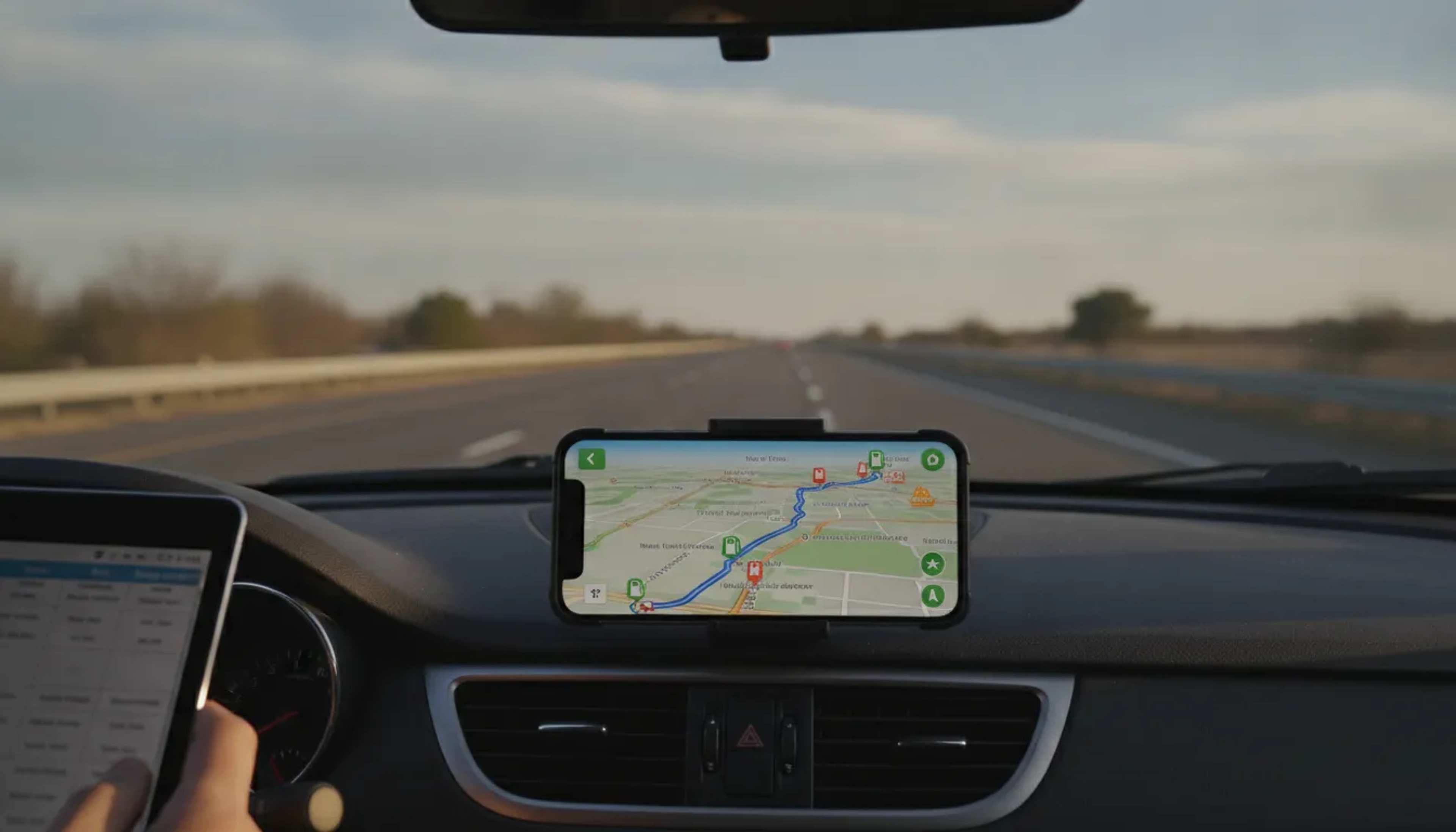
The stranger’s hand reaches for your phone.
Your stomach drops before your mind catches up.
You smile. You say yes. You hand it over.
But something inside you – ancient, animal, alert – does not let go.
That micro-second of panic is not rudeness. It is not paranoia. It is a signal. And the signal has a name. Travelers are a peculiar breed. We construct identities in motion – the curious wanderer, the fearless explorer, the one who says yes to everything. We perform openness. We perform trust. But the device in our pocket tells a different story. It holds the unedited version of us. The real coordinates. The private photographs. The messages we would never read aloud in a market square in Marrakech. The gap between the traveler we perform and the person the phone knows – that is the Identity Gap. It is the space where privacy trauma lives.
1. The Surrendered Device
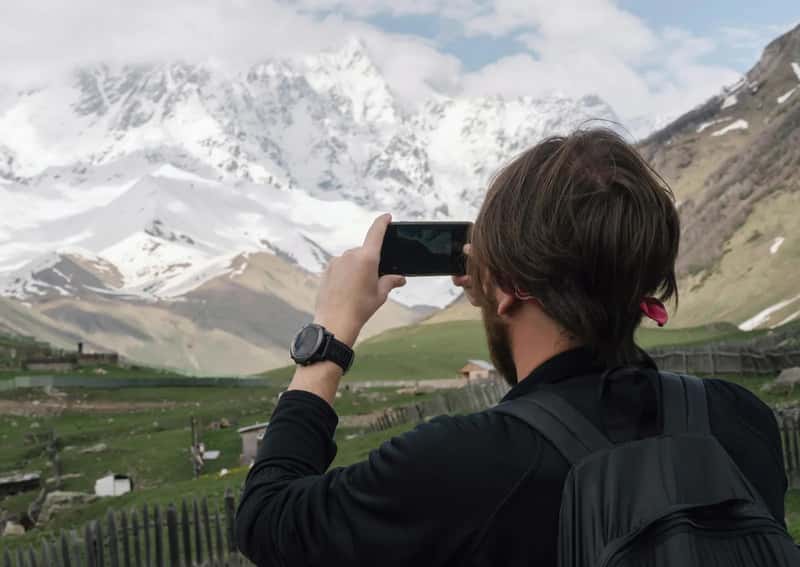
A local guide in Lisbon offers to take your photo. The light is golden. The gesture is kind. And yet – every nerve fires.
What you are experiencing in that moment has a clinical shape. Privacy anxiety is a psychological state rooted in the fear or discomfort that personal data is being accessed, tracked, or shared without consent. But travel adds a brutal layer to this. You are in an unfamiliar city. You do not know this person’s name. You will likely never see them again.
The phone is not just a device. Researchers increasingly find that people view smartphones as an extension of themselves, including their identity and even their body.
Handing your phone to a stranger, then, is not a casual transaction. It is a surrender of self. And some of us – those shaped by past exposures, past violations, past moments where our digital world was infiltrated – have learned the hard way that surrender carries cost.
The panic is not irrational. It is memory. It is the body keeping score, even under golden-hour light in Lisbon.
2. The Digital Body Double
Think about what lives on that device.
Your banking app. Your children’s faces. Your medical notes. The last conversation you had with someone you love. The search history you would never narrate at a dinner party.
We live in an era where our most intimate details – from our location data to our deepest insecurities whispered to health apps – are constantly harvested, analyzed, and monetized.
Your phone is a second body. A body double that travels with you everywhere. It knows things about you that your closest friends do not. And now, somewhere near a cobblestone street, it is in a stranger’s hands.
The traveler who has experienced a data breach, a stolen device, or a digital violation before will recognize this sensation immediately. The psychological implications of mobile phone loss focus particularly on depression and information access anxiety resulting from compromised personal information. That is not an abstraction. That is a lived, embodied experience that gets encoded into the nervous system.
When the local guide lifts your phone to frame the shot, your nervous system isn’t being dramatic. It is being a responsible archivist of everything that has ever gone wrong.
3. The Control Collapse
Here is what privacy trauma is really about: control.
Not data. Not passwords. Control.
“As human beings, we want a sense of agency and choice around our own lives. We experience internal distress as we see it getting taken away,” explains Jahenzeb Baldiwala, a clinical psychologist.
Travel already strips control from us in layered, relentless ways. We do not know the language. We do not know the local customs. We do not know which neighborhood is safe at 11 PM. Every day abroad is a negotiation between curiosity and vulnerability.
So when someone asks for the phone – the one thing we control absolutely, the one thing tethered to our real life – the anxiety compounds. This is not about distrust of the guide specifically. It is about how much control has already been quietly surrendered just by being somewhere unfamiliar.
Privacy trauma thrives at the intersection of accumulated vulnerability and one moment too many of letting go. The phone in the stranger’s hands becomes the symbol of every boundary already pushed that day.
4. The Hypervigilance Hangover
Once you have had your privacy violated – really violated – the brain rewires.
It does not forget. It catalogues. It creates threat maps.
A perpetual lack of privacy invades people’s personal space and sense of security. “This leads to hypervigilance, doubts, constant fears, and paranoia in some cases,” says counseling psychologist Namrata Khetan. They converge into the larger inability to trust people, surroundings, and things.
Travelers with a history of privacy violations carry this hypervigilance like invisible luggage. It does not show up in the overhead bin. But it is there. It is there when a hostel asks to hold your passport. It is there when a hotel Wi-Fi network asks for your email. And it is there – sharp, sudden, immediate – when a warm stranger in a sunny square reaches for your phone.
Constant surveillance, in other words, is cognitively draining, as it pushes the brain into a state of fight or flight. For trauma survivors, this fight-or-flight does not require constant surveillance. It requires only the memory of it. The brain fills in the threat whether it is present or not.
The hypervigilance hangover is the tax levied on every open moment by every closed wound.
5. The Traveler’s Paradox
I will tell you something.
I have stood on a pier in Dubrovnik, handed my phone to a stranger who looked like someone’s grandfather, and spent the entire fifteen seconds he held it mentally rehearsing what I would say to the police.
The man took a perfectly framed photograph. He handed the phone back with a small bow. I thanked him. I walked away and sat on a wall and felt the absurdity of my own anxiety wash over me like the Adriatic below.
But the absurdity does not make it less real. While occasional concern about online privacy is normal, privacy anxiety becomes problematic when it leads to chronic stress, distrust in digital environments, and even avoidance behaviours like deleting social media or turning off phones entirely.
This is the traveler’s paradox. We go abroad specifically to open ourselves – to new places, new faces, new experiences. And yet the device in our pocket pulls us back toward closure. Toward guardedness. Toward the locked screen of ourselves.
The very thing we carry to document our openness becomes the instrument of our anxiety. The camera that should capture joy instead captures our fear of losing control at the most unexpected moment.
6. The Identity Exposure
There is a deeper wound beneath the device anxiety.
It is the wound of exposure.
Privacy is a fundamental psychological need: it allows us to recover from harm and develop an individual identity, according to Stanford psychiatrist Elias Aboujaoude. When we travel, we are in the very process of building that identity – or at least performing a version of it. We are the adventurer. The explorer. The person who got on the plane.
But the phone holds the identity we left behind. The one with the overdue bills and the difficult relationship and the 3 AM searches about whether our symptoms are serious.
Handing it to a stranger feels like handing them a dossier. Even though they want nothing more than to compose a decent horizon shot.
Psychologically, we need private spaces to experiment with ideas, process emotions, and develop an authentic sense of self without external judgment. Travel is supposed to be that private space. But the phone – always-on, always-connected, always-witnessed – collapses the wall between our private experiment and the outside world. The panic is the wall trying to rebuild itself in real time.
7. The Borrowed Trust Problem
Trust, in travel, is always borrowed.
You trust the airline. You trust the hotel lock. You trust the street food vendor. You trust, provisionally and constantly, people whose last names you do not know and whose intentions you cannot verify.
People who are anxious may be more likely to view social interactions as risky or threatening, especially with strangers or weak ties. Anxious people might hence desire more privacy. And most travelers, beneath the brave face of the boarding pass, carry some degree of social anxiety. The solo traveler most of all.
Privacy trauma sharpens this borrowed trust problem. Because it whispers, every time, that the last time you trusted someone they did not earn it. The last time you handed something over it did not come back whole.
Evidence indicates that people experience physiological symptoms – including heart rate increase and heightened anxiety – when they are unable to answer their ringing phones. Now extrapolate that to a phone physically out of their hands entirely. The physiological response becomes a full-body alert system.
Borrowed trust, for those with privacy trauma, is borrowed at an extraordinarily high interest rate. The local guide holds the phone. The borrower’s nervous system holds its breath.
8. The Digital Overhang
Privacy trauma does not begin in a foreign city. It accumulates long before the passport is stamped.
Smartphones help us navigate, communicate, bank, shop, and even relax – but they also collect a vast amount of personal data. Every interaction with the device is a small deposition of trust. Over time, those deposits become a vault. And every data breach, every phishing attempt, every moment of unauthorized access chips away at the vault’s walls.
By the time you reach a cobblestone square in a beautiful city, you are not carrying just a phone. You are carrying every violation that phone has ever been adjacent to. Every notification about suspicious login activity. Every moment you Googled your own name and found something you did not put there.
This is the digital overhang – the accumulated weight of all the moments your data moved without your permission. Privacy fatigue caused by privacy data disclosure and the complexity of privacy control has become an important factor influencing people’s privacy decision-making behavior.
The local guide does not know any of this. They see a tourist who needs a photo. You feel the entire weight of the digital age land in your chest at once.
9. The Performance of Normalcy
Here is the cruelest part of privacy trauma in a travel context: you cannot show it.
You cannot explain, in the two seconds between offer and acceptance, the full psychological history of why you are terrified to hand over a device. So you perform normalcy. You smile. You say “thank you so much.” You watch the stranger walk backward to get the angle right.
Generally, research has found that the self-concealment of one’s thoughts, behaviors, and feelings takes a lot of emotional labor. It can have negative psychological effects, including anxiety and depression, and can even become a physiological stressor.
Travelers are expert performers of normalcy. We perform delight when we are exhausted. We perform gratitude when we are lost. We perform calm when we are, in fact, tracking the location of a stranger with our phone in their hand and calculating the sprint distance to the nearest embassy.
The performance costs something. Every smile over a suppressed panic is a small withdrawal from an account that was already running low. The traveler with privacy trauma is performing not just for the guide, but for themselves. Trying to convince the body that the mind is correct: it is fine. You are safe. They just want to take the photo.
10. The Unwitnessed Weight
No one validates this fear for you. That is what makes it so heavy.
Privacy trauma, in the context of travel, is almost entirely unwitnessed. There is no support group at the hostel. No one at the breakfast table says, “I know – I had a full panic attack when the tour guide in Kyoto held my iPhone for eight seconds.” The world assumes this anxiety is eccentricity, not injury.
The psychological impact of mobile phone loss and compromised personal information necessitates a comprehensive approach to mental health and data security. But the psychological community has barely begun to name what happens when a history of digital violation meets the vulnerability of travel. The two forces compound each other in ways that remain largely undiscussed.
Elias Aboujaoude, MD, a Stanford professor of psychiatry and behavioral sciences, argues that we need to think about internet privacy as a mental health issue, noting that some of his patients have suffered from anxiety, depression and post-traumatic stress disorder after their personal details were exposed online.
That is the full, formal weight of what the unwitnessed traveler carries to that cobblestone square. Not eccentricity. Not rudeness. Not antisocial behavior. A genuine, clinically recognizable wound that has never been given a travel-specific name. Until now, perhaps, we might call it what it is: Contextual Privacy Trauma – the acute activation of privacy-based psychological injury in moments of otherwise ordinary social trust.
And it lives in the space between a stranger’s kind offer and the reluctant extension of your own arm.
The photo gets taken. The phone comes back. The moment passes. And you stand there, in the golden light of some beautiful city you traveled thousands of miles to inhabit, quietly gathering yourself back together – piece by piece, app by app, breath by breath. You look at the image. It is lovely. You are smiling in it, which surprises you slightly. You look like someone who was not afraid at all.
Perhaps that is the most honest portrait of the modern traveler: a person who moves through the world collecting beautiful moments and quiet panics in equal measure, always a little more guarded than the landscape deserves, always a little braver than the body feels ready to be. The anxiety is not a character flaw. It is a scar that learned to walk upright, learned to carry a passport, learned to say yes to the photo.
The phone is back in your pocket now. You keep walking. And somewhere behind you, a stranger is already holding someone else’s device, trying to do nothing more than frame the light correctly – completely unaware of the courage it took to let them.