The departure board flickers.
Your stomach drops before your brain can explain why.
It’s just a number on a screen. Two letters: Delayed.
And yet something inside you – something old and practiced and sharp – reads it as a personal verdict.
There is a gap between the person who boards a plane with a color-coded itinerary and the person who unravels when that itinerary dissolves. That gap is where the real story lives. It’s the distance between the identity you perform in the world – competent, organized, ahead of schedule – and the identity that surfaces when the world stops cooperating.
One version of you moves through airports like a general. The other version stands at a gate, jaw tight, re-reading a notification that hasn’t changed in twelve minutes. Learning to let go doesn’t mean something bad will happen. It means accepting that everything going smoothly isn’t entirely up to you – and that’s okay.
The Illusion You Packed First
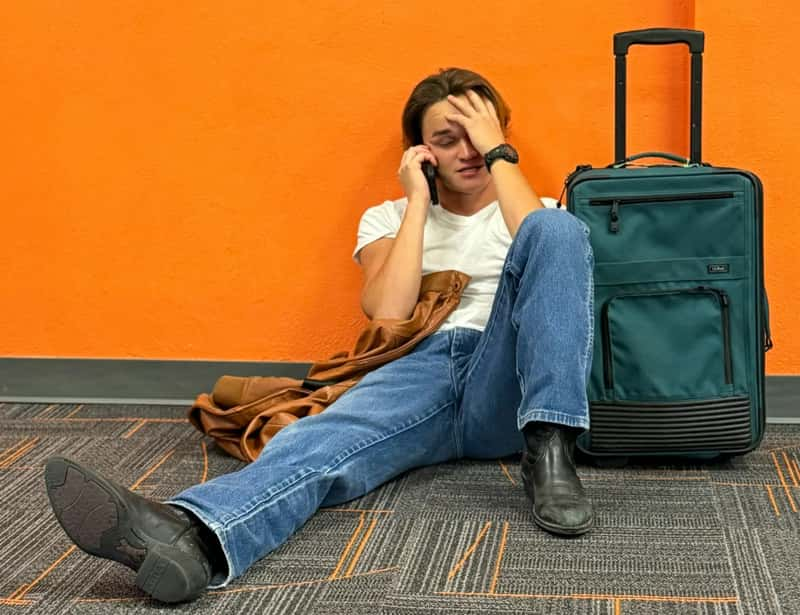
Before the clothes. Before the passport.
You packed a quiet assumption: that control was yours to carry.
The illusion of control is a mental bias leading people to overestimate the control they have over the outcome of events. We don’t notice we’re doing it. We buy travel insurance and early boarding passes and call it preparation. We tell ourselves we’ve accounted for everything. We haven’t. We’ve just built an elaborate psychological fortress around the word maybe. The airport doesn’t respect fortresses. It doesn’t respect your timeline, your connecting flight, or your carefully arranged sense of self. It simply announces a delay. And the fortress cracks.
The crack isn’t about the delay. It never was.
The Body Knows Before You Do
The cortisol spikes first.
Then the scanning. The replanning. The silent catastrophizing.
When under stress, the mind and body look for ways to control that stress. In a car, if you’re feeling uncomfortable, you know you can pull over at any time. A flight offers no such exit. That is the psychological trap hidden inside every delayed departure. Your nervous system is running software written thousands of years ago – software that treats an uncertain outcome as a potential threat. The boarding gate becomes a pressure chamber. The overhead announcement becomes a provocation. Gate anxiety is a deeply human reaction to uncertainty, status cues, and the fear of being left behind – a survival instinct that hasn’t yet learned the difference between a departing Airbus and a migrating tribe.
Your body is not overreacting. It’s running the only program it knows.
The Ritual as Armor
You check the departures board again.
You already know what it says.
Humans crave control, especially in stressful settings. Gate anxiety often manifests as rituals designed to regain that illusion of control. These behaviours don’t actually influence boarding. But they reduce anxiety by making the traveller feel proactive – even when the real control lies with the airline’s systems, crew, schedule, and operational decisions. This is the architecture of the anxious traveler. Every redundant boarding pass check, every compulsive refresh of the airline app – these are not strategies. They are ceremonies. Small, repetitive acts of faith in a god called Control. We perform them not because they work, but because stillness, in the face of randomness, feels like surrender.
And surrender, for some of us, is the one thing we were never taught to survive.
The Map You Drew in Childhood
Control doesn’t start at the airport.
It starts much earlier. In smaller rooms.
Introjection tends to activate when a situation resembles past conditions where you needed to adapt to stay safe. For many of us, that adaptation was simple: if I stay organized, if I anticipate everything, if I leave nothing to chance – nothing bad can happen. It was a child’s logic applied to an adult’s life. And it worked, until it didn’t. Being inflexible in the face of the inevitable curve balls life throws at us creates a pressure cooker of frustration and anger that just brings on more anxiety. The delayed flight doesn’t create the pressure cooker. It simply turns up the heat on one that’s been simmering for years.
The Moment I Recognized Myself at Gate 14B
I remember the specific quality of the fluorescent light.
I remember my knuckles against the chair armrest.
It was a Tuesday. A 47-minute delay on a domestic flight that meant nothing to anyone except me and, apparently, every nerve ending I had. I wasn’t angry about the flight. I understand that now. I was angry at the universe for confirming what I already feared: that I am not, have never been, in charge of anything. That the schedule I maintain so religiously is not a plan – it’s a prayer. Standing at that gate, watching other travelers shrug and find chargers for their phones, I understood for the first time that my rage was not about transportation. It was about the original wound: a world that felt random from the beginning, and a self that learned to build walls against that randomness and call them competence.
The delay didn’t attack me. It just showed me who I’d become in order to survive.
The Identity That Only Exists on Schedule
There is a version of you that only works when things go according to plan.
That version is not the whole of you. But it thinks it is.
Perhaps one of the most profound psychological effects of airports is how they temporarily strip away our usual identity markers. In the international transit zone, national boundaries become fluid, and our usual social roles temporarily suspend. The executive is just a person in a seat. The organized traveler is just someone whose flight is late. This dissolution of identity can be both liberating and unsettling. Some travelers embrace this temporary freedom from social constraints, while others might feel adrift without their usual anchors of self-definition. If your entire sense of self rests on being the person who has it together – the delay doesn’t just inconvenience you. It dismantles you.
That’s too much weight to put on a departure time.
The Control Freak Is Always the Frightened Child
Nobody becomes controlling because they feel powerful.
They become controlling because they once felt powerless.
Numerous studies show that feelings of lack of control can lead to anxiety, helplessness, pessimism, failure to act when it is possible to influence events, and even depression. The person who snaps at the gate agent isn’t a difficult traveler. They’re someone whose nervous system has declared an emergency. Flight delays strip away our illusion of certainty, forcing us to adapt in real-time. The rigid planners among us struggle most. And the planners – the ones with the color-coded packing cubes and the laminated backup itineraries – are often the ones who feel the most acutely that chaos is coming for them personally. Because for them, it always has been.
Control is not a personality. It’s a scar tissue.
The Airport as Psychological Mirror
The terminal holds everything up to the light.
You can’t hide in an airport. Not really.
The way we react when our flight gets delayed isn’t random. It’s a window into our deepest personality traits, our coping mechanisms, and yes, even our generation’s collective mindset. Watch what people do in those 47 minutes of limbo. Some read. Some sleep across two seats with the abandon of people who trust the world to keep running without them. Others pace. Others corner the gate agent. The airport does not create these responses – it reveals them. In psychology, liminal space is a threshold state: a pause, a transition, a space that can feel uncertain, uncomfortable and even disorienting. It’s the space between the old story and the new one – it rarely comes with a roadmap and often comes with a feeling of lost. The airport is the most honest room you will ever stand in.
What You’re Actually Defending Against
It is not the delay you fear.
It is what the delay implies.
Coined by psychologist Ellen Langer in 1975, the illusion of control describes our tendency to believe we can influence outcomes that are inherently random. Paradoxically, while this belief doesn’t align with objective reality, it fulfills deep psychological needs – shaping how we gamble, invest, cope with uncertainty, and even maintain our mental health. A delayed flight implies that you are not the author of your own story. That variables exist outside your spreadsheet. That the universe operates with a kind of indifferent momentum that your morning routine cannot override. The need to control thoughts and outcomes is rooted in fear. And fear, when fed, only grows stronger. Every controlled schedule is a negotiation with that fear. And every delay is the universe declining the terms.
The Softer Architecture of Getting Somewhere
There is another way to travel.
It doesn’t come naturally. It has to be chosen, over and over, until it does.
Control is an illusion. You don’t have control over most things in life, yet you move through them every day. The traveler who sits with a delay, who breathes through the fluorescent hum of a terminal at dusk, who lets the disruption be what it is without making it a referendum on their worth – that traveler has done something quietly radical. They have separated their identity from their itinerary. They have understood, somewhere below the level of thought, that who they are does not depend on what time the plane departs. Liminal space fosters transition, passage, and change. It acts as a bridge for different stages of life and gives people the chance to build a new personality. It also encourages personal growth and makes people face their fears. Moreover, this space encourages a person to embrace transformation, makes people look for the future, and releases themselves from the past.
The delay, in this light, is not a failure of logistics. It is an uninvited threshold.
There is a particular kind of grief in realizing that the control you’ve spent years building was never really protection. It was performance. A very convincing, very exhausting performance staged for an audience of one – the terrified version of yourself who decided, somewhere early on, that if everything stayed on schedule, nothing could hurt you.
The departure boards of the world will keep flickering. Delays will keep happening. Mechanical issues will materialize without apology. Weather systems will not consult your connecting flight. And every single time, you will have a choice – not about the delay, but about what story you tell yourself while you wait. The story that the universe is conspiring against you specifically. Or the quieter, stranger, more liberating story: that you are simply a person, in an airport, in a moment that belongs to no one and asks nothing of you except your presence.
You were never in control of when the plane left. You were only ever in control of who you were while you waited for it.