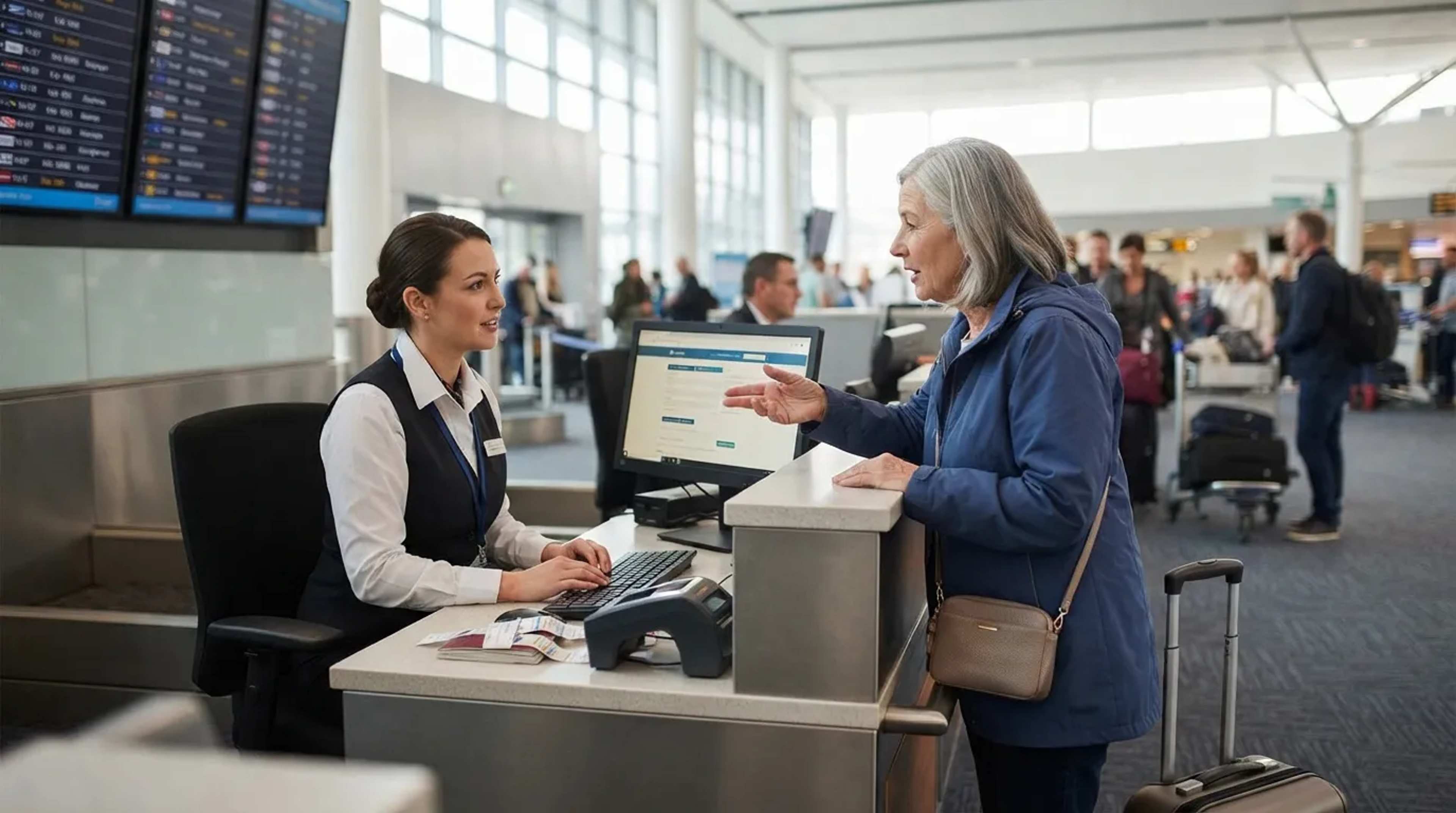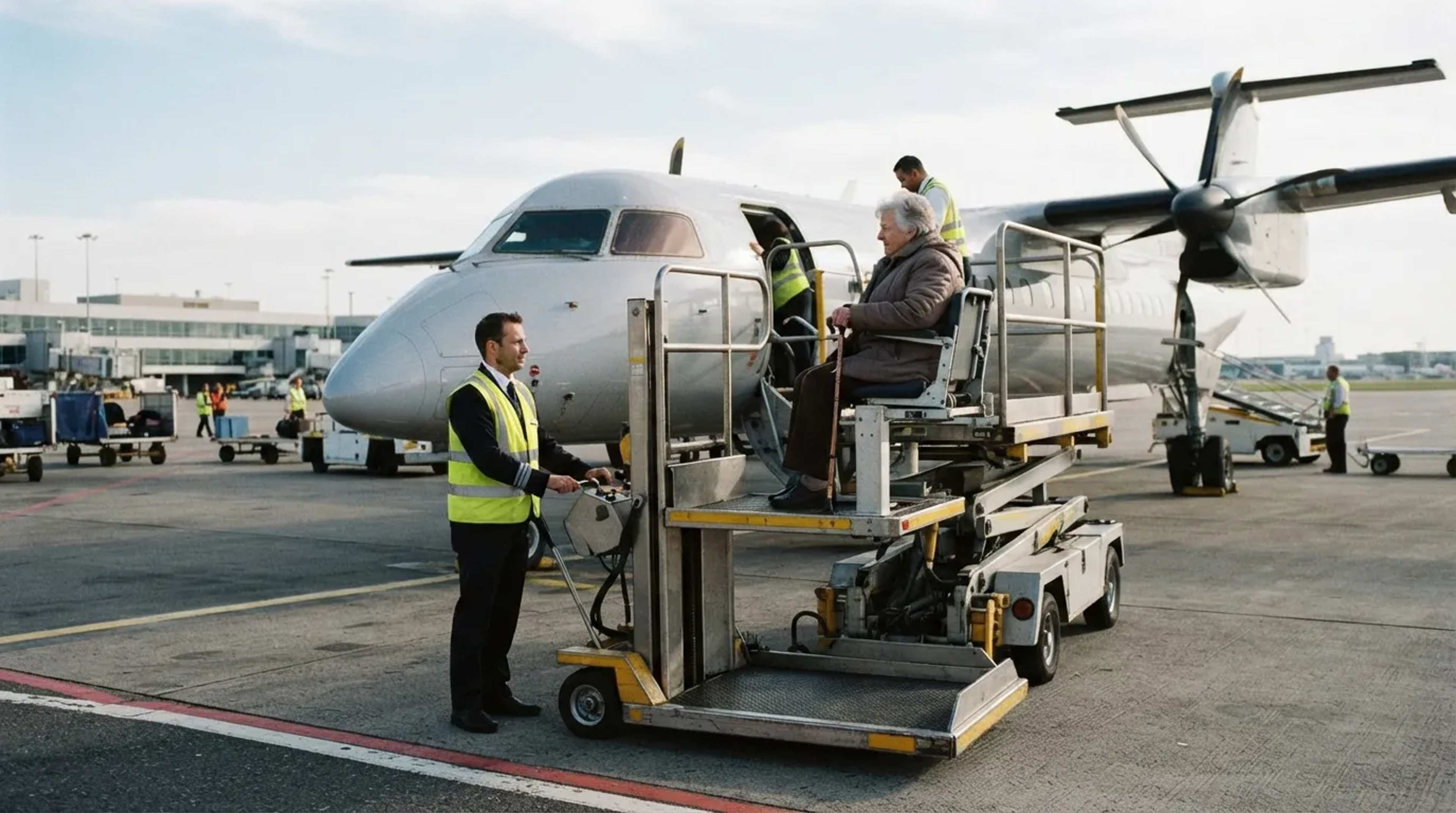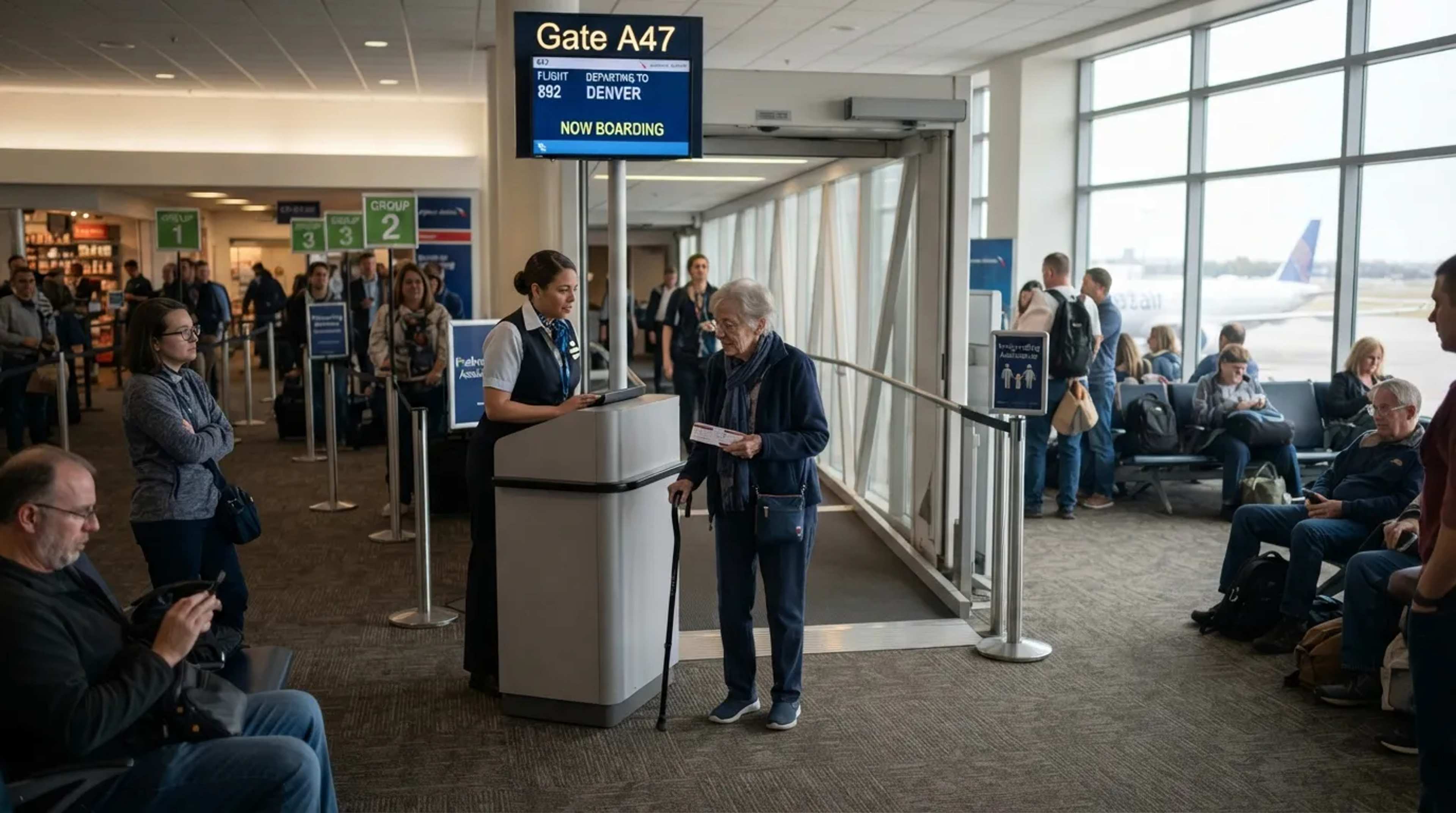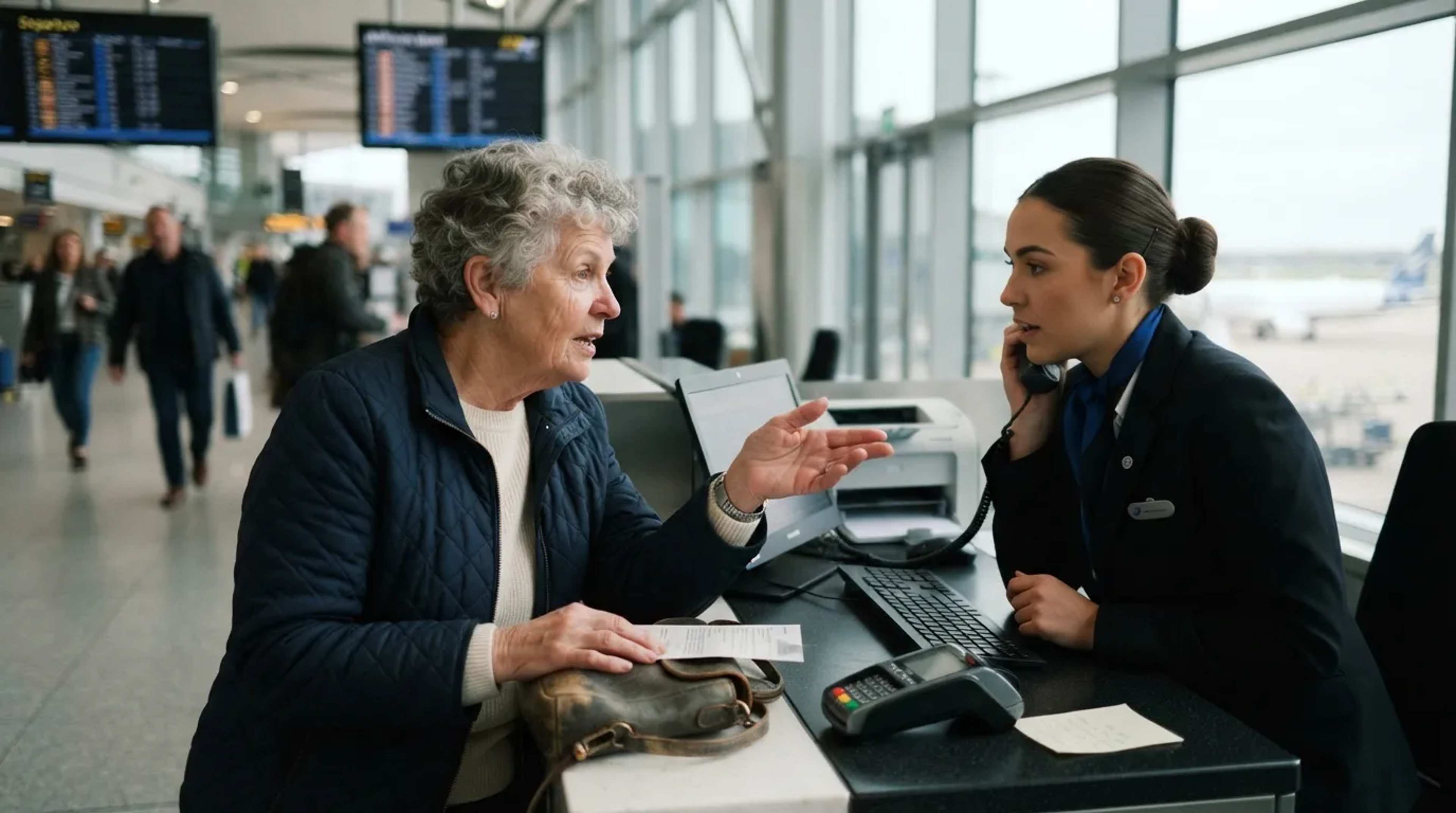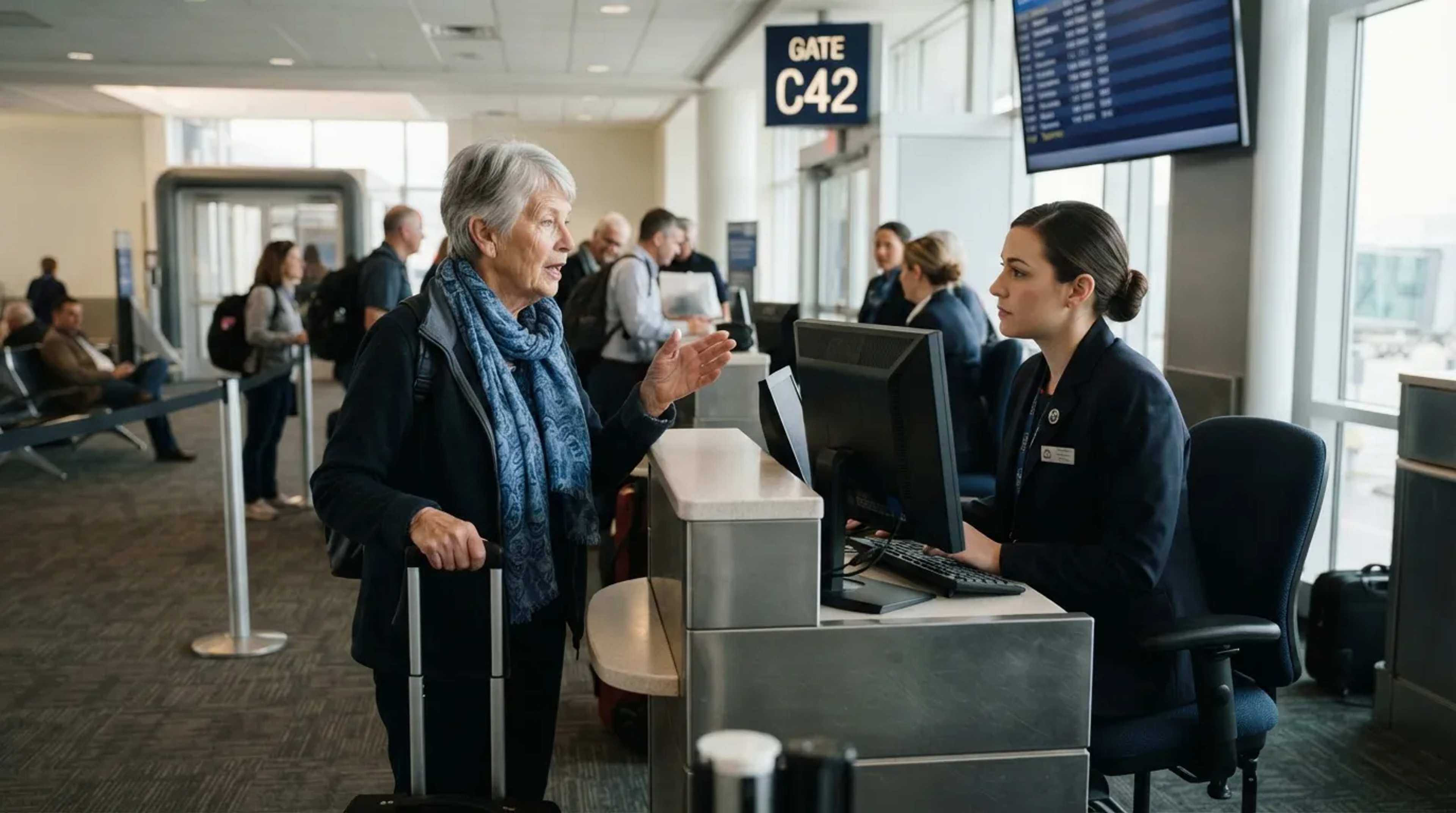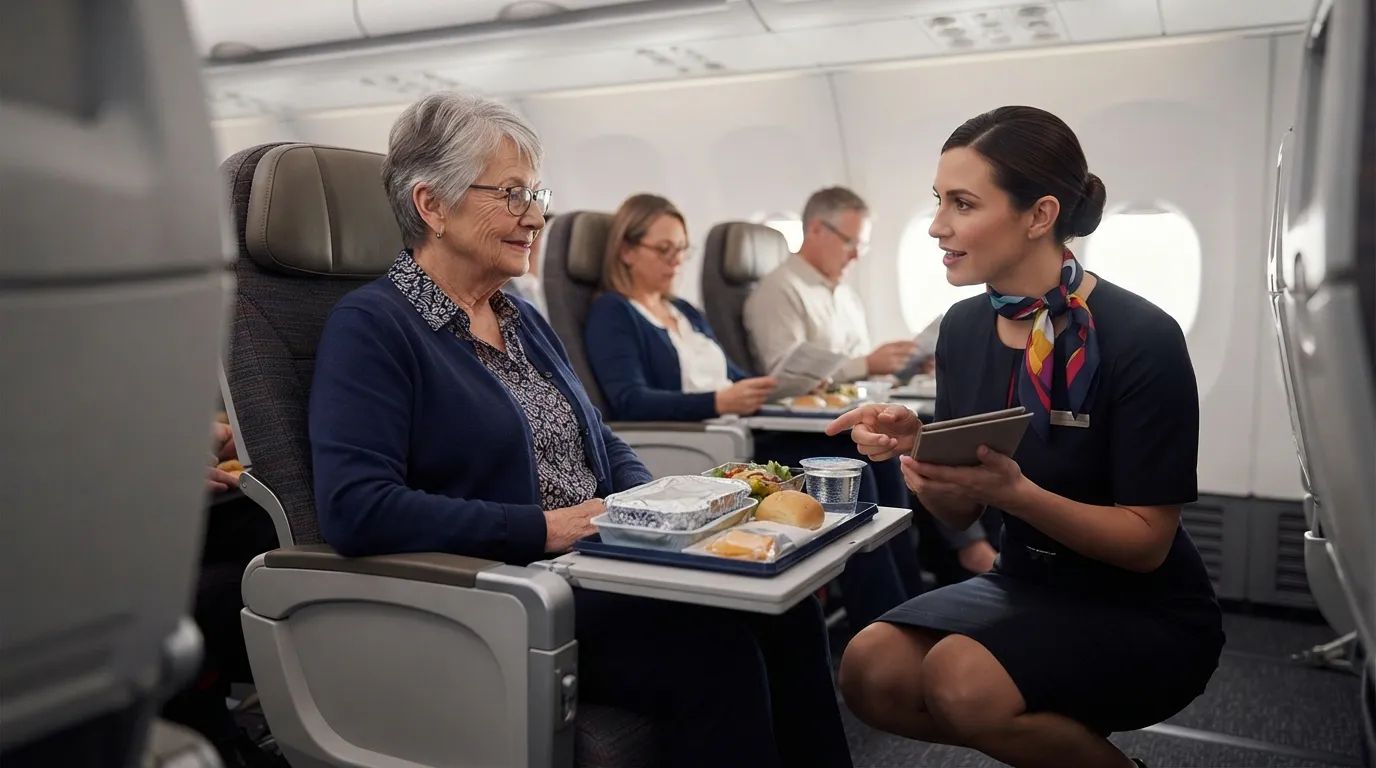
Experienced flyers over 65 know something the boarding screens never mention: a seat, a bin spot or a few extra minutes can still be rearranged by a real person at the gate. Neither Southwest nor American runs a boarding group just for seniors, so the people who get these quiet favors are the ones who ask.1
None of this is a right tied to your birthday, because every item depends on your airline, your ticket type and the seats still open. Stay for #1, where the agent can promise nothing and a wrong guess can cost you an afternoon, but start with the clock at the gate.
#15 – The Minutes Before Your Zone Is Called
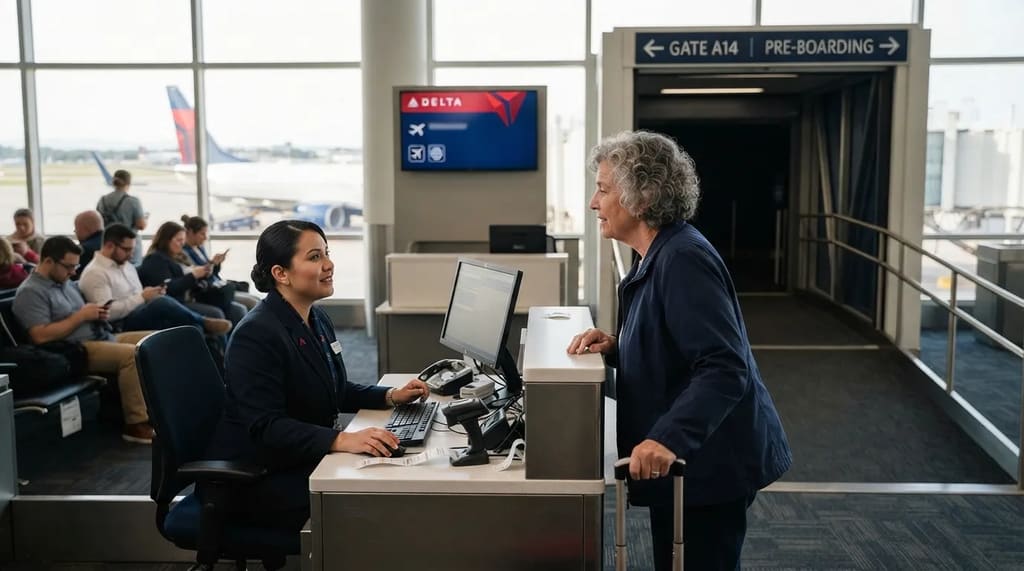
Delta’s own policy is that any passenger who needs extra time to board can and should request it at the gate.2 The perk runs on need rather than age, so what works is describing what you need in one plain sentence.
Once your zone is called, the preboarding window has already closed. Boarding typically begins 30 to 40 minutes before scheduled departure, so be at the desk about 15 minutes before boarding begins.3
Waiting for a senior boarding line to appear is the weakest plan on this list. The sentence you say at the desk is the only boarding advantage you control, and it takes about ten seconds.
Something like “I’d like a little extra time getting down the jet bridge” is plenty. No long story, no apology.
Where you stand while you wait counts too, because the desk makes announcements that never reach the far corner of the gate area.
#14 – A Chair Within Earshot of the Desk
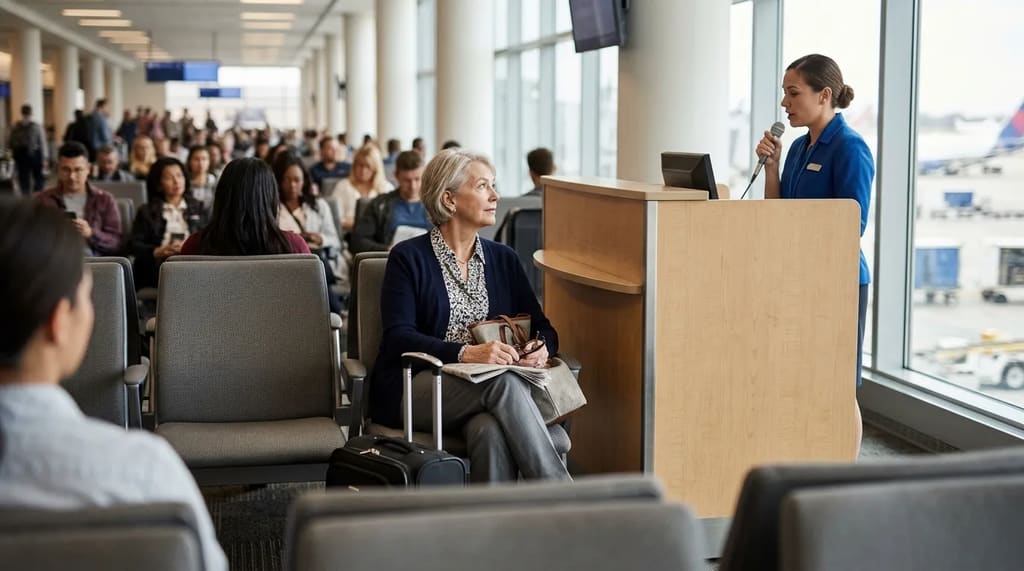
Gate changes, delay updates and last-minute boarding changes reach the room through the agent’s microphone first. A chair near the desk gets you that news before the crowd at the far end has heard it.
Your own name can be called there too, for a seat issue or a document check. If you’re sitting by the windows with your earbuds in, you may not hear it until the line has formed.
Sit where you can hear the desk, not in the farthest row of chairs. It also keeps you a few steps away when the agent’s work goes quiet, which is the moment a polite question gets a real answer.
What you say once you get there matters more than where you sat, and a general complaint is the weakest thing you can bring.
#13 – One Specific Ask Instead of a Complaint
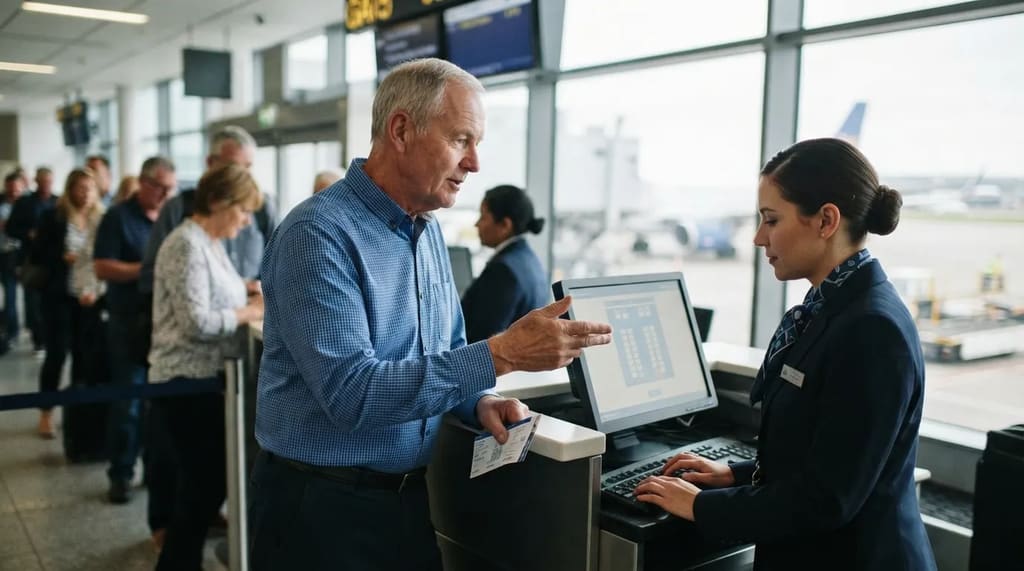
A polite, specific request such as “Is anything open on the aisle?” usually works better than a vague complaint. A long account of your flight and your seat gives the agent nothing to click.
Ask for one thing only. An aisle, a seat beside your spouse or a row nearer the front for a tight connection are all requests an agent can check in seconds.
The agent can see the seat map, and you can’t. Name the exact seat you want and ask for only that. A specific request hands over the one part of the job only the agent can do.
Before you ask for anything, there’s one question worth putting first, because its answer tells you whether to wait for a better seat or take what’s offered.
#12 – How Full the Flight Really Is
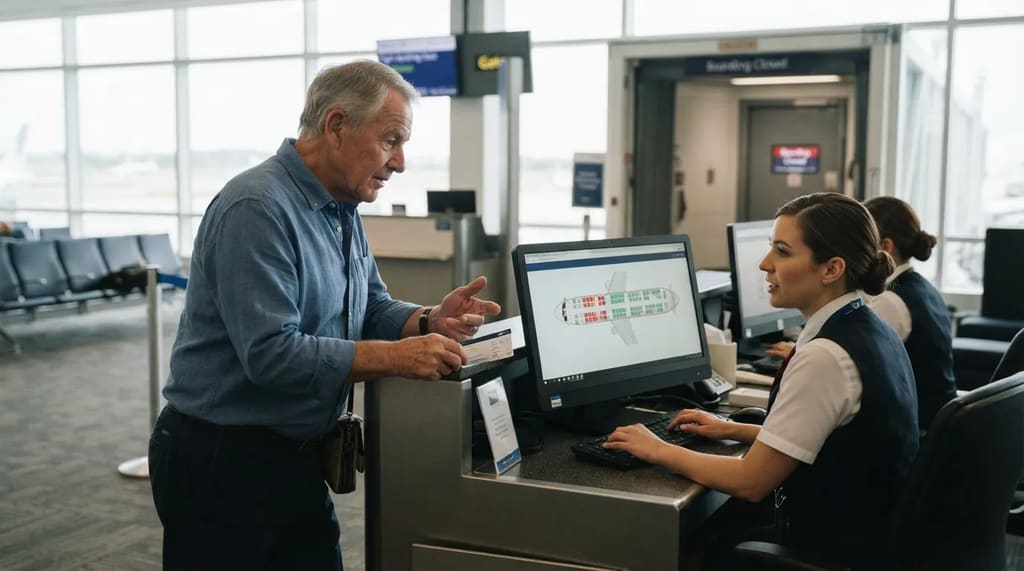
Every request in this piece runs into the same limit. A gate request only works when the plane has empty seats.
So open with a question about the plane, not about yourself. A short, low-pressure line like “Do you see any open aisles?” works well, and then you step back and let the agent look.
That answer tells you whether to wait for a better seat or take what’s left. Ask how full the flight is before you decide to hold out.
Quick Compare
- Light flight: Patience may pay off as seats free up late.
- Full flight: The first decent seat offered may be the best you’ll see.
- Not sure: Ask the agent how full it is, then let the answer decide.
If the agent does offer a seat, look hard at what it’s traded against, because an aisle for a middle is the swap that rarely works between passengers.
#11 – Why a Middle Seat Never Buys an Aisle
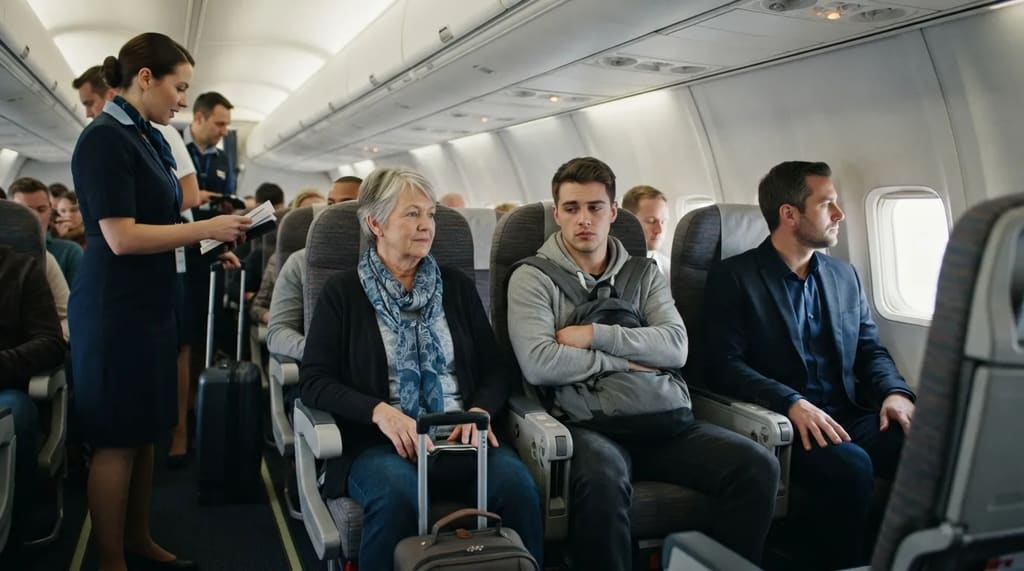
Swapping with another passenger has its own arithmetic. An aisle carries the most bargaining power, followed by the window.
Almost no one will move from an aisle or window into a middle. The other traveler has to receive an equivalent or better seat, such as a comparable aisle elsewhere.
Don’t offer a back-row middle for an aisle, and don’t accept one in someone else’s trade either. It’s a poor deal for whoever is moving, and an agent will see that at once.
Agree to a swap only for a seat of equal value, and have it recorded first. The gate agent controls the final assignment, so have a flight attendant or the agent note the agreed change before either person moves.
Some rows are worth leaving for reasons that have nothing to do with the aisle, and the one behind the lavatory is the clearest case.
#10 – A Seat Away From the Lavatory Line
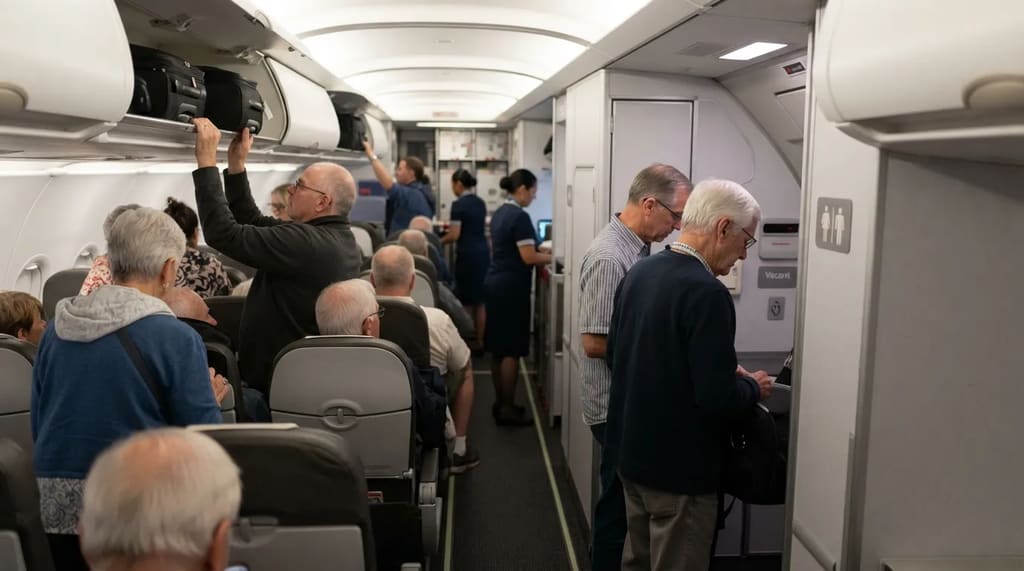
Row 28 is a different trip from row 18. Rows beside lavatories and galleys see steady foot traffic for the whole flight.
An agent hears “I’m in the back row” as a vague gripe. Being specific about the problem, such as “I’m in 22D and that’s right behind the bathroom,” tells them exactly what you need.
That sentence gives the agent a location to search from, not a grievance to manage. Name your row, say what’s wrong with it, and ask for anything open farther forward.
A move of a few rows costs the agent nothing when the seat is empty. It’s also an easier yes than an aisle request, since you’re asking to leave a seat no one else wants.
Even a good seat can change before boarding, and what you ask when it does decides whether the change is permanent.
#9 – The Question to Ask When Your Seat Changes
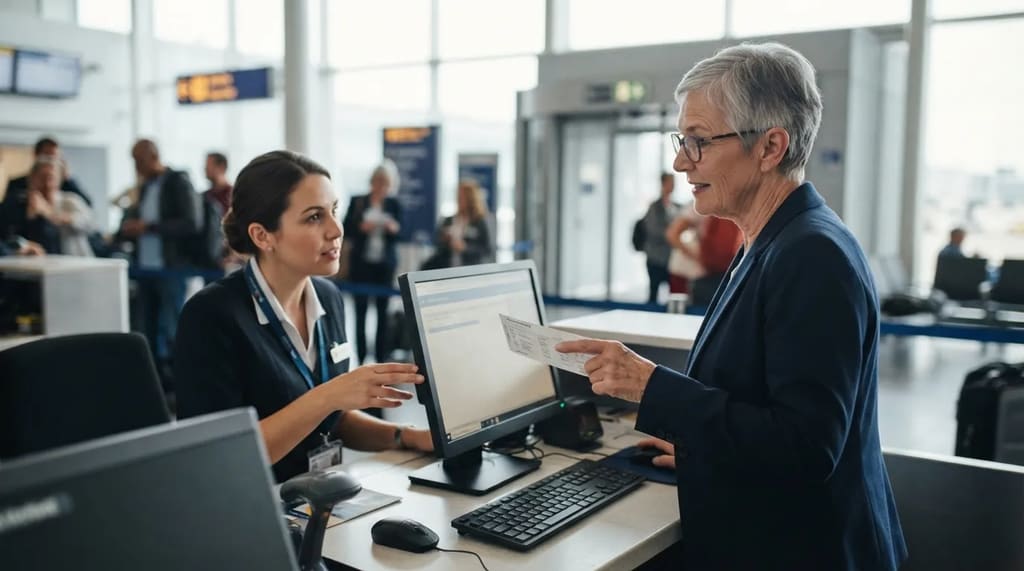
A different seat number on your boarding pass is unsettling. A polite “What changed?” gets a far better answer than demanding the old seat back.
Seats get reshuffled for dull reasons, like an aircraft swap or a hold the system placed on your row. Most of the time nobody is trying to move you out of a good seat.
Then ask the second question. Ask whether the new seat is temporary or final before you leave the desk.
The answer tells you whether to come back near the end of boarding, when no-shows are confirmed and agents can reassign seats they were holding.
Sometimes the problem isn’t the seat itself but who’s sitting three rows away from you, and that one is more fixable than it looks.
#8 – Two Seats Together Before the Line Forms
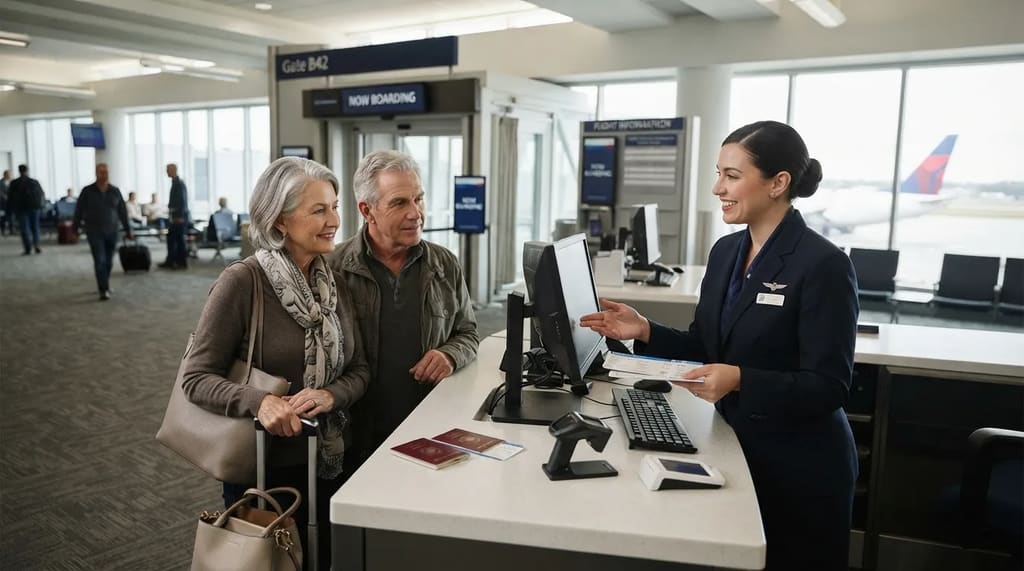
A boarding pass that puts you three rows from your spouse can often be fixed at the desk. Ask before boarding opens, and know that whether a change is possible depends on your ticket type and what’s open.
Give the agent both names and both seats at once, and say what you want in one sentence: two seats together, anywhere. Flexibility widens the agent’s search and makes yes an easier answer.
Offer to sit together anywhere, even in a different part of the cabin. A request for two aisle seats across from each other is harder to meet than a request for two seats side by side.
At a Glance
- Bring: both names and both seat numbers.
- Say: “Two seats together, anywhere.”
- Timing: before boarding opens.
- Backup: check back as boarding winds down.
Don’t be surprised if the agent says to check back. A first conversation puts you on the agent’s radar, and that matters for the next item.
Sitting together on a half-empty plane can mean something better than adjacent seats, and the timing of that request is the reverse of everything above.
#7 – An Empty Middle Between the Two of You
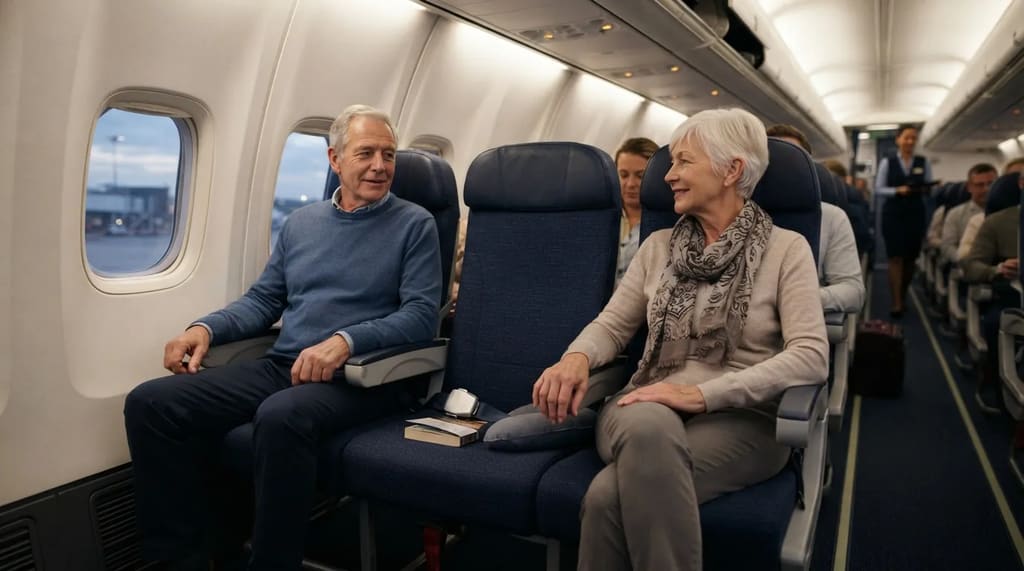
In a row of three, a couple in the aisle and window seats can hope the middle stays empty. On a light flight, an agent can help that hope along.
Once boarding is nearly finished and no-shows are confirmed, agents can freely reassign the empty seats they were forced to hold. Ask too early and the seat is still locked.
This works together with #8 rather than against it. Make your request early so the agent knows who you are, then step back to the desk as boarding winds down.
Ask early, then check back when boarding is nearly over. Standing by the desk, as in #14, makes the second visit easy.
Seats are one half of the gate conversation. The other half is the bag you carry, and on a full flight it can be taken from you at the jet bridge.
#6 – A Gate-Check Plan for a Crowded Cabin
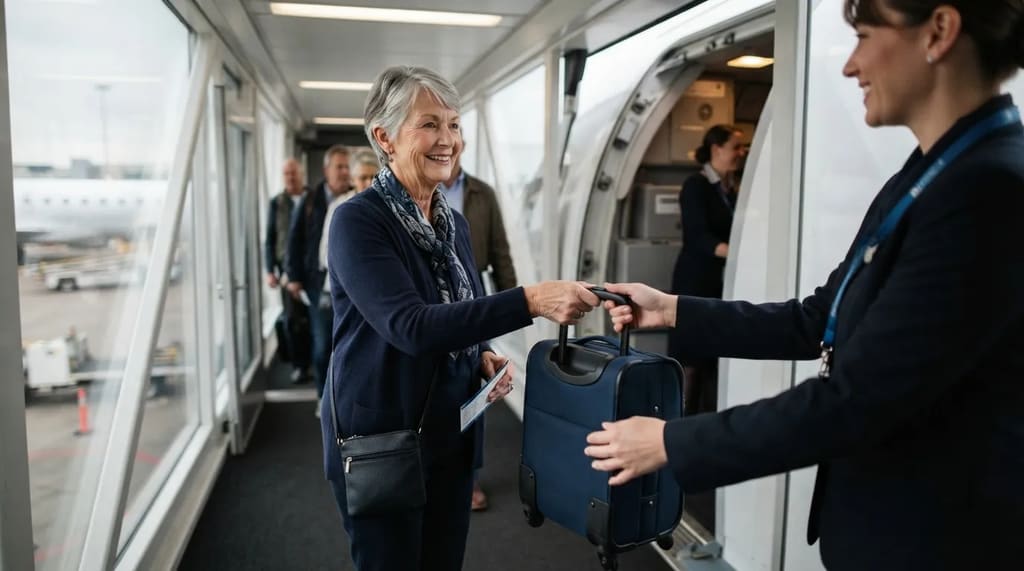
On full flights, especially on regional jets with smaller bins, gate agents often ask later boarding groups to gate-check carry-ons. By the time you hear it, you’re standing in the jet bridge with a line behind you.
Decide before then. Ask the agent at the desk how full the flight is and whether bins are expected to fill, so the answer isn’t a surprise at the door.
Pack a small personal bag with your essentials before any bag goes below. Glasses, phone charger, a snack and your reading material should ride with you.
If lifting a bag over your shoulder is a strain, handing it to the agent at the door beats a fight for bin space. You walk down the aisle with nothing to hoist, and nobody has to rearrange a row of coats for you.
If the bag does go overhead, it doesn’t have to go in the bin above your seat, and that’s worth knowing before you start down the aisle.
#5 – The Bin a Few Rows Away
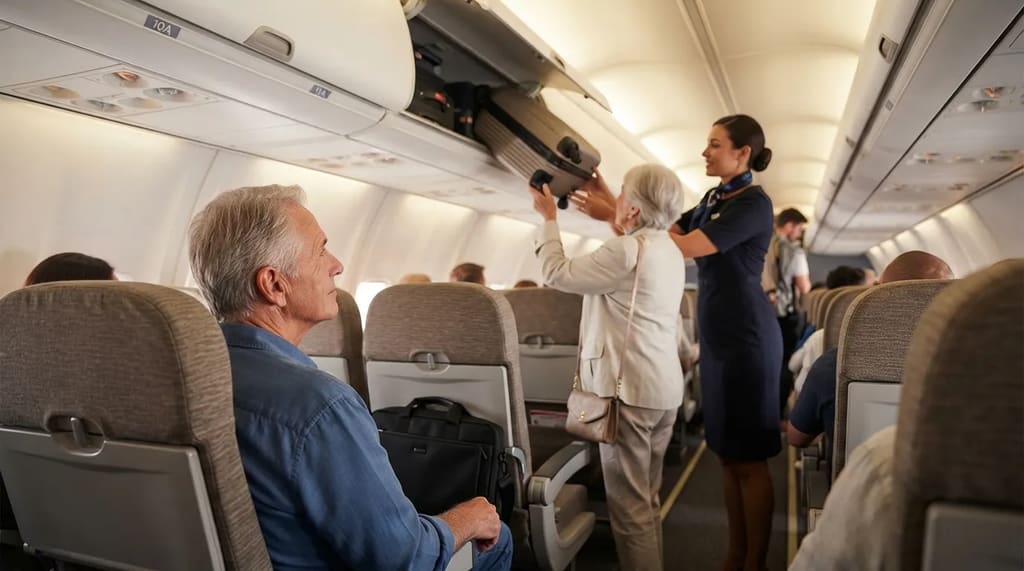
Overhead bins are first come, first served, so the space above your seat isn’t guaranteed to be yours. A spot a few rows away is fair game, and putting the bag nearer the front can even shorten the walk off at the other end.
Only your largest carry-on belongs overhead. A handbag or laptop bag goes under the seat in front of you, which leaves bin room for the bags that need it.
Put small items under the seat so the bin holds only your biggest bag. Crew can help you find overhead space near your row, so ask early in boarding while bins still have gaps.
Worth Knowing
- Bin space is first come, first served, not tied to your seat.
- Your largest carry-on goes overhead; everything else goes under the seat.
- A bin nearer the front can shorten your walk off the plane.
- Ask the crew early, while bins still have gaps.
Early boarding does buy earlier access to the bins and time to settle. That’s why #15 comes first on this list.
Even a perfect seat-and-bin plan can vanish when the plane itself changes, and that’s the next thing to watch for.
#4 – Your Seat After a Plane Swap
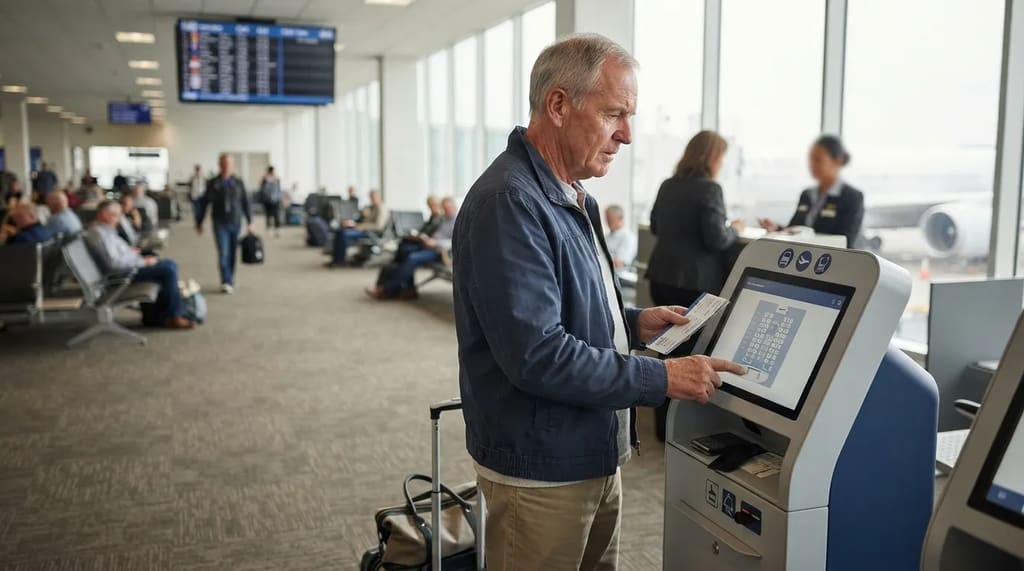
When the gate announces an aircraft change, the seat map you chose from may no longer apply. Look at your seat assignment again as soon as the change is announced.
A new plane can mean new rows, and the system assigns what’s left. The best time to ask is as soon as the new seat map appears, trying the app first and then the kiosk or the gate agent.
Re-check your seat the minute the gate announces a different aircraft. If you had an aisle before, you’re asking the agent to restore it, which is an easier request than asking for one fresh.
An aircraft change can erase more than a seat, and the other casualty is something you ordered days ago that you can’t re-order at the gate.
#3 – A Meal Request That Survives the Gate
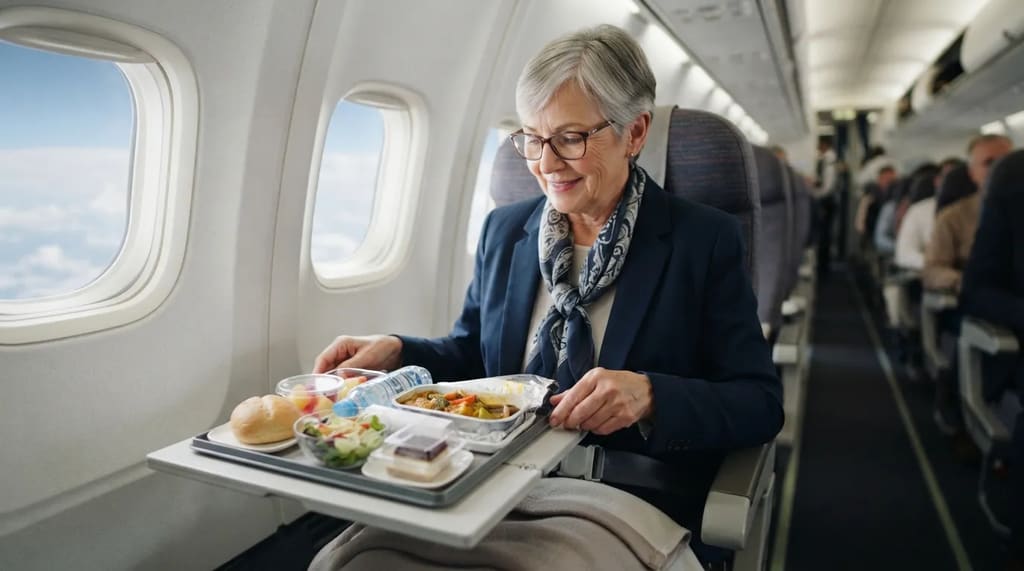
This is where the gate desk can’t help. Many airlines set a deadline around 24 to 48 hours before departure, and there is no universal cutoff.4 5
Miss it, and the meal isn’t added in the jet bridge. Only the standard meal will be waiting on board, and some routes or cabins may not offer special meals at all.6
Related Stories From Travelbinger
If you did order one, check it. A request can occasionally disappear after a flight change, rebooking or schedule update, so ask at check-in whether it’s visible in the reservation.
Confirm the meal shows on your reservation before you reach the gate. On a connecting trip, each flight needs its own request, so check both legs.
Once the meal is on file, there’s still the question of when it arrives, and that part you can influence from your seat.
#2 – When Your Meal Arrives, and Who Knows
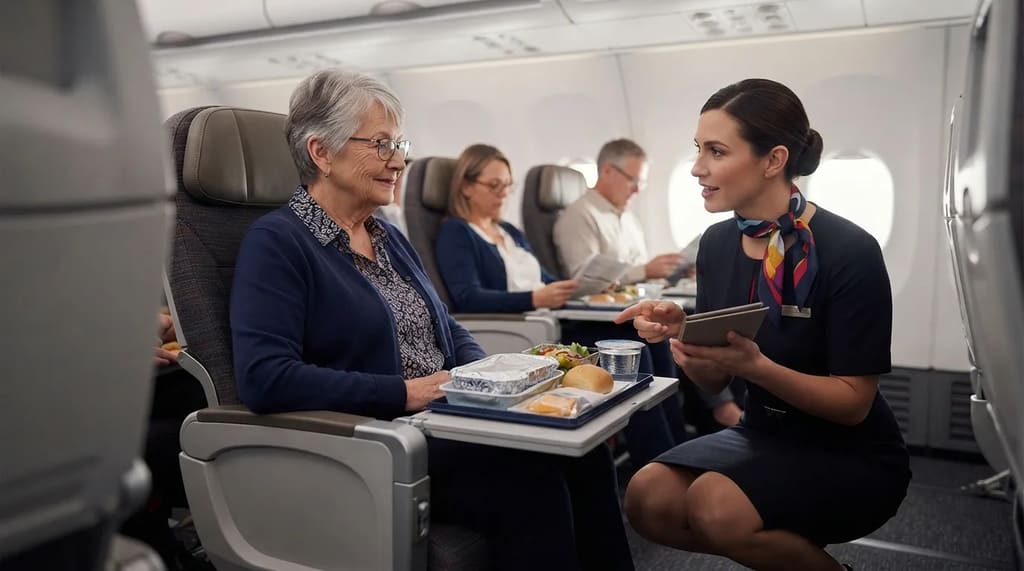
Special meals are often served before the standard economy service. A passenger asleep or out for a walk can miss the first pass.5
Once on board, cabin crew may confirm special meals before the main meal service. A word to the attendant as you board costs you ten seconds.
For a regular meal, the timing isn’t something you can order. Ask the attendant when service is expected to begin, and plan your snack around the answer.
A direct question gets you a plan. That beats guessing between a snack bag and a cart that may still be far down the aisle.
Everything so far moves a seat, a bag or a tray. The last item moves your whole day, and it’s the one request where the person behind the desk can promise you nothing.
#1 – More Time on a Tight Connection
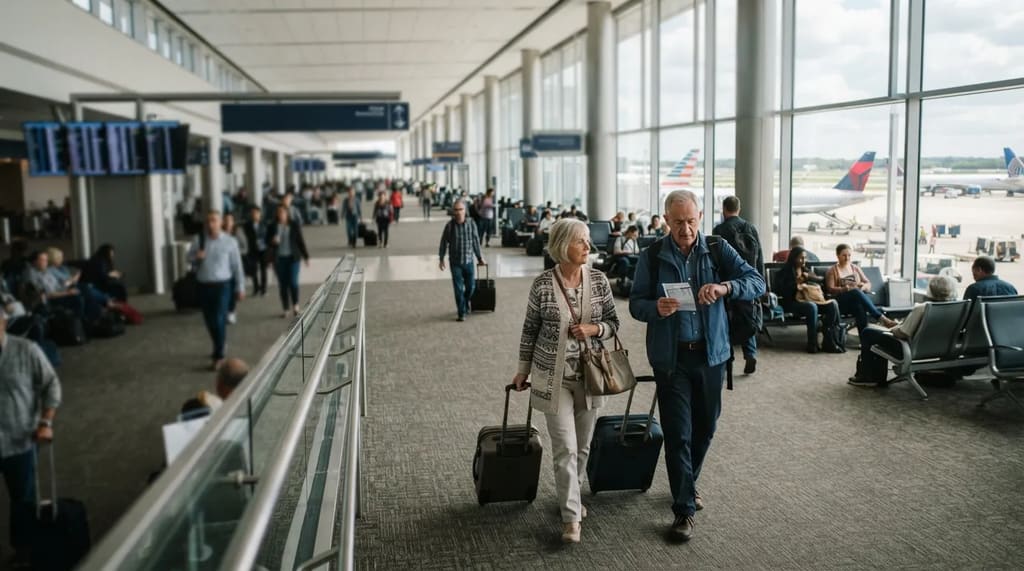
There’s no overarching rule about minimum connection times, and airlines are free to set their own and sell itineraries accordingly. Reservation systems won’t build an itinerary that violates the airline’s own minimum.7
“Legal” in this case means in line with the airline’s policies, and that’s often not enough time, especially if the first flight is late or taxis longer than expected. A common guide is at least 90 minutes for a domestic connection.7
So treat the airline’s minimum as a floor, and book 90 minutes or more domestically. Anything under an hour is a connection worth changing before you fly, however good the schedule looks on the screen.
Fast Facts
- Each airline sets its own minimum connection time.
- A common domestic guide is at least 90 minutes.
- Single ticket: the airline rebooks you after a missed connection.8
- Separate tickets: you lose the flight you missed.
If you’re already holding a tight one, tell the agent at your connecting gate early. Some airlines let agents hold a departure for a few minutes when connecting passengers are close, though that’s the airline’s call, not a promise.
Ask for a seat nearer the front so you can get off fast.
The Desk Can Only Move What’s Still Flexible
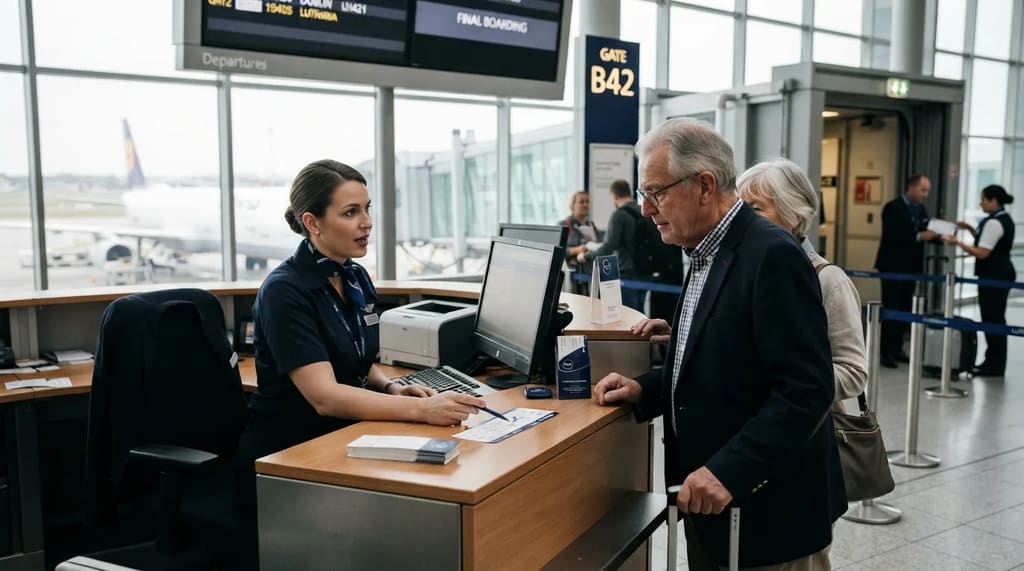
Look back over the list and you’ll see a pattern: the desk can move a seat, a bag or a few minutes only while something is still loose. Every ask worked best early, and the meal and the connection had to be settled before you reached the airport.
So think of the gate as the last stop of a plan that started at booking, not as the place where trouble gets fixed. Choose the longer layover, order the meal ahead and then use the desk for the small adjustments only an agent can make.
The flyers who seem to get lucky at the gate usually aren’t lucky at all. They show up early, ask for one clear thing, and leave the agent room to say yes.
Think of your last tight connection: how many minutes did you have, and would you book it again knowing what you know now?
- Upgraded Points Southwest Boarding: https://upgradedpoints.com/travel/airlines/southwest-airlines-boarding-process-groups/
- Delta Accessible Travel Services: https://www.delta.com/us/en/accessible-travel-services/cognitive-disability-assistance
- The Points Guy Boarding Guide: https://thepointsguy.com/airline/airport-boarding-guide
- JetBlue Special Meal Menus: https://www.jetblue.com/flying-with-us/inflight-experience/inflight-menus/special-meal-menus
- Special Meals and Dietary Requests: https://wingandaisle.com/onboard/special-meals-and-dietary-requests/
- Airline Meals Guide: https://getabite.app/en/guides/airline-meals
- Autopilot Minimum Connection Time: https://withautopilot.com/blog/minimum-connection-time
- SmarterTravel Connecting Flights Guide: https://www.smartertravel.com/tight-airport-connections-what-you-need-to-know-about-making-a-connecting-flight/